What Lens Tint and Wraparound Fit Do Kids’ Ski Sunglasses Need?
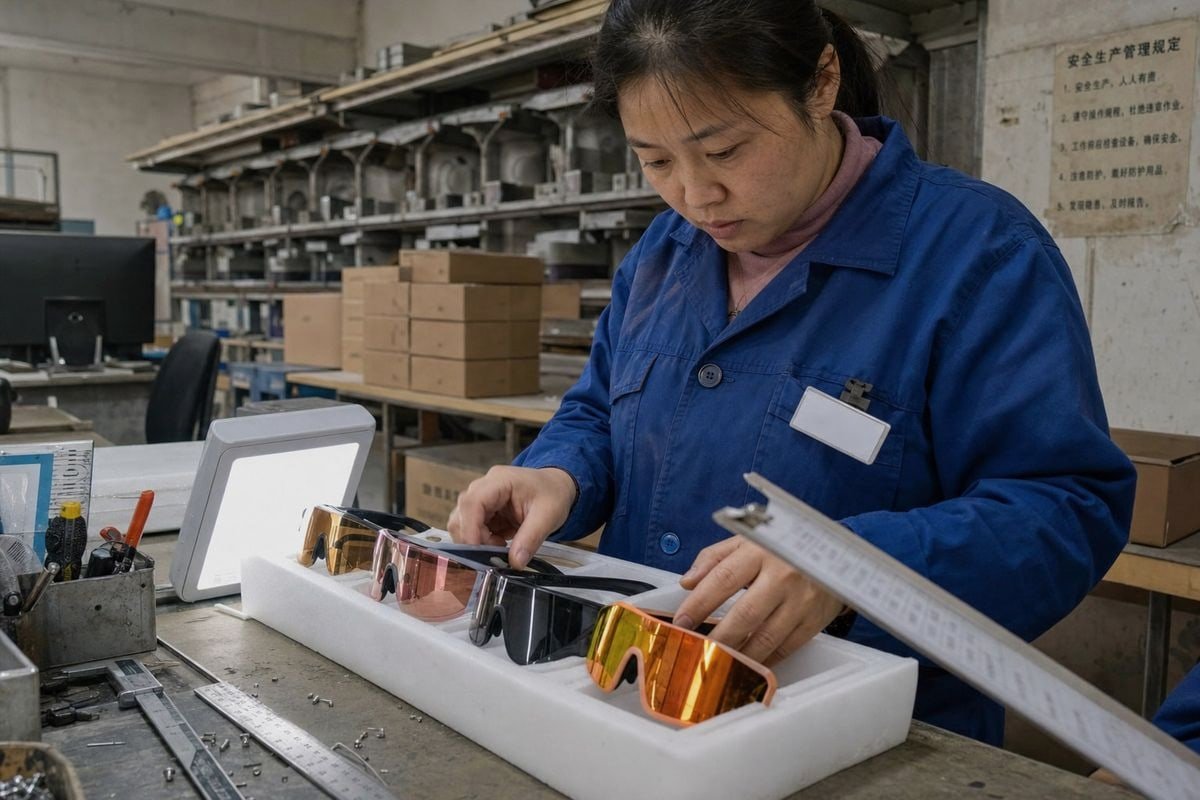
Snow glare stopped one of our early kids’ ski sunglasses samples cold. Parents complained the lenses were too dark on cloudy slopes, and children kept pulling them off mid-run. On our production line, we learned that [ski eyewear for kids](https://okayeyewear.com/what-role-kids-sunglasses-play-ski-trips-snow-scenarios/) fails for two reasons: wrong tint and loose fit. That double failure is exactly what this guide helps your brand avoid, because once we matched tint to snow conditions and reshaped the wrap, complaints disappeared.
Kids’ ski sunglasses need warm, contrast-boosting tints — amber, rose, or copper for mixed light, dark gray or mirrored lenses for bright sun — with Category 3 UV400 protection. The frame must be a close, high-wrap design that blocks side glare, resists fogging, and stays secure during movement.
Let me break this down step by step. We will cover tint and VLT first, then fit, then materials, and finally how to customize designs for your own brand.
What Lens Tint Level Works Best for Snow and High-Altitude Glare?
Buyers often ask us for the darkest lens we can supply, assuming darker means safer for skiing. In our experience exporting to snow markets in Europe and Japan, that instinct is usually wrong for children.
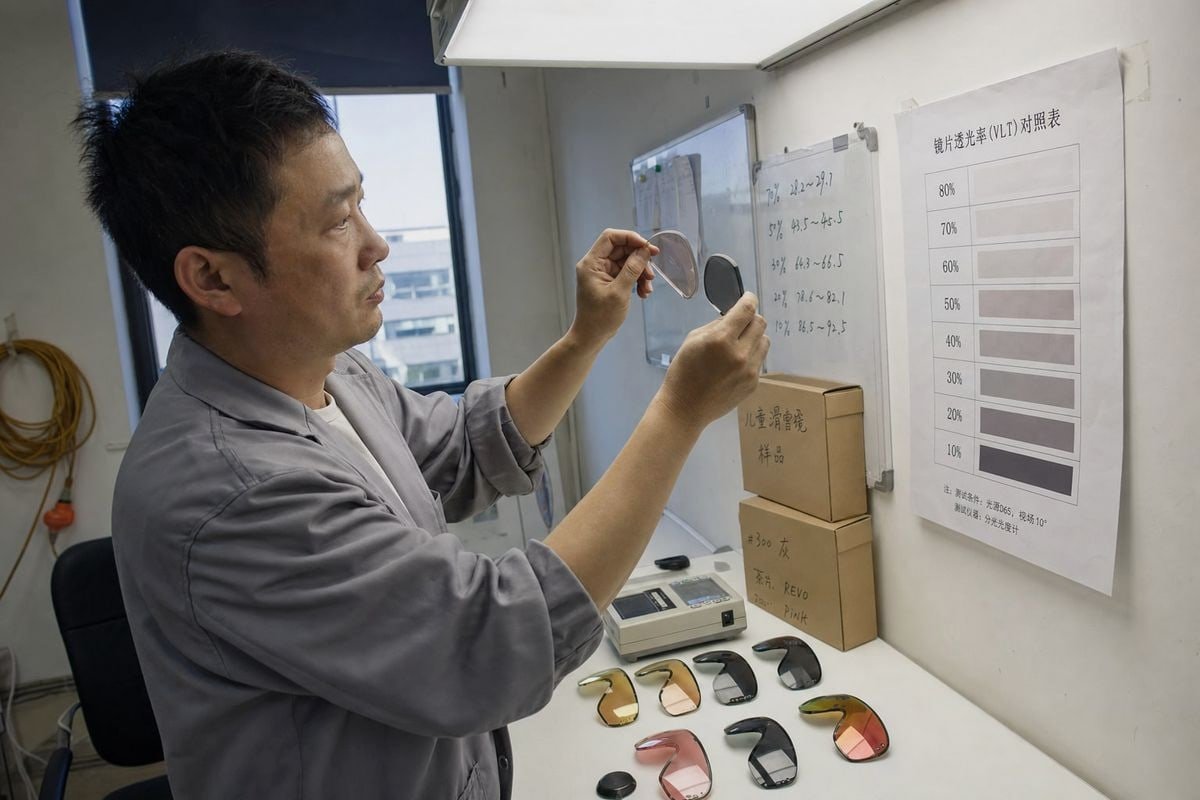
A medium-VLT warm tint — amber, rose, or copper at roughly 20%–40% VLT — works best for most kids' ski days. Reserve dark gray or mirrored Category 3–4 lenses for bright bluebird conditions, and use yellow or gold lenses above 40% VLT for flat light and snowfall.
Snow reflects up to 80% of UV-Strahlung 1 back into the eyes, and children's clearer ocular lenses let more of that radiation reach the retina than adult eyes do. So the tint decision is really two decisions: how much light the lens admits, and what kind of contrast it creates.
VLT Percentage in Plain English
VLT stands for sichtbare Lichtübertragung 2. It is the percentage of light that passes through the lens. A low VLT percentage means a dark lens. A high VLT percentage means a light lens. Darker is better for glare. Lighter is better for dim, flat light. Here is the mapping we use when advising buyers:
| Snow Condition | Recommended Tint | VLT Range | Glaskategorie |
|---|---|---|---|
| Bright bluebird day | Dark gray, dark brown, mirror coating | 5%–25% | Category 3–4 |
| Typical mixed light | Amber, rose, copper | 20%–40% | Category 2–3 |
| Overcast or snowing | Yellow, gold, light rose | 40%–70% | Category 1–2 |
| Very low light / late afternoon | Clear or very light yellow | 70%+ | Category 0–1 |
Why Warm Tints Win on Snow
Warm tints filter blue light. On snow, that filtering makes bumps, dips, and ice patches stand out. Neutral gray lenses reduce brightness but add no contrast, so on a cloudy day the slope looks like a flat white sheet. That is dangerous for a child learning to ski. Warm amber and rose lenses reveal terrain instead of hiding it, which is why they appear in almost every credible snow-sports guide as the all-around choice.
A mirror coating helps on very bright days by bouncing extra glare away, which supports snow blindness prevention 3 at altitude. One of our popular shield styles pairs an orange-to-gold mirrored gradient with a warm base tint, giving glare control and contrast at once. Polarized lenses also cut reflected glare well, but they can hide the shine of ice, so many ski instructors prefer non-polarized contrast lenses for children on hard-packed runs.
One important note on Category 4 lenses: they admit under 8% of light and suit glacier conditions, but they are too dark for mixed weather and are not suitable for any driving. For most kids, Category 3 is the practical ceiling.
How Should Wraparound Kids' Ski Sunglasses Fit to Prevent Slipping and Fogging?
A distributor in Australia once returned a fitting sample to us with a single note: "Slides down on every kid over ten minutes." That sample taught our team more about wraparound geometry than any spec sheet.
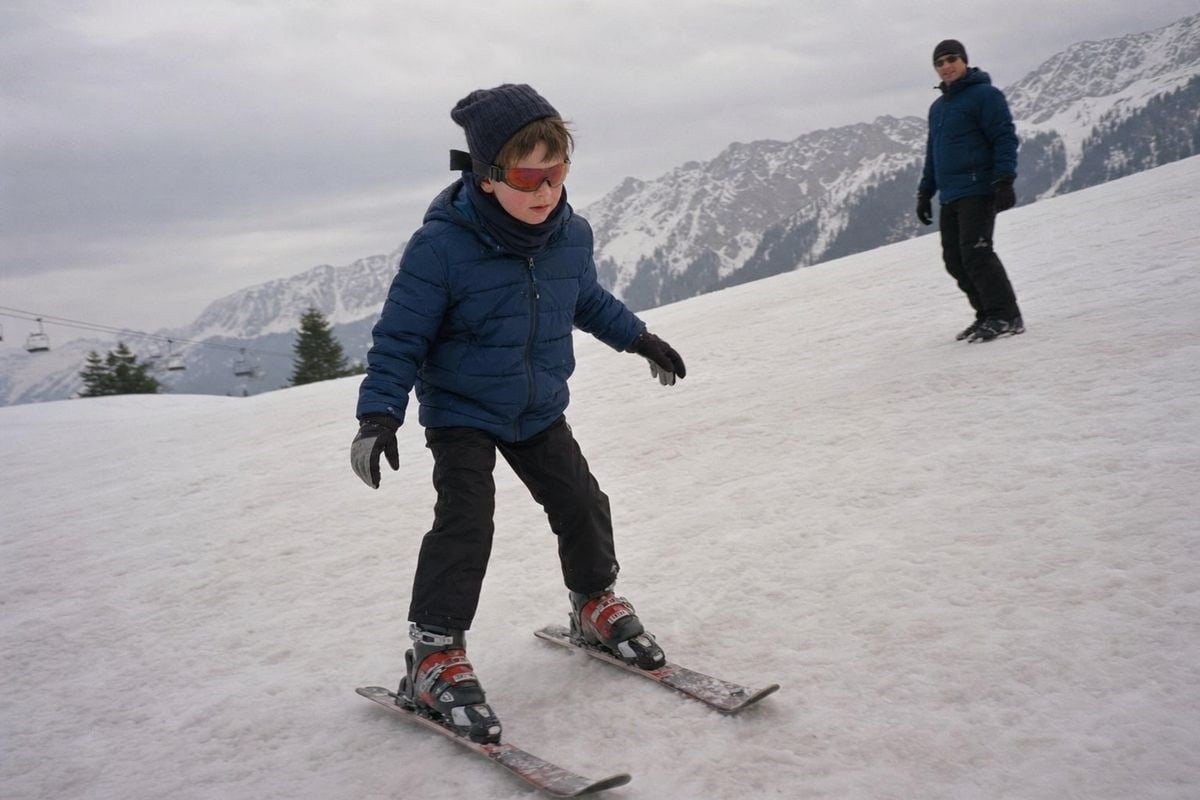
Wraparound kids' ski sunglasses should sit close to the brow and cheeks with full peripheral coverage, grip with rubberized temple tips and nose pads, and leave a small ventilation gap at the top edge. An adjustable head strap keeps them secure during falls and fast turns.
Snow glare does not arrive from one direction. It bounces up from the slope, sideways off drifts, and down from the sky. Flat everyday sunglasses leave large gaps at the sides of a child's small face, and UV "leakage" pours through those gaps. A proper wraparound frame closes them.
The Four Fit Checkpoints We Test
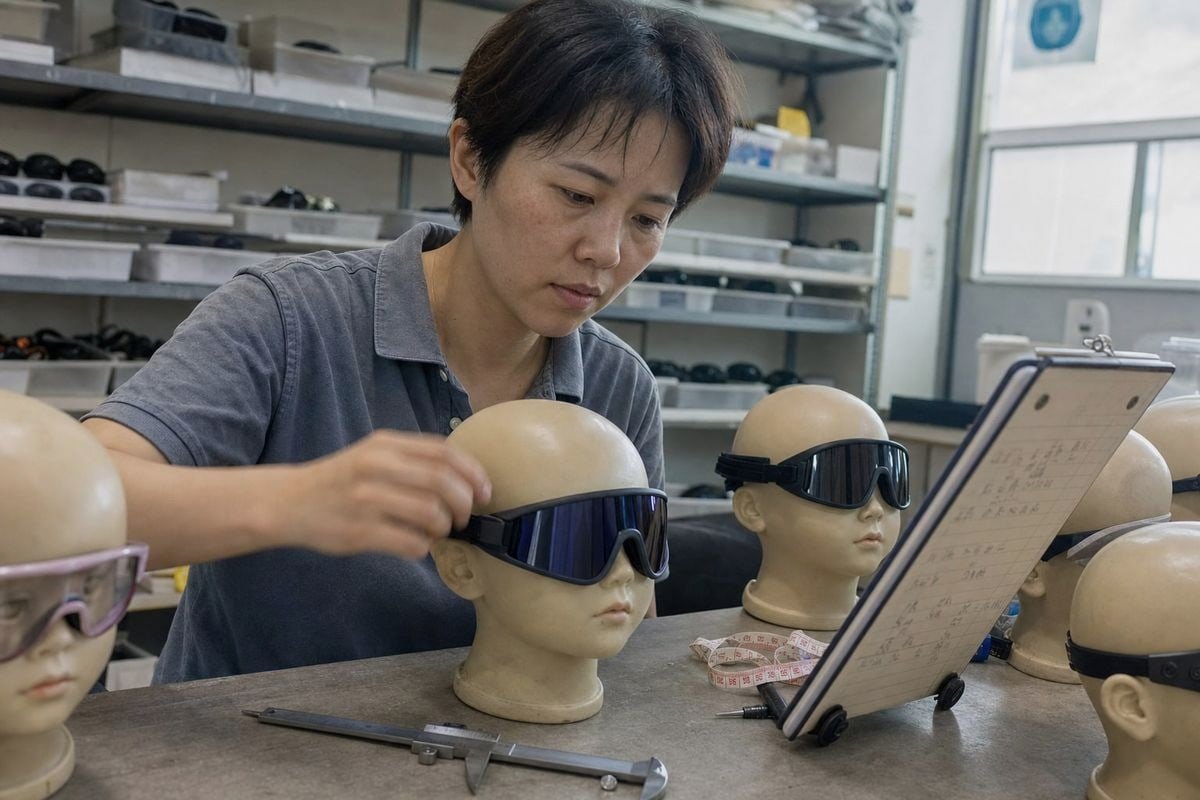
When we run fit checks on children's head forms in our workshop, we look at four zones in order:
- Brow line. The frame should follow the eyebrow closely without touching the lashes. A gap here lets overhead glare in.
- Side coverage. The lens should curve past the outer corner of the eye. This blocks side light and stops wind-induced tearing that blurs a child's vision mid-run.
- Nose bridge. Kids have low, soft nose bridges. Soft, grippy nose pads spread pressure and stop the slide that makes children push frames up every minute.
- Temple grip. Temples should curve gently behind the ear with flexible, rubber-touch tips. Pressure points cause kids to take the eyewear off, and eyewear in a pocket protects nothing.
Preventing Fog Without Losing Coverage
Fogging is the hidden trade-off of wraparound design. Seal the frame too tightly and warm breath condenses on the cold lens. The fix is controlled airflow: a slight standoff at the top edge, plus an anti-fog coating 5 on the inner lens surface. Emerging hydro-oleophobic treatments also help, because they shed melting snow and fingerprints before they smear the view.
There is one more optical detail worth knowing. High-wrap lenses bend light at the edges, which can create a peripheral "prism effect." Quality wraparound lenses use aspheric geometry 6 to correct this distortion, so children do not feel dizzy or misjudge distances. Finally, an adjustable head strap converts sport sunglasses into near-goggle security for aggressive little skiers, and it is a low-cost accessory we recommend to almost every snow-focused brand.
Which Frame Materials Keep Kids' Ski Sunglasses Flexible and Safe in Cold Weather?
Cold-chamber testing changed how we specify frames. Years ago, our engineers left sample frames in a freezer overnight, then flexed them the next morning. The cheap plastic samples cracked. The TPEE and TR90 7 samples bent and sprang back.
TR90 and TPEE are the best frame materials for kids' ski sunglasses because they stay flexible and impact-resistant in sub-zero temperatures. Pair them with shatterproof polycarbonate lenses, which absorb impacts during falls and block UV rays inherently.
Standard sunglass plastics like basic acrylic or low-grade PC frames become brittle in freezing air. A brittle frame that snaps during a fall creates sharp edges next to a child's eye. That is why material choice is a safety decision first and a comfort decision second.
How the Common Materials Compare
| Material | Cold Flexibility | Impact Resistance | Gewicht | Best Use on Kids' Ski Sunglasses |
|---|---|---|---|---|
| TPEE | Excellent, rubber-like even below freezing | Very high, bends instead of breaking | Sehr leicht | Full frames or flexible temples for younger children |
| TR90 | Very good, thermo-stable memory polymer | High, returns to shape after twisting | Sehr leicht | Main frame fronts for active kids |
| Bio-sourced polymers (e.g., Rilsan-type) | Very good in sub-zero conditions | Hoch | Leicht | Eco-positioned lines with lower footprint |
| Standard cheap plastic | Poor, turns brittle in cold | Low, may snap or crack | Leicht | Not recommended for snow sports |
Why We Combine TR90 Fronts with TPEE Temples
At our Taizhou factory, one of our signature constructions is a TR90 front with TPEE temples. The TR90 front holds the lens geometry stable, which protects the optical alignment of the wraparound lens. The TPEE temples flex almost like rubber, so when a child falls, sits on the frame, or yanks it off with gloves, the temples absorb the abuse. Over fifteen years of building children's eyewear, this combination has produced the fewest breakage claims from our export customers.
Das Glas verdient die gleiche Aufmerksamkeit. Polycarbonat-Gläser 8 are the standard for children's snow sports for two reasons. First, their impact resistance is exceptional; they deform rather than shatter when a ski pole or icy patch meets a face. Second, polycarbonate blocks UV naturally, so UV400 protection is built into the material rather than depending only on a surface coating. Some advanced pediatric ski lenses now add infrared filters as well, aimed at reducing thermal stress that dries the eye's surface faster at altitude. We treat those as premium options rather than baseline requirements, but they show where the category is heading.
Can I Get Custom Ski Sunglasses Designs for My Kids' Outdoor Brand?
A product manager from a European outdoor brand emailed us last winter with one question: could she launch a ski sunglasses line without paying for new molds? Her budget was tight, but her spec sheet was serious — Category 3 lenses, wraparound coverage, retail-ready packaging.
Yes. OEM/ODM factories like ours offer custom kids' ski sunglasses through existing tooling — around 800 open styles — with custom lens tints, mirror coatings, frame colors, logos, and packaging. This lets brands launch snow eyewear without heavy mold investment or long development timelines.
Custom ski eyewear does not have to mean custom molds. In our own catalog, buyers usually start with an existing wraparound shield or sport frame, then customize everything the customer actually sees.
What You Can Customize Without New Tooling
| Anpassungsbereich | Typical Options | Impact on Cost and Timeline |
|---|---|---|
| Lens tint and VLT | Amber, rose, copper, gray, yellow; polarized lenses optional | Low cost, fast turnaround |
| Lens coating | Mirror coating, anti-fog coating, hydro-oleophobic finish | Moderate cost, adds strong shelf appeal |
| Rahmenfarbe | Solid, two-tone, matte or glossy in TR90/TPEE | Low cost, minimum order applies per color |
| Branding | Temple logos, lens etching, printed straps | Low cost |
| Accessories | Adjustable head strap, case, microfiber pouch | Low to moderate cost |
| Verpackung | Branded boxes, hang tags, retail-ready display | Moderate cost, high retail value |
A Practical Development Path for Snow Lines
The path we walk buyers through is simple. First, pick two or three base frames from open tooling — usually one shield style for older kids and one softer round style for younger children, similar to the periwinkle two-tone frames we produce for toddler lines. Second, define the lens program: a medium-VLT amber or rose as the core lens, plus a mirrored Category 3 option for bright-sun markets. Third, lock the safety spec — UV400 protection, polycarbonate lenses, and flexible TPEE or TR90 construction — because your retail buyers in Australia, Japan, or Europe will ask for it. Fourth, finalize logos, colors, and packaging so the product arrives shelf-ready.
Because we run our own 5S-managed workshop with about 120 workers, quality control stays under one roof rather than being scattered across trading-company subcontractors. For a first snow-sports collection, that consistency matters more than shaving a few cents per unit. Testing the market on existing styles first, then investing in a fully custom mold once sales prove demand, is the lowest-risk route we know.
Schlussfolgerung
Wrong tint blinds kids in flat light; loose frames leak glare. Match warm tints to VLT, demand true wraparound fit with flexible TR90/TPEE frames, and your brand's ski sunglasses will actually stay on children's faces — we build them that way daily.
Fußnoten
<span id="footnote-
Weitere Artikel, die Ihnen gefallen könnten

August 2026
Sollte die Fabrik die Verpackung und Kennzeichnung von Kinder-Sonnenbrillen übernehmen oder einen bestimmten Lieferanten nutzen?

August 2026
Eigenes Lager vs. Direktlieferung durch den Lieferanten: Was senkt die Retourenkosten für Marken von Kinder-Sonnenbrillen?

August 2026
Direkt zum Lagerhafen oder Lagerung in Übersee: Was spart mehr bei den Versandkosten für Kinder-Sonnenbrillen?
Auf der Suche nach einem zuverlässigen Partner für Kinderbrillen?
Entdecken Sie über 800 sofort verfügbare Modelle und umfassenden OEM/ODM-Support, der auf Ihre Marke zugeschnitten ist.
Kontakt aufnehmen English
  Español de México
  Deutsch
  Français
  日本語
日本語  العربية
  Português do Brasil