What Information Is Required on Kids’ Sunglasses Packaging Labels?
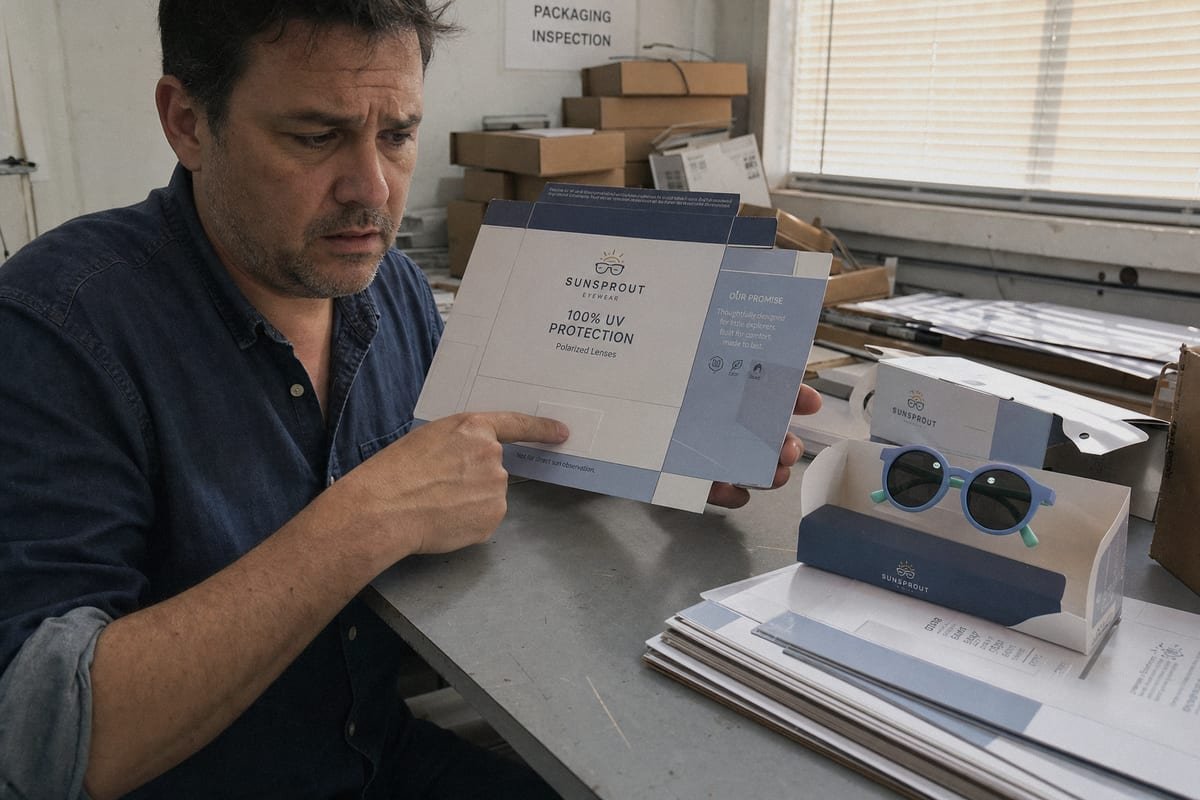
Kids’ sunglasses packaging labels caused one of our buyers a costly customs delay last year. On our production line, we now review label artwork before any print run — because incomplete labels can block whole shipments.
Kids’ sunglasses packaging labels must show the manufacturer or importer name and address, country of origin, UV protection claims, lens filter category, safety warnings, and CPSIA tracking information for the US market. The EU requires CE marking details, and Australia mandates lens category labeling.
That is the short answer. But the details change by country, and mistakes are expensive. Let me walk you through what belongs on the box, market by market.
What Safety and Compliance Information Must I Include on My Kids' Sunglasses Labels?
During a packaging review at our Taizhou factory, a client's artwork looked beautiful but missed the tracking label block entirely. We caught it two days before printing ten thousand boxes.
Every kids' sunglasses label needs manufacturer identification, country of origin, a UV protection statement, a lens filter category, applicable safety warnings, and — for the US — CPSIA tracking details including batch, date, and production location. Claims must be truthful and supported by test reports.
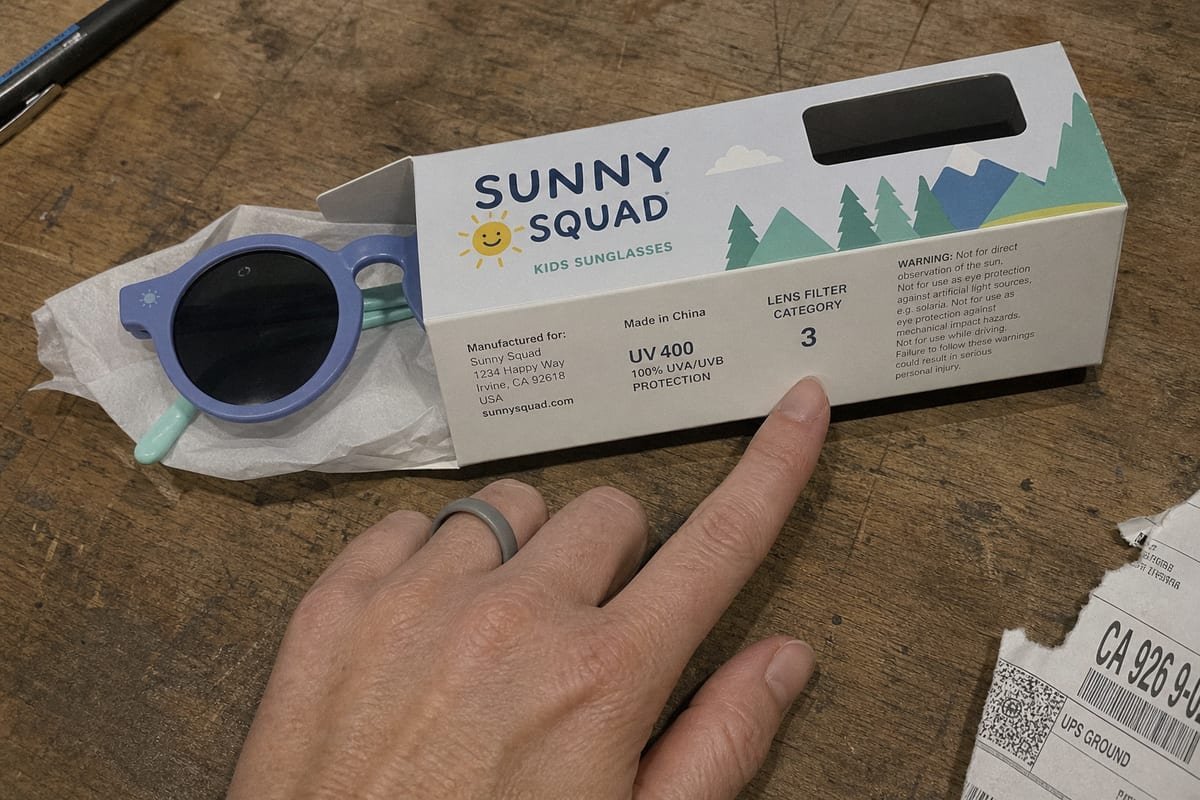
The starting point is understanding that children's sunglasses are regulated products, not fashion accessories. In the United States, nonprescription sunglasses fall under FDA medical device classification 1 as over-the-counter devices. That means general device labeling rules apply: the name and place of business of the manufacturer, packer, or distributor; a clear statement of identity and intended use; and no false or misleading claims. Required statements must also appear prominently, not buried in tiny print.
The Core Label Elements
Here is the baseline checklist we use when we prepare verkaufsfertige Verpackungen for our OEM clients:
| Label Element | Was es abdeckt | Warum es wichtig ist |
|---|---|---|
| Manufacturer/importer identity | Full company name and contact address | Required in the US, EU, UK, and Australia |
| Country of origin | e.g., "Made in China" | Customs requirement in most markets |
| UV protection claim | UV400 protection rating or "100% UVA/UVB" | Must match actual lens test results |
| Lens filter category | Category 0–4 based on light transmittance | Mandatory in Australia; expected in the EU |
| Safety warnings | "Not for direct sun observation," "Not for night driving" | Consumer protection requirement |
| CPSIA tracking label 2 | Batch, production date, and location | Mandatory for US children's products |
Warnings That Apply Specifically to Kids
Children's products carry extra scrutiny. If your packaging includes small detachable parts — cases, cords, charms — a choking hazard warning 3 may be required for products aimed at younger children. We also advise clients to state the intended age range clearly. In our experience, an age statement helps both compliance reviewers and retail buyers understand exactly who the product is for.
One more point: any impact resistance claim on the box must be backed by an actual impact resistance test on file. Never print a claim you cannot document.
How Do Labeling Requirements Differ Across My Target Export Markets?
A procurement manager from Melbourne once sent us her artwork for approval, and it was fully compliant for the EU — but missing the lens category number Australia insists on. Different markets, different rules.
The US demands FDA device-style labeling plus CPSIA tracking labels; Australia mandates lens category numbers, usage descriptions, and supplier identity on the label; the EU and UK require CE or UKCA marking, manufacturer name and postal address, and batch or serial identification in the local language.
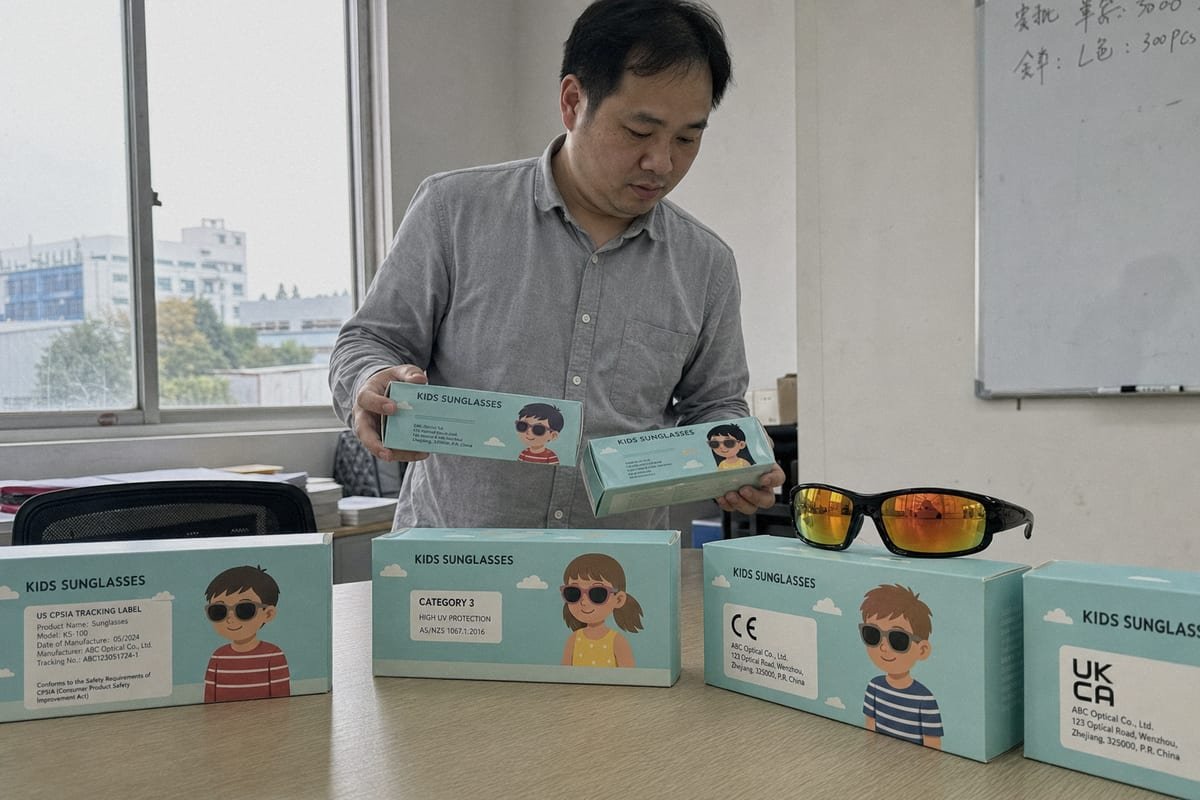
Here is a quick comparison before we go deeper:
| Markt | Regulatory Framework | Key Packaging Label Items |
|---|---|---|
| Vereinigte Staaten | FDA device rules + CPSIA compliance | Company name and address, intended use, tracking label, truthful UV claims, drop-ball impact resistance test on file |
| Australia | Mandatory sunglasses standard | Supplier identity, lens category number, category description, usage information, warnings |
| EU | PPE framework, nur ISO 12312-1 4 standard | CE marking, manufacturer name and postal address, batch/serial number, end-user information in local language |
| UK | UKCA regime (mirrors EU rules) | UKCA marking, UK responsible person address, batch identification |
| Japan | Voluntary + consumer protection rules | Importer identity, transmittance information, care instructions |
The US in Detail
The US framework has two layers. First, FDA device labeling covers identity, intended use, and honest claims, and lens performance sits alongside ANSI Z80.3 5 requirements as the industry benchmark. Second, CPSIA compliance requires tracking labels on children's products and their packaging — batch number, date of production, and production location — so any defective batch can be traced and recalled.
Australia in Detail
Australia is unusually explicit. The mandatory standard requires a clear, legible mark showing the manufacturer or supplier, the lens category number from 0 to 4, a description of that category, and usage guidance. Most kids' sunglasses we ship to Australian brands are lens category 3, which suits bright sunlight.
EU and UK in Detail
In Europe, sunglasses are treated as persönliche Schutzausrüstung 6. The packaging or product needs CE-Kennzeichnung 7, the manufacturer's name and postal address, and a batch or serial number. Instructions and warnings must be understandable to end users — which usually means translation into local languages. The UKCA mark follows the same logic for Great Britain.
What Branding Details Should I Add to My Packaging Without Losing Compliance Space?
Balancing brand personality against regulatory text is a trade-off we help clients weigh on nearly every packaging project. A crowded box looks cheap; a bare box wastes shelf appeal.
Reserve one panel — usually the back or base — for compliance text, then use the front and sides for your logo, product name, age range, color story, and key selling points like flexible TPEE frames or polarized lenses. Keep mandatory statements legible and never covered by stickers.
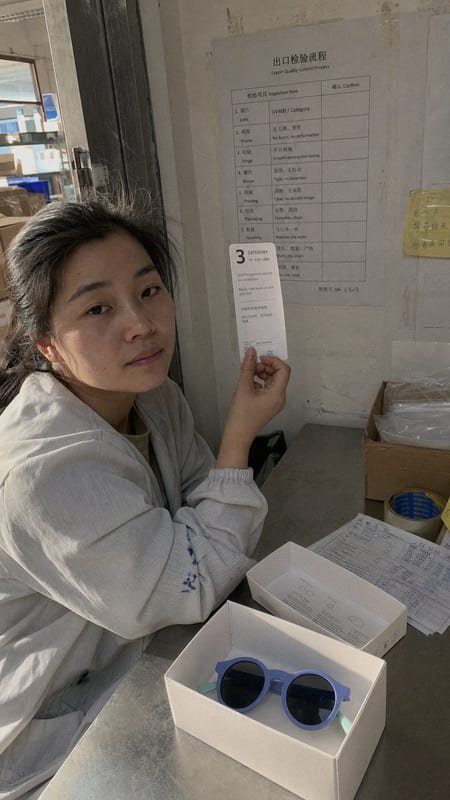
Good packaging tells two stories at once. One story speaks to the parent picking up the box: safety, comfort, style. The other speaks to the regulator or customs inspector: identity, origin, warnings. Our design team maps both stories onto the box before any artwork is finalized, so neither crowds out the other.
A Practical Panel Layout
This is the layout structure we recommend to brands launching from our catalog of roughly 800 existing styles:
- Front panel — logo, product name, hero image or window showing the frame, one headline benefit such as "UV400 protection" or "Flexible & unbreakable."
- Side panels — age range, color name, a short fit note, and any physical fit scale printed on the box for temple-to-temple sizing.
- Back panel — full compliance block: manufacturer/importer name and address, country of origin, lens category, warnings, and care instructions.
- Base or inner flap — CPSIA tracking label with batch code, production date, and factory location.
Selling Points That Also Support Compliance
Some marketing claims double as useful information. A UV400 protection rating is both a benefit and a regulated statement, so keep it accurate. If your frames use bio-based or recycled content, stating the percentage builds trust — but only print figures your material supplier can certify. The same logic applies to screw-less hinge icons or antimicrobial coating claims: they differentiate the product on shelf, yet each one must be verifiable. Our rule for clients is simple — every icon on the box needs a document behind it.
Can My Manufacturer Help Me Design Labels That Meet International Standards?
Fifteen years of shipping children's eyewear to buyers in more than twenty countries has taught our team one thing: label problems are far cheaper to fix before printing than at the port.
Yes — an experienced OEM/ODM factory can pre-fill compliance blocks for your target markets, supply the test reports behind every claim, print CPSIA tracking codes per batch, and deliver retail-ready packaging that passes customs review. You remain the responsible brand, but the factory carries the technical groundwork.

A capable factory does more than print your artwork. It should understand the standards behind the label. When we develop a new kids' style — say, a flexible TR90 frame with TPEE temples — we align the lens specification with ISO 12312-1 for European buyers and ANSI-based expectations for American buyers before the packaging conversation even begins. That way, the claims on the box are already supported.
What to Ask Your Factory Before Printing
| Frage | Was eine gute Antwort ausmacht |
|---|---|
| Can you provide UV transmittance test data? | Yes, per lens batch, matching the UV400 claim on the box |
| Do you support CPSIA tracking labels? | Yes, with batch, date, and location printed per production run |
| Can you adapt one design for multiple markets? | Yes, with market-specific compliance panels or insert cards |
| Who verifies translated warnings? | The factory drafts; the brand's local reviewer confirms |
| Can artwork be checked before mass printing? | Yes, with a pre-production label review as a standard QC step |
Where the Responsibility Line Sits
Be clear on one point: the brand or importer named on the box carries legal responsibility in the destination market. Our job is to make that responsibility easy to carry. We prepare the compliance block, keep test documentation ready — including impact resistance test records — and flag anything in your artwork that looks risky. Several of our long-term clients now send label drafts with every new purchase order, and we treat that review as part of quality control, not an extra service. That habit has prevented more shipment delays than I can count.
Schlussfolgerung
Incomplete labels stall shipments and damage brands. Get the compliance block right for each market, protect space for branding, and partner with a factory that reviews labels before printing.
Fußnoten
1. Clarifies FDA’s regulatory classification for nonprescription sunglasses as OTC devices. ↩︎
2. CPSC guidance on mandatory tracking labels for children’s products under CPSIA. ↩︎
3. CPSC safety guidance on choking hazards relevant to detachable packaging parts for kids. ↩︎
4. Official ISO standard page defining sunglasses and lens category requirements referenced for EU buyers. ↩︎
5. Background on ANSI, the body behind the Z80.3 sunglasses performance standard. ↩︎
6. Background on the PPE classification the EU applies to sunglasses regulation. ↩︎
7. Explains the CE marking system required on EU sunglasses packaging. ↩︎
Weitere Artikel, die Ihnen gefallen könnten
August 2026
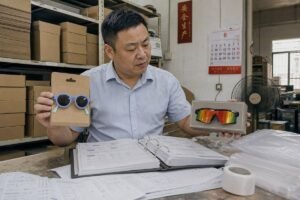
Sollte die Fabrik die Verpackung und Kennzeichnung von Kinder-Sonnenbrillen übernehmen oder einen bestimmten Lieferanten nutzen?
August 2026
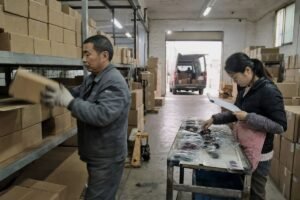
Eigenes Lager vs. Direktlieferung durch den Lieferanten: Was senkt die Retourenkosten für Marken von Kinder-Sonnenbrillen?
August 2026
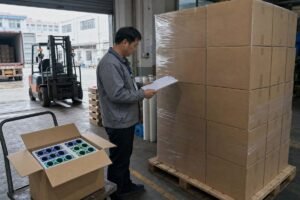
Direkt zum Lagerhafen oder Lagerung in Übersee: Was spart mehr bei den Versandkosten für Kinder-Sonnenbrillen?
Auf der Suche nach einem zuverlässigen Partner für Kinderbrillen?
Entdecken Sie über 800 sofort verfügbare Modelle und umfassenden OEM/ODM-Support, der auf Ihre Marke zugeschnitten ist.
Kontakt aufnehmen English
  Español de México
  Deutsch
  Français
  日本語
日本語  العربية
  Português do Brasil