How to Set Terms for Delivery Delays and Quality Disputes in Kids’ Optical Frames Procurement?

Kids’ optical frames procurement can go wrong fast. I have watched buyers lose entire retail seasons because their contract never defined what “late” or “defective” actually meant.
Set terms for kids’ optical frames procurement by defining when the lead-time clock starts, committing to a firm ship window, applying AQL 2.5/4.0 inspection standards against a signed golden sample, and building a stepped remedy ladder: notice, cure, replacement, expedited freight, then cancellation.
Those elements sound simple. But each one needs careful drafting to work for children’s eyewear. Let me walk you through how I recommend buyers structure each clause, based on what actually happens on a factory floor.
What Delivery Delay Clauses Should I Include in My Kids' Optical Frames Contract?
A buyer from Australia once sent me a purchase order 1 with the single line "delivery: 45 days." Our production team asked: 45 days from what? That one question exposed the whole problem.
Include a defined clock-start event, a committed ship window with milestone dates, a written delay-notice duty, a cure period of five to ten business days, liquidated damages or air-freight upgrades for supplier-caused delays, and a force majeure clause limited to genuinely external events.

The single biggest ambiguity in eyewear contracts is when the lead time actually begins. Supplier-friendly terms often say delivery dates are "approximate" and that "time is not of the essence." That language protects the factory and leaves you with nothing enforceable. You should push back. In our own OEM agreements, we accept a defined clock start because it protects both sides. It usually starts at the latest of: deposit received, final artwork approved, and golden sample signed. Once those three things happen, the countdown is real, and lead time guarantees become measurable.
Define the Clock Start Precisely
Do not let the clock start at the purchase order date. A PO can sit for weeks while packaging artwork or lens specifications go back and forth. Instead, tie the start to concrete events you both control:
| Clock-Start Trigger | Why It Matters for Kids' Frames |
|---|---|
| Deposit payment received | Confirms the order is financially committed |
| Final sample approval signed | Locks color, fit, and hinge specification |
| Complete spec data delivered | Prevents delays from missing lens or sizing data |
| Packaging artwork approved | Custom retail packaging is a common bottleneck |
Build a Remedy Ladder, Not a Single Penalty
A contract that jumps straight to cancellation is unrealistic and will scare off good factories. A stepped structure works better. First, the supplier must give written notice of any delay within 48 hours of learning about it. Second, a cure period follows — typically five to ten business days. Third, if the delay continues, the supplier pays for expedited shipping or grants a service credit. Some buyers use liquidated damages 2 of a small percentage per week of delay; a shift to air freight at the supplier's expense often achieves the same result with less friction. Only after those steps fail should cancellation rights kick in.
Also separate production delay from shipping delay. Your Incoterms choice 3 decides who carries carrier and customs risk. Under FOB, the factory's obligation ends at the port; under DDP, it does not. Match your delay remedies to the risk you actually hold.
How Can I Define Acceptable Quality Standards Before I Place a Bulk Order?
Our QC room in Taizhou keeps a shelf of signed golden samples, one for every active customer program. When a color dispute lands on my desk, that shelf settles it in five minutes.
Define quality standards through a signed golden sample, AQL 2.5 for major and 4.0 for minor defects, zero tolerance for safety-related flaws, ISO 12870 compliance, documented CPSIA or REACH conformity, and specific kids' eyewear tests like hinge cycle life and glazing tolerance.
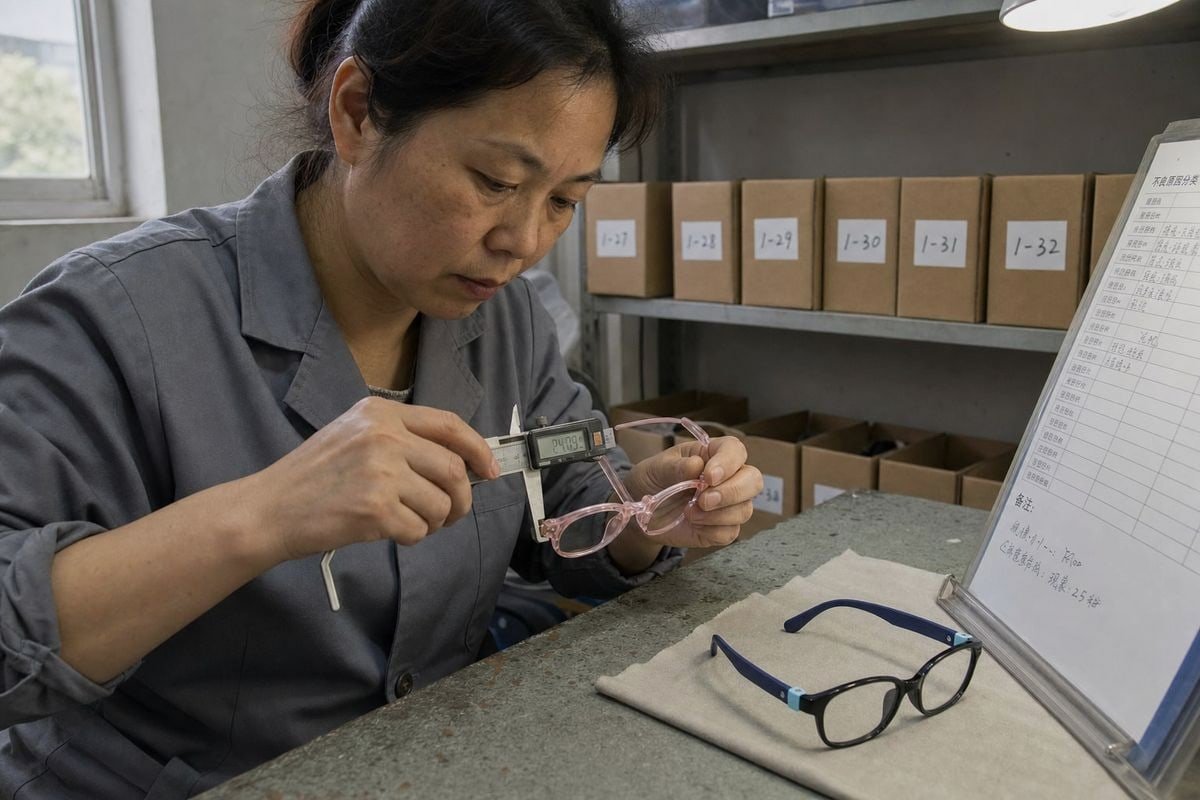
Quality disputes in children's eyewear are rarely about a single scratched lens. They are about disagreements over what was promised. Written specifications solve most of this before it starts. In fifteen years of running eyewear production, I have learned that vague terms like "good quality finish" cause more disputes than actual factory errors do.
Use AQL Levels and Defect Categories
The industry-standard tool is the AQL sampling table. For kids' optical frames, most serious buyers apply AQL 2.5 for major defects and AQL 4.0 for minor ones. Critical defects 4 — anything touching child safety — should carry zero tolerance and trigger immediate batch rejection.
| . Defektklasse | Examples in Kids' Frames | Acceptable Threshold |
|---|---|---|
| . Kritisch | Sharp edges, loose small parts, chemical non-compliance | Zero; reject batch |
| . Hauptsächlich | Hinge failure, frame warping, wrong color vs golden sample | AQL 2.5 |
| . Kleinere | Faint mold lines, slight packaging misprint | AQL 4.0 |
Write your defect rate threshold into the contract, not just the inspection booking form. That way a failed quality control inspection has contractual consequences, not just an awkward email chain.
Add Kids-Specific Technical Standards
Adult frame specs are not enough. Children's frames face sunscreen, skin oils, and constant flexing. Your quality terms should reference ISO 12870 standards 5 for frame durability, and add child-focused criteria: a flex-hinge cycle life minimum (20,000 cycles is a reasonable benchmark), environmental stress cracking resistance so TR90 and TPEE parts do not discolor or turn brittle, and glazing tolerance limits defining how much the frame may deform when high-index prescription lenses are inserted. We design our TR90-Rahmen 6 with TPEE temples specifically around these stresses, because a frame that survives an adult's desk will not survive a seven-year-old's playground. Finally, make documented CPSIA, REACH, or your regional children's product compliance a non-negotiable condition of acceptance, with test reports delivered before shipment.
What Should My Dispute Resolution Process Look Like If a Shipment Doesn't Meet Specifications?
Years ago, a European distributor rejected a shipment over temple color drift. Because we had batch traceability and a signed sample on file, we isolated the issue to one material lot and replaced only the affected units within three weeks.
Your dispute resolution mechanism should require defect notice within a fixed acceptance window, photo and batch-number documentation, comparison against the golden sample, a supplier response deadline, then a remedy sequence of rework, replacement, partial rejection, credit, and finally escalation to mediation or arbitration.

A dispute process only works if both sides know the steps in advance. Without one, quality problems turn into email wars, held payments, and dead partnerships. Here is the procedural flow I recommend writing into your agreement.
The Five-Step Dispute Procedure
- Notice. You must notify the supplier of nonconformity within a defined acceptance window — typically 15 to 30 days after delivery. Claims raised later are harder to attribute to production.
- Documentation. The notice must include photos, quantities affected, batch numbers 7, and reference to the specific spec or sample clause breached. Batch traceability protocols — such as unique codes printed inside temple tips — let both parties isolate the problem to a raw material lot or production shift instead of arguing about the whole order.
- Supplier response. The factory gets a fixed period, usually five business days, to accept the claim, dispute it with evidence, or propose joint re-inspection.
- Remedy. Agree the remedy hierarchy upfront: rework where feasible, replacement manufacturing for failed units, partial rejection with credit, or a price adjustment. Crucially, state whether replacement production resets any delivery deadlines — this is where remakes silently destroy school-year or retail launch schedules.
- Escalation. If the parties still disagree, the contract should name the escalation path: senior management review, then mediation, then arbitration in a named venue under named rules.
Keep the Golden Sample as the Referee
Most disputes over color, finish, and material feel are subjective — unless a physical benchmark exists. A golden sample signed and retained by both parties turns opinion into comparison. In our workshop, every dispute review starts by placing the questioned unit next to the signed sample under standard lighting. Write that comparison step into your contract, and require the supplier to keep their counterpart sample for the life of the program. Also require third-party pre-shipment inspection as a condition for balance payment; it prevents most disputes from ever reaching the destination port.
How Do I Choose a Manufacturing Partner Who Will Honor These Terms Long-Term?
The hardest lesson I have learned in this business is that contract language is only as strong as the factory signing it. A supplier who resists reasonable terms during negotiation will resist them harder during a crisis.
Choose a partner who accepts written lead-time commitments and AQL terms without resistance, shows verified factory ownership and QC systems, offers transparency on capacity and sampling rounds, holds relevant compliance documentation, and demonstrates a track record of honoring remedies when problems occurred.

Terms and partner selection are two halves of the same risk decision. Strong clauses with a weak partner still fail; you just fail with better paperwork. So evaluate how a supplier responds to your terms before you award the business.
Watch How They Negotiate Your Clauses
A factory's reaction to your draft terms tells you a lot. When buyers send us AQL requirements, delay-notice duties, and pre-shipment inspection conditions, we sign them — because our 5S-managed workshop already runs batch testing protocols internally, so the terms describe what we do anyway. A supplier who fights every clause is telling you their process cannot support the commitment. Reasonable pushback is fine: a factory should ask for buyer-dependency carve-outs (late artwork approval, missing spec data) and a fair force majeure clause. Unreasonable pushback — refusing any delay remedy, rejecting third-party inspection, calling all dates "estimates" — is a red flag.
Score Suppliers on What Predicts Performance
| Evaluation Area | What to Verify | Why It Predicts Reliability |
|---|---|---|
| Factory vs trader | Audit or video tour of actual production lines | Traders cannot control lead times or QC directly |
| Vorhandene Stilbibliothek | Breadth of ready designs (we maintain ~800) | Reduces mold risk and shortens sampling rounds |
| Material expertise | Real TR90/TPEE flexible-frame capability | Kids' safety depends on genuine material knowledge |
| QC-System | In-line checks, batch testing protocols, traceability | Predicts consistent defect rate threshold performance |
| Transparency | Honest capacity, seasonal constraints, sampling timelines | Prevents overpromised dates during peak season |
| Track record | References on how past problems were resolved | Past remedy behavior predicts future remedy behavior |
Manage the Relationship With Metrics
After award, track supplier performance metrics 8 quarterly: on-time delivery rate, first-pass inspection rate, response time to issues, and sampling turnaround. Share the scorecard with the factory. In our experience exporting to buyers in 20+ countries, the programs that run smoothest are the ones where both sides review the same numbers. Long-term partners earn flexibility; new partners earn it over time. That is a healthier dynamic than squeezing the lowest price and hoping the terms hold.
Schlussfolgerung
Strong kids' optical frames procurement terms buy certainty, not just frames. Define the clock, fix the standards, script the disputes, and choose a partner who welcomes accountability.
Fußnoten
1. Authoritative Wikipedia entry defining purchase orders and their role in commercial transactions. ↩︎
2. Highly authoritative legal definition from Cornell Law School’s Legal Information Institute. ↩︎
3. Official ICC resource explaining standardized trade terms for international shipping and risk. ↩︎
4. Industry standard definition for classifying defects that impact product safety or function. ↩︎
5. Official ISO standard specifying requirements and test methods for unglazed spectacle frames. ↩︎
6. Technical information on high-performance polyamides used in flexible, durable children’s eyewear frames. ↩︎
7. Explanation of lot numbering systems essential for quality control and batch traceability. ↩︎
<span id="foot
Weitere Artikel, die Ihnen gefallen könnten

August 2026
Bio-Based vs Regular Cellulose Acetate: What's the Difference for Kids' Frames?

August 2026
How Recyclable Are Kids' Optical Frame Materials, and What Eco-Friendly Alternatives Exist?

August 2026
Bleichen Kinderbrillengestelle im Lager aus oder altern sie, und wie kontrolliert man die Lagerbedingungen?
Auf der Suche nach einem zuverlässigen Partner für Kinderbrillen?
Entdecken Sie über 800 sofort verfügbare Modelle und umfassenden OEM/ODM-Support, der auf Ihre Marke zugeschnitten ist.
Kontakt aufnehmen English
  Español de México
  Deutsch
  Français
  日本語
日本語  العربية
  Português do Brasil