How to Monitor Size-Completeness of Kids Optical Frames to Avoid Lost Orders?
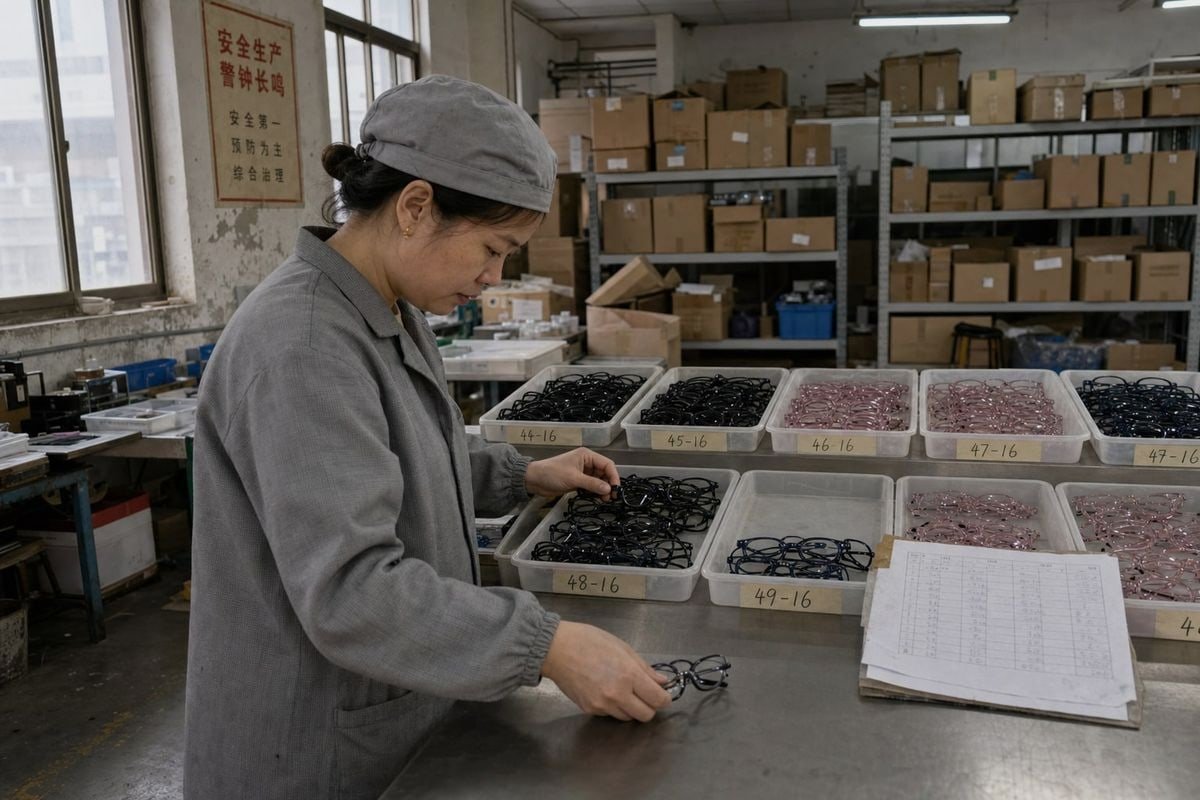
Size-completeness of kids optical frames decides whether an order converts or dies. On our TR90 production line in Taizhou, I have watched one missing bridge size sink an entire reorder.
Monitor size-completeness of kids optical frames by mapping your assortment across lens width, bridge width, and temple length, tracking size run availability at SKU level, setting broken-set alerts, and scheduling restock reviews with your manufacturer every 60–90 days.
That answer sounds simple. In practice, most lost orders come from gaps nobody measured. Let me walk you through how I help buyers close those gaps, step by step.
How can I check if a supplier's size range truly fits my target age groups before placing an order?
A buyer from Australia once sent me her age chart and asked if our frames would fit. I asked her a different question first: what pupillary distance range 1 does your customer base actually have?
Request the supplier's full measurement matrix — lens width, bridge width, temple length, and total front width — for every style, then map those figures against pediatric PD ranges and age bands rather than trusting age labels alone.
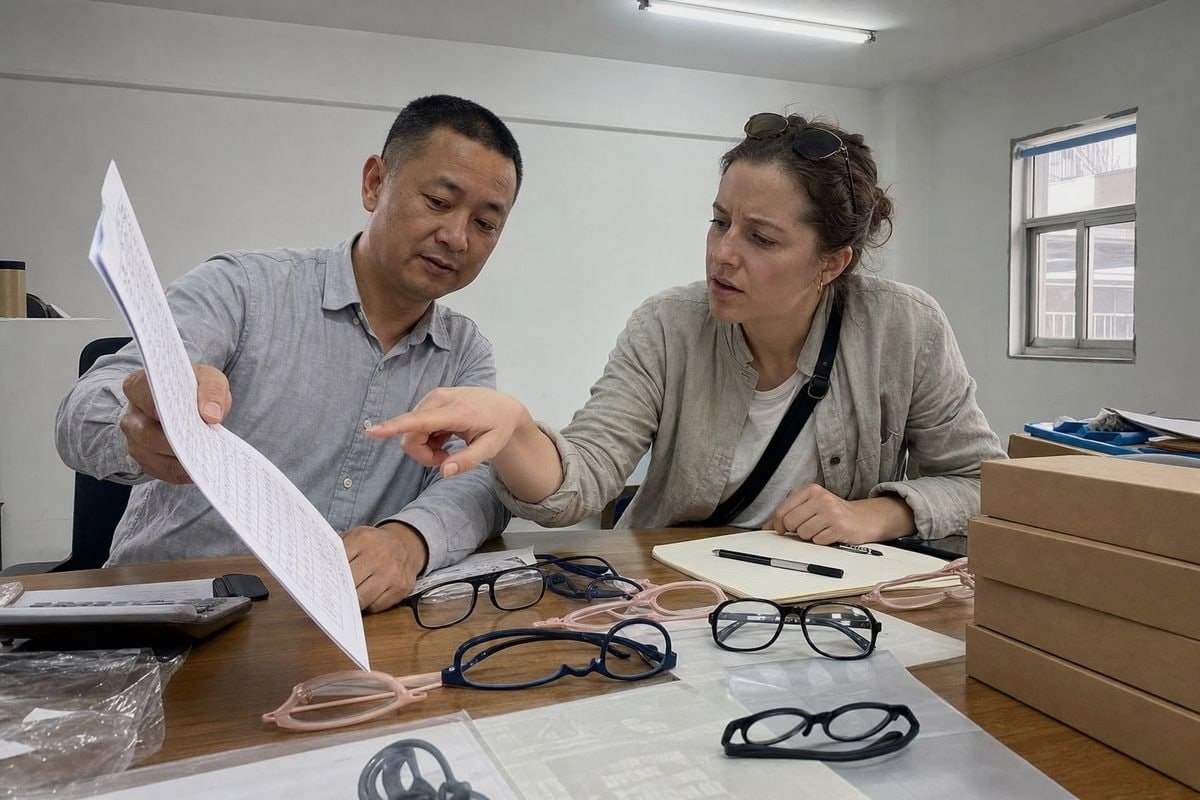
Age charts are convenient. Parents like them, and they work fine as a browsing filter. But I will be honest with you: age alone will not protect your order. Children's eyewear sizing depends on facial geometry 2, not birthdays. A tall five-year-old can need a frame sized for a seven-year-old. If you buy purely by age band, you inherit that mismatch as returns.
Ask for the numbers, not the labels
When buyers evaluate our catalog of roughly 800 existing styles, I encourage them to request a spreadsheet with all four core measurements per SKU. Then compare those against real pediatric data. A useful reference: children's PD typically runs from about 42 mm in toddlers up to 62 mm in pre-teens, and frame front sizes track that range from roughly 35 mm up to 52 mm.
| Age Band | Typical PD Range | Suggested Frame Size Range |
|---|---|---|
| 0–3 years | 42–48 mm | 35–40 mm |
| 4–7 years | 48–54 mm | 40–45 mm |
| 8–10 years | 52–58 mm | 44–48 mm |
| 10–16 years | 56–62 mm | 47–52 mm |
Test the edges, not just the middle
Most suppliers cover the middle band well. Gaps hide at the edges: very narrow toddler bridges and longer pre-teen temples. Before you commit, ask your supplier to confirm coverage at both extremes of your target demographic. On our side, we cross-check a buyer's target market against our TR90 and TPEE frame geometry before we ever quote, because a well-fitted first order is what earns the second one.
What size-completeness reports should I request to avoid discovering gaps after production starts?
Early in my career, we shipped an order that looked complete on paper — sixty styles, all confirmed. The buyer later found that every style clustered in the 44–46 mm band. The paperwork counted SKUs. Nobody counted dimensions.
Request a pre-production size distribution report showing SKU counts per width band, a bridge and temple coverage matrix, a PD-to-frame alignment sheet, and a signed size run confirmation before mass production begins.
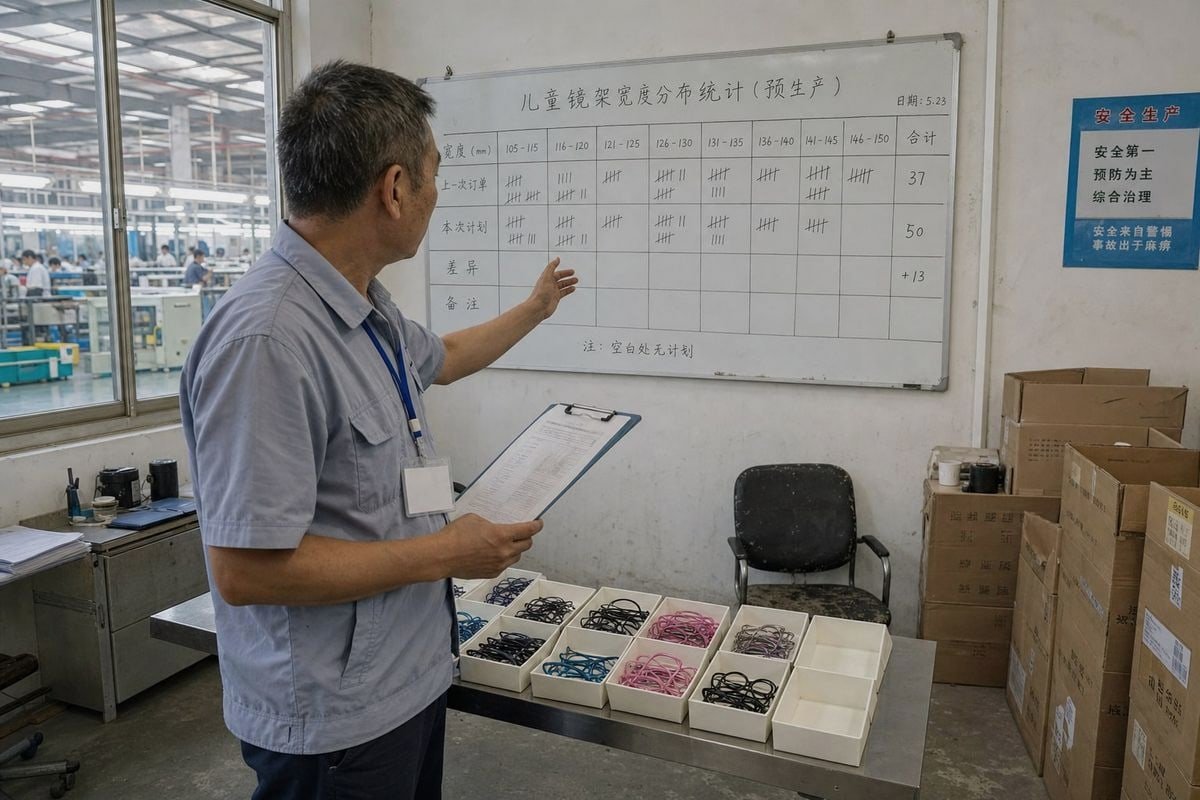
A complete-looking assortment can still fail. That is the trap. SKU count tells you how many products exist. It tells you nothing about whether the right sizes exist. In our 5S-verwalteten Werkstatt 3, we build size-completeness reports into the pre-production stage precisely because fixing a gap on paper costs nothing, while fixing it after molding and assembly costs weeks.
The three reports that catch gaps early
Here is what I recommend every procurement manager request, in order:
- Size distribution report. A count of styles per width band. If 80% of your order sits in one band, you have a merchandising problem, not an assortment.
- Bridge and temple coverage matrix. Bridge fit and temple fit are the two most common failure points in kids frames. A professional dispensing rule of thumb says a frame should touch the face at only three points: the nose and the tops of both ears. Missing bridge widths break that rule immediately.
- PD alignment sheet. This maps each frame's functional PD range against your target customers. Any frame whose range falls outside your demographic gets flagged before production, not after shipment.
| Report | What It Reveals | When to Request |
|---|---|---|
| Size distribution report | Clustering or gaps across width bands | At quotation stage |
| Bridge/temple coverage matrix | Missing fit dimensions within bands | Before sample approval |
| PD alignment sheet | Order-risk frames for your demographic | Before deposit payment |
| Size run confirmation | Final agreed quantities per size | Before mass production |
Make the supplier sign off
One more lesson we learned the hard way: verbal confirmations disappear. Get the final size run in writing, with quantities per size per style. When we run OEM projects with custom colors and packaging, this signed sheet becomes the QC reference our inspectors check cartons against. It also supports SKU rationalization 4 later, because you can compare what you ordered against what actually sold.
Which tools or methods help me track inventory across all sizes so I don't lose sales to stockouts?
There is a trade-off I discuss with almost every distributor: tracking inventory at the style level is easy, but tracking at the size level is what actually prevents lost sales. The extra effort is real. So is the payoff.
Use matrix-based inventory tracking in optical retail software, barcode or RFID scanning to kill phantom inventory, weekly sell-through audits on top styles, broken-set alerts for missing median sizes, and centralized multi-location visibility for internal transfers.
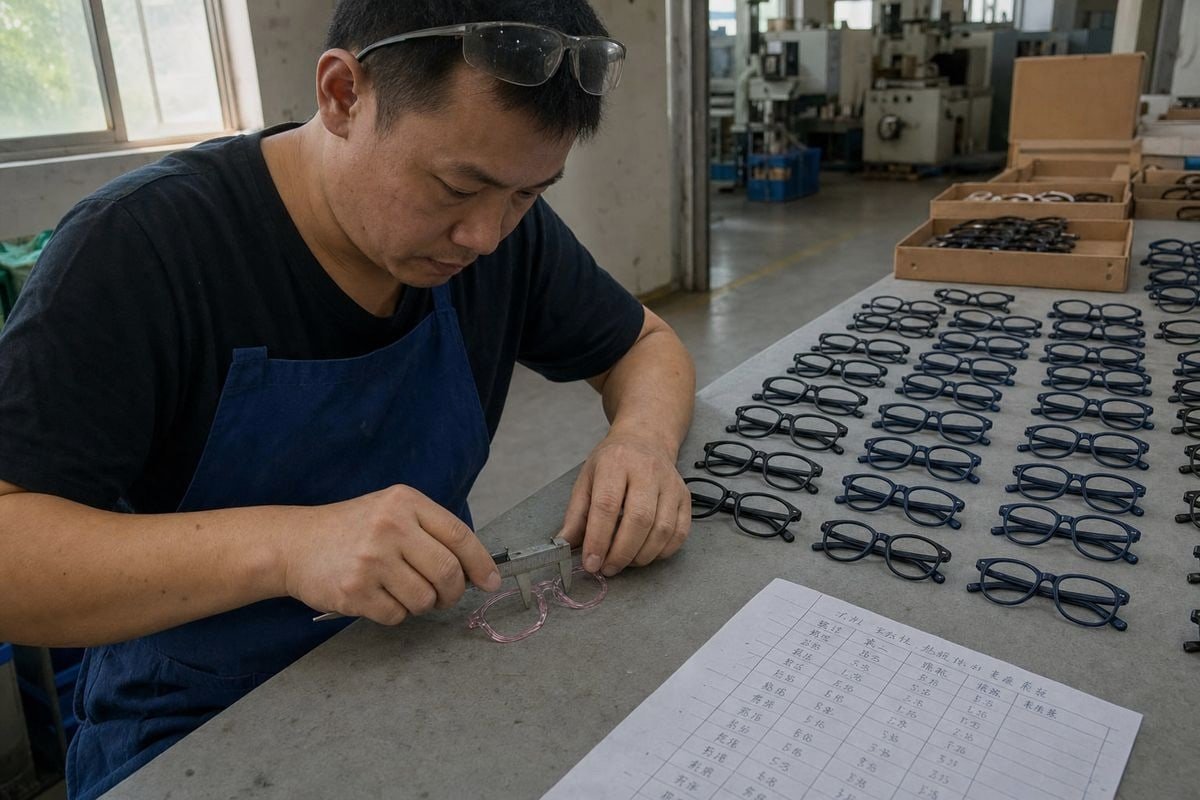
Stockout prevention in children's eyewear is harder than in adult eyewear for one simple reason: kids grow. An assortment that was complete six months ago may no longer match your current customer mix. Clinical guidance even recommends rechecking a child's frame fit every two to three months. Your inventory system needs to move at the same speed.
Track the matrix, not the model
Matrix-based tracking means each eye-size, bridge-width, and temple-length variant is a separate trackable unit inside your optical retail software. When frame board management treats a style as one item, a "in stock" flag can hide the fact that the median size — the one most children need — is gone. That is a broken set, and incomplete size curves sharply lower the probability of a successful dispense. Set automated alerts that fire whenever a median size goes to zero.
Layer your methods
| Methode | Problem It Solves | Review Frequency |
|---|---|---|
| Matrix-based SKU tracking | Hidden gaps inside "in stock" styles | Continuous |
| Barcode/RFID scanning | Phantom inventory and shelf inaccuracy | At intake and checkout |
| Sell-through audits | Broken size runs in top collections | Weekly |
| Demographic weighting | Assortment drift from local age mix | Vierteljährlich |
| 90-day aging triggers | Slow sizes tying up capital | Monthly |
| Multi-location visibility | One branch out, another overstocked | Continuous |
Watch your leading indicators
Two metrics tell you whether the system works. Your optical capture rate 5 shows how many examined patients actually buy frames — a falling rate often signals fit gaps, not weak demand. Your Umsatzverhältnis 6, calculated per size band rather than overall, shows where capital sits idle. Also mine your returns data monthly. Notes like "needs smaller size" or "slides down nose" are size-completeness failures wearing a customer-service costume. If you sell online, virtual try-on analytics add another layer: high-intent size searches that end without purchase point directly at the dimensions you should stock next.
How do I work with my manufacturer to quickly restock missing sizes without delaying my whole order?
A Japanese buyer taught me something valuable a few years back. Instead of waiting for a full container reorder, she asked us to split her replenishment into a fast small-size batch and a slower main order. Her back-to-school season never missed a size again.
Split restocks into fast partial shipments, pre-agree a standing size run with your manufacturer, share sell-through data monthly so they can pre-position materials, and use existing catalog styles to bridge gaps while custom molds are queued.

The biggest restocking mistake I see is treating every replenishment like a brand-new order. It does not have to be. When a manufacturer already knows your size curve, your colors, and your packaging spec, the lead time collapses. At our factory, repeat size-run orders on existing styles move much faster than first orders, because molds, material batches, and QC standards are already locked.
Build the restock playbook before you need it
Here is the process I recommend agreeing on at contract stage, not at crisis stage:
- Define your core sizes. Identify the two or three size bands that drive most of your dispensing efficiency. These get priority in every restock.
- Set a reorder trigger. When any core size drops below a set threshold, the restock conversation starts automatically — no waiting for a quarterly review.
- Agree on partial shipping. Missing sizes ship by air or fast sea in a small batch; the balance follows on the normal schedule. Your whole order never waits on one gap.
- Share data monthly. When buyers send us sell-through by size, we can pre-position TR90 and TPEE material for their likely reorder. That trims days off every cycle.
- Negotiate exchange terms. Ask about swapping slow-moving sizes for high-velocity core sizes on 90-day aging triggers. Not every factory offers this, but it is worth raising.
Bridge gaps with existing styles
One advantage of working with a factory that carries a deep existing catalog: if a custom style's size extension needs a new mold, you can often fill the gap immediately with a similar ready-made style in the missing size. We do this regularly for brands facing seasonal surges — especially around school vision screening cycles 7, when first-time wearer demand spikes and a missing 42 mm frame means a lost family, not just a lost sale.
Schlussfolgerung
Lost orders are usually a sizing-data problem, not a demand problem. Measure your size curves, demand real reports, track every dimension, and restock in fast partial batches.
Fußnoten
1. Wikipedia provides the standard definition and typical measurement ranges for pupillary distance in pediatric and adult populations. ↩︎
2. Anthropometry is the scientific study of human body measurements, including facial geometry essential for proper eyewear fitting. ↩︎
<span
Weitere Artikel, die Ihnen gefallen könnten

August 2026
Bio-Based vs Regular Cellulose Acetate: What's the Difference for Kids' Frames?

August 2026
How Recyclable Are Kids' Optical Frame Materials, and What Eco-Friendly Alternatives Exist?

August 2026
Bleichen Kinderbrillengestelle im Lager aus oder altern sie, und wie kontrolliert man die Lagerbedingungen?
Auf der Suche nach einem zuverlässigen Partner für Kinderbrillen?
Entdecken Sie über 800 sofort verfügbare Modelle und umfassenden OEM/ODM-Support, der auf Ihre Marke zugeschnitten ist.
Kontakt aufnehmen English
  Español de México
  Deutsch
  Français
  日本語
日本語  العربية
  Português do Brasil