Full-Rim vs Half-Rim vs Rimless Kids’ Optical Frames: What’s the Difference?

Choosing between full-rim, half-rim, and rimless kids’ optical frames confuses many buyers who visit our Taizhou factory. Pick wrong, and returns pile up. Pick right, and your collection thrives.
Full-rim kids’ optical frames enclose the lens completely for maximum durability and lens protection. Half-rim frames hold only the top of the lens with a nylon cord, cutting weight. Rimless frames attach lenses directly to the bridge and temples, making them the lightest but most fragile option for children.
Each style serves a different child, a different prescription, and a different price point. Let me walk you through how we help brands decide, based on fifteen years of building children’s eyewear.
How do I choose between full-rim, half-rim, and rimless frames for my kids' collection?
Last spring, a buyer from Australia asked me to quote all three frame types for her launch. We spent an hour mapping each style to a real customer age group before she ordered a single sample.
Choose based on your target age group and prescription range. Full-rim frames suit children under ten and strong prescriptions. Half-rim frames fit older kids wanting a lighter look. Rimless frames work only for careful, mature wearers with mild prescriptions and thin lens edges.
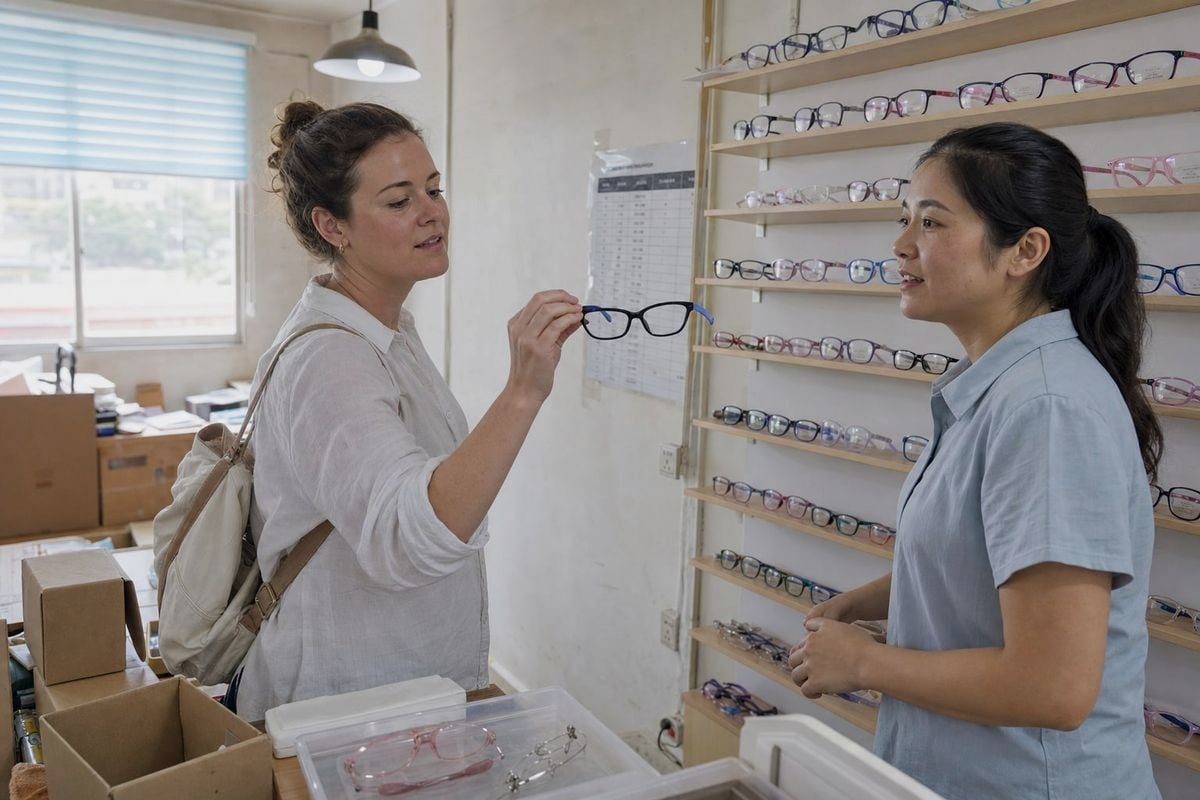
The fastest way to decide is to compare the three constructions side by side. Here is the reference table we share with new buyers:
| Merkmal | Full-Rim | Half-Rim | Rimless |
|---|---|---|---|
| Lens enclosure | Complete, all around | Top only, nylon cord below | None; drilled mounting points |
| Durability | Highest | Mäßig | Lowest |
| Gewicht | Heaviest | Middle | Lightest |
| Prescription range | Widest | Mäßig | Narrow, thin lenses only |
| Best age group | 3–10 years | 10–14 years | 12+ responsible wearers |
Match the frame to the child, not the trend
Adult eyewear trends push toward minimal, barely-there designs. That is why rimless and half-rim styles stay popular with grown-ups. But children are not small adults. They drop glasses. They yank frames off with one hand. They stuff them into backpacks without cases. So a style that sells well in an adult line can generate warranty claims in a kids' line. We remind buyers of this whenever they ask us to shrink an adult rimless design down to a child's size.
Think about your lens partner too
Frame choice also affects lens choice. Full-rim frames accept standard polycarbonate lenses without issue. Rimless and half-rim frames put stress on drilled holes and grooves. For those, Trivex-Gläser 1 are the safer pairing because their tensile strength resists spider-web cracking at drill points. If your optical lab mostly cuts polycarbonate, that alone is a reason to lead with full-rim styles. Your collection should reflect what your supply chain can actually support, not just what looks good on a mood board.
Which frame style is safest and most durable for active children?
Our drop-test bench tells the honest story. When we develop a new TR90 full-rim style, we flex the temples hundreds of times and drop finished samples onto hard flooring before it ever reaches our catalog.
Full-rim frames are the safest and most durable choice for active children. The complete rim protects lens edges from chipping, distributes impact across the whole frame, and survives drops, twisting, and rough play far better than half-rim or rimless constructions.
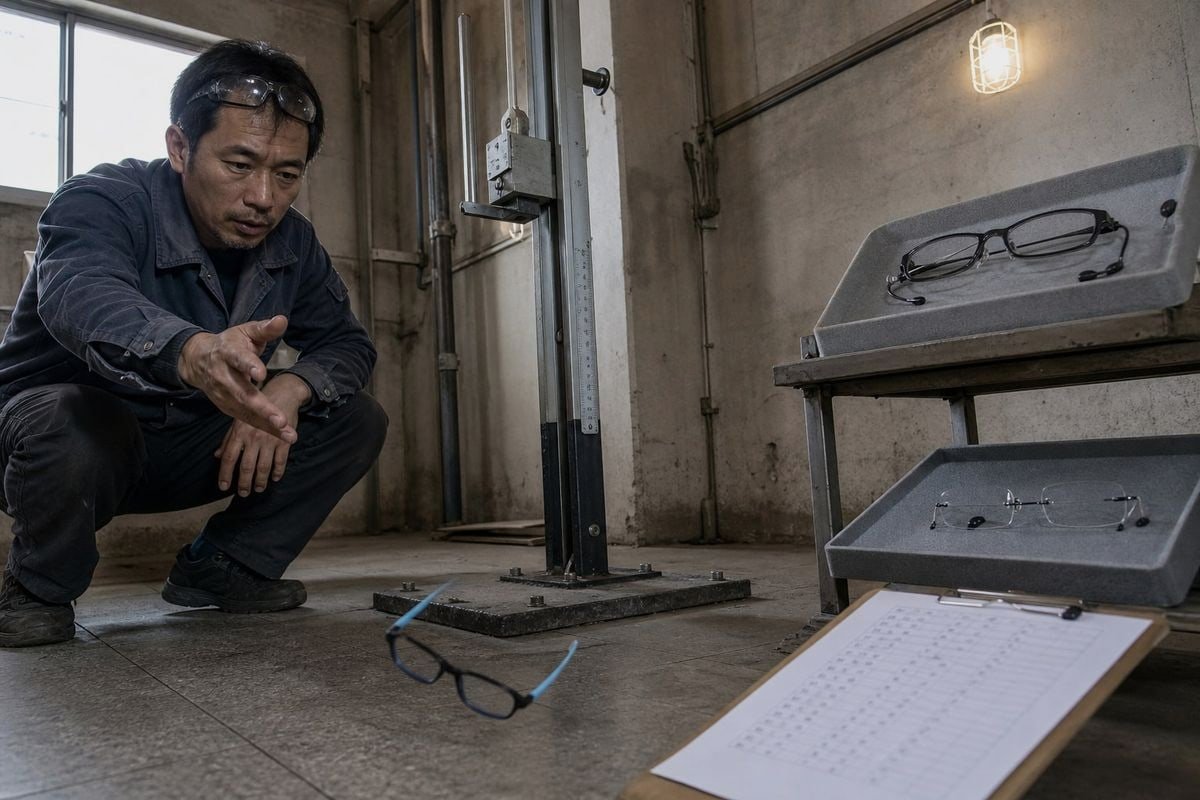
Durability is not one single property. It breaks down into several separate risks, and each frame style handles them differently.
Where each style fails first
Full-rim frames usually fail at the hinge after years of flexing. Spring hinges 2 und flexible TR90 material 3 push that failure point even further out. Half-rim frames fail at the nylon cord. The cord stretches or snaps, and the lens drops out. Rimless frames fail at the drilled mounting points. A twist during play can loosen a screw or crack the lens around the hole.
There is also a repair angle most buyers overlook. If a lens pops out of a full-rim frame at school, a teacher or parent can often press it back in on the spot. A half-rim or rimless failure usually needs specialized optical tools or nylon restringing. That means a trip to the optician and a child who cannot see clearly in the meantime.
Growth spurts create a hidden durability problem
Children's faces change fast. As facial symmetry shifts during growth spurts, the minimalist structure of rimless frames drifts out of alignment more easily. These frames need more frequent professional re-squaring than rigid full-rims. Our engineers address fit stability another way: adjustable ear hooks and soft TPEE temple tips grip gently as the child grows. Combined with impact resistance from polycarbonate lenses, a well-built full-rim frame can genuinely last through a full prescription cycle.
| Failure risk | Full-Rim | Half-Rim | Rimless |
|---|---|---|---|
| Lens edge chipping | Niedrig | Mäßig | Hoch |
| One-handed removal damage | Niedrig | Mäßig | Hoch |
| Field repairability | Easy re-insertion | Needs restringing | Needs optical tools |
| Alignment drift during growth | Niedrig | Mäßig | Hoch |
What are the pros and cons of full-rim, half-rim, and rimless frames for my brand?
A trade-off we weigh constantly in our sample room is weight versus strength. Every gram we remove from a frame front makes it more comfortable on a small nose, and slightly easier to break.
Full-rim frames offer durability, wide prescription compatibility, and design flexibility, but weigh the most. Half-rim frames balance lighter weight with reasonable stability. Rimless frames deliver minimal weight and a natural look, but demand careful handling, thin lenses, and higher after-sale support.

For a brand builder, the question is not only which frame survives. It is which frame supports your positioning, your margins, and your customer service load. Here is how we frame the trade-offs with our B2B partners:
| Business factor | Full-Rim | Half-Rim | Rimless |
|---|---|---|---|
| Return and warranty risk | Niedrig | Mittel | Hoch |
| Design and color options | Widest | Gut | Begrenzt |
| Hides thick lens edges | Ja | Partially | Nein |
| Perceived style level | Playful, bold | Modern, lighter | Premium, minimal |
| Recommended collection share | 60–70% | 20–30% | 0–10% |
Prescription compatibility drives real revenue
This point deserves emphasis. Full-rim frames handle the widest range of prescriptions. A thick rim masks lens thickness, so a strong prescription still looks tidy. Rimless mounts are the pickiest: high-power lenses can look unsightly or even sit unstably in the mount unless the parent upgrades to high-index lenses, which raises the retail price. Half-rim sits in between, hiding the top edge but exposing the bottom. If your customer base includes children with strong prescriptions, an all-rimless collection quietly excludes them.
Style and field of vision still matter
To be fair to the minimal styles, rimless frames give the most natural aesthetic and an unobstructed field of vision, with no visible border in the child's peripheral view. Some children find a bold full rim distracting at first. Half-rim frames offer a genuine compromise: the structural stability of a traditional top bar with a lighter, less intrusive lower profile. We produce soft translucent acetate frames and two-tone TR90 designs precisely because full-rim does not have to mean heavy or clunky. Modern materials closed much of the weight gap, and titanium frames show the same lesson in metal.
Can I source all three frame types from one manufacturer to simplify my supply chain?
One lesson our export team learned early: buyers who split full-rim, half-rim, and rimless orders across three factories end up with three different color standards, three packaging specs, and three sets of delivery risks.
Yes, and consolidating with one children's eyewear manufacturer is usually smarter. A single factory keeps color matching, quality standards, packaging, and lead times consistent across all three frame styles, reduces minimum order pressure, and gives you one accountable partner instead of three.

Consolidation is not just about convenience. It changes what your brand can realistically launch, and how fast.
Why an existing style library lowers your risk
Opening a new mold for each frame style is expensive. That is why we maintain roughly 800 existing styles across full-rim, half-rim, and specialty constructions. A new brand can pick proven shapes, apply custom colors and logos, and test the market without heavy tooling investment. When the market tells you which style sells, you scale that one. Buyers from more than twenty countries have used this route to launch, and it consistently beats guessing with custom molds on day one.
What to verify before consolidating
A single supplier only simplifies your chain if that supplier genuinely masters all the constructions you need. Here is the checklist I suggest:
- Ask for flexibility and drop-test data on their TR90 and TPEE frames, not just photos.
- Confirm they control lens fitting in-house, including lens thickness limits for half-rim grooves.
- Check hardware quality: spring hinges, screws, and adjustable nose pads should come from consistent, traceable sources.
- Review their OEM/ODM scope — custom colors, logos, lenses, and retail-ready packaging should sit under one roof.
- Visit or audit the workshop. Our own 5S-managed floor with around 120 workers exists because process discipline, not machinery alone, keeps quality stable across styles.
When those boxes are ticked, one purchase order can cover your entire full-rim, half-rim, and rimless range, with one quality standard behind it.
Schlussfolgerung
Full-rim wins for durability and prescriptions, half-rim balances weight and stability, rimless serves careful older wearers. Build your kids' collection around real childhood, and source all three wisely.
Fußnoten
1. Official manufacturer site detailing the material properties and durability of Trivex for rimless and semi-rimless frames. ↩︎
2. Reliable Wikipedia reference explaining eyeglass frame construction and hinge types. ↩︎
3. Official product documentation for Grilamid TR (TR90), the industry-standard polymer used in flexible children’s eyewear. ↩︎
Weitere Artikel, die Ihnen gefallen könnten

August 2026
Bio-Based vs Regular Cellulose Acetate: What's the Difference for Kids' Frames?

August 2026
How Recyclable Are Kids' Optical Frame Materials, and What Eco-Friendly Alternatives Exist?

August 2026
Bleichen Kinderbrillengestelle im Lager aus oder altern sie, und wie kontrolliert man die Lagerbedingungen?
Auf der Suche nach einem zuverlässigen Partner für Kinderbrillen?
Entdecken Sie über 800 sofort verfügbare Modelle und umfassenden OEM/ODM-Support, der auf Ihre Marke zugeschnitten ist.
Kontakt aufnehmen English
  Español de México
  Deutsch
  Français
  日本語
日本語  العربية
  Português do Brasil