Why Are TR90 Kids Optical Frames Returned, and How Can Stores Reduce Returns?

Every returned pair of TR90 kids optical frames eats margin, and after 15 years on our Taizhou production line, we know most causes are avoidable.
TR90 kids optical frames are returned mainly for poor fit, pressure points, hinge or bridge failure, and gaps between online photos and real wear. Stores reduce returns through precise pediatric frame sizing guidance, pre-shipment quality checks, honest durability claims, clear return policies, and a manufacturer with reliable QC.
The material is rarely the real problem. The process around the material usually is. Below, I break down where returns come from and what a store can do at each step, from the factory to the child’s face.
How can I identify the main reasons customers return TR90 kids optical frames?
Last spring a European distributor sent us a box of returned frames to inspect flexible-material expertise 1. Only one had a real defect. Most of the others were simply the wrong size for the child.
Identify return reasons by logging every return under a fixed set of categories: sizing, comfort, breakage, appearance mismatch, lens or prescription issues, and transit damage. Then separate true defects from misuse. Within a few months, the pattern shows whether fit, quality, or expectations drive most returns.

Most stores do not track returns well. A parent says "it didn't work" and the frame goes back on the shelf. That single sentence hides five or six different problems. If you cannot name the problem, you cannot fix it.
Start with a simple return log
I recommend a spreadsheet with one row per return. Record the style code, the child's age, the stated reason, and what the staff member actually observed. Add a column for "defect" or "not defect." Optical dispensing teams already do this for lens remakes. Frames deserve the same discipline.
Prescription eyewear return rates are often cited around 8–12%, and each return can cost a store roughly $50–150 once you count labor, materials, and lost margin. On a kids' frame with a modest wholesale price, that cost can wipe out the profit on several other pairs.
The six categories we see most often
| Return reason | What the parent says | What is usually going on |
|---|---|---|
| Poor fit | "It keeps sliding down" | Bridge too wide for a flatter nasal bridge, or temples too long |
| Comfort | "It hurts behind the ears" | Temple arm flexibility too stiff, or tips not curved enough |
| Breakage | "The hinge snapped" | Weak hinge insert, thin rim, or misuse being reported as a defect |
| Appearance mismatch | "It looked brighter online" | Glossy studio photos versus a matte or translucent finish |
| Lens or prescription | "Vision seems off" | Pupil distance or lens mounting issue blamed on the frame |
| Transit damage | "It arrived bent" | Frame distortion from soft packaging or heat in the shipping container |
Why fit dominates the list
Children grow fast, and frame dimensions 2 are not standardized across brands. A 48-16-130 from one supplier does not sit like a 48-16-130 from another. Kids also tend to have a lower, flatter nose bridge than adults, so nose pad comfort and bridge shape matter more than rim style. Virtual try-on tools often miss this. They show the front view well but cannot simulate bridge depth or how far the temple must wrap behind a small ear. That "digital-to-physical" gap is a return waiting to happen.
Finally, watch for the expectation problem. TR90 is a thermoplastic memory resin. It bends and springs back. Marketing copy turns that into "indestructible," and parents remember the word. When a hinge finally gives up after months of active play, the return feels justified to them, even if the frame did its job.
What quality issues should I check before shipping TR90 optical frames to my store?
Thinner rims look more stylish on a child's face, but every extra millimeter we remove from a TR90 rim is a millimeter of lens retention we give up.
Before shipping TR90 optical frames, check hinge screw torque and free movement, temple alignment on a flat surface, bridge symmetry, lens groove depth and retention, surface coating adhesion, color match against the approved sample, and the absence of sharp flash or plasticizer odor. Also confirm the material grade documentation.
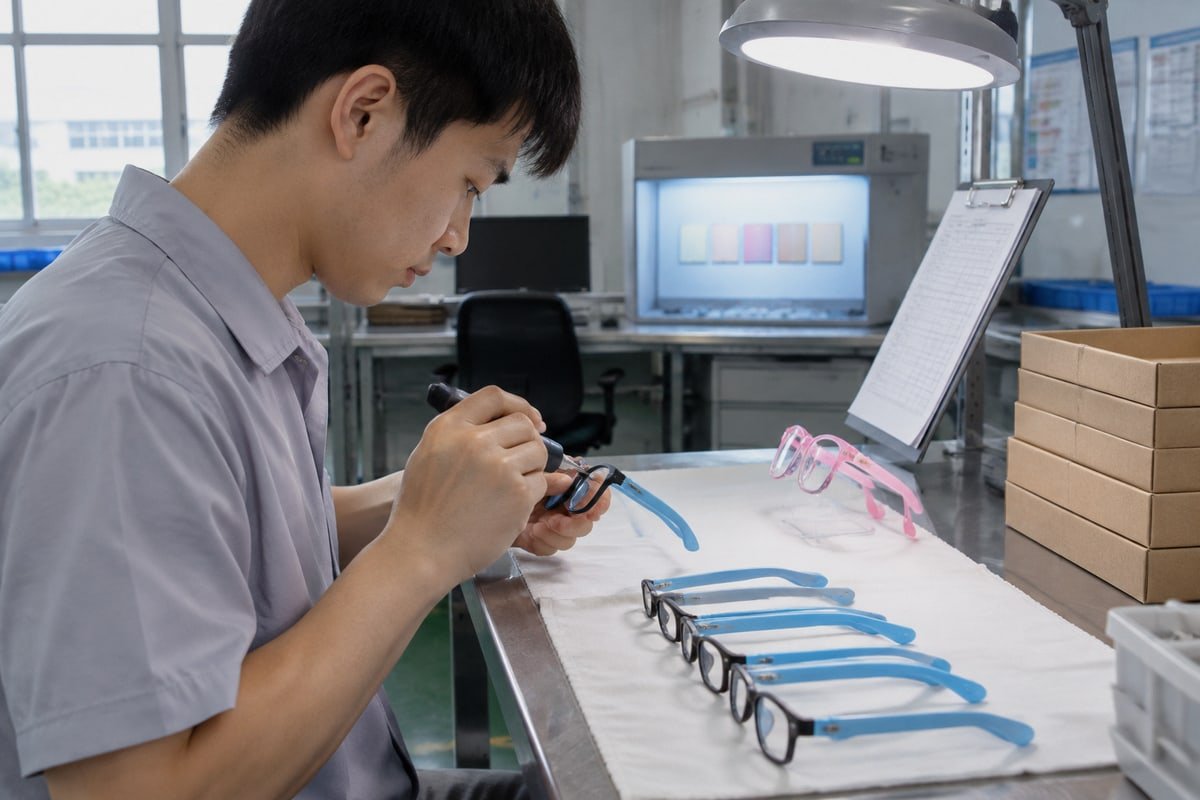
Quality checks for kids' frames are different from adult frames. Small faces expose small errors. A 1 mm twist in a temple that an adult would never notice becomes a pressure point on a six-year-old. In our 5S-managed workshop, we treat pre-shipment inspection as the last chance to stop a return before it starts.
A practical inspection sequence
- Flat-surface test. Lay the frame open on a flat table. Both temple tips and both lower rims should touch. Any rocking means frame distortion from cooling or handling.
- Hinge check. Open and close each temple ten times. The movement should be smooth with no clicking. Tighten screws to a consistent feel, not "as tight as possible," because over-torqued screws crack the TR90 around the hinge insert.
- Bridge fit adjustment check. Look at the bridge from above. The two lens planes should be symmetrical. Kids' bridges cannot be reshaped much afterward, so this must be right from the mold.
- Lens retention. Push gently on each demo lens from the back. TR90 has a fairly high thermal expansion coefficient. If the groove is too shallow, lenses can pop out during big temperature swings, such as a hot car in summer.
- Surface and smell. Run a thumb along every edge for flash. Smell the frame. A sharp chemical odor points to poor coating cure or low-grade plasticizers, which can also cause skin irritation.
Material grade is a quality issue too
Not all TR90 is equal. Lower-grade resin lacks the flexibility and impact resistance of premium Swiss Grilamid-type material. It can look identical on day one and turn brittle within a season. We ask our resin suppliers for grade documentation 3 and keep it on file per batch. We also stay with BPA-free materials 4 because a child's frame sits on skin all day. Hypoallergenic properties are not a marketing line for us; they are a reason we control coatings and pigments as carefully as the base resin.
| Defect found before shipping | Likely outcome if missed |
|---|---|
| Rocking on flat surface | Comfort return within the first week |
| Stiff or clicking hinge | Breakage claim within a few months |
| Shallow lens groove | Lens pop-out and "frame is faulty" return |
| Color off from approved sample | Appearance mismatch return |
| Chemical odor or sticky coating | Skin irritation complaint and return |
How can I choose a manufacturer that reduces return risks for kids' eyewear?
A procurement manager from Australia once asked us one question before anything else: can you show me how a frame fails, not just how it flexes?
Choose a manufacturer that is a real factory with flexible-material expertise, a large library of proven kids' styles, documented material grades, in-line quality control, and full OEM/ODM support for packaging and sizing labels. Ask for size specs per style, defect definitions, and how they handle warranty replacements.

That question was a good one. A supplier who only talks about flexibility is selling a feature. A supplier who can explain failure modes is managing your return risk. Here is how I would evaluate a partner if I were on the buying side.
Factory or trading company?
| Question to ask | What a return-conscious answer looks like |
|---|---|
| Who makes the frames? | A real factory with its own workshop, not a trading company passing on someone else's QC |
| How many kids' styles exist already? | Hundreds of tested styles, so you can launch without heavy mold investment and test the market first |
| What materials do you use? | Named grades of TR90 and TPEE, with documentation, and a clear position on BPA-free materials |
| How is fit checked? | Per-style size specs plus a flat-surface and hinge check before packing |
| What counts as a defect? | A written definition that separates manufacturing faults from misuse |
| Can you brand and package? | Custom colors, logos, lenses, cases, and size labels, delivered retail-ready |
At our factory we run about 120 workers and offer around 800 existing styles. That library matters for returns more than people expect. A style that has already shipped to buyers in 20+ countries has had its bridge, hinge, and temple length tested by thousands of real children. A brand-new mold has not.
Two objections I hear often, and how I answer them
"TR90 is the best material for kids, so the material choice solves the return problem." I agree TR90 is the right base. It is lightweight, it recovers from impact, and it suits active children. But the material only removes one return category. Fit and comfort remain. That is why we combine TR90 fronts with TPEE temples on many styles. TPEE gives more temple arm flexibility around the ear, so the frame stays put without squeezing.
"Flexible does not mean return-proof, so why pay more for a flexible-material specialist?" This objection is correct, and it is the reason to pick a specialist rather than avoid one. Getting a TR90 bridge right for a flatter pediatric nose, setting the hinge insert depth, and cutting the lens groove to hold through temperature swings are all flexible-material skills. Fifteen years of doing only children's eyewear is what lets a factory get those details right the first time.
Support after the sale
Ask how the manufacturer handles a real defect. We prefer a no-charge replacement for genuine faults, and we want to see the returned frame. Every returned pair we inspect teaches us something we can push back into the mold or the inspection sheet. A partner who never wants to see a return is not learning from it.
What packaging and sizing practices can help me minimize optical frame returns?
We learned the hard way that a frame can pass every bench test and still come back because the size label was missing from the case.
Print lens width, bridge width, and temple length on every frame and case, group styles by age range and face shape, ship frames in rigid cases with demo lenses intact, add a care card covering cleaning and storage, and state the return window and unworn condition clearly before checkout.
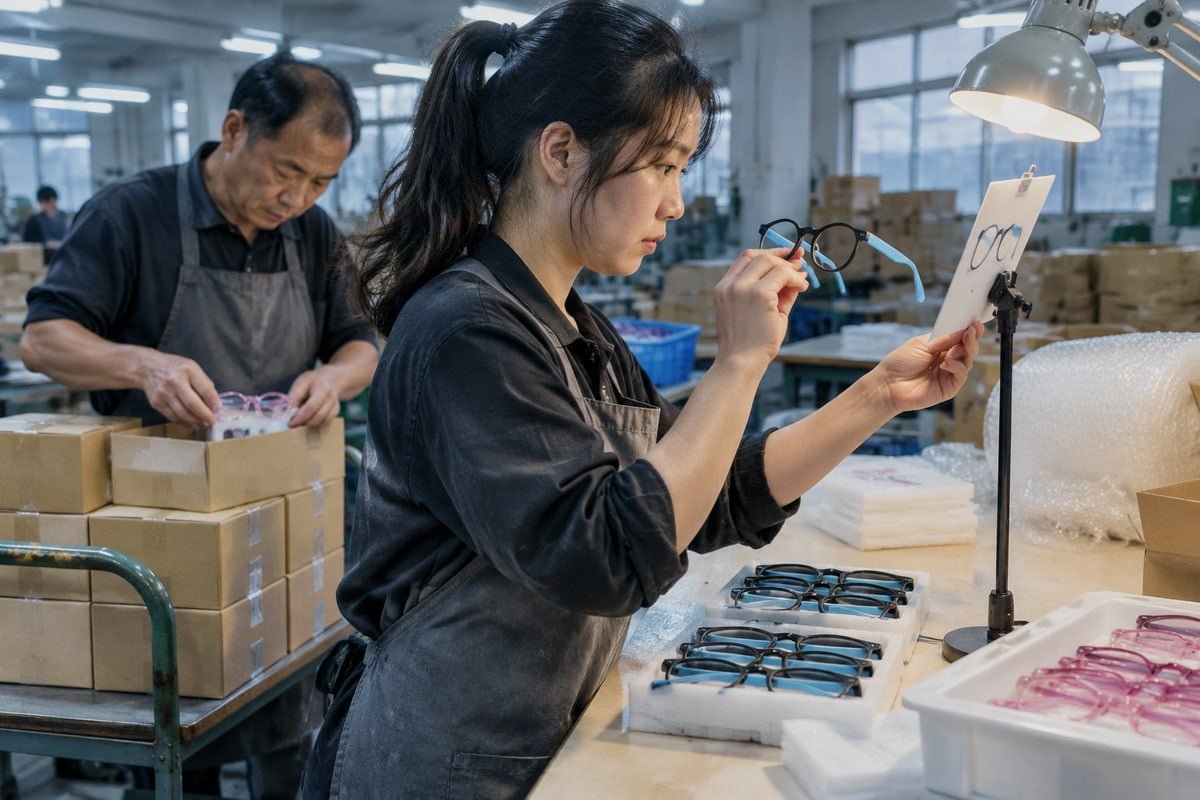
Packaging and sizing are where the store and the manufacturer meet. If the factory prints the numbers and the store publishes them, the parent can self-select. If either side skips it, the parent guesses. Guessing creates returns.
Sizing information that actually helps a parent
Standard frame measurements are necessary but not enough. A parent does not know what a 16 mm bridge means. We supply, and I encourage stores to publish, a short fit guide per style that translates numbers into plain words.
| What to publish | Why it prevents a return |
|---|---|
| Lens width, bridge width, temple length | Lets parents compare with a frame the child already wears |
| Suggested age range | Gives a starting point, since children's frames are not standardized across brands |
| Face-shape note | "Best for narrow faces" or "best for a low nose bridge" helps self-selection |
| Bridge style | A keyhole bridge on our round matte-black style sits differently from a saddle bridge |
| Use-case tag | "Best for active kids" or "best for first glasses" sets the right expectation |
Add real-world photos next to studio shots. Our translucent pink gradient frame looks crystal-clear at the rims and soft pink at the brow. Studio lighting can make it look brighter than it is. One honest photo on a plain background beside one photo in daylight closes that gap.
Packaging that survives the journey
Frame distortion in transit is a silent return driver. A soft pouch in a hot container can leave a TR90 front slightly twisted. We ship in rigid cases, and we keep demo lenses fitted so the front holds its shape. For OEM/ODM customers, we print the size and style code on the case, the temple, and the outer label, so the store never has to guess which box holds which size.
The care card
Parents rarely know how to look after a flexible frame. A small card in the case should say three things. Clean with mild soap and water 5, not harsh solvents, and avoid ultrasonic cleaning that can stress the resin over time. Store in the case, away from car dashboards. Explain that TR90 is impact-resistant and flexible, not indestructible. That single sentence reframes the parent's expectation before the first hinge ever gets stressed.
Return rules that protect margin
Most optical retailers already use a 14–30 day window, unworn condition, intact demo lenses, and sometimes a restocking fee. These rules are not hostile. They stop wear-and-tear frames from being resold, and they keep the store's return cost under control. Show the policy before checkout, and separate manufacturer defects from misuse in plain language. A parent who knows the rules in advance is far less likely to argue about them later.
Conclusion
Returns of TR90 kids optical frames drain margin, yet most trace back to fit, expectations, and skipped checks. Fix those, and the flexible material finally delivers.
Interested in sourcing the products mentioned in this article? See details and request a quote here:
Footnotes
1. EMS-Grivory is the primary manufacturer of Grilamid TR90, providing technical expertise in flexible thermoplastic resins. ↩︎
2. The American Academy of Ophthalmology offers authoritative guidance on pediatric eye health and proper frame fitting. ↩︎
3. ISO standards ensure that manufacturers maintain proper grade documentation and quality management systems for industrial products. ↩︎
4. The FDA provides safety regulations and information regarding BPA-free materials in consumer and food-contact products. ↩︎
5. Wikipedia provides general maintenance and cleaning instructions for eyewear, including the use of mild soap and water. ↩︎
More Articles You Might Like


Looking for a Reliable Kids Eyewear Partner?
Explore 800+ ready styles and full OEM/ODM support tailored to your brand.
Get in Touch English
 Español de México
 Deutsch
 Français
 日本語
 العربية
 Português do Brasil