Why Test TPEE Kids’ Sunglasses for Phthalates and Heavy Metals?
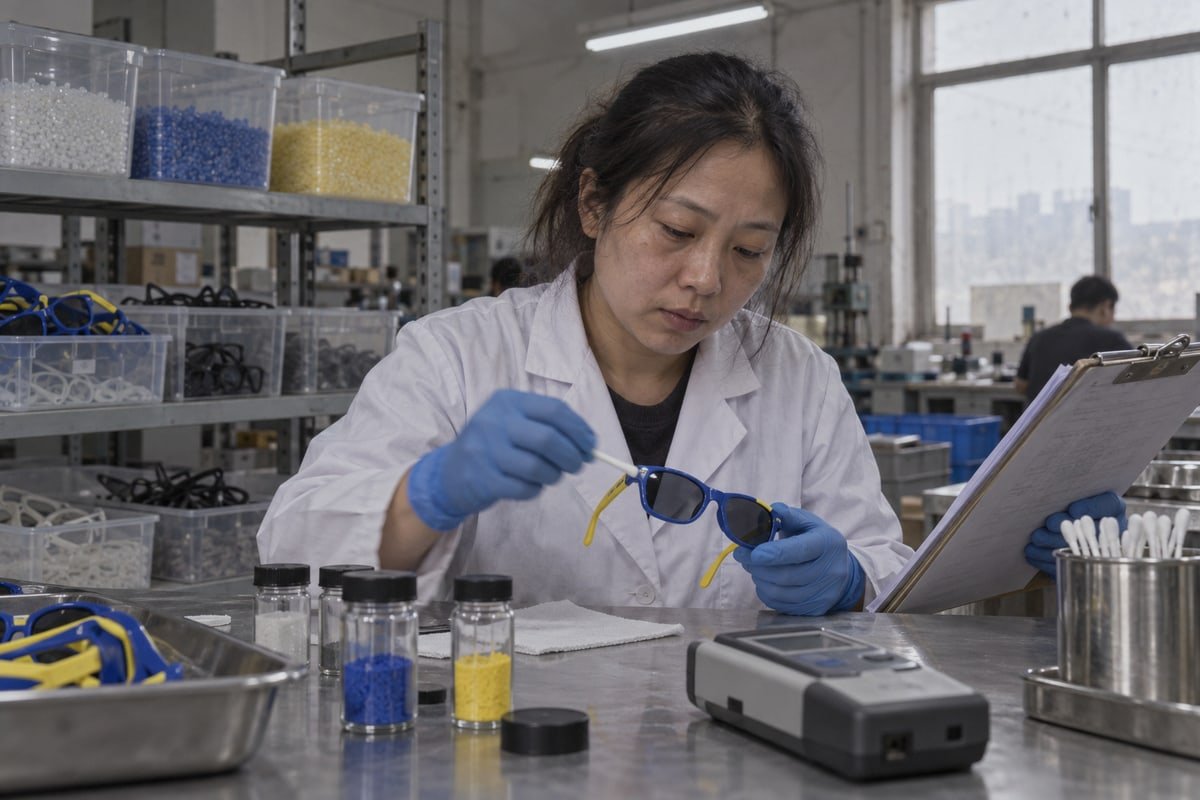
Testing TPEE kids’ sunglasses 1 for phthalates and heavy metals seems excessive when the frame bends softly. Yet one untested pigment can trigger a recall. Our production line learned that early.
You should test TPEE kids’ sunglasses for phthalates and heavy metals because children’s eyewear is a regulated children’s product. Pigments, coatings, hinges, and recycled inputs can add lead, cadmium, or phthalates even when the base polymer is clean, and third-party laboratory testing proves the finished product complies.
This article walks through the four questions buyers ask us most. I will cover how to check a supplier, which standards matter, why TPEE starts from a safer place, and what documents you can demand before you commit to a bulk order.
How do I know if my TPEE sunglasses supplier tests for phthalates and heavy metals?
A procurement manager from Australia once asked me for our test reports before she asked for our price list. I remember thinking: that is exactly the right order.
You know a TPEE sunglasses supplier tests for phthalates and heavy metals when they show recent third-party laboratory testing reports for the finished product, name the lab and standard, cover every component including hinges and paint, and explain how often they retest new colors and batches.
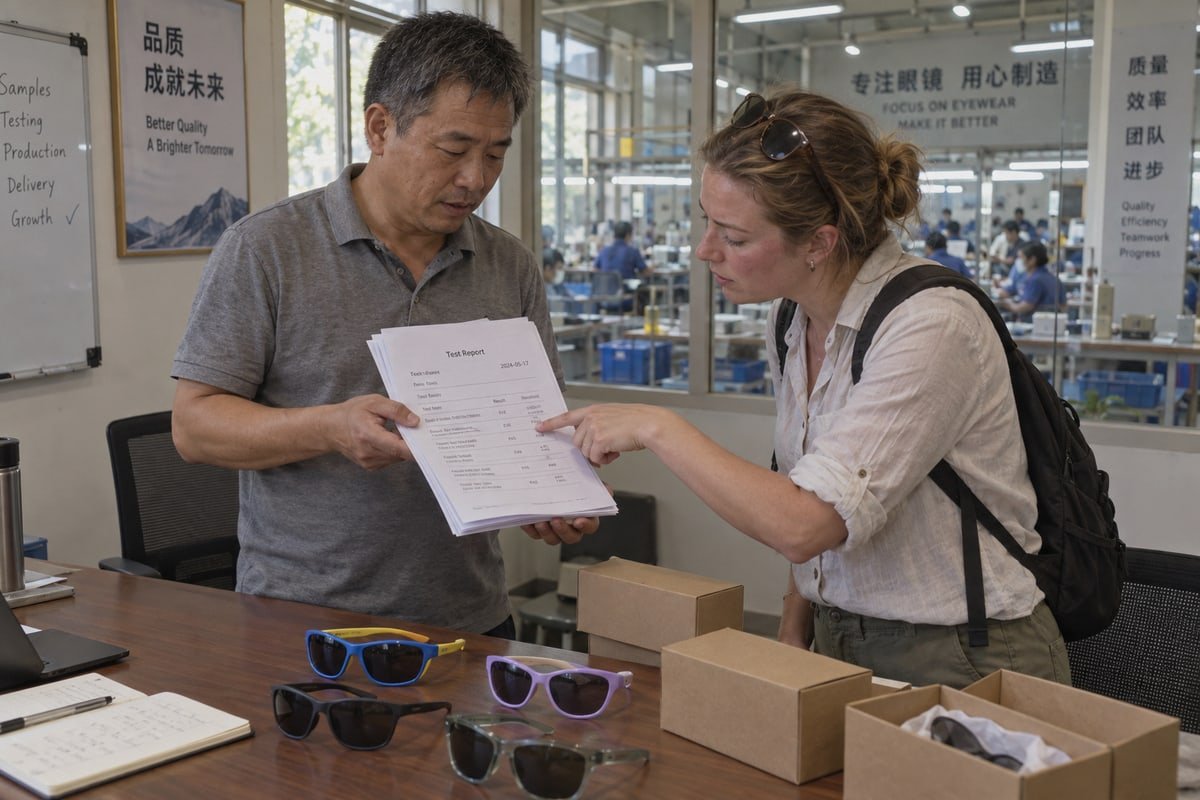
Almost every factory will say "yes, we test" when you ask. The useful work starts after that answer. I want to give you the same questions our own buyers use on us. They work because they force specifics, and specifics are hard to fake.
Five questions that separate proof from promises
| Question to ask | Weak answer | Strong answer |
|---|---|---|
| Can I see the latest report for this exact style? | One undated PDF for a different product | Dated report with lab name, style number, and a photo of the tested sample |
| Which components were tested? | "The frame material" | Front, temples, nose area, hinges, paint, and printed logo listed separately |
| Which standards and limits were applied? | "International standard" | CPSIA 16 CFR 1307 at 1,000 ppm, lead in substrate and coatings, EN71-3 migration |
| How often do you retest? | "When the customer requests it" | Every new color, every new pigment supplier, plus periodic batch checks |
| Do you use recycled elastomer? | Silence or a vague "eco" claim | A clear yes or no, with the source and its test record |
Why the component list matters so much
Take one of our two-tone styles. It has a royal blue front, yellow temples, and small silver hinges. That is three colorants and one metal part in a single product. Each one is a separate exposure point. In my experience, lead and cadmium content rides in pigments and metal accents, not in the elastomer itself. Phthalates ride in soft coatings, glossy finishes, or adulterated resin. So a report that only says "TPEE frame, pass" tells you very little about the hinge or the yellow arm.
The same logic applies to the small engraved text and CE marking on the inner temple of our lavender cat-eye style. That engraving shows the product was declared for the EU market. It does not, by itself, prove chemical testing happened.
Batch testing beats one old report
Complex supply chains create hidden risk. A pigment sub-supplier can change formulation without telling anyone. Recycled elastomer can carry "legacy" phthalates from plastic streams made before modern bans. That is why we lock our resin source, keep material lot records in our 5S workshop, and retest whenever any input changes. One report from two years ago is a starting point. It is not ongoing CPSIA compliance.
What safety standards should I ask my manufacturer to meet for children's eyewear compliance?
Choosing which standard to test against is a real trade-off for us. Testing every frame to every market's rule costs time, so we map standards to where a buyer sells.
Ask your manufacturer to meet CPSIA compliance with 16 CFR 1307 phthalate limits and lead limits for the U.S., EN71 safety standards and REACH regulation for Europe, ASTM F963 standards where applicable, plus California Proposition 65 disclosure, and to back each claim with a children's product certificate.
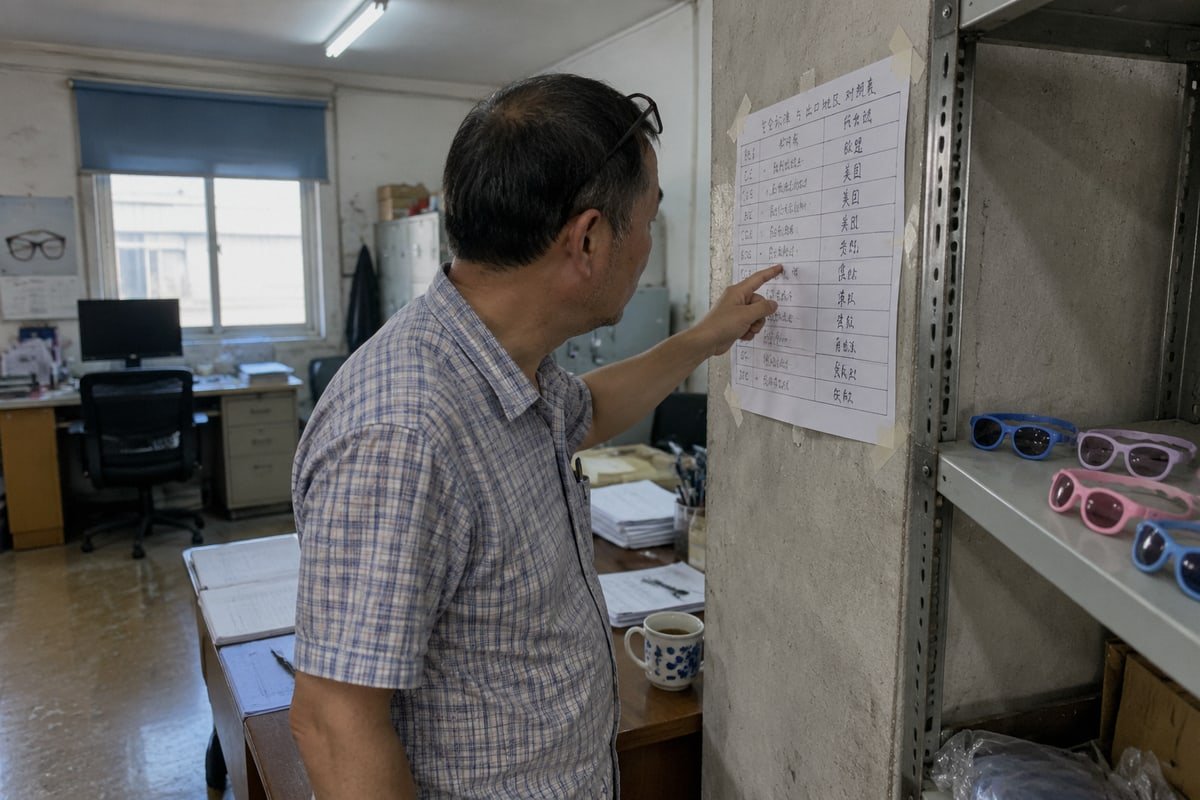
Standards sound abstract until you see them side by side. Below is the map I share with new brand partners. It is not legal advice. It is the working list our engineers use when a buyer tells us "we sell in the U.S. and Germany" or "we sell in Australia and Japan."
The standards map for kids' sunglasses
| Market | Rule | What it controls | Key limit or note |
|---|---|---|---|
| United States | CPSIA with 16 CFR 1307 | Eight listed phthalates in accessible plasticized parts | 0.1% (1,000 ppm) per phthalate |
| United States | CPSIA lead limits | Lead in substrate and in paint or coatings | 100 ppm substrate, 90 ppm coatings |
| United States | ASTM F963 standards | Toy safety, including soluble heavy metals in coatings and substrates | Applies when eyewear is marketed as a toy; many retailers request it anyway |
| California | Proposition 65 | Disclosure of listed chemicals | A warning duty, not a ban; testing supports "no warning needed" claims |
| European Union | EN71 safety standards (EN71-3) | Migration of 19 elements, including lead and cadmium | Category-based chemical migration limits |
| European Union | REACH regulation, Annex XVII | Phthalates, cadmium, lead in consumer articles | 0.1% by weight for restricted phthalates |
| European Union | Sunglasses under PPE rules | UV, optical class, CE marking | Optical compliance, separate from chemical compliance |
Match the standard to where you sell
The U.S. treats children's sunglasses as a children's product. That triggers lead limits and, when the product is marketed for play, the phthalate ban under 16 CFR 1307. Compliance is shown through a children's product certificate 2 based on third-party lab results. Europe leans on EN71-3 migration testing and REACH. When we build a frame for a buyer in Europe, we ask the lab for both, because pigments behave differently under migration testing than under total-content testing.
Do not confuse UV compliance with chemical compliance
Buyers in Australia usually ask about the sunglasses standard for UV performance first. That matters, and our UV400 and polarized lens 3 options are built for it. But UV testing says nothing about endocrine disruptors in the frame. A frame can block 100% of UV and still fail a lead test on its paint. I always ask buyers to hold both test types in mind. Non-toxic materials and proper lenses are two separate promises to parents.
Why is TPEE material safer than PVC or low-grade plastics for my kids' sunglasses line?
Our QC team keeps a drawer of failed frames from competitor samples buyers have sent us. The cracked, sticky, and faded ones are almost never TPEE.
TPEE is safer than PVC or low-grade plastics because it gets its flexibility from its polymer structure, not from added phthalate plasticizers. It is BPA-free, resists cracking into sharp edges, tolerates heat and UV better, and starts from a cleaner base, though every finished frame still needs testing.
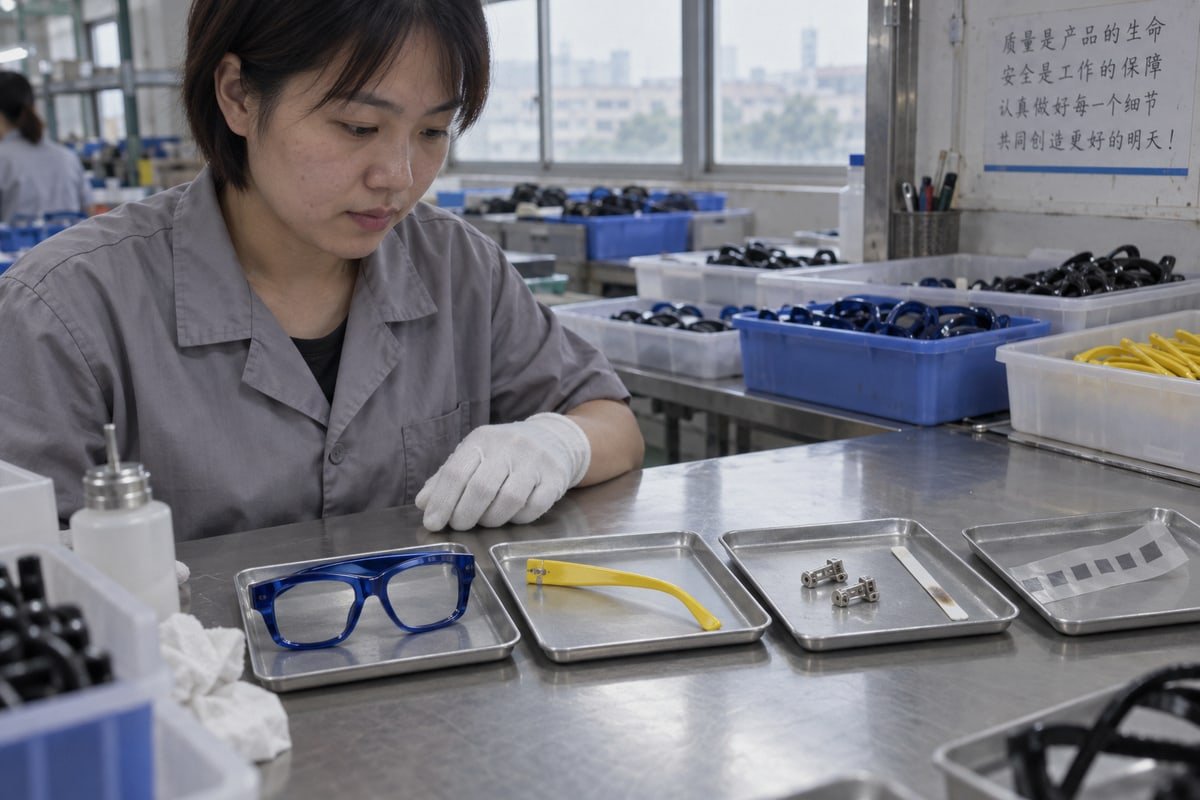
Here is how the common frame materials compare. I have included TR90 because most of our optical frames use TR90 fronts with TPEE temples, and buyers often ask how the two relate.
Material comparison at a glance
| Material | Where flexibility comes from | Phthalate risk | BPA | Break behavior | Heat and UV | Our use |
|---|---|---|---|---|---|---|
| TPEE | Built-in hard and soft polymer segments | Low by nature; risk only from additives or coatings | BPA-free frames | Bends and returns | Good | Kids' sunglasses, temples |
| TR90 | Polyamide memory structure | Low | BPA-free | Bends, very light | Good | Optical fronts with TPEE temples |
| Soft PVC | Added plasticizers, often phthalates | High | Chlorine-based; may use heavy metal stabilizers | Goes sticky, deforms | Poor; leaches faster in heat | Not used |
| Low-grade recycled blends | Unknown mixed inputs | Unknown; legacy phthalates possible | Unknown | Snaps into sharp pieces | Poor | Not used |
The objection: a known polymer does not need testing
Some buyers push back. They point out that CPSC guidance says certain materials known not to contain phthalates do not need testing unless they have been treated or adulterated. That is correct. TPEE, as a resin, sits in that low-risk group. My answer is simple. We do not sell resin. We sell a finished pair of TPEE kids' sunglasses with pigments, a gloss finish, hinges, and sometimes a printed logo. Vivid colors like our royal blue or bright yellow can rely on stabilizers or pigments that carry heavy metals if the compound is not formulated for high-contact children's goods. The polymer earns the low-risk label. The finished product has to earn it again in the lab.
Heat, UV, and chewing change the picture
Children chew on frames. A soft, rubber-like temple invites it. That makes chemical migration through saliva 4 a primary concern, which is why EN71-3 migration limits matter even when total content looks fine. Heat matters too. A closed car in summer can accelerate the leaching of any plasticizer far beyond what ambient-temperature testing shows. Long UV exposure can also cause polymer chain scission, which may raise the rate at which internal additives move to the surface over time. TPEE handles these stresses better than PVC. Its flexible frame durability comes from the polymer, not from an additive that can escape. That is the real safety advantage, and it is why we chose TPEE for children's temples in the first place.
Can I get lab test reports and certificates before I place a bulk order with my factory?
Early in our export work, I learned that a report sent after shipment helps nobody. Now we share documents at the sampling stage, before any buyer commits to volume.
Yes. A reliable factory can provide existing third-party laboratory testing reports for the same material and color family before a bulk order, then run fresh tests on your pre-production samples. Expect the lab report, a children's product certificate or declaration of conformity, and a material declaration.
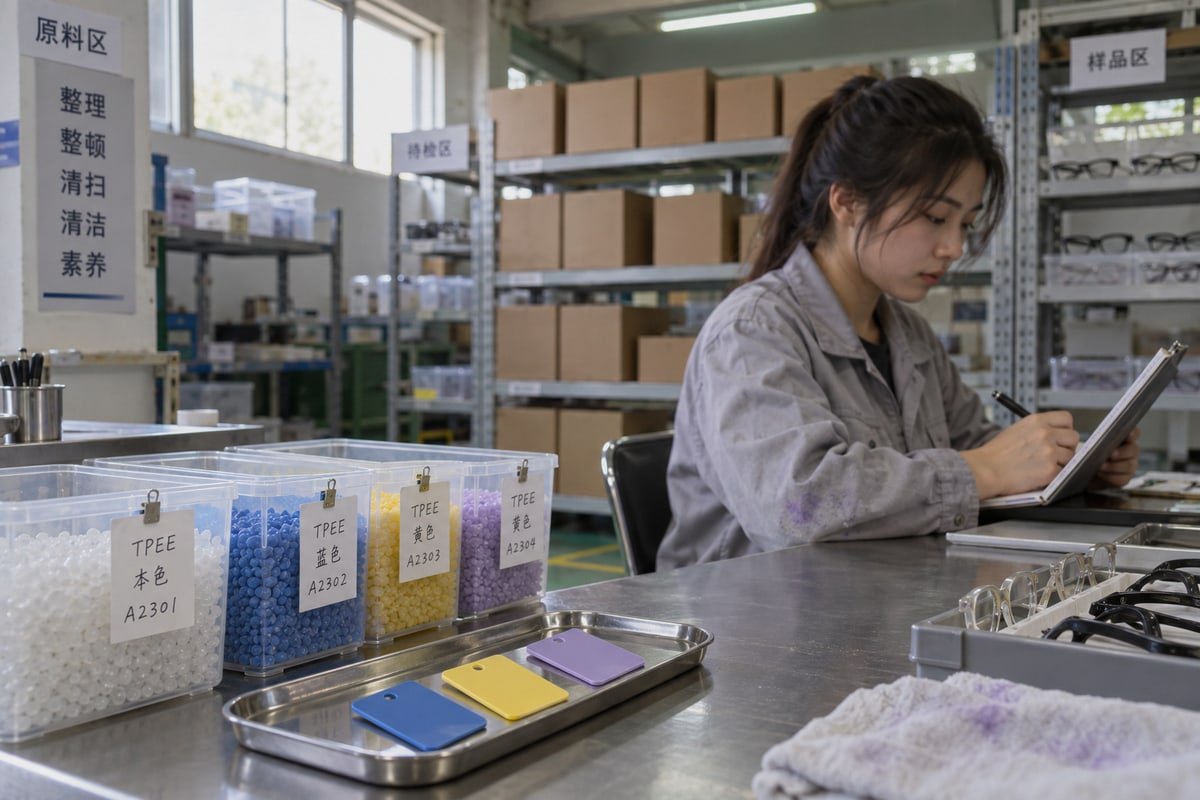
With around 800 existing styles, we usually already hold reports that cover the material and many of the color families a buyer wants. That lets a new brand see real documents before spending on molds or committing to a container. Here is the sequence we follow with most B2B partners.
The six-step document path we use
- Request existing reports. Ask for the most recent report on the same TPEE compound and, ideally, the same colorway. Check the date, the lab, and the tested components.
- Confirm the scope in writing. Agree on which standards apply to your market before samples are made. Phthalates, lead, cadmium, and migration should each be named.
- Approve samples. Review the physical sample for fit, flex, and finish. This is also when you approve custom colors, logos, and packaging.
- Test the pre-production sample. Send the approved sample, with your logo and coating, to a third-party lab. New pigments and prints are the parts most likely to change results.
- Receive the certificate. For the U.S., this is the children's product certificate listing the rules and the test report it relies on. For the EU, it is a declaration of conformity supported by EN71-3 and REACH results.
- Retain samples and batch-check. We keep retained samples from each production lot. Buyers can request periodic batch testing, especially after a color or supplier change.
How to read a report without getting lost
| Field | What to check |
|---|---|
| Sample description and photo | Does it match your style, color, and logo? |
| Test items | Are phthalates, lead, cadmium, and migration listed separately? |
| Components tested | Frame, temple, hinge, paint, and print, each with its own result |
| Method and standard | 16 CFR 1307, CPSIA lead, EN71-3, REACH Annex XVII named clearly |
| Result versus limit | Numbers shown next to the limit, not just "pass" |
| Date and lab | Recent, and issued by an accredited third-party lab |
A report you cannot match to your product is not your report. That sounds obvious, but it is the most common gap I see when buyers forward documents from other factories.
Conclusion
Untested TPEE kids' sunglasses put children and your brand at risk. Test finished products, not just resin, and partner with a factory that shares proof before you order.
Interested in sourcing the products mentioned in this article? See details and request a quote here:
Footnotes
1. Official CPSC guidance on phthalate restrictions in children’s products. ↩︎
2. Official CPSC resource for Children’s Product Certificate (CPC) compliance. ↩︎
3. Wikipedia entry covering sunglasses standards, including UV protection and lens types. ↩︎
4. Wikipedia overview of toy safety standards, including the EN71 series for chemical migration. ↩︎
More Articles You Might Like

Looking for a Reliable Kids Eyewear Partner?
Explore 800+ ready styles and full OEM/ODM support tailored to your brand.
Get in Touch English
 Español de México
 Deutsch
 Français
 日本語
 العربية
 Português do Brasil