How Do UV-Protective Lenses in Kids’ Sunglasses Work?
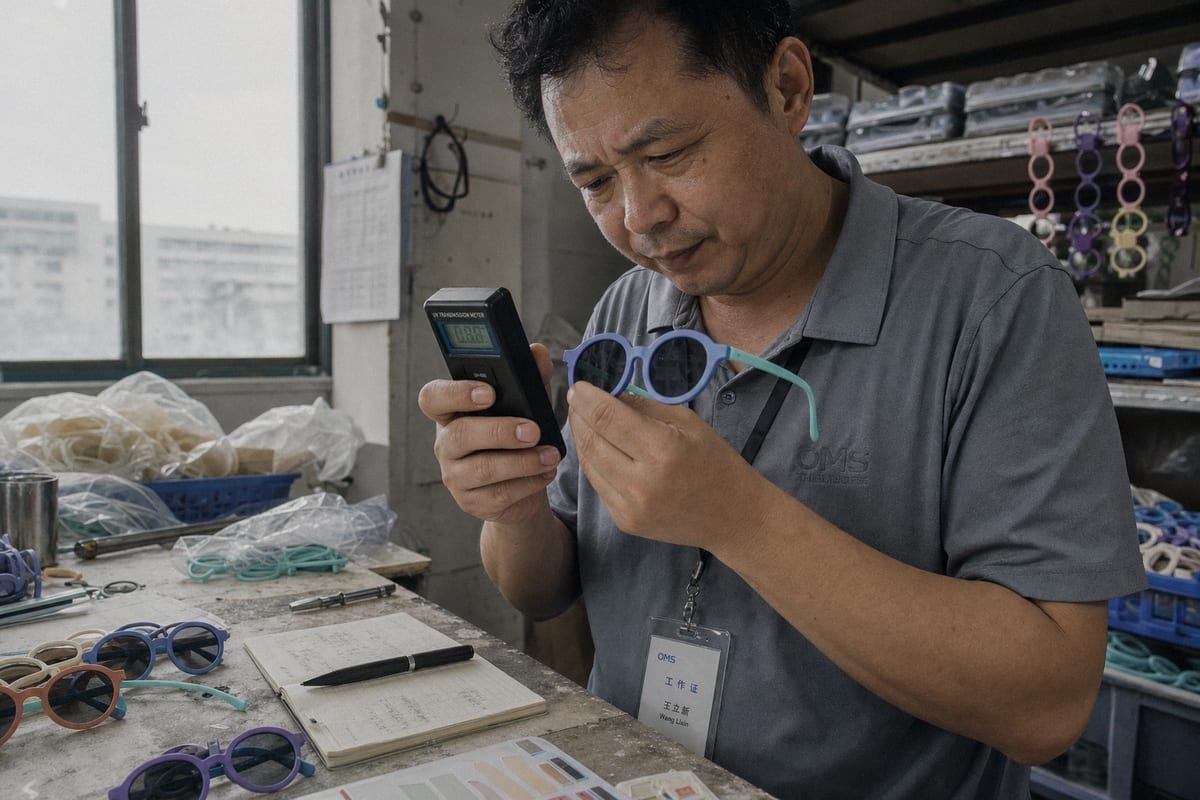
UV-protective lenses in kids’ sunglasses sit at the heart of everything our factory in Taizhou builds. Yet many buyers still confuse dark tint with real protection — a costly mistake.
UV-protective lenses in kids’ sunglasses work by absorbing or blocking ultraviolet radiation before it reaches the eye. UV-absorbing molecules embedded in the lens material, or applied as coatings, capture UVA and UVB photons and dissipate them as heat, stopping wavelengths up to 400 nanometers.
That is the science in one paragraph. But if you source children’s eyewear for a brand, you need more detail. Let me walk you through what actually matters.
What UV Protection Level Should I Look for When Sourcing Kids' Sunglasses?
A few years ago, a European buyer sent us a competitor's sample for testing. The lens was nearly black — and it failed our UV transmission check. Our engineers were not surprised.
When sourcing kids' sunglasses, always specify UV400 protection, which blocks 100% of UVA and UVB radiation up to 400 nanometers. Some industry-standard lenses only filter to 380 nm, so require UV400 or 100% UVA/UVB certification in writing before ordering.
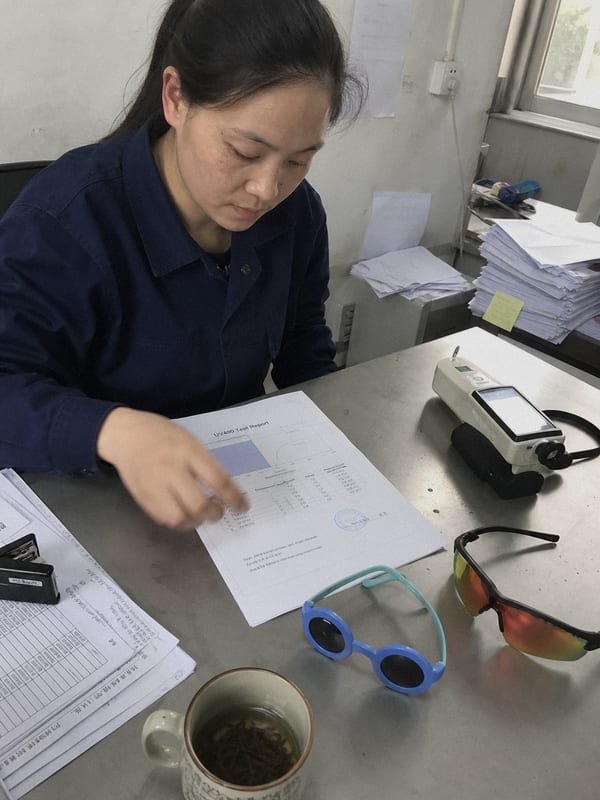
The distinction between 380 nm and 400 nm sounds tiny. It is not. UVA radiation 1 extends right up to 400 nanometers, and children's eyes are especially vulnerable to it. A child's crystalline lens 2 is clearer than an adult's. It cannot filter UV as effectively. That means more radiation reaches the retina, where it can contribute to cumulative retinal damage 3 over decades. Research also suggests children receive a large share of their lifetime UV eye exposure before age 18. So the protection level you choose today shapes ocular health for years.
The Standards You Should Reference
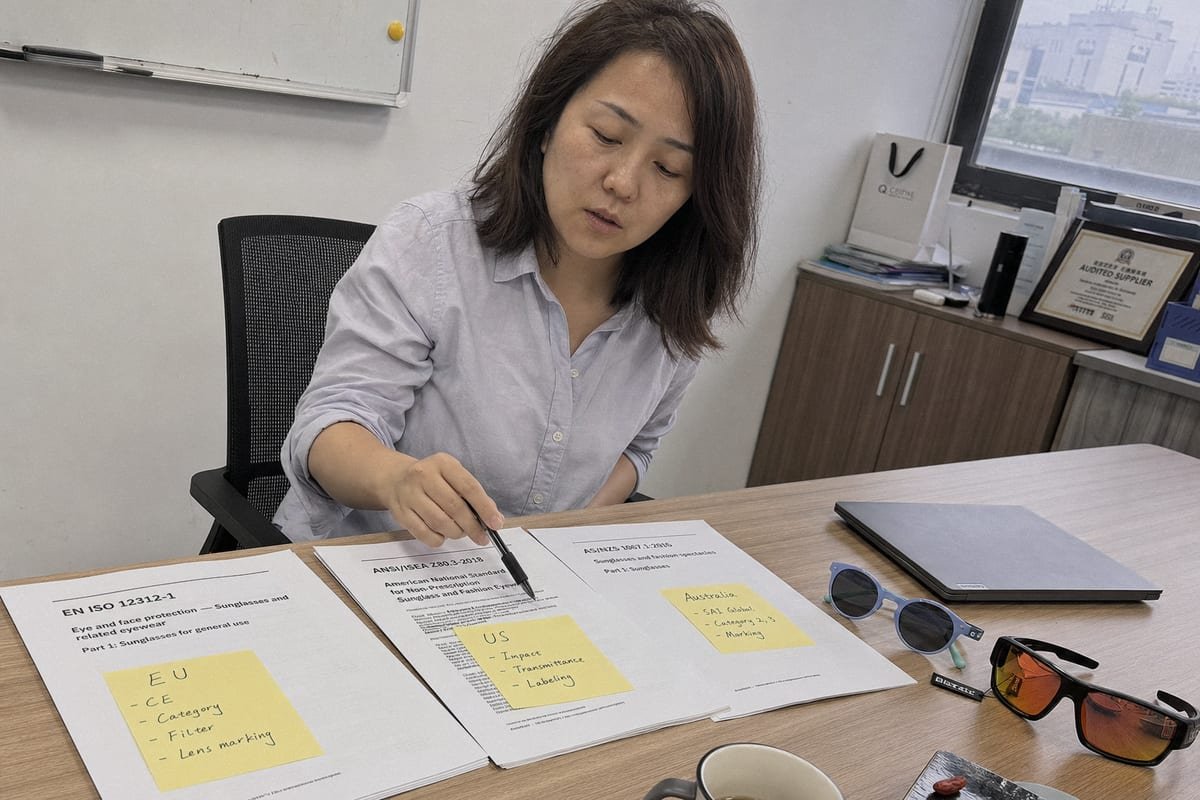
When we quote for buyers in Australia, Europe, or Japan, we always confirm which standard applies to their market. The main ones are below.
| Standard | Region | What It Covers |
|---|---|---|
| UV400 | Global benchmark | Blocks all UV up to 400 nm (full UVA and UVB) |
| ANSI Z80.3 | United States | UV transmission limits, lens quality, impact safety |
| EN ISO 12312-1 | Europe | UV filtering, lens categories, mechanical safety |
| AS/NZS 1067 4 | Australia/NZ | Strict UV rules for a high-UV climate |
Why Tint Level Is a Separate Question
Tint controls visible light transmission — how bright the world looks. UV protection controls invisible radiation. A lens can be very dark yet let UV through. Worse, a dark lens without UV blocking makes pupils dilate, which lets in more radiation than wearing no glasses at all. This is why we tell buyers: specify the UV rating and the tint category separately. Never assume one implies the other.
Are Polarized Lenses Different From UV400 Lenses for Children's Eyewear?
Buyers ask us this question on almost every video call, so I will answer it the way I answer them — with a direct comparison first, then the trade-offs we weigh on the production line.
Yes, they are different technologies. UV400 blocks invisible ultraviolet radiation and protects eye health; polarization filters horizontal glare from water, sand, and roads to improve visual comfort. Polarized lenses are not automatically UV-protective, so children's eyewear should always carry UV400 first.

Here is the simple way to think about it. Tint equals comfort. Polarization equals glare control. The UV rating equals eye safety. These are three separate features, and only one of them is non-negotiable for children.
| Feature | What It Does | Protects Eye Health? | Required for Kids? |
|---|---|---|---|
| Tint | Reduces visible brightness | No | Optional |
| Polarization | Cuts reflected horizontal glare | No | Optional |
| UV400 | Blocks UVA and UVB radiation | Yes | Essential |
When Polarization Adds Real Value
Polarized lenses shine — literally — around water. For beach brands, swim-school programs, and outdoor kids' lines, glare off water and wet sand is intense. Children are also shorter than adults, so they stand closer to reflective ground surfaces like pavement and sand. That proximity raises their reflected UV and glare dose. In those use cases, we recommend combining polarization with UV400 in one lens, and we supply both options across our roughly 800 existing styles.
When UV400 Alone Is Enough
For everyday playground wear, school runs, and stroller use, a quality UV400 lens does the essential job. Skipping polarization keeps the retail price accessible for a first collection. Many of our newer brand clients launch with UV400-only lenses, test the market, then add a polarized premium tier in season two. That staged approach lowers risk without compromising safety, because the ultraviolet blocking — the part that prevents photokeratitis and long-term damage — is present from day one.
How Can I Verify UV Protection Quality Before Placing a Bulk Order?
One lesson from fifteen years in eyewear: never accept a supplier's claim without evidence. We hold ourselves to that rule too, which is why our 5S-managed workshop keeps UV verification inside the QC routine, not as an afterthought.
Verify UV protection by requesting third-party lab reports against ANSI Z80.3 or EN ISO 12312-1, testing pre-production samples with a UV spectrophotometer, confirming UV400 marking on lenses and packaging, and auditing incoming lens batches during production. Never rely on visual tint inspection alone.
You cannot see UV protection. That is the core problem. A lens that passes and a lens that fails can look identical to your eye. So verification has to be procedural, not visual. Here is the process we recommend to every buyer, whether they order from us or anyone else.
A Five-Step Verification Process
- Request documentation first. Ask for recent test reports referencing ANSI Z80.3 standards 5, EN ISO 12312-1, or AS/NZS 1067, depending on your market. Check the report date and the exact lens specification tested.
- Test pre-production samples independently. Send samples to a third-party lab, or use a UV spectrophotometer. Many optical shops can run a quick transmission check across the 280–400 nm range.
- Confirm labeling matches reality. The lens or packaging should state UV400 or 100% UVA/UVB. Vague phrases like "UV resistant" or "sun protection" are red flags.
- Audit during production. Ask your supplier how they verify each incoming lens batch. At our factory, lens lots are checked before assembly, because a substituted lens batch is the most common failure point in this industry.
- Re-test golden samples against shipped goods. Keep a sealed approved sample. Compare shipment pulls against it for lens spec, tint depth, and visible light transmission category.
Red Flags That Predict Failure
Watch for suppliers who quote suspiciously low lens costs, cannot name the lens material 6, or offer "UV coating" on cheap acrylic without documentation. Coatings can work, but embedded protection in the lens material is more reliable for children's products because it cannot scratch off. Also ask about back-surface anti-reflective coatings: a poorly designed AR coating can reflect UV from behind the child back into the eye, so it must be engineered for UV as well as glare.
Which Lens Materials Offer the Best UV Safety for Active Kids?
Material selection is where our engineers spend most of their development time. When we pair a lens with our TPEE and TR90 frames, we are matching two safety systems — one for radiation, one for impact.
Polycarbonate lenses offer the best combination for active kids: they naturally absorb 100% of UVA and UVB without added coatings, and they provide superior impact resistance. Trivex is a strong premium alternative, while untreated acrylic should be avoided for children's sunglasses.
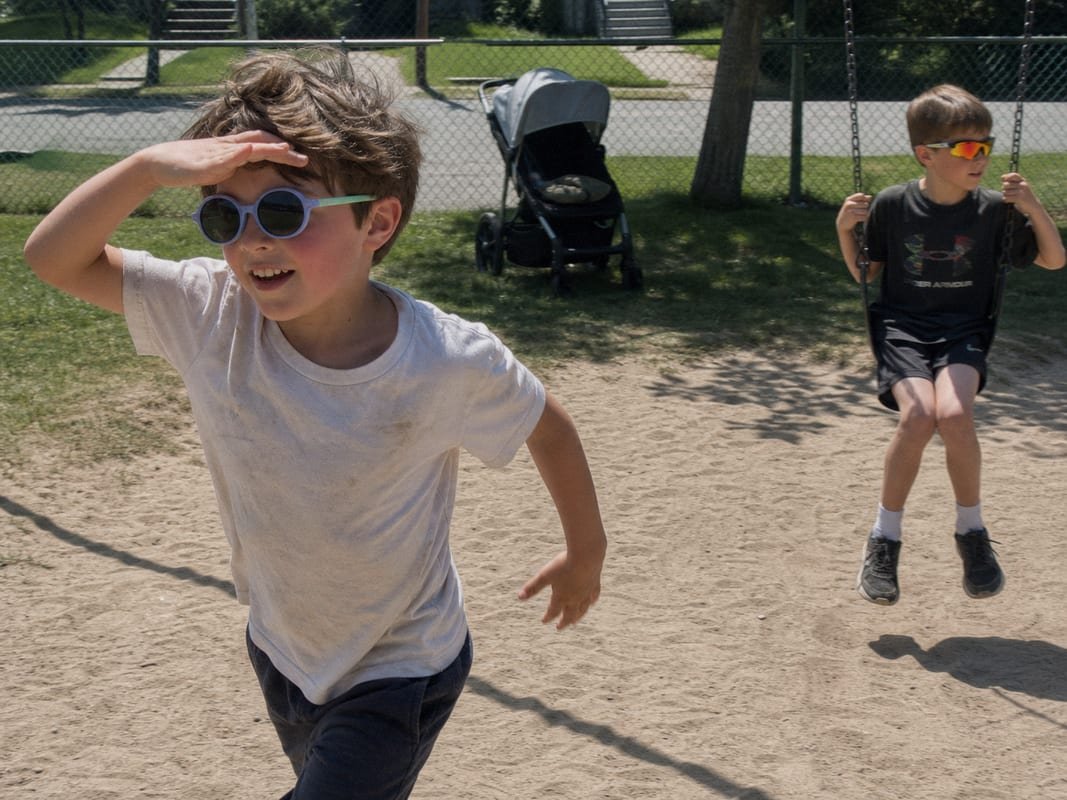
Why does material matter so much? Because children fall, throw, sit on, and chew their sunglasses. A lens that shatters is a laceration risk. A lens that lets UV through is a slow, invisible risk to ocular health. The right material eliminates both problems at once.
Comparing the Common Lens Materials
| Material | UV Blocking | Impact Resistance | Weight | Best Use |
|---|---|---|---|---|
| Polycarbonate | Inherent 100% UVA/UVB | Excellent | Very light | Everyday and sport kids' eyewear |
| Trivex | Inherent full UV blocking | Excellent | Lightest | Premium kids' optical and sun lenses |
| CR-39 (resin) | Needs UV treatment | Moderate | Light | Adult optical, less ideal for young kids |
| Acrylic (untreated) | Poor without additives | Low | Light | Not recommended for children |
Why Polycarbonate Dominates Children's Eyewear
Polycarbonate absorbs the full ultraviolet spectrum 7 as a property of the material itself. The protection is not a surface layer, so scratches from playground use do not degrade it. The same molecular structure that absorbs UV photons also flexes under impact instead of cracking. That is why polycarbonate is the default lens across most of our children's styles, whether the frame is a soft round two-tone design for toddlers or an angular wraparound sports shield for older kids.
The Frame Completes the System
A perfect lens still leaks protection if light enters from the sides. Wraparound shield designs, like the sport styles we produce with single-piece mirrored lenses, cut the UV entering at the temples. Reflected rays matter here too: children's shorter stature puts their eyes closer to reflective pavement, sand, and water. Pair the lens with a flexible TR90 or TPEE frame that stays put during play, and recommend a wide-brimmed hat in your marketing. Sunglasses work best as part of a broader sun-safety routine, and buyers who tell that full story tend to build more trusted brands.
Conclusion
Cheap tinted lenses can silently expose children's eyes to lifelong harm. The fix is simple: demand verified UV400 protection, polycarbonate lenses, wraparound fit, and documented testing from your supplier.
Every collection we develop starts from that principle. If you are building a kids' eyewear line, choose a partner who treats UV protection as engineering, not marketing — and your brand will earn the trust that keeps parents coming back.
Footnotes
1. WHO guidance on the ultraviolet radiation spectrum and its associated health implications for human eyes. ↩︎
2. Anatomical overview of the crystalline lens and its function within the human ocular system. ↩︎
3. Clinical explanation of how ultraviolet light exposure contributes to long-term cumulative retinal damage. ↩︎
4. Official Australian government safety standards for sunglasses and fashion spectacles in high-UV climates. ↩︎
5. Overview of international sunglass standards including the American ANSI Z80.3 for nonprescription eyewear. ↩︎
6. Technical overview of various materials used in optical lenses and their specific refractive properties. ↩︎
7. Scientific definition and properties of the ultraviolet spectrum within the electromagnetic radiation range. ↩︎
More Articles You Might Like


Looking for a Reliable Kids Eyewear Partner?
Explore 800+ ready styles and full OEM/ODM support tailored to your brand.
Get in Touch English
  Español de México
  Deutsch
  Français
  日本語
日本語  العربية
  Português do Brasil