Which Packaging—Blister Pack, Hang Card, or Box—Suits TPEE Kids Sunglasses Sales?
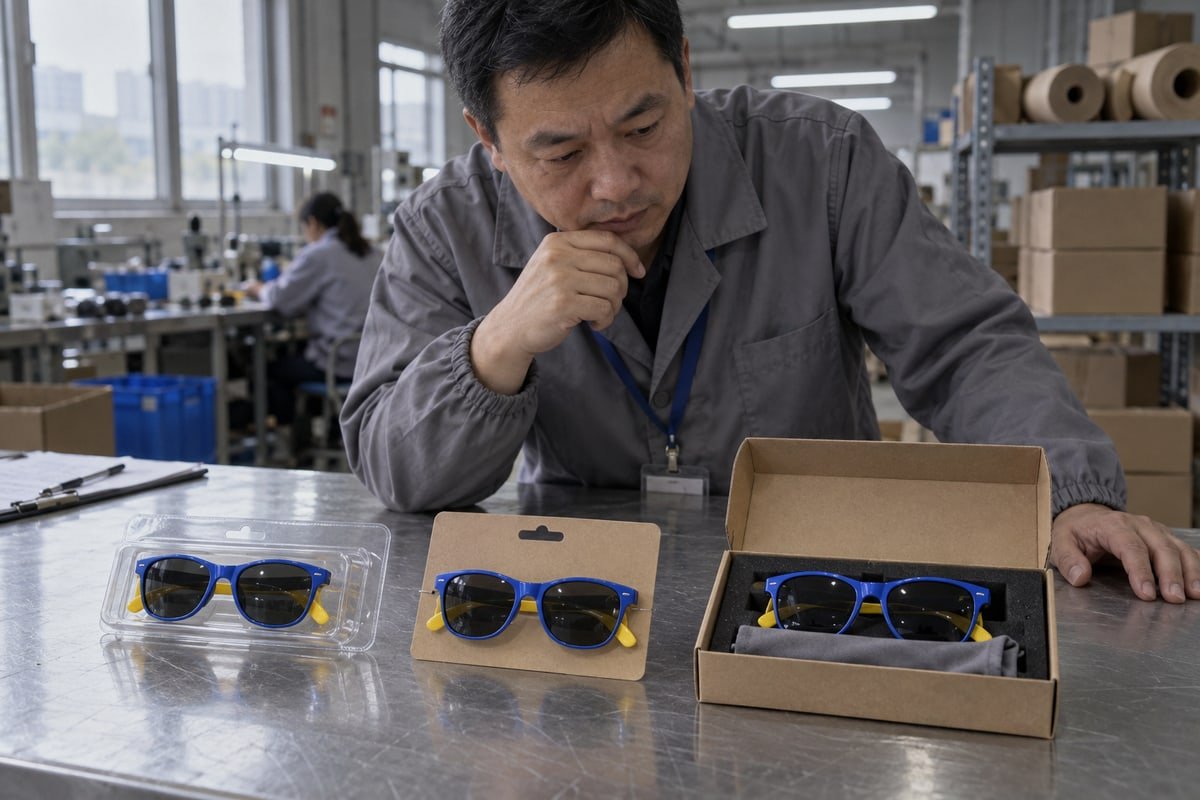
Choosing TPEE kids sunglasses packaging keeps many of our buyers awake. Pick wrong, and margins leak or frames arrive scratched. On our Taizhou line, we test all three formats.
TPEE kids sunglasses packaging should match the sales channel: choose a blister pack for peg-hook mass retail and tamper evidence, a hang card for lowest-cost high-volume lines, and a paperboard box for premium, giftable, or e-commerce sales where protection and unboxing matter most.
There is no single winner. Each format has a job. Below, I walk through how we help brands decide, how each option protects a flexible frame, which one looks most professional, and how to keep costs sane.
How do I choose between blister pack, hang card, and box packaging for my kids' sunglasses brand?
Last spring, an Australian baby-brand buyer asked us to quote the same royal-blue-and-yellow frame in all three formats. The pricing gap surprised her less than the channel question.
Choose by channel and margin first. Blister packs suit big-box and discount retail on pegs. Hang cards suit entry-level, promotional, and seasonal volume. Boxes suit DTC e-commerce, gift sets, and eco-positioned premium lines. Then confirm compliance space, sustainability goals, and shipping survivability.
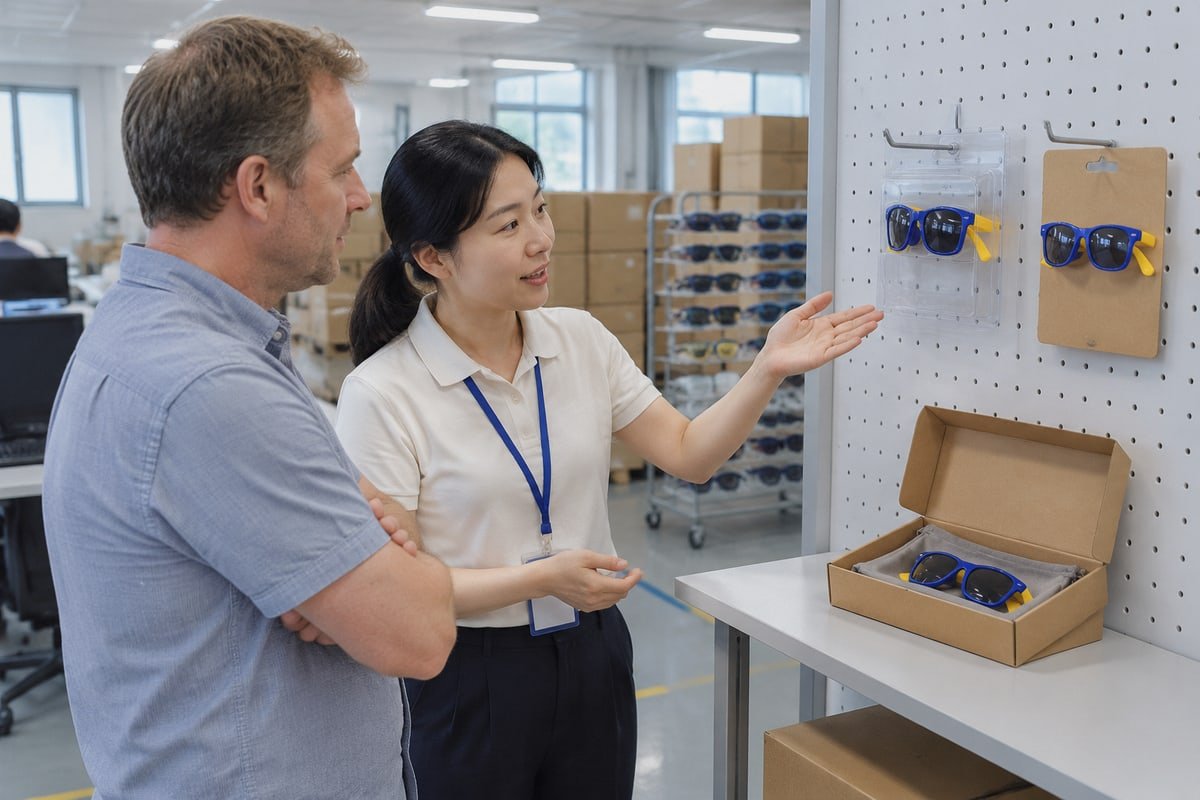
Here is the quick comparison we send buyers before any quote.
| Factor | Blister pack | Hang card | Box |
|---|---|---|---|
| Unit cost | Medium | Lowest | Highest |
| Transit protection | Medium | Low | High |
| Shelf visibility | Highest (360-degree view) | High | Low (product hidden) |
| Tamper evidence | Strong | Weak | Medium |
| Sustainability perception | Weakest (plastic-heavy) | Good (paperboard) | Best (paperboard, minimal) |
| Perceived value | Medium | Low to medium | High |
| Best channel | Pegboard merchandising, discount chains | Promo sets, seasonal impulse | DTC, gifting, premium |
Start with the channel, not the design
When I ask a new brand where the sunglasses will sell, the answer usually decides the format. Peg-hook retail rewards retail display efficiency. A blister pack hangs straight, shows the frame from every angle, and reassures parents with a sealed shell. A hang card does the same job for less money, but with less protection. A box works poorly on pegs. It works very well on a screen, where the unboxing replaces the in-store touch.
Handle the common objections honestly
Buyers push back, and they should. The cost-first buyer says kids sunglasses are price-sensitive, so a hang card is the only sane choice. That is true for entry-level lines. It stops being true the moment the product ships direct to a consumer, because a scratched lens costs more than a box. The merchandising buyer says blister packs win because they improve point of sale marketing and cut theft. That holds in big-box aisles. It fails with an eco-positioned brand, where thermoformed plastic can undercut the brand story. The sustainability buyer prefers eco-friendly cardboard options over any plastic shell. Market commentary supports that direction: one 2026 source projects boxes at roughly 47.6% of eyewear packaging share 1, driven by demand for sustainable and minimalist formats.
Our practical default
For most TPEE kids sunglasses, our default recommendation is a split strategy. Use a hang card or blister pack for pegged retail volume. Use a paperboard box with a microfiber pouch for online and gift SKUs. With around 800 existing styles to pick from, a brand can test both channels without paying for new molds, which frees budget for the packaging itself.
What packaging option best protects flexible TPEE frames during shipping and retail display?
During a drop test on our 5S-managed workshop floor, a carded lavender cat-eye frame survived the fall, but its lens picked up a scuff from the neighboring hang tab.
A rigid or paperboard box with an internal insert and microfiber pouch protects flexible TPEE frames best in transit, because it stops lens-to-lens rubbing. Thermoformed blister packs protect best on the shelf against handling. Plain hang cards offer the least protection for either scenario.
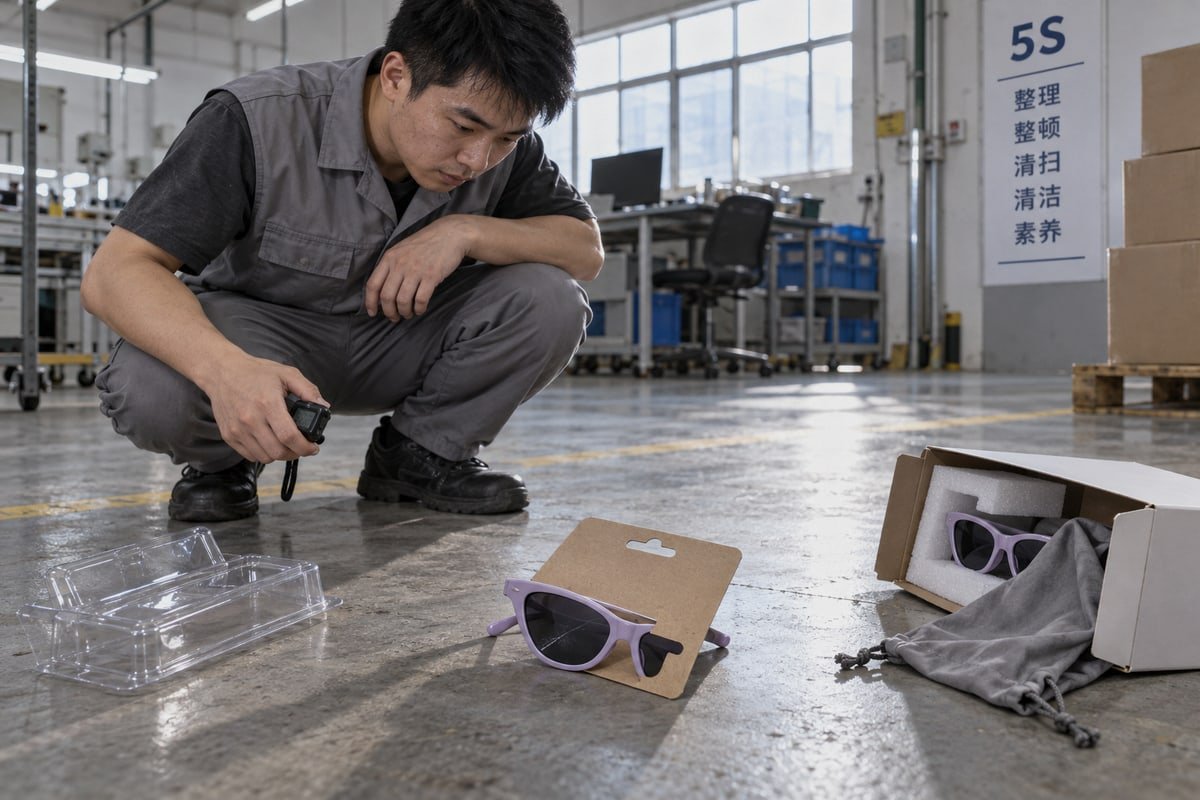
That drop test taught me something simple. With TPEE, the frame is rarely the problem. The lens is.
Why TPEE changes the protection question
Buyers sometimes call TPEE an unbreakable frame material. We prefer the phrase highly flexible. A TPEE temple bends flat and springs back, which is exactly why parents like it for active kids. This flexibility means a child sitting on the glasses usually does no harm. But the same softness means a frame cannot brace its own lens against a hard edge in a carton. So our impact resistant eyewear needs packaging that protects the lens surface, not a shell built for a rigid acetate frame.
That flexibility also creates an opportunity. Because the temples fold and flex, we can design slimmer flat-pack boxes that a rigid frame would never fit. Slimmer boxes mean more units per master carton and better shipping cost optimization for e-commerce brands.
Damage risks by format
| Risk | Blister pack | Hang card | Box with insert |
|---|---|---|---|
| Lens scratching in transit | Low to medium | High | Low |
| Handling damage on shelf | Low | Medium to high | Low (but hidden) |
| Temple deformation | Low | Low (TPEE recovers) | Low |
| Dust and fingerprint exposure | Low | High | Low |
| Crush damage in master carton | Medium | High | Low |
How we pack for each format
- Blister pack. The frame sits in a thermoformed plastic packaging 2 cavity shaped to the exact style. The lens does not touch the card. This is our go-to for high-traffic big-box aisles where dozens of hands touch the product.
- Hang card. The frame clips or ties to the card. We recommend a lens sleeve or a small protective film if the card will travel in mixed cartons.
- Box. The frame goes into a microfiber pouch, then into a die-cut insert. A tactile window on the box face lets parents feel the TPEE flex without opening the package.
Retail display versus the last mile
Shelf protection and transit protection are different jobs. A blister pack wins on the shelf. A box wins in a courier bag. When a brand sells through both, we usually run the same frame in both formats rather than compromise one channel.
Which packaging style gives my brand the most professional, retail-ready presentation?
Every packaging brief forces one trade-off: instant shelf visibility versus a slower, richer unboxing. We weigh it differently for a pegged blush-pink round frame than for a boxed gift set.
A printed paperboard box delivers the most professional, retail-ready presentation for kids sunglasses brands, since it carries full branding, safety messaging, and unboxing value. For pegboard retail, a well-designed blister pack with a printed backing card looks equally professional while keeping the frame visible.
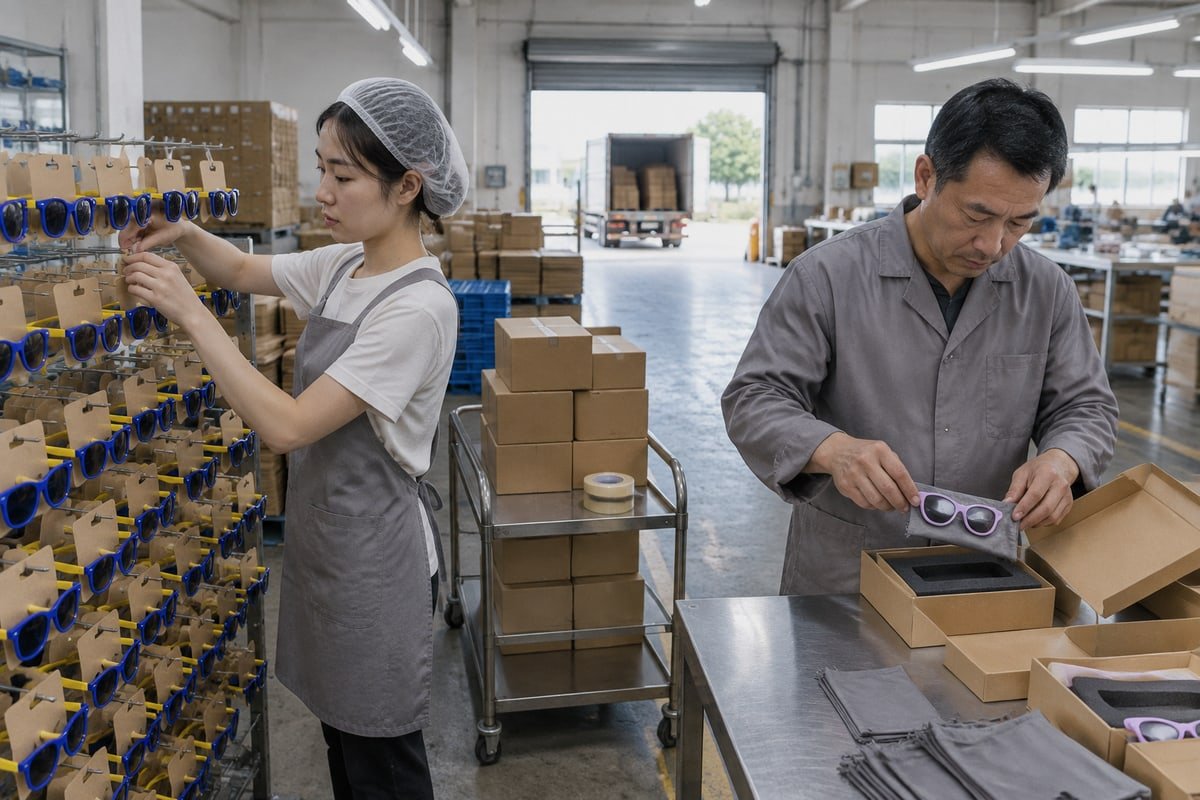
Professional presentation is not the same as expensive presentation. In our OEM/ODM work, the brands that look most polished on shelf are the ones that treat the pack as two audiences at once.
Two audiences on one pack
The parent reads. The child looks. Parent-facing text needs the practical facts: age range, UV400 protection standards, and any polarized lens technology on the SKU. It also needs the compliance marks required by child safety regulations 4 in the destination market, the same reason we engrave a CE mark on the inner temple of frames bound for Europe. Child-facing design needs color and fun. Our two-tone royal-blue-and-yellow frame sells itself through a clear window. The card behind it should not fight that color with clutter.
What belongs on the pack
- Front: brand mark, frame color name, and a clear view or window
- Back: age guidance, UV claim, lens type, care instructions, and compliance text
- Side or flap: QR code linking to a fit guide or virtual try-on, which bridges the store and the phone
- Inside a box: a microfiber pouch, and where the brand wants it, a secondary-life function such as a box that folds into a storage case
Minimalism reads as quality
Current eyewear packaging trends favor minimalist, sustainable designs over busy, bulky ones. That works in a brand's favor. A one- or two-color print on uncoated paperboard often looks more premium than a full-bleed gloss card. We also see growing interest in antimicrobial aqueous coatings on paperboard, which speak directly to parents buying something that touches a child's face.
Custom brand identity without overspending
Custom brand identity comes from consistency more than from extras. A repeated logo position, a fixed color name system across the blister card and the box, and the same typography on every SKU make a range look deliberate. We handle these details in-house, so a brand can move from unbranded samples to a retail-ready shelf set in one development cycle rather than several.
How can I balance packaging costs with quality when ordering custom kids sunglasses packaging?
One lesson from fifteen years of eyewear production: packaging overspend rarely lifts conversion, but packaging underspend always shows up as damage claims. Neither helps a young brand.
Balance cost and quality by matching packaging spend to each SKU's margin and channel: use hang cards for entry-level volume, blister packs for pegged retail, and boxes only where unboxing or transit protection earns back the cost. Standardize sizes, print in fewer colors, and order alongside existing frame styles.
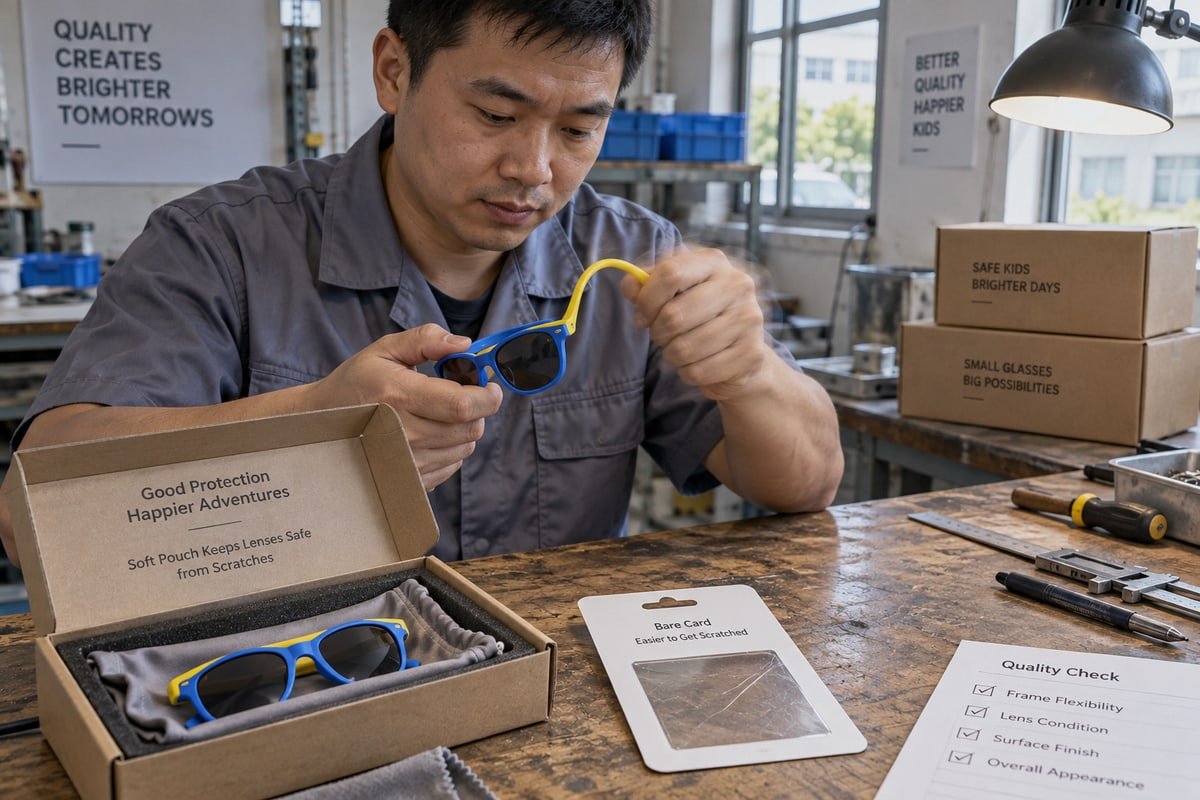
Cost control in TPEE kids sunglasses packaging is mostly about a few levers. Pull the right ones, and quality does not have to drop.
The cost levers we discuss with every buyer
| Lever | Cost impact | Quality impact | Our note |
|---|---|---|---|
| Format choice | High | High | Decide by channel before design starts |
| Standardized box or card size | Medium | Neutral | One size across many styles cuts tooling and stock |
| Print colors and finishes | Medium | Low | Two colors on good stock beats six colors on cheap stock |
| Insert and pouch | Low to medium | High | Cheapest lens protection per unit |
| Material grade | Medium | Medium | FSC-certified recycled paperboard costs slightly more but supports the eco story |
| Order quantity | High | Neutral | Consolidate SKUs to reach better price breaks |
A simple ordering process
- Fix the channel mix. Decide what share sells on pegs, online, and as gifts.
- Assign one format per channel. Do not design a hybrid that serves neither.
- Pick frames from existing styles. Choosing from our 800-plus catalog avoids mold costs, so the packaging budget stays intact.
- Standardize dimensions. Our TPEE frames fold flat, so one slim box or card can hold many shapes.
- Approve one printed sample per format. Check text, compliance marks, and window fit before mass production.
- Ship packaging with the frames. Combined orders simplify QC and reduce freight handling.
Where sustainability and cost meet
Some buyers assume eco-friendly cardboard options always cost more. Often the opposite is true. A reduced-material hang card in recycled paperboard uses less material than a plastic blister and ships lighter. For brands selling to Europe or Japan, where parents ask about plastic, that choice also protects the brand story. The trade-off is protection. So we pair the lighter card with a lens sleeve, which costs little and prevents the most common return reason.
The operations view
Operations managers tell me the best packaging is the one that cuts damage, labor, and SKU complexity. I agree with that more than any design argument. One box size, one card size, and one blister tool across a color range keeps the line simple, keeps delivery on time, and keeps quality consistent from the first carton to the last.
Conclusion
No single packaging wins. Match blister packs to pegged retail, hang cards to volume, boxes to premium and online sales—and we can build all three around your chosen frames.
Interested in sourcing the products mentioned in this article? See details and request a quote here:
Footnotes
1. Authoritative market data regarding global eyewear industry trends and packaging market segments. ↩︎
2. Scientific overview of thermoforming processes used to create rigid plastic packaging cavities. ↩︎
3. ISO standard defining nomenclature and properties for thermoplastic elastomers like TPEE used in manufacturing. ↩︎
4. Official CPSC guidelines for safety standards and compliance requirements for children’s products. ↩︎
More Articles You Might Like
Looking for a Reliable Kids Eyewear Partner?
Explore 800+ ready styles and full OEM/ODM support tailored to your brand.
Get in Touch English
  Español de México
  Deutsch
  Français
  日本語
日本語  العربية
  Português do Brasil