How to Choose Packaging Formats for Kids’ Sunglasses with Suppliers?

Choosing packaging formats for kids’ sunglasses trips up more buyers than frame design does. On our production line, I have seen great frames arrive scratched because the packaging conversation happened too late.
Choose packaging formats for kids’ sunglasses by starting with your sales channel, then layering protection: a microfiber pouch or hard case as primary packaging, a printed folding carton or rigid box for retail, and a standardized shipper carton. Confirm MOQ, materials, and samples with your supplier first.
That short answer hides a lot of decisions. Let me walk you through each one, the way I do with buyers who visit our Taizhou factory.
What packaging formats work best for retail-ready kids' sunglasses?
A buyer from Australia once told me her first shipment looked "like a flea market" on the shelf. The frames were fine. The packaging was not. We rebuilt her whole packaging stack together.
The best retail-ready formats for kids' sunglasses are a printed folding carton with an insert, paired with a microfiber pouch inside. Hard shell cases suit premium or gift lines, while hang-tag blister-free cards work for grab-and-go displays. Match the format to shelf type and price point.
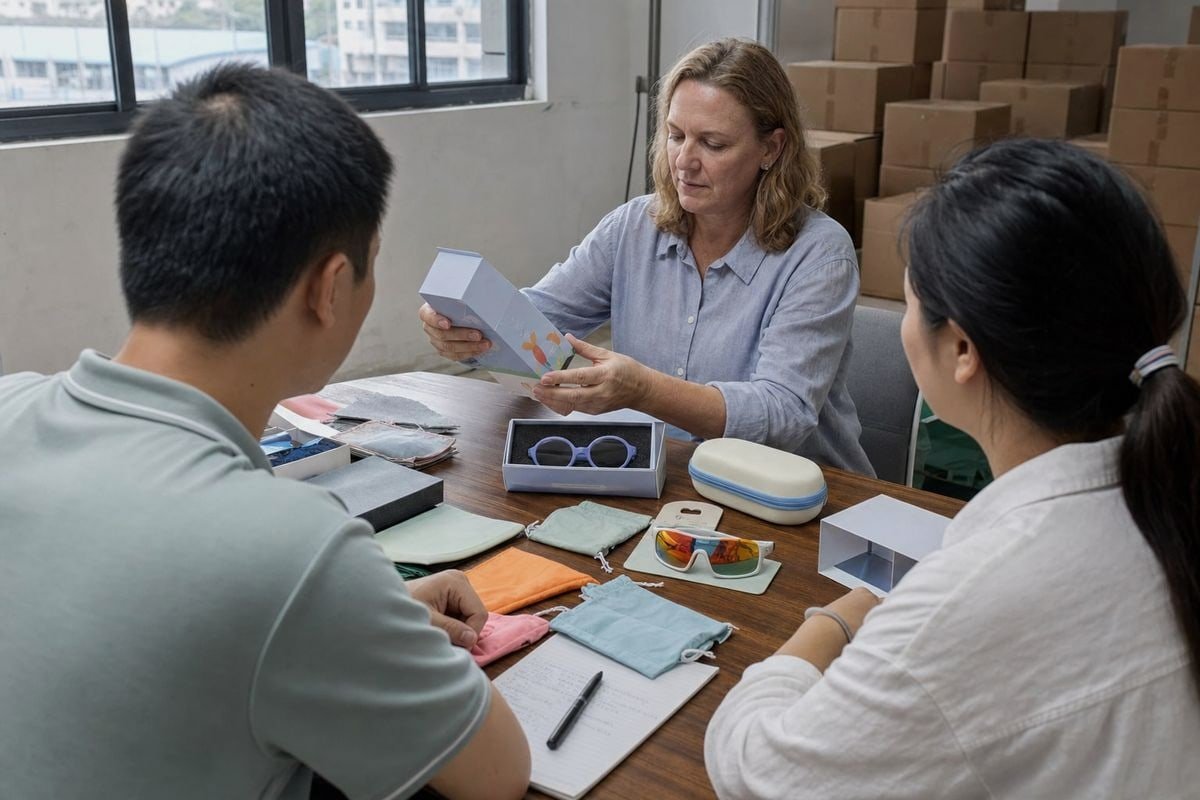
Here is a quick comparison of the main formats we produce and pack every week:
| Format | Protection | Shelf appeal | Relative cost | Best channel |
|---|---|---|---|---|
| Microfiber pouch only | Scratch protection, low crush resistance | Low | $ | Wholesale, promo |
| Pouch + folding carton | Good all-round | Medium-high | $$ | Retail, e-commerce |
| EVA zipper case | Strong, reusable | Medium | $$ | Outdoor and travel lines |
| Plastic hard case + sleeve | Strong, giftable | Medium-high | $$$ | Gift sets, opticians |
| Rigid or magnetic box | Very good | Premium | $$$$ | Premium DTC, gift |
Why kids' sunglasses need their own criteria
Children's frames are smaller and lighter than adult frames, but they are handled roughly. Kids grab boxes off low shelves. Parents open packaging one-handed. So retail packaging for children's eyewear needs three things at once: crush resistance, easy opening, and a design that speaks to two audiences. We often print playful graphics on the outside for the child and place UV400 protection labels 1 and lens information clearly for the parent. That dual-audience approach sells better than either style alone.
Retail display matters as much as the unit box
Retail display boxes that hold 6 or 12 units are often forgotten in supplier conversations. If your retailer uses counter displays, we design the unit carton and the display together so the sizes nest cleanly. It saves freight space 2 and looks intentional on the counter. Ask your supplier early whether they can supply both, because retrofitting a display around an existing carton size almost never looks right.
How do I balance custom packaging costs with my MOQ as a growing brand?
The trade-off I discuss most often with new brands is this: you want branded packaging on day one, but you cannot commit to premium-box volumes. There is a smart middle path.
Balance cost and minimum order quantity by customizing cheap-to-print items first: folding cartons, stickers, and custom microfiber pouches typically have low MOQs, while injection-molded hard cases need higher volumes. Start with printed paperboard plus a branded pouch, then upgrade formats as order sizes grow.
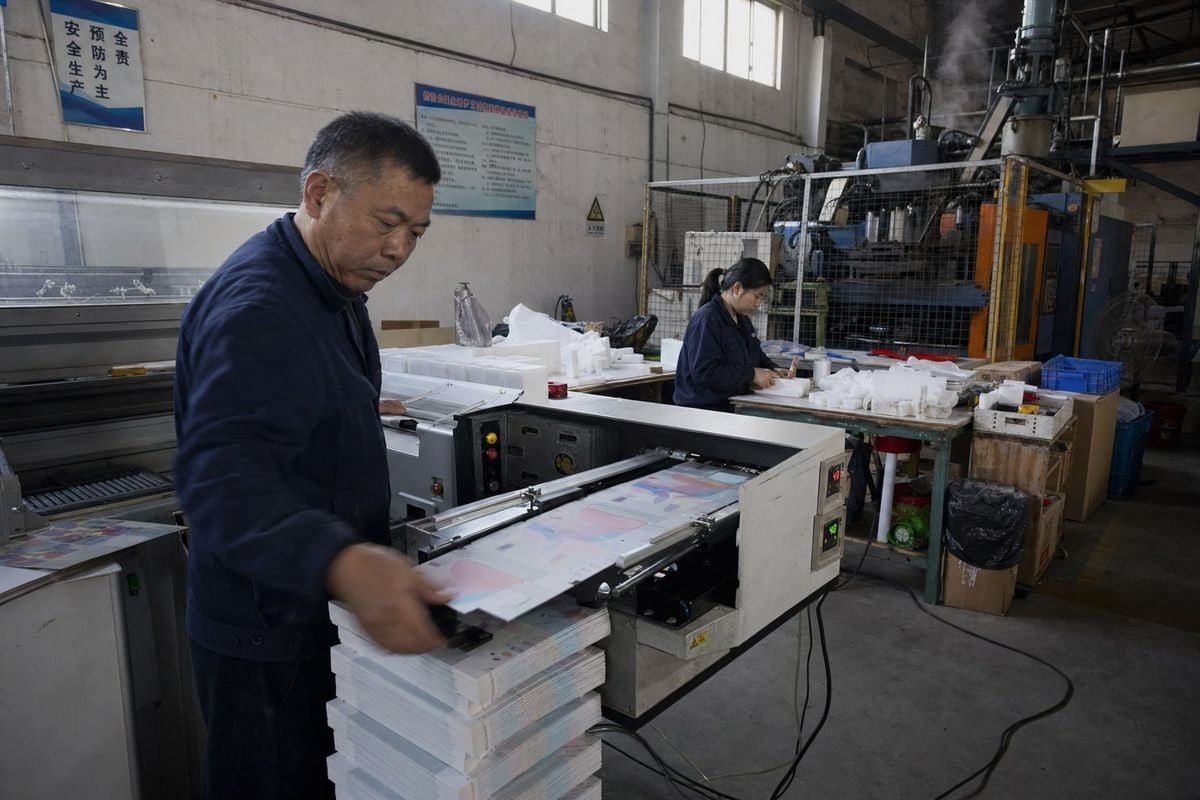
The core insight is that MOQ is driven by tooling and setup, not by ambition. A printed carton only needs a printing plate. An injection-molded case 3 needs a mold. That difference shapes everything below.
Rough cost and MOQ expectations by format
| Packaging item | Typical unit cost range | MOQ pressure | Why |
|---|---|---|---|
| Printed folding carton | From roughly $0.30/unit | Low | Digital or offset printing, no tooling |
| Custom microfiber pouches | Low | Low-medium | Screen or heat-transfer printing |
| EVA zipper case with logo | Medium | Medium | Shaped molding plus debossing |
| Custom plastic hard case | Medium-high | High | Injection mold investment |
| Rigid or magnetic box | Can exceed $3.00/unit at low volume | Medium-high | Hand assembly, thick board |
A staged approach that works for growing brands
In my experience supporting brands from 20+ countries, the healthiest path looks like this:
- Launch: stock frames from an existing style library, printed carton, branded pouch. This is the low-risk route we built our ~800-style catalog for, so new brands avoid heavy mold investment.
- Traction: add private label branding 4 on temples, upgrade to a custom insert and spot-color printing.
- Scale: move to custom hard shell cases or rigid boxes once volumes justify the tooling.
Also, ask your supplier to quote packaging separately from frames. Bundled quotes hide where your money goes. And always confirm whether the packaging MOQ matches the frame MOQ; a mismatch there is one of the most common ordering mistakes I see.
Which packaging materials keep my kids' eyewear safe during shipping and on the shelf?
Years ago we shipped a container where one carton style crushed under stacking pressure at the port. Every frame inside survived because of the inner layers. That lesson shaped how we spec materials today.
Use layered materials: a microfiber pouch or polybag against the lens, a paperboard carton or EVA case around it, dividers or trays inside master cartons, and double-wall corrugated shippers. Choose eco-friendly materials like FSC-certified paperboard and kraft, and avoid PVC windows and polystyrene fillers.
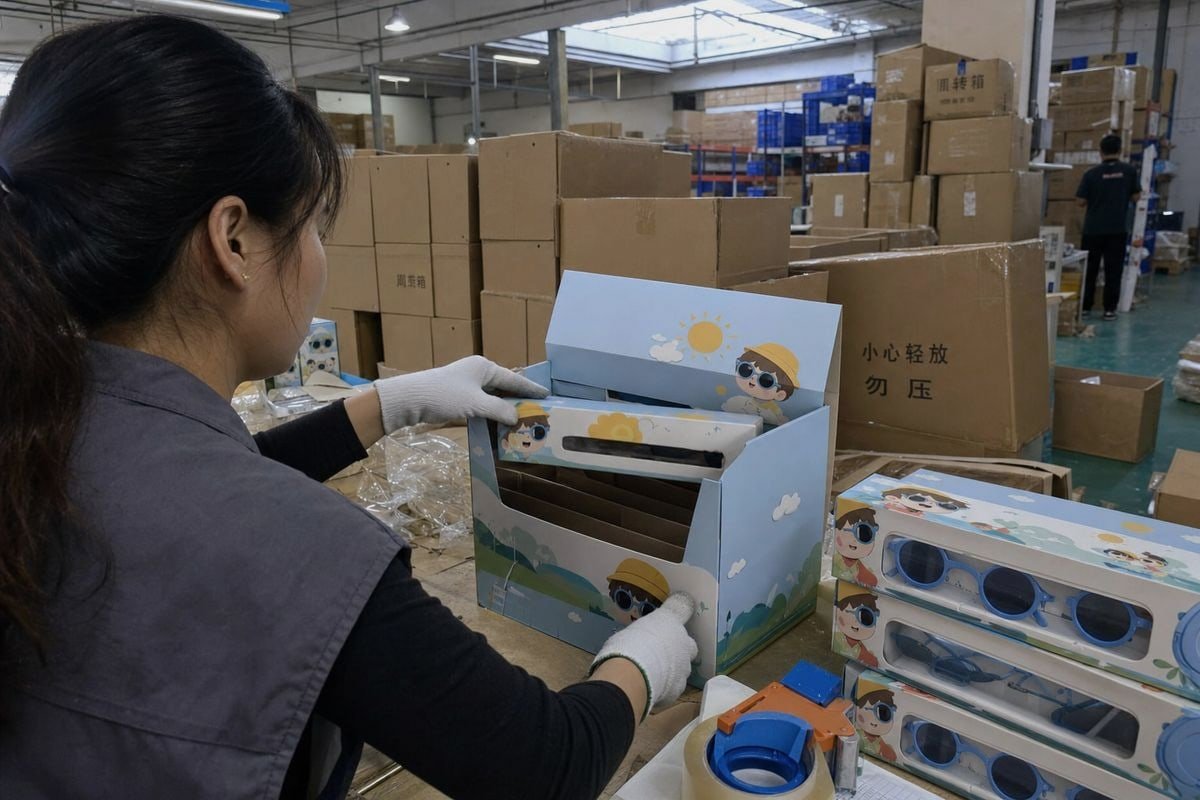
Think of protection as three layers, each with its own job:
| Layer | Purpose | Common materials | Kids-specific notes |
|---|---|---|---|
| Primary | Stops lens scratches and dust | Microfiber pouch, polybag | Soft-touch, reusable, doubles as a cleaning cloth |
| Secondary | Stops bending and crushing, carries branding | Folding carton, EVA case, rigid box | Rounded edges, easy-open structure, no small loose parts |
| Tertiary | Survives transit and stacking | Corrugated master carton, dividers | Standardized sizes reduce freight waste |
Flexible frames change the equation, but not entirely
Our TPEE and TR90 frames 5 bend and bounce back, which is exactly why we chose these materials for active kids. That flexibility means the frame itself rarely snaps in transit. But lenses still scratch, mirror coatings still abrade, and hinges still take stress under crushing loads. So even flexible eyewear needs the full stack: pouch against the lens, structure around the frame, corrugated protection outside. For sport styles with large shield lenses and mirrored gradient coatings, we add a lens-facing liner because those coatings show every scuff.
Materials that meet parent expectations
Parents buying children's products increasingly check what packaging is made of. Recyclable paperboard 6, kraft, and water-based inks read as responsible. Unnecessary plastic windows read as lazy. Child safety compliance also touches packaging: inks and coatings should be non-toxic, and structures should avoid sharp edges and choking-size loose components. When sustainability matters to your market, ask your supplier for material certifications rather than accepting a verbal promise. We keep documentation ready because European and Japanese buyers ask for it almost every time.
How closely should I work with my supplier to get branded packaging right the first time?
One of our longest-standing clients still jokes about the sample round where her logo printed two shades too dark on kraft board. We caught it at the prototype stage, not in a 10,000-unit run. That is the whole point of working closely.
Work with your supplier through every stage: share brand guidelines upfront, review digital proofs, approve physical pre-production samples, and inspect the first mass-production units. Confirm color codes, logo placement, insert fit, and carton dimensions in writing before authorizing full production.
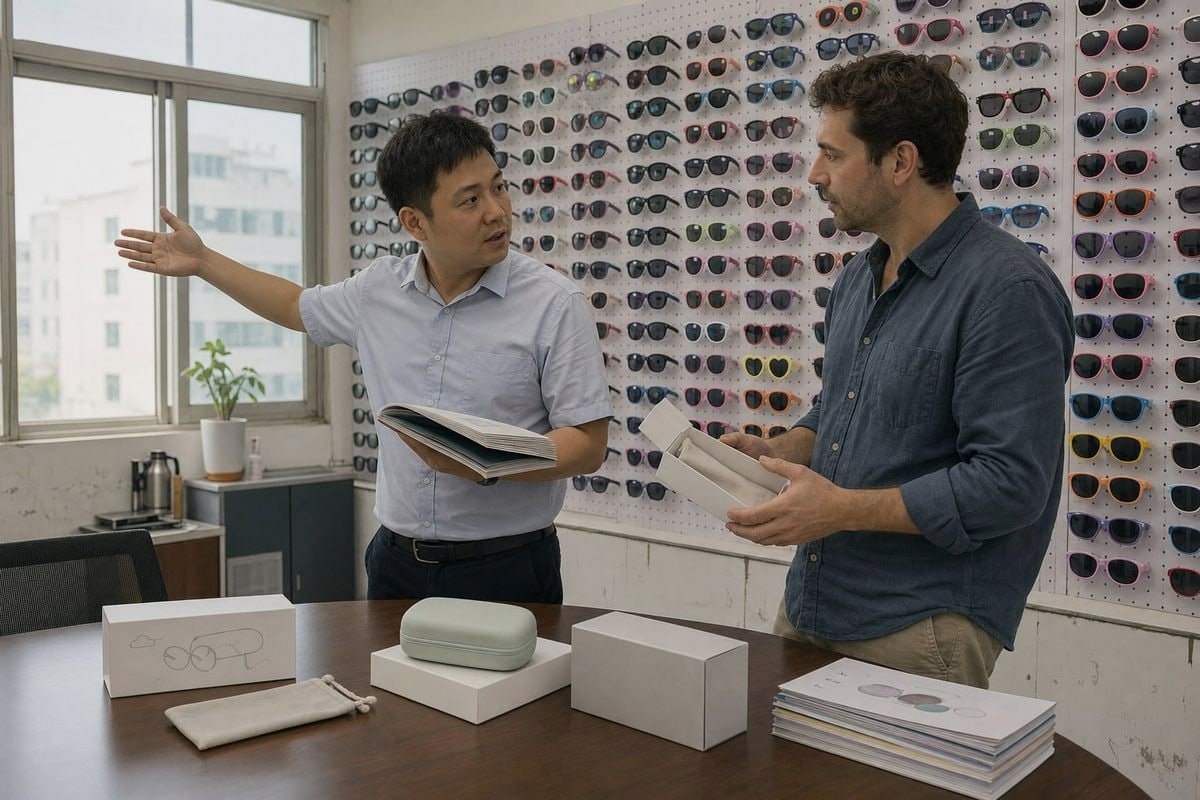
Branded packaging fails for boring reasons: wrong color on a different substrate, an insert that does not grip the frame, a barcode printed where the shrink band covers it. Every one of these is preventable with a structured process.
The five-step collaboration process we use
- Brief. Send your logo files, Pantone codes, channel plan, and target retail price. A good OEM manufacturing partner will push back if the packaging spec does not fit the price point.
- Digital proof. Review dielines and artwork on screen. Check spelling, UV400 protection labels 7, and regulatory text for your market.
- Physical sample. Ink behaves differently on kraft, coated board, and microfiber. Approve real samples with your actual frames inside, not empty boxes.
- Pre-production confirmation. Sign off on the sample and keep a golden sample on both sides. We keep one in our 5S-managed workshop for every active client.
- First-run inspection. Check the first cartons off the line against the golden sample before the full run continues.
What good communication looks like
Expect your supplier to raise problems early, not hide them. If a folding eyewear case will not fit your chosen carton, or your artwork bleeds past the dieline, you want to hear it in week one. In our fifteen years of eyewear work, the projects that go smoothly are always the ones where the buyer answers questions fast and the factory flags issues honestly. Treat packaging development as a joint project with a timeline, not a line item on a purchase order. Budget two to three sample rounds and roughly three to five weeks for packaging development alongside frame production, and the first mass run will rarely surprise you.
Conclusion
Packaging decides whether great kids' sunglasses arrive scratched or shelf-ready. Choose by channel, layer your protection, respect MOQ realities, and sample everything with your supplier before mass production.
Footnotes
1. Background on UV400 standards helps buyers understand why lens labeling matters for kids’ eyewear. ↩︎
2. International Trade Centre resource on logistics efficiency supports freight-saving packaging design claims. ↩︎
3. Clarifies the manufacturing process behind higher-MOQ hard case packaging tooling. ↩︎
4. Alibaba.com is a major sourcing platform for private label manufacturing partnerships in trade. ↩︎
5. Explains the flexible plastic materials used in durable kids’ sunglasses frames. ↩︎
6. EPA resource on recycling supports the sustainability claims about paperboard packaging. ↩︎
7. Explains the UV400 lens protection standard referenced on packaging labels for parents. ↩︎
More Articles You Might Like
Looking for a Reliable Kids Eyewear Partner?
Explore 800+ ready styles and full OEM/ODM support tailored to your brand.
Get in Touch English
  Español de México
  Deutsch
  Français
  日本語
日本語  العربية
  Português do Brasil