What Safety Standards Must Kids Sunglasses Meet in Australia?
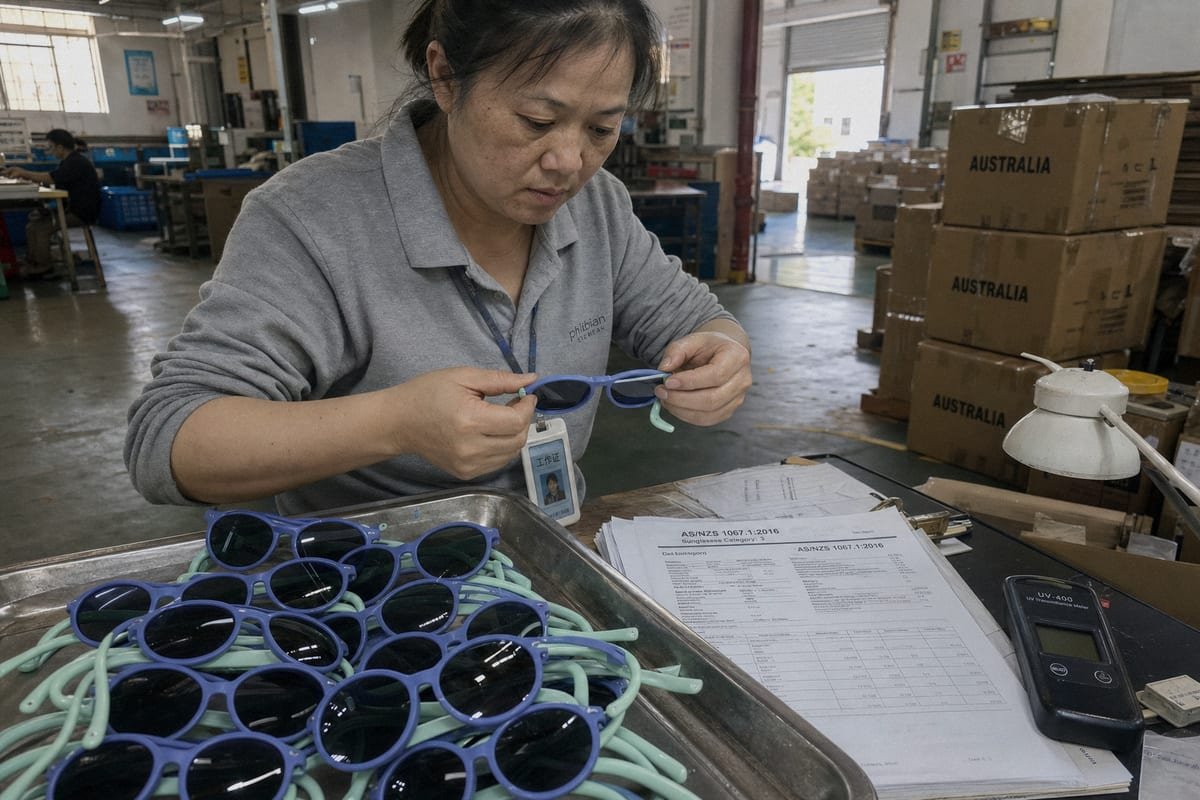
Kids sunglasses safety standards in Australia trip up more importers than almost any other market rule we see visible light transmission 1. On our production line in Taizhou, we have watched promising Australian orders stall because a buyer assumed a “UV400” sticker was enough. It is not. Australia treats children’s sunglasses as a regulated product 2, and if your goods arrive without the right testing and labelling, you risk seizure, recalls, and a damaged brand before your first sale. The good news is that the requirements are clear once you know where to look, and a factory that builds compliance in from the start makes the whole process painless.
Kids sunglasses sold in Australia must comply with the mandatory standard AS/NZS 1067.1:2016. This requires lenses to block UV radiation across 280–400 nm, meet design, construction, and impact tests, and carry labels showing the lens category, supplier identity, and standard compliance.
That is the short answer. But if you are importing, you need more detail. Below, I break down the certifications, the testing paperwork, and the materials that get you through customs and onto Australian shelves safely.
What safety certifications should I look for when importing kids sunglasses to Australia?
A few years back, an Australian buyer showed me a competitor's shipment that had been pulled from sale. The frames were fine. The paperwork was not. That lesson shaped how we prepare every Australian order today.
Look for test reports proving compliance with AS/NZS 1067.1:2016, the mandatory standard enforced by the ACCC under Australian Consumer Law. There is no separate certification mark; instead, you need accredited lab test reports plus correct product labelling showing lens category and supplier details.
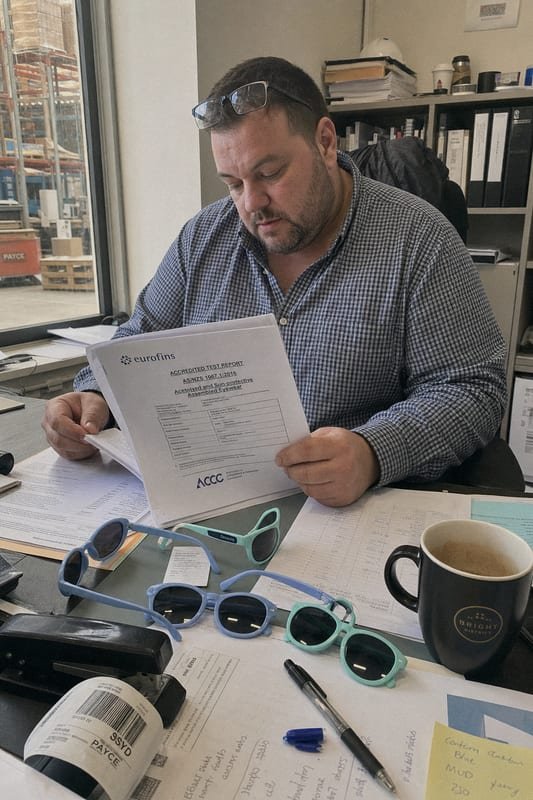
Australia works differently from Europe or the USA. There is no CE mark equivalent. Instead, the ACCC mandatory standards regime makes AS/NZS 1067.1:2016 legally binding for all non-prescription sunglasses, and children's sunglasses are explicitly included in its scope. Since 1 July 2019, every pair sold in Australia must be tested and labelled to this standard. Fashion spectacles, clip-ons, and one-piece visors are covered too.
What the standard actually regulates
The standard is not just about dark lenses. It covers five areas: UV transmittance 3, visible light transmission, optical quality, construction robustness, and labelling. A lens can look nearly black and still fail UV tests, which is exactly why regulators do not let tint stand in for protection.
| Requirement Area | What It Means for Importers |
|---|---|
| UV transmittance | Lenses must block UV radiation from 280–400 nm |
| Lens categories 0–4 | Category must be tested, assigned, and printed on the label |
| Optical quality | No distortion that could harm a child's developing vision |
| Construction | Frames and lenses must survive robustness testing |
| Labelling | Supplier identity, category number, and compliance statement |
Toy sunglasses are a trap
One nuance catches many new brands. Toy sunglasses sit outside the protective standard, but they must be clearly labelled as toys and cannot be marketed for sun protection. SunSmart guidelines specifically warn parents against using toy eyewear outdoors. If your product looks like a toy but claims UV protection, you sit in the worst possible position legally. We always advise buyers to commit fully to compliant sunwear. Our flexible TPEE and TR90 kids' styles are built and tested as genuine sunglasses, never as novelty items, precisely because that grey zone is where recalls happen.
How do I verify a supplier's UV400 lens claims meet Australian requirements?
Buyers often email me asking whether our UV400 protection lenses "count" in Australia. It is one of the most sensible questions a procurement manager can ask, and the answer needs some unpacking.
UV400 is a marketing term, not an Australian legal benchmark. To verify a supplier's claim, request a spectrophotometer test report from an accredited laboratory showing UV transmittance results across 280–400 nm measured against AS/NZS 1067.1:2016, including the assigned lens category for each colourway.
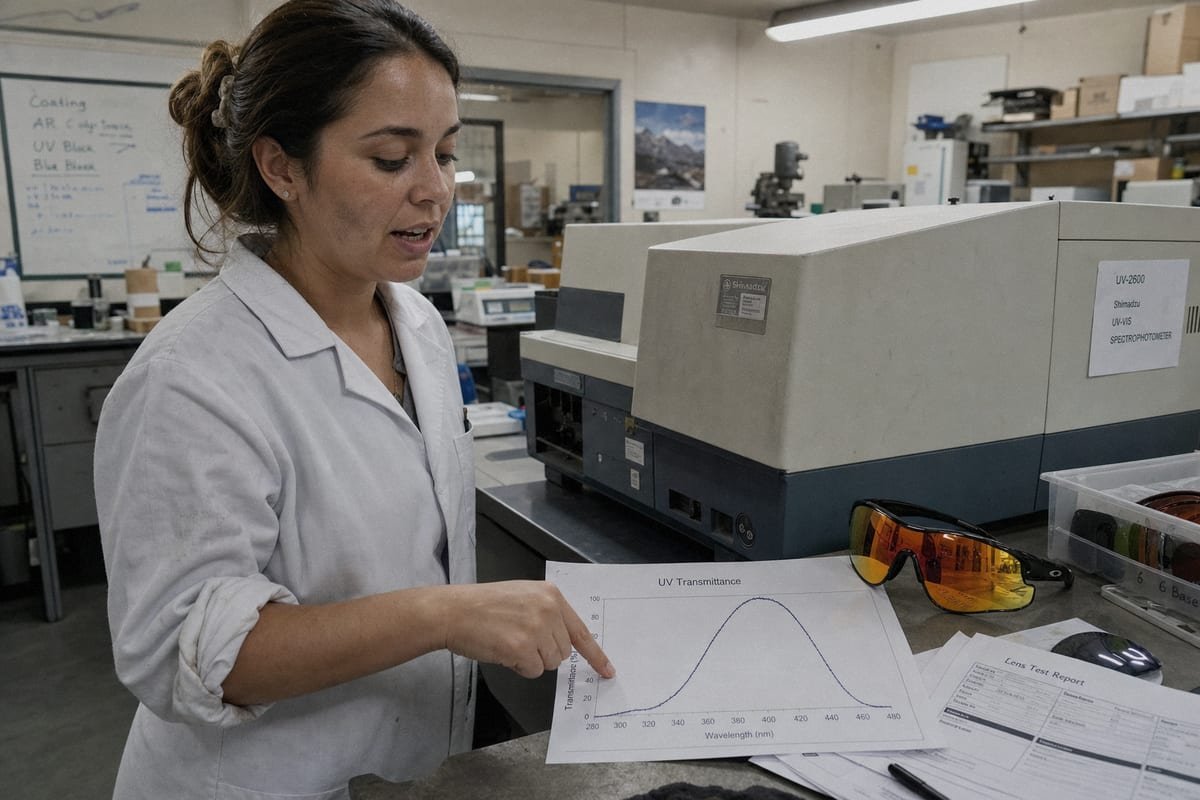
UV400 protection simply means a lens blocks wavelengths up to 400 nanometres. That happens to align with the upper limit of the Australian standard's 280–400 nm range, so a genuine UV400 lens usually passes. The problem is the word "genuine." At our factory, we have tested sample lenses from cheaper suppliers that carried UV400 stickers yet leaked measurable UVA. The sticker cost a fraction of a cent. The actual UV-absorbing lens material costs real money. That gap is where eye damage from UV radiation becomes a genuine risk for children, whose clearer crystalline lenses let more UV reach the retina than adult eyes do.
A practical verification process
- Ask for the lab report, not a certificate summary. A one-page "certificate of conformity" with no data is a red flag.
- Check the tested wavelength range. It must cover 280–400 nm, not just 380 nm.
- Match the report to your actual lens. Reports for a different tint or batch prove nothing about yours.
- Confirm the lens category. Lens category 3 is the common benchmark for Australia's high-glare conditions.
- Spot-check with third-party testing. Send random production samples to an accredited lab before shipment.
Understanding lens categories
| Category | Light Transmission | Suitability for Australian Kids |
|---|---|---|
| 0–1 | Very high to high | Fashion only, not sun protection |
| 2 | Medium | Acceptable general sun use |
| 3 | Low | Recommended for bright Australian sunlight |
| 4 | Very low | Extreme glare only, never for driving |
Polarised lenses for kids are popular with our Australian clients because they cut reflected glare 4 from water and sand. But polarisation is a comfort feature. It does not replace UV testing, and a polarised lens still needs its category verified.
What testing documentation should my manufacturer provide before shipping to Australia?
There is a trade-off we discuss with every new Australian client: test every colourway of every style, or test representative samples? Getting this balance right saves money without creating legal exposure.
Before shipping, your manufacturer should provide accredited lab test reports covering UV transmittance, lens category assignment, optical quality, and frame robustness per AS/NZS 1067.1:2016, plus labelling artwork approval, batch traceability records, and a signed declaration linking the reports to your specific production run.
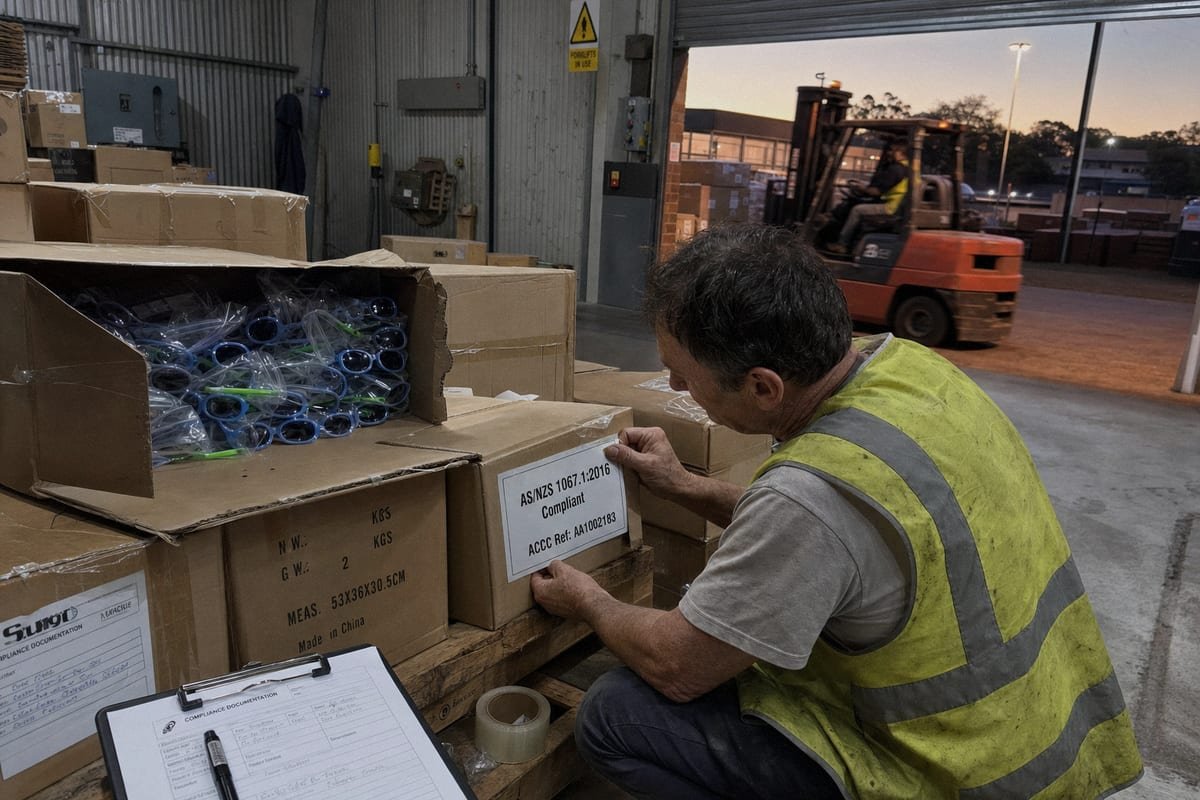
Documentation is where good factories separate themselves from cheap ones. Under Australian Consumer Law, the importer is legally responsible for compliance, not the overseas factory. If regulators question your product, you must produce evidence quickly. In our fifteen years of eyewear production, we have learned that the paperwork package should be assembled before the goods leave the workshop, not chased after a problem appears.
The complete document package
| Document | Purpose | When You Need It |
|---|---|---|
| Accredited lab test report | Proves UV, optical, and robustness compliance | Before production approval |
| Lens category confirmation | Assigns category 0–4 per tint | Before label printing |
| Labelling artwork sign-off | Confirms supplier ID, category, driving suitability text | Before mass production |
| Batch traceability record | Links reports to your shipment | At shipping |
| Declaration of conformity | Your file for ACCC or retailer audits | At shipping |
Labelling is documentation too
The swing tag and label are legal documents in miniature. Each pair must identify the manufacturer or supplier, state the lens category number 5, declare compliance with AS/NZS 1067.1, and warn if lenses are not suitable for driving. Some of our Australian clients also add Eye Protection Factor style consumer messaging on packaging, which is fine as long as the mandatory elements come first. Because we offer full OEM packaging support, we build these elements into retail-ready swing tags during artwork approval. That way, the compliance story is finished before cartons are sealed, and your customs broker never has to improvise.
Which frame materials help my kids sunglasses pass Australian safety and durability standards?
When we were developing our first TR90 frames with TPEE temples, the goal was simple: a frame a toddler could bend, chew, and drop without creating a hazard. Australian testing rewards exactly that thinking.
Flexible, impact resistant frames made from TR90 and TPEE give kids sunglasses the best chance of passing Australian robustness testing. These materials bend without snapping into sharp fragments, resist deformation in heat, are lightweight on small faces, and can be produced BPA-free and phthalate-free for chemical safety.
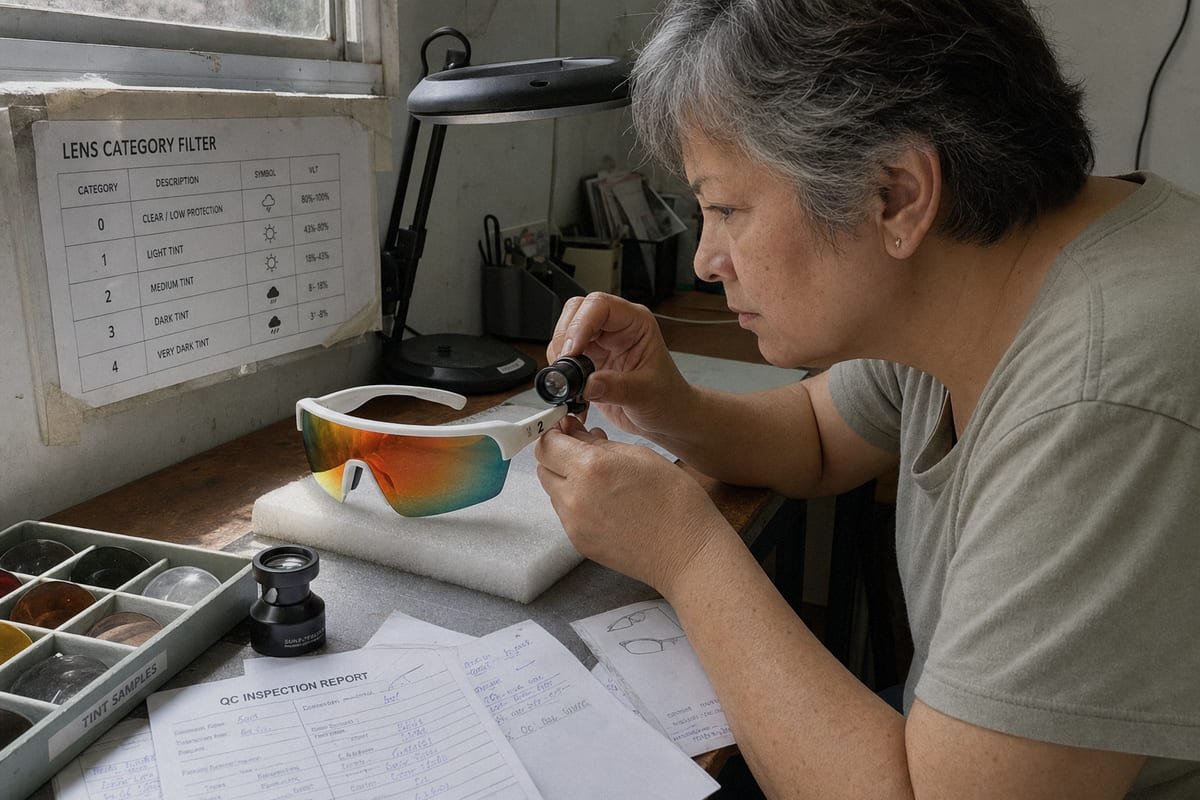
Frame material decides more than comfort. The Australian standard's construction and robustness requirements exist because a frame that shatters near a child's eye is a hazard in itself. Rigid, brittle plastics common in cheap novelty sunglasses can crack under the twisting and dropping that active kids deliver daily. Flexible engineering plastics behave differently. They absorb the energy and spring back.
Why TR90 and TPEE lead for children's eyewear
TR90 is a thermoplastic with memory. Twist the frame, and it returns to shape. TPEE is even softer and more rubber-like, which is why we often pair TR90 fronts with TPEE temples: the front holds the lenses in stable alignment, while the temples flex safely around a child's head. In our 5S-managed workshop, we torsion-test and drop-test samples from every production batch, because a material is only as good as the moulding behind it.
Chemical safety matters just as much for this age group. Toddlers chew temple tips. Our material sourcing 6 prioritises environmentally friendly, BPA-free and phthalate-free compounds, which aligns with the food-grade safety expectations Australian children's brands increasingly write into their specifications.
Material comparison for Australian compliance
Consider how the common options stack up:
- TR90: excellent impact resistance, lightweight, holds lens alignment; ideal for fronts.
- TPEE: extreme flexibility and soft touch; ideal for temples and full baby frames.
- Standard polycarbonate frames: decent strength but stiffer on small faces.
- Cheap acrylic or PS plastic: brittle, prone to sharp fracture; a robustness-test risk.
One more design point supports compliance goals. ARPANSA and SunSmart guidance 7 favour wrap-around styles because they block side UV entry. Our sport shield styles with wide wraparound lenses give young athletes broad coverage, while our soft round pastel frames suit toddlers who need gentle, flexible fits. Both approaches can pass Australian standards; the material and lens quality decide it.
Conclusion
Australian compliance is not a hurdle; it is a filter that removes weak competitors. Meet AS/NZS 1067.1:2016 with tested lenses, flexible frames, and complete documentation, and your kids' eyewear brand launches with confidence. Our team at OKAY EYEWEAR builds that compliance in from the first sample, so you can focus on selling.
Footnotes
1. Technical explanation of light transmittance principles relevant to lens category testing and optical standards. ↩︎
2. Authoritative Australian government source defining the mandatory safety standards for sunglasses as a regulated product. ↩︎
3. World Health Organization resource explaining UV radiation and the importance of blocking transmittance for health. ↩︎
4. Scientific explanation of reflected glare and how polarized lenses function to mitigate visual discomfort. ↩︎
5. ARPANSA provides the official breakdown of lens categories and their specific protection levels under Australian law. ↩︎
6. General overview of industrial sourcing practices relevant to selecting compliant materials like TR90 and TPEE. ↩︎
7. Official Australian SunSmart guidelines for choosing sunglasses that provide adequate protection for children. ↩︎
More Articles You Might Like

Looking for a Reliable Kids Eyewear Partner?
Explore 800+ ready styles and full OEM/ODM support tailored to your brand.
Get in Touch English
  Español de México
  Deutsch
  Français
  日本語
日本語  العربية
  Português do Brasil