How to Verify UV400 Protection in Kids Sunglasses Lenses?
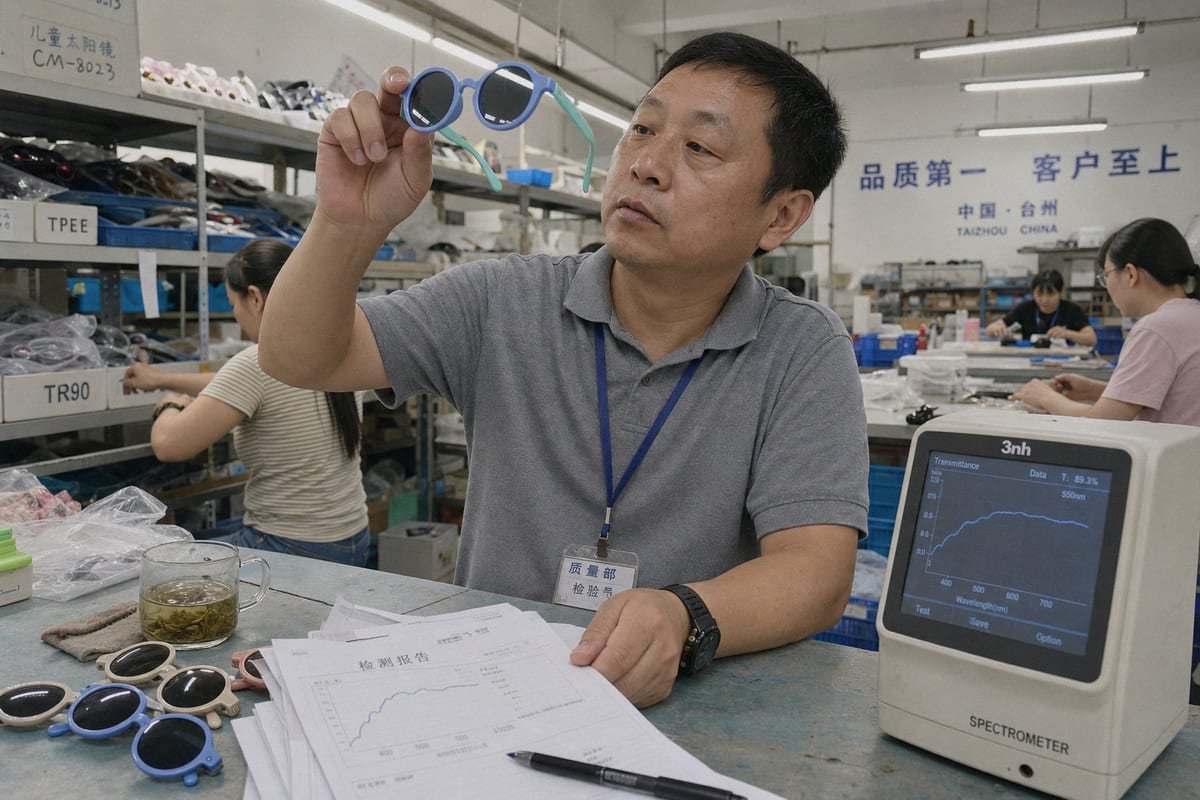
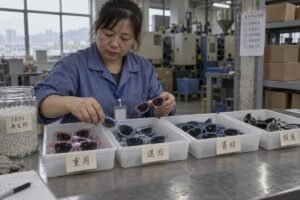
Verifying UV400 protection in kids sunglasses lenses is a question I hear weekly on our production line in Taizhou. Dark tint alone proves nothing — and a child’s eyes can pay the price.
To verify UV400 protection in kids sunglasses lenses, check for explicit UV400 or 100% UVA/UVB labeling, request batch-specific spectrometer test reports from your supplier, confirm compliance with standards like ANSI Z80.3 or EN ISO 12312-1, and validate claims through third-party or optical shop photometer testing.
Below, I walk through each verification step in practical detail. I will cover testing methods, documentation, third-party labs, and the exact standards for the EU, US, and Australian markets.
How can I test whether kids sunglasses lenses truly block 99-100% of UV rays?
Last year, a buyer sent us a competitor's sample that looked nearly black. Our spectrometer showed it leaked UVA badly. That test taught her more than any label ever could.
You can test UV blocking with a UV spectrometer or photometer, which measures light transmittance from 280 to 400 nanometers. Professional optician lens testing is the most reliable option; DIY checks with a UV flashlight and fluorescent object work only as rough screening tools.

The first thing I tell every new buyer is simple: UV protection and lens darkness are two different things. Visible light transmission controls how dark a lens looks. UV blocking depends on the lens material 1 and its UV absorbers. A pale yellow lens can block 100% of UVA and UVB radiation. A nearly black lens can let harmful rays straight through. So never judge kids sunglasses by tint alone.
Professional testing options
The gold standard is spectrometer testing. A spectrophotometer scans the lens across the UV range 2, from 280nm (UVB) up to 400nm (UVA), and records how much radiation passes through. A true UV400 lens shows near-zero transmittance across that entire range. Many optical shops offer a quick photometer verification for free. If you are a brand buyer evaluating samples, this five-minute check can save you from a bad container.
DIY screening at home or in the office
You can run a rough proxy test yourself. It is not calibrated, but it flags obvious failures.
| Method | How it works | Reliability |
|---|---|---|
| UV flashlight + banknote | Shine UV light at the security watermark through the lens; the glow should vanish | Rough screening only |
| UV-reactive test card | Card stays unchanged behind a good lens | Rough screening only |
| Color-changing UV beads | Beads should not change color behind the lens | Rough screening only |
| Optical shop photometer | Machine reads actual UV transmittance | High |
| Lab spectrometer | Full spectral scan, 280–400nm | Highest |
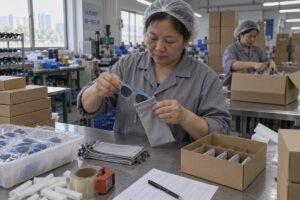
If a DIY check gives an ambiguous result, take the sample to an optician. When we develop new lens batches at our factory, we never rely on visual inspection. Every incoming lens lot from our suppliers gets machine verification before it goes near assembly.
What certifications or lab reports should I request from my sunglasses supplier to confirm UV400 compliance?
A procurement manager from Australia once asked me for "the certificate." I had to explain there is no single one — there is a stack of documents, and each proves something different.
Request a recent third-party lab test report showing UV transmittance below 1% up to 400nm, plus compliance certificates for your market: EN ISO 12312-1 with CE certification for the EU, ANSI Z80.3 for the US, and AS/NZS 1067 for Australia.
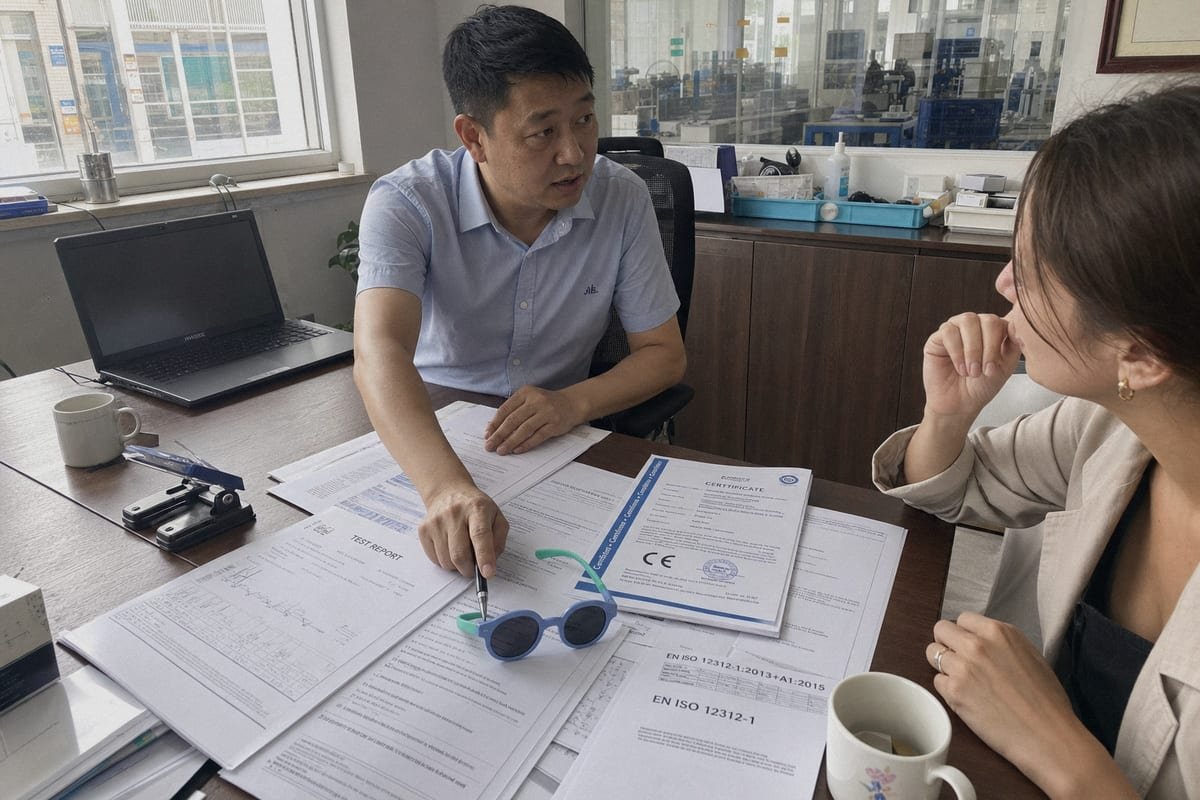
Documentation is where serious factories separate themselves from traders. In 15 years of making children's eyewear 3, I have learned that a buyer who asks for the right papers early avoids almost every downstream problem. Here is what I recommend you request before placing any order.
The core document checklist
| Document | What it proves | Red flag if missing |
|---|---|---|
| Third-party UV transmittance report | Actual spectrometer data showing UV blocking to 400nm | Supplier cannot substantiate the UV400 claim |
| Standard compliance certificate (EN ISO 12312-1, ANSI Z80.3, or AS/NZS 1067) | The lens and frame meet your market's legal requirements | Product may be refused at customs or recalled |
| Impact resistance safety test | Lenses will not shatter into a child's eye | Serious product liability exposure |
| Declaration of Conformity (EU) | The importer's legal basis for the CE certification mark | You cannot legally sell in the EU |
| Material safety report | Frame and lens materials are free of harmful substances | Especially critical for children's products |
Check the details, not just the letterhead
A report is only as good as its specifics. Verify three things. First, the report should reference the exact lens type and model you are buying, not a generic "sunglass lens." Second, check the date; a five-year-old report says nothing about current production. Third, confirm the testing lab is accredited and recognizable — SGS, TÜV, Intertek, or a national accredited laboratory. When our customers request batch-level documentation, we supply test data tied to that production run, and some brands now print QR codes on packaging that link to serialized reports. That level of traceability is becoming a real differentiator on retail shelves.
Can I trust UV400 labeling alone, or should I ask for third-party testing on every order?
We once tested a bin of novelty kids sunglasses a client bought at a trade fair for comparison. Every pair carried a UV400 sticker. Nearly a third failed our in-house transmittance check.
Do not trust UV400 labeling alone. A printed sticker costs nothing and is easily faked on unbranded products. Require third-party testing on initial orders and new lens sources, then use periodic batch testing and random in-house photometer checks to maintain ongoing confidence.
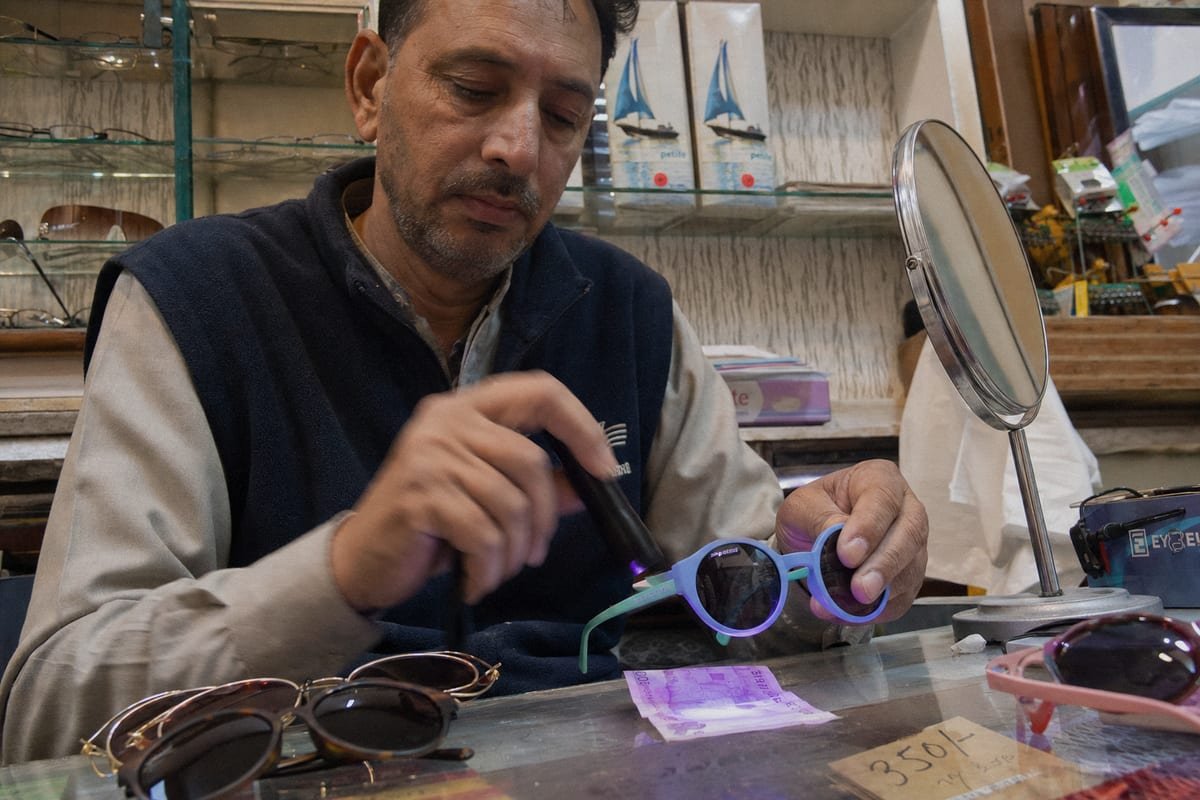
A UV400 label is a claim, not evidence. On a well-run production line, that claim traces back to verified lens stock and documented incoming quality control. On a no-name product, it may trace back to nothing at all. The honest answer to this question is that trust should be earned in stages, and your testing intensity should match your risk.
A practical testing cadence for B2B buyers
- First order with a new supplier: always commission independent third-party testing. Pay for it yourself if needed. This is your baseline.
- Repeat orders, same lens specification: rely on the supplier's batch test data, but spot-check samples with an optician or a desktop photometer.
- Any change in lens supplier, color, or coating: treat it as a new product. Retest. UV absorber performance can shift when a lens formula changes.
- Annual review: re-run full third-party testing once a year even on stable products, because regulations and factory sourcing both drift over time.
Why this matters more for children's products
Kids' eyes transmit more UV to the retina 4 than adult eyes. Their lenses are clearer, and their pupils are larger. A protection failure that would be a minor issue in an adult fashion accessory becomes a genuine safety concern in a toddler's sunglasses. That is also why the polarized vs UV protection confusion is dangerous. Polarization reduces reflected glare from water and pavement. It does nothing, by itself, to guarantee UV blocking. Many of our lens options combine both, but we always document each function separately, because they are separate physical properties.
There is one more overlooked issue: degradation. Chemical UV absorbers in cheap lenses can saturate over time, especially after repeated high-heat exposure such as a car dashboard. Hand-me-down sunglasses with subtle yellowing or solarization deserve retesting or replacement.
What UV protection standards do I need to meet for markets like the EU, US, or Australia?
Shipping to more than 20 countries has forced our team to keep a living map of eyewear regulations. Each market treats children's sunglasses differently, and the differences trip up new brands constantly.
For the EU, meet EN ISO 12312-1 and affix the CE mark with a Declaration of Conformity. For the US, comply with ANSI Z80.3 and FDA impact-resistance rules. For Australia and New Zealand, AS/NZS 1067.1 is mandatory, with defined lens categories.
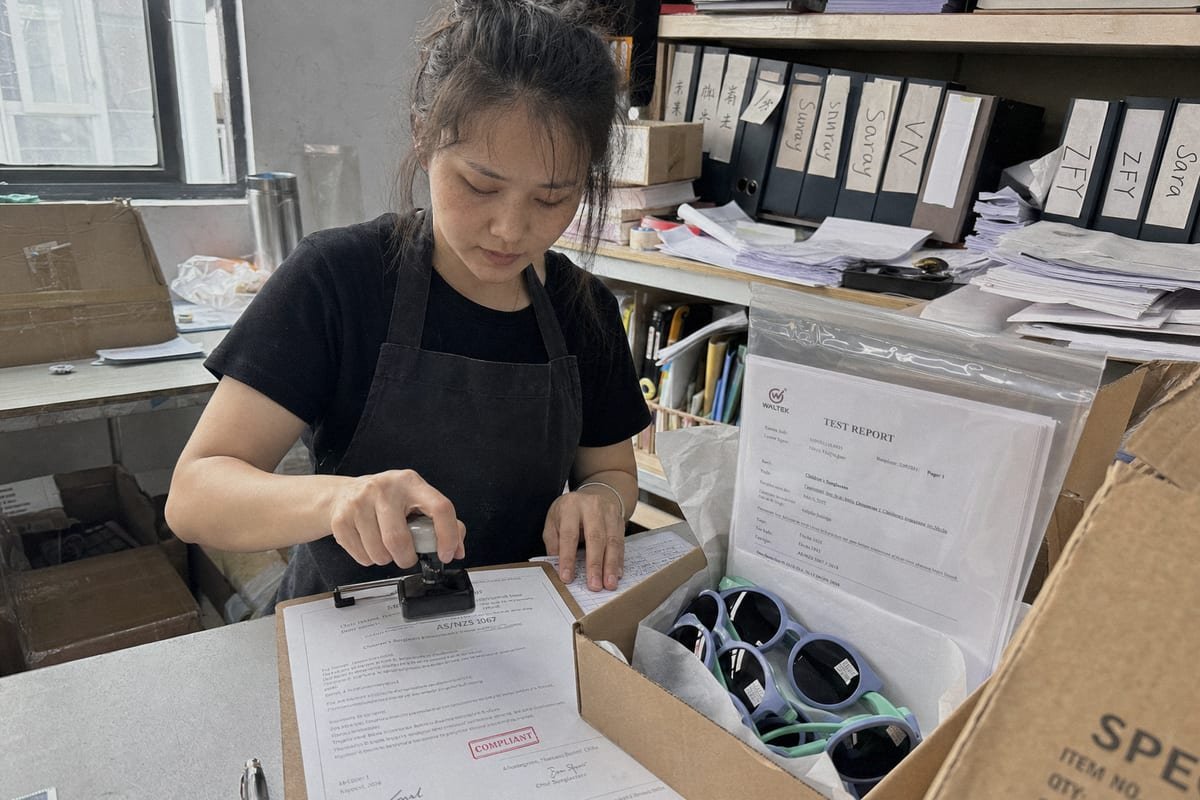
Sunglasses are not treated the same way everywhere. In the EU, they are regulated as Personal Protective Equipment. In Australia, sunglasses compliance is mandatory under consumer law 5, and the standard is enforced. In the US, the framework is a mix of FDA requirements 6 and a voluntary — but commercially expected — ANSI standard. If you are building a children's brand, you need to know which rules bind you legally and which ones your retailers will demand anyway.
Market-by-market comparison
| Market | Standard | Legal status | Key requirements |
|---|---|---|---|
| European Union | EN ISO 12312-1 under PPE Regulation (EU) 2016/425 | Mandatory | CE certification mark, Declaration of Conformity, UV transmittance limits, lens category labeling |
| United States | ANSI Z80.3; FDA 21 CFR 801.410 | ANSI voluntary but expected; FDA drop-ball impact test mandatory | UV transmittance limits tied to lens category, impact resistance safety testing |
| Australia / New Zealand | AS/NZS 1067.1 | Mandatory | Lens categories 0–4, strict UV limits, labeling requirements, enforced by regulators |
| United Kingdom | BS EN ISO 12312-1 with UKCA marking | Mandatory | Mirrors EU requirements post-Brexit with UKCA mark |
Practical notes from our export experience
Three details deserve extra attention. First, lens category labeling matters everywhere. A category 3 lens is typical for bright outdoor use; category 4 is too dark for driving and must be labeled as such. Second, children's products attract extra scrutiny beyond optics — chemical safety of frame materials, small parts, and mechanical strength. Our TPEE and TR90 frames were chosen partly because these flexible materials 7 handle mechanical safety testing well on small faces. Third, remember that the importer, not the factory, usually carries the legal responsibility in the destination market. Your supplier should hand you the full technical file so you can meet that obligation confidently. Frame design also plays a role in real-world protection: wraparound coverage reduces peripheral UV entering from the sides, which standards measure less directly but parents feel immediately.
Conclusion
Verify UV400 protection through labels, batch-specific lab reports, spectrometer or photometer testing, and market-standard compliance. Trust documentation and measurement — never tint, polarization, or a sticker alone.
Footnotes
1. Technical details on how different lens materials and chemical filters provide UV protection. ↩︎
2. Explains how spectrophotometry is used to measure light transmittance across the ultraviolet range. ↩︎
3. Official EU Commission page for PPE regulations, which classify sunglasses as Category I equipment. ↩︎
4. Authoritative WHO resource explaining how UV radiation affects internal eye structures like the retina. ↩︎
5. Australian government site detailing mandatory safety standards for sunglasses under national consumer law. ↩︎
6. Official FDA regulation regarding mandatory impact resistance testing for sunglass lenses. ↩︎
7. Information on TPEE and TR90, which are flexible materials used in durable children’s frames. ↩︎
More Articles You Might Like

Looking for a Reliable Kids Eyewear Partner?
Explore 800+ ready styles and full OEM/ODM support tailored to your brand.
Get in Touch English
  Español de México
  Deutsch
  Français
  日本語
日本語  العربية
  Português do Brasil