What Frame Requirements Apply for Lens Ring Size and Optical Center in Kids’ Myopia Control Lenses?
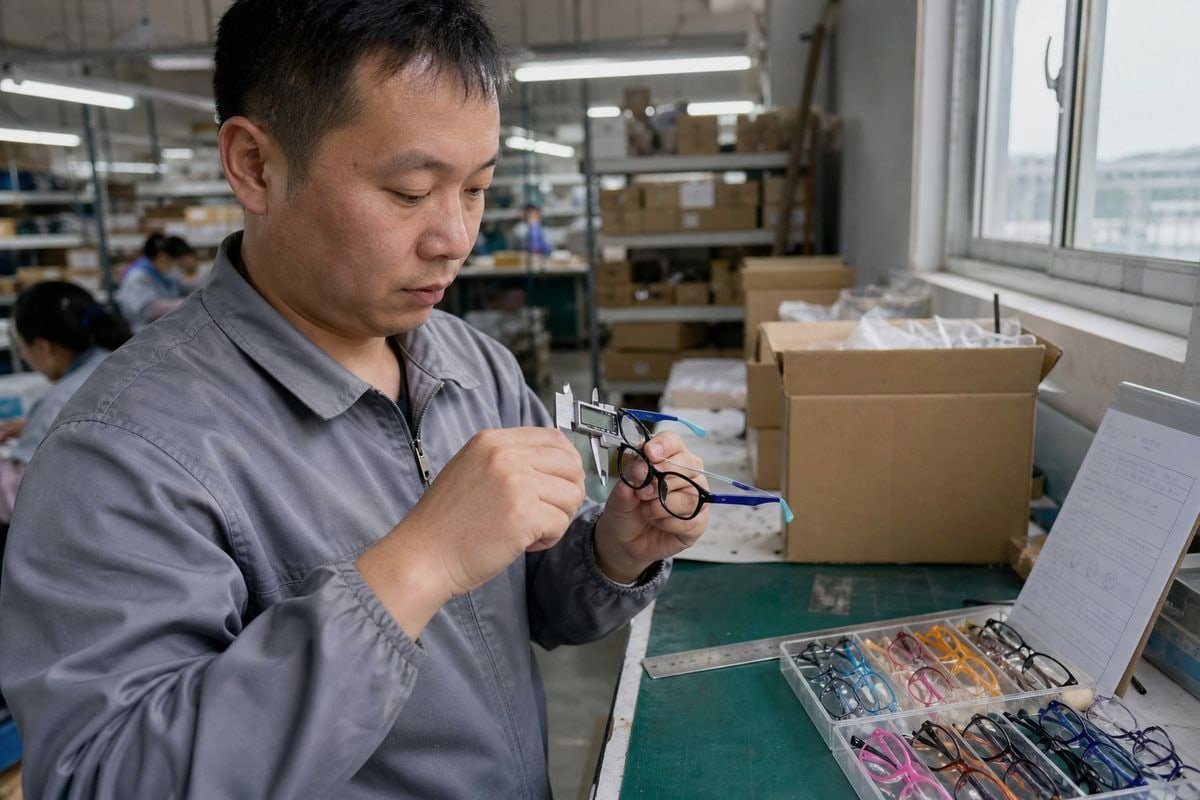
Frame requirements for kids’ myopia control lenses are stricter than buyers expect. On our production line in Taizhou, I have seen good lens designs fail because the frame geometry was wrong.
Kids’ myopia control lenses require a lens ring with a B-measurement above 25 mm, at least 12 mm of clearance above the pupil, vertex distance of 10 mm or less, pantoscopic tilt near 0°, face-form angle under 5°, and monocular centration matching the optical center to the pupil.
These numbers matter because the frame is part of the treatment. Let me walk through each requirement and show you how to specify them correctly.
How do I match frame lens ring size to a child's pupillary distance for accurate optical center alignment?
A buyer from Australia once sent us a frame spec with a 52 mm eye size for six-year-olds. We flagged it immediately. The lens ring was far too wide for children's monocular pupillary distance 1.
Match the frame's boxed center distance (A size plus DBL) to the child's pupillary distance as closely as possible, ideally within 2–4 mm. This minimizes lens decentration, keeps the optical center on the pupil, and preserves the symmetry of the peripheral defocus rings.

The math here is simple, but the consequences are not. The boxed center distance is the horizontal distance between the geometric centers of the two lens rings. You calculate it by adding the A measurement (lens width) to the DBL (bridge width). If a child's PD is 56 mm and the frame's boxed center distance is 64 mm, the lab must decenter each lens 4 mm inward. On a standard single-vision lens 2, that is routine. On a myopia control lens with concentric lenslet rings or defocus zones, that decentration shifts the clear central zone 3 and pushes the treatment rings asymmetrically across the retina.
Why monocular measurements matter
Children's faces are rarely symmetrical. We always advise our optical customers to work from monocular pupillary distance, not a single binocular number. A child with a 27/29 mm split needs each optical center placed independently. A frame that only allows symmetric centration forces a compromise on one eye.
Practical sizing bands
Here is the sizing logic we apply when we help brands build a myopia-control-ready frame range from our roughly 800 existing styles:
| Child's PD range | Recommended boxed center distance | Typical A size + DBL combination |
|---|---|---|
| 50–54 mm | 52–58 mm | 42–44 mm A + 14–16 mm DBL |
| 55–58 mm | 56–62 mm | 44–46 mm A + 15–16 mm DBL |
| 59–62 mm | 60–66 mm | 46–48 mm A + 16–17 mm DBL |
Also remember vertical centration. The pupil should sit slightly above the geometric center of the lens ring, with at least 12 mm of lens above the pupil so the superior treatment zone stays intact. This is your minimum fitting height, and it is a hard requirement, not a preference.
What frame design tolerances should I require to keep myopia control lenses within their functional zone?
The hardest trade-off we weigh in frame development is style versus geometry. A fashionable wrapped front looks great on a line sheet, but excessive frame wrap angle can quietly neutralize a defocus lens design.
Require a pantoscopic tilt of 0° to 2°, a face-form angle between 0° and 5°, a vertex distance of 10 mm or less, a B-measurement above 25 mm, and stable bridge geometry. These tolerances keep the treatment zone aligned with the child's visual axis during real wear.
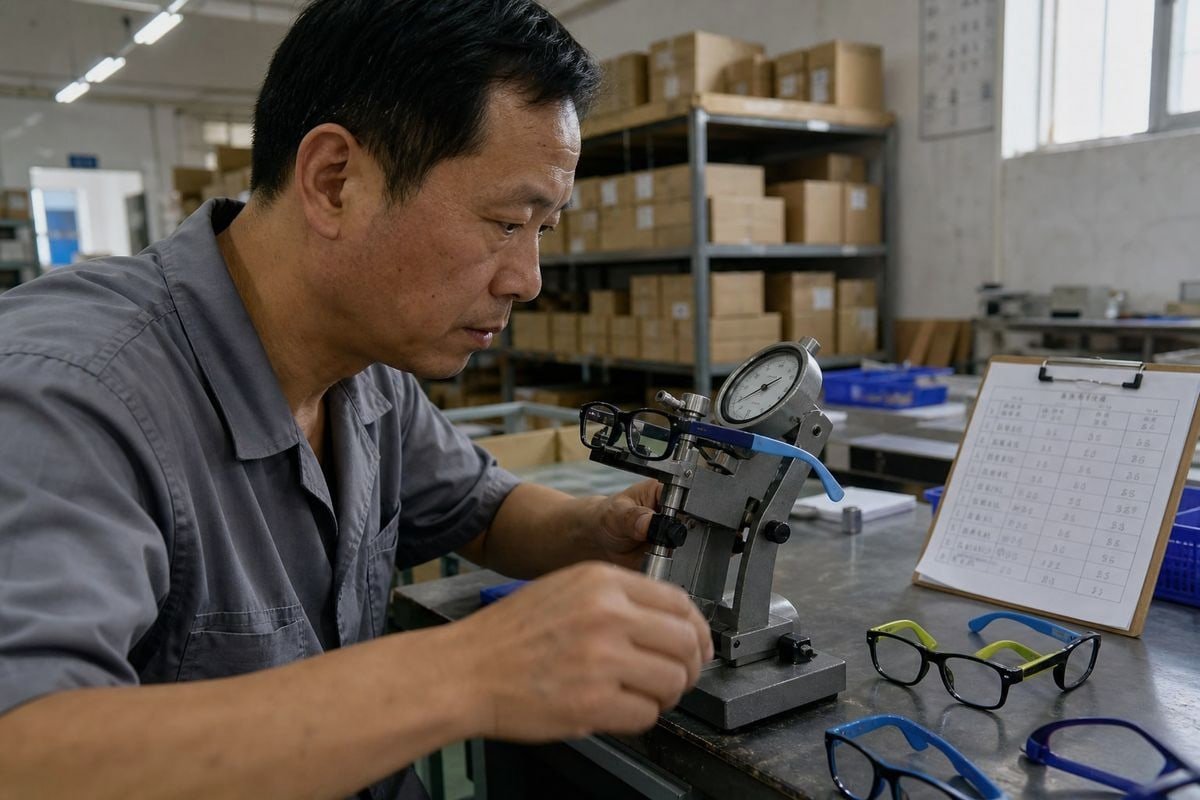
Ordinary kids' frames tolerate a lot of variation. Myopia control frames do not. These lenses combine a clear central zone, often around 7–10 mm across depending on the brand, with surrounding peripheral defocus structures. Every degree of tilt and every millimeter of vertex distance changes where those zones land relative to the retina.
The core tolerance table
This is the checklist we build into our QC documentation when a customer orders frames for a myopia management program:
| Fitting factor | Required tolerance | Why it matters |
|---|---|---|
| Pantoscopic tilt | As close to 0° as possible; roughly -2° to +2° | Tilt shifts the defocus signal vertically relative to the retina |
| Face-form angle (frame wrap) | 0° to 5° maximum | Excess wrap induces peripheral astigmatism that erodes the intended volume of defocus |
| Vertex distance | ≤10 mm | A short vertex distance maximizes the effective retinal area covered by the treatment zone |
| B-measurement | >25 mm, ideally 25–30 mm | Prevents the lenslet rings being cut off during glazing |
| Boxed lens size | Minimum around 37 mm × 17 mm usable space around the pupil | Ensures adequate treatment area in all directions |
| Bridge fit | Adjustable pads or anatomically matched saddle bridge | Prevents slippage that changes all the values above |
Shape matters too
Round or oval lens rings preserve more of the concentric treatment rings at the top and bottom edges than aggressive rectangles do. Also watch nasal clearance. A very narrow bridge design can cut off the nasal defocus segments, which matter during near-work convergence. Finally, check the effective diameter of the lens ring against the lens blank; if glazing trims into the outer rings, part of the treatment simply disappears.
Why does frame fit affect the effectiveness of myopia control lens technology in children?
Years ago, an optical distributor told me their clinics saw uneven results with the same lens across different frames. That conversation changed how we think about fit stability in every kids' frame we develop.
Frame fit determines whether the child's line of sight passes through the clear central zone or drifts into the treatment zones. A frame that slips, tilts, or sits too far from the eye displaces the peripheral defocus signal and can reduce the lens's myopia control effect.

Here is the plain-English version I give to parents-facing brands. These lenses are not uniform. The pupil center must align with the optical center of the lens myopia control lens technology 4 for the design to deliver clear vision through the middle and myopic defocus in the periphery. When the pupil and optical center separate, two things happen at once. The child's vision through the central zone degrades, so comfort drops. And the defocus geometry shifts, so the treatment signal lands in the wrong place.
Now add real life. Children run, sweat, and push their glasses around. A frame that slides even 2–3 mm down the nose moves the treatment zone out of the effective visual axis. That is why bridge fit stability is not a comfort feature in this category. It is a treatment-delivery feature.
Some buyers push back here. They assume that as long as the child wears the glasses full-time, the lens works equally well. The dispensing literature says otherwise: performance depends on precise placement, and a poorly fitted frame undermines an expensive lens. This is exactly why we build kids' frames in TR90 with flexible TPEE temples. The material holds its adjusted shape, grips without pressure points, and survives being dropped, twisted, and worn during sport. Our curved ear-hook temple designs with textured silicone tips exist for one reason: they keep the vertex distance and vertical centration stable through a full school day. A rigid frame that fits perfectly in the dispensing chair but shifts by lunchtime delivers less treatment than a slightly less stylish frame that stays put.
One lesson from fifteen years of OEM work: the projects that go smoothly are the ones where the spec sheet is boring, complete, and agreed before tooling. Myopia control programs punish vague specifications harder than any other category.
Share the frame's A, B, DBL, and effective diameter, the target pantoscopic tilt and face-form angle, expected vertex distance, minimum fitting height, the lens brand's fitting chart, and the age band's typical monocular pupillary distance range. Confirm all values against the lens manufacturer's tolerances before ordering.

Different lens families publish different fitting constraints. Hoya MiYOSMART guidance, for example, calls for vertex distance at or under 10 mm, pantoscopic angle near zero, and face-form angle no more than 5°. Other designs specify their own minimum fitting height or clear-zone alignment rules. So the safest process is not to memorize one universal rule, but to lock your frame spec to the specific lens family your program uses.
The specification checklist we ask for
When an optical brand approaches us about frames for a myopia management line, this is the information exchange we run before sampling:
| Specification item | What to provide | Who confirms it |
|---|---|---|
| A / B / DBL / ED | Exact boxed measurements per size | Frame factory |
| Minimum fitting height | Pupil-to-lower-rim distance, plus 12 mm superior clearance | Lens supplier's chart |
| Pantoscopic tilt as-built | Target 0°, tolerance ±2° | Frame factory QC |
| Frame wrap angle | 0–5° measured at the front | Frame factory QC |
| Vertex distance estimate | Based on bridge design and pad geometry for the age band | Both parties |
| Age band and PD range | Monocular PD data for the target market | Brand / dispenser |
| Material and adjustability | TR90 front, TPEE or adjustable temples, pad options | Frame factory |
Why this exchange protects your program
For children with higher prescriptions, also flag it in the spec. A smaller eye size reduces edge thickness and weight, and it keeps high-power edge aberrations away from the engineered defocus zones. Because we hold around 800 existing kids' styles, most programs can select compliant geometries from stock tooling and avoid mold investment entirely. For full OEM projects, we adjust bridge height, tilt, and temple design to the lens chart, then verify each batch in our 5S-managed workshop before shipment. Clear specs upfront mean no surprises at glazing.
Conclusion
Frame geometry is part of the treatment in kids' myopia control lenses. Get the ring size, centration, tilt, and stability right — and verify every spec against the lens fitting chart.
Footnotes
1. Authoritative guide on measuring PD from the American Academy of Ophthalmology. ↩︎
2. Authoritative guidance on clinical standards for dispensing various lens types. ↩︎
3. WHO information on vision correction and the importance of clear central vision. ↩︎
4. Authoritative ophthalmology source explaining myopia control lens mechanisms and clinical relevance. ↩︎
More Articles You Might Like


Looking for a Reliable Kids Eyewear Partner?
Explore 800+ ready styles and full OEM/ODM support tailored to your brand.
Get in Touch English
  Español de México
  Deutsch
  Français
  日本語
日本語  العربية
  Português do Brasil