What Are Common After-Sales Issues With Kids’ Anti-Blue-Light Eyewear?
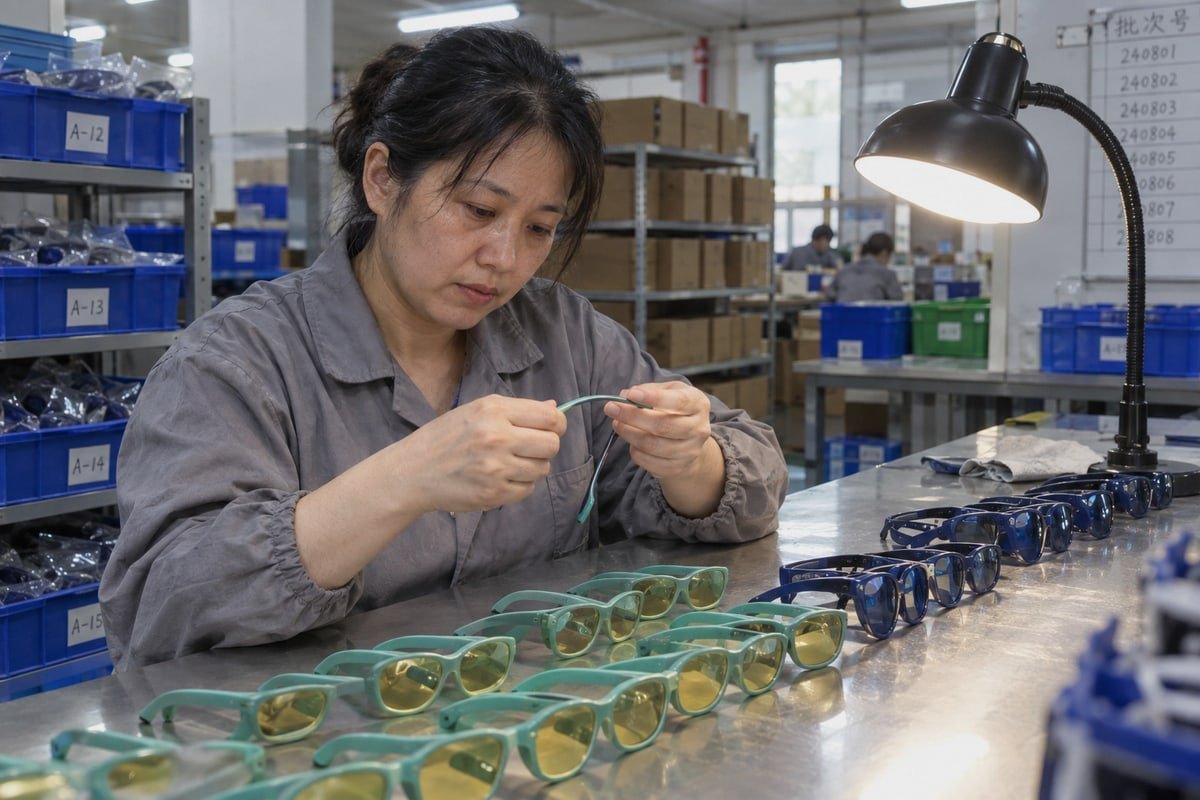
Common after-sales issues with kids’ anti-blue-light eyewear 1 rarely appear on our inspection tables in Taizhou. They surface weeks later, when a parent emails you after a child refuses the glasses.
The most common after-sales issues with kids’ anti-blue-light eyewear are frame breakage, poor fit, lens coating peeling or scratching, smudge-prone lenses, and disputed blue-light claims. Most complaints trace back to fragile materials, unclear sizing, and limited warranty or return support rather than the core product idea.
That gap between shipping day and the first complaint is where brands lose money and trust anti-reflective coating 2. In this article, I will walk through the four problems our B2B buyers ask about most. I will also explain what a factory should do about each one, and what you can do before the goods ever leave the warehouse.
What should I do if a customer reports lens coating peeling or discoloration over time?
A few years ago, we pulled a lens batch after our QC team found tiny crazing lines under a lamp hypoallergenic frame materials 3. That single check kept a full order from turning into complaints.
Ask the customer for clear photos, the purchase date, and their cleaning routine. Then judge whether the fault is anti-reflective coating peeling, crazing, or scratches from misuse. Replace genuine coating defects quickly, log the lens batch, and report the pattern to your manufacturer so the root cause gets fixed.
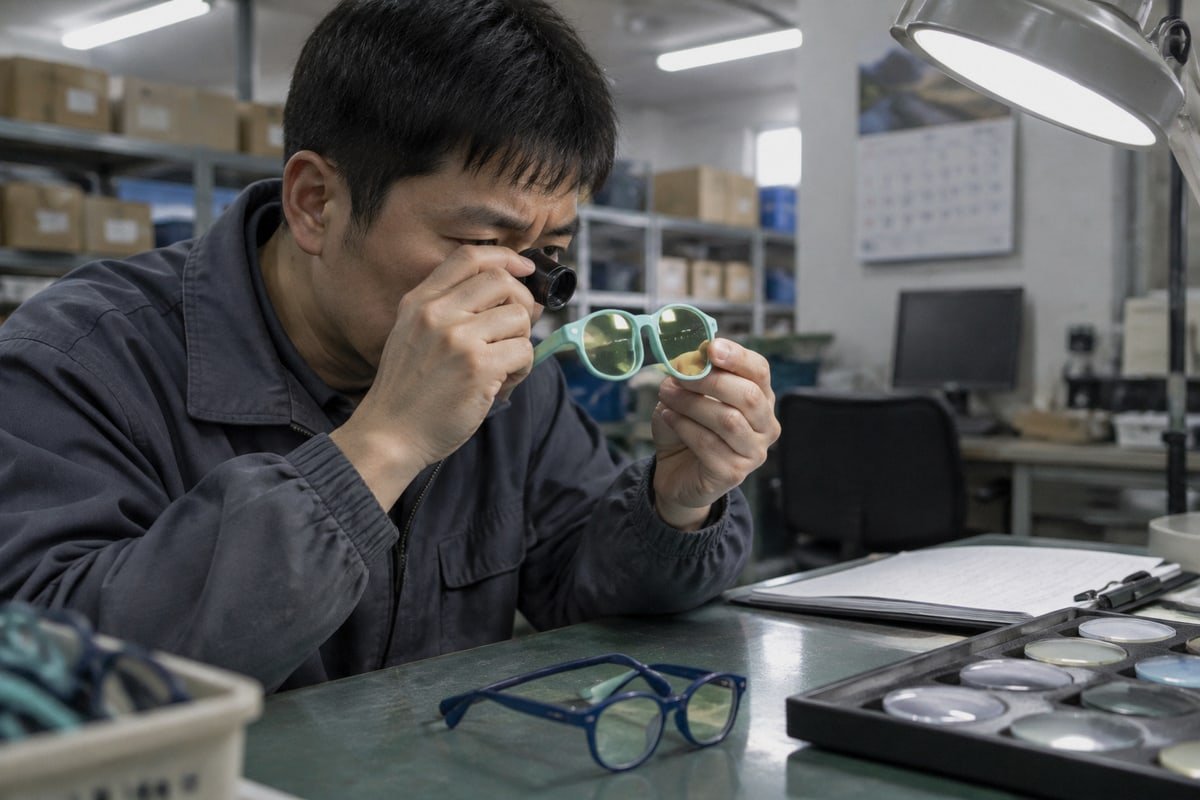
Coating complaints are the hardest ones to judge from a distance. The lens looks bad in the photo, but the photo does not tell you why. So the first job is to read the symptom, not to argue about fault.
Reading the symptom before you reply
I ask my own team to sort every lens complaint into one of five buckets. Each bucket points to a different cause, and each one carries a different answer on coverage.
| What the customer describes | Most likely cause | Usually a warranty defect? |
|---|---|---|
| Flaking or bubbling, often starting at the lens edge | Weak adhesion between the anti-reflective layer and the hard coat | Yes |
| A fine web of cracks across the surface (crazing) | Heat stress, solvent exposure, or a thin, brittle coating | Depends on age and use |
| Even yellowing of the whole lens, darker than the original tint | Oxidation of the lens monomer, common in low-grade material | Yes, if it appears within months |
| Random deep scratches | Dropped on concrete, wiped on a sweater | No, this is wear and tear |
| Smudges and fingerprints that will not wipe clean | Oleophobic top layer has worn away | Depends on age |
Two of these need a special note. First, discoloration. Many kids' anti-blue-light lenses ship with a pale yellow or amber tint on purpose. That tint is part of the filter. A parent may report "yellowing" on a lens that is simply doing its job. So I always ask for a comparison photo against a white sheet of paper, and I compare it with our reference sample. Real oxidation yellowing is uneven, deepens over time, and cuts light transmittance. Design tint does not change.
Second, lens scratch resistance. A hard coat is not a shield against everything. Children rub lenses on shirts, drop them in backpacks, and leave them face-down on tables. A scratched lens after six months of that is normal wear. A scratched lens on arrival is a packing or inspection failure, and that one is on the supply chain.
A three-step response that keeps parents calm
- Collect evidence within 48 hours: photos in daylight, the purchase date, and a short note on how the glasses are cleaned. Alcohol wipes and hot water are frequent hidden causes of crazing.
- Match the evidence to the table above and tell the customer plainly what you see. Parents accept "this is wear" far better when you explain it than when you just refuse.
- Replace real defects without a fight, then record the lens batch. If two or more complaints come from the same batch, send the pattern to your factory. At our workshop, that batch record is what lets us trace a problem back to a coating run rather than guess.
The point is not to win each case. The point is to find the batch problem early, before it spreads across a whole season of sales.
How do I handle warranty claims for broken frames on active kids' eyewear?
Every children's frame we design forces a choice between stiffness and give. A rigid frame looks sharp but snaps. A flexible one survives a playground.
Set a written warranty that separates manufacturing defects from wear and tear, then run every claim through the same warranty claim process: gather photos, confirm purchase date, match the failure to a known defect type, and offer repair, replacement parts, or a new pair within a fixed response time.
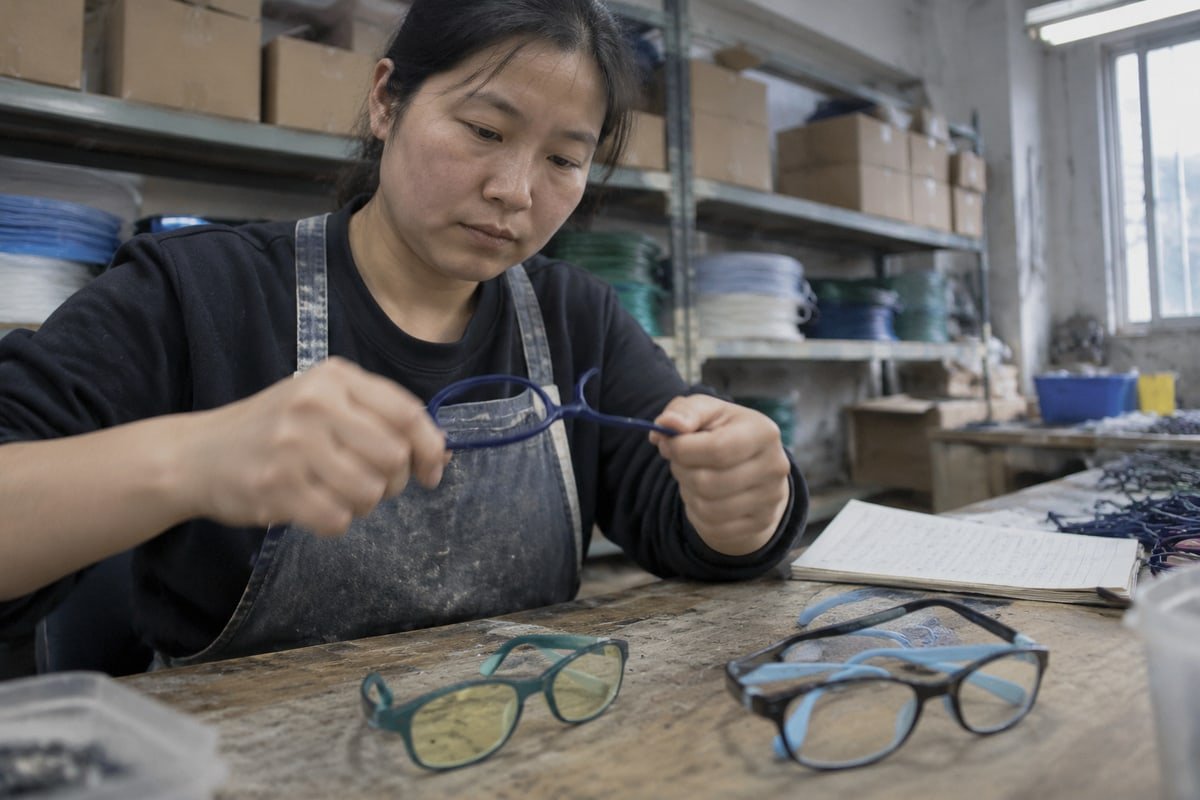
Broken frames generate more heated emails than any other issue. A parent sees a snapped temple and assumes the product is junk. Sometimes they are right. Sometimes a seven-year-old sat on the glasses. The warranty claim process exists so that you do not have to decide by mood.
Defect or wear and tear?
Frame durability claims break into two groups. The line between them is where most disputes live, so I put it on paper for every buyer.
| Failure type | Typical sign | Classification |
|---|---|---|
| Hinge screw backs out or shears within weeks | Loose or missing screw, no impact marks | Manufacturing defect |
| Temple snaps at the hinge under normal opening | Clean break at a thin wall or weld point | Manufacturing defect |
| Spring hinge loses tension or seizes early | Temple flops or will not open fully | Manufacturing defect |
| Frame front cracks after a fall on hard ground | Scuffs and impact marks near the break | Wear and tear |
| Temple bent flat and cracked | Twisted shape, stress whitening on plastic | Wear and tear |
| Nose pad falls off within days | Pad missing, no damage to the mount | Manufacturing defect |
Material matters here more than most buyers expect. TR90 material flexibility lets a frame bend and return to shape instead of cracking. We pair TR90 fronts with TPEE temples on most of our children's styles for exactly that reason. The temple can twist under a bike helmet strap and come back. That single design choice moves many "broken frame" reports out of the warranty column altogether, because the frame does not break in the first place.
A five-step claim workflow
- Acknowledge the claim within one business day. Silence is what turns a complaint into a bad review.
- Ask for two photos: the whole frame and a close-up of the break. Video helps if the hinge is the problem.
- Confirm the purchase date against your warranty window. Wholesale terms I see most often run 90 days to 6 months, and some sellers extend to 3 to 12 months depending on the buyer type. State your window clearly on the packaging insert.
- Classify the failure using the table. Defects get a free fix. Wear and tear gets a paid option, and I recommend keeping that option cheap.
- Choose the remedy. Spring hinge repair is quick if you hold spare hinges. Replacement parts availability is the quiet hero of after-sales work: a spare temple, a bag of screws, or a set of nose pads solves most claims without shipping a whole new pair.
One caution on marketing. Some kids' models advertise a lifetime warranty, and buyers still report small sizing, broken screws, and scratched lenses on those same models. A long warranty does not stop breakage. It only changes who pays. Strong materials and a stock of spare parts do more to protect your reputation than any promise on the box.
What after-sales support should I expect from my manufacturer for defective anti-blue-light lenses?
A product manager from Europe once sent me a spreadsheet of complaints and asked one question: which of these are your fault? That question shaped our support policy.
Expect written test reports showing blocked wavelengths and filtration percentages, a defect replacement policy with clear time limits, replacement parts availability, batch traceability, and a named contact who answers within days. A serious manufacturer also helps you separate real lens defects from unrealistic expectations about blue-light glasses.

Lens disputes almost always begin before the sale. If the claim on the box is vague, every complaint becomes a debate about what the glasses were supposed to do. So the support you should demand from a factory starts with documents, not apologies.
The support checklist I would hold any factory to
| Support item | Why it matters after the sale |
|---|---|
| Test report listing blocked wavelengths and filtration percentage | Lets you answer "these don't block blue light" with data instead of opinion |
| Sample-to-bulk consistency check on HEV light filtration | Prevents the common complaint that bulk lenses filter less than the approved sample |
| Written defect replacement policy with a time limit | Removes guesswork on what gets replaced and how fast |
| Lens batch traceability | Turns three scattered complaints into one solvable coating problem |
| Disclosure of lens material, tint level, and prescription compatibility | Stops the "after-sales surprise" that leads to a second purchase or a return |
| Spare lenses and parts held in stock | Cuts replacement time from weeks to days |
| One named contact with a response window | Keeps a small issue from becoming a lost account |
Raising the hard objection
Some buyers push back on the whole category. They argue that the real problem is not fit or coatings. The real problem, in their view, is that blue-light glasses over-promise. Digital eye strain 4 often comes from reduced blink rate and long focus distance, and a filter does nothing about either. Some parents see no change and feel cheated. Others worry that high-blocking lenses worn all day in dim rooms could interfere with a child's natural light exposure.
I take that objection seriously, and I think it actually supports the case for better after-sales support. On the other side, many families use these glasses as a practical habit tool for evening screen time, and they report less glare and easier sessions. Both views can be true. What resolves the tension is honest labeling. A factory should tell you the exact filtration level 5 so you can market a light-tint daytime lens differently from a stronger amber evening lens. It should also warn you about color distortion issues: a deep amber tint shifts how a child sees colors during art homework or games, and that is a known source of returns.
Materials and skin
One more item belongs on the list. A small number of complaints are not about lenses at all. Parents report red marks or itchy skin behind the ears or on the nose. Cheap "unbreakable" frames can carry plasticizers, dyes, or BPA-heavy compounds 6 that irritate sensitive skin. At our factory we build children's styles in TPEE and TR90 specifically because the materials are light, flexible, and skin-friendly. Your manufacturer should be willing to state what the frame is made of, in writing, before you order. If they hesitate, that is your answer.
How can I reduce return and complaint rates before products reach my customers?
The hardest lesson our workshop learned was simple: most returns are decided before the carton is sealed. Fit, inspection, and honest claims do the real work.
Reduce returns by choosing flexible, hypoallergenic frame materials, publishing a clear size chart by age, inspecting every shipment for loose screws, scratches, and missing nose pads, stating blue-light filtration honestly, and offering a simple return window so parents can test fit at home without fear.

Kids' eyewear creates more post-purchase friction than adult eyewear, and the reasons are structural. Children grow fast. Their face shapes vary widely within the same age. They handle glasses roughly, and they are very sensitive to discomfort. A parent cannot judge fit from a product photo, so many problems only show up at home. Prevention has to account for all of that.
Fix fit before you fix anything else
Poor fit drives non-compliance. A frame that slides down the nose gets pushed up fifty times an hour until the child gives up. A frame that pinches the temples causes pressure headaches, and the glasses end up in a drawer. I recommend three sizing and fit adjustments at the product stage. Publish lens width, bridge width, and temple length for every SKU, then map them to age ranges. Offer at least two sizes for popular styles. And make the temples adjustable or flexible enough that a parent can shape them at home. Our ~800 existing styles cover small, medium, and youth sizes, which lets a new brand test a size range in a real market before paying for a single mold.
Inspect on arrival, every time
Inspection catches the defects that become instant returns. The list is short and boring, and that is why it works.
- Loose or missing hinge screws
- Scratched or hazy lenses
- Crooked or smeared logos
- Missing nose pads or temple tips
- Wrong colors or missing parts against the order sheet
- Crushed or damaged packaging, which usually means a damaged frame inside
Check a sample from every carton, not just the first one. Shipping damage clusters in the corners of a pallet.
Say what the glasses do and do not do
Honesty on the box prevents the most expensive complaint of all: disappointment. State the filtration level plainly. Say that the lens has a slight tint if it does. Note that the glasses help with glare during screen time but do not replace breaks, blinking, or daylight. When expectations are set correctly, the "it didn't work" return almost disappears.
| Pre-shipment control | Complaint it prevents |
|---|---|
| Two frame sizes plus a size chart by age | Sliding, pinching, headaches, child refuses to wear |
| TR90 front with TPEE temples | Snapped temples, cracked fronts, skin irritation |
| Lens filtration test on bulk, not just samples | "These block less than the pair I tried" |
| Carton-level inspection for screws, scratches, nose pads | Damaged-on-arrival returns |
| Rigid retail-ready box with an inner tray | Crushed frames in transit |
| Clear return window printed on the insert | Angry emails, chargebacks, negative reviews |
A clear return policy is a competitive advantage in this category, not a cost. Parents buy with more confidence when they know a bad fit can go back. In my experience, brands that offer it see fewer disputes, because a calm exchange replaces a fight.
Conclusion
After-sales issues with kids’ anti-blue-light eyewear grow from fit, fragile frames, coating quality, and vague claims. Fix those upstream with the right partner, and complaints shrink.
Interested in sourcing the products mentioned in this article? See details and request a quote here:
Footnotes
1. Authoritative medical perspective from the American Academy of Ophthalmology on blue light and digital eye strain. ↩︎
2. High-authority technical reference for the definition and application of anti-reflective coatings. ↩︎
3. Scientific study from PubMed regarding allergic contact dermatitis caused by various spectacle frame materials. ↩︎
4. Authoritative clinical guide on the symptoms and causes of computer vision syndrome. ↩︎
5. ISO technical standard for measuring short wavelength visible radiation transmission in ophthalmic lenses. ↩︎
6. FDA information regarding the safety and monitoring of Bisphenol A (BPA) in consumer materials. ↩︎
More Articles You Might Like
September 29, 2026
Can Kids' Anti-Blue-Light Glasses Be Recycled, and How to Dispose of Old Ones?

September 29, 2026
Can Silicone Nose Pads and Temple Tips on Kids' Blue-Light Glasses Cause Skin Allergies?

September 29, 2026
What Does a Kids' Anti-Blue-Light Glasses Warranty Cover, Including Accidental Drops?
Looking for a Reliable Kids Eyewear Partner?
Explore 800+ ready styles and full OEM/ODM support tailored to your brand.
Get in Touch English
  Español de México
  Deutsch
  Français
  日本語
日本語  العربية
  Português do Brasil