O que a Garantia para Óculos de Sol Infantis Geralmente Cobre?
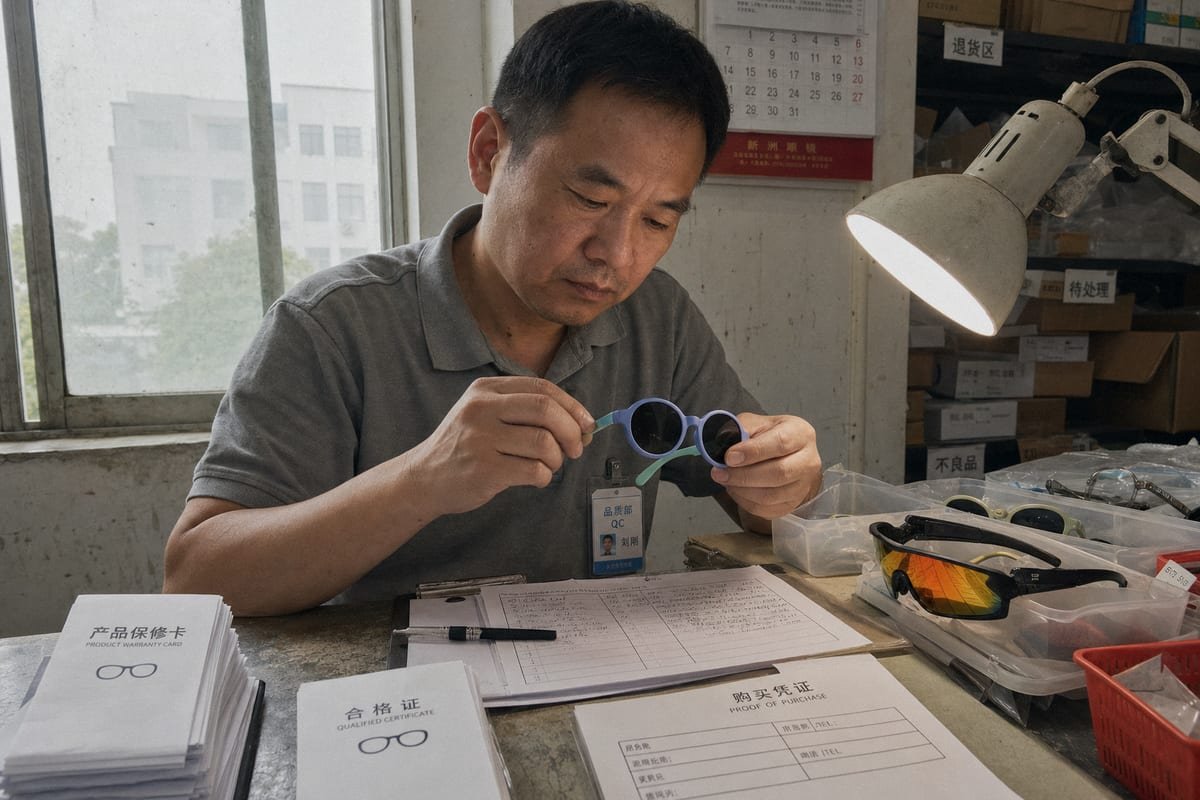
Compradores perguntam sobre a garantia para óculos de sol infantis em quase todos os pedidos de orçamento que nossa fábrica recebe. Uma disputa sobre uma dobradiça quebrada pode azedar uma parceria. Termos claros evitam essa dor completamente.
Uma garantia para óculos de sol infantis normalmente cobre defeitos de fabricação em armações, lentes, dobradiças e revestimentos por um a dois anos, com comprovante de compra. Danos acidentais, arranhões, perda e desgaste normal geralmente são excluídos, a menos que um plano de proteção ou substituição separado seja adquirido.
Essa resposta curta esconde muitos detalhes. A cobertura varia muito entre marcas, varejistas e fábricas. Deixe-me guiá-lo pelo que é realmente coberto, o que não é e como compradores B2B podem moldar melhores termos.
Quais Defeitos ou Problemas Geralmente Estão Incluídos na Garantia de Óculos de Sol Infantis?
No ano passado, uma inspeção de lote 1 em nossa oficina em Taizhou detectou um problema de tolerância no parafuso da dobradiça antes do envio. Esse é exatamente o tipo de problema que uma garantia adequada existe para cobrir.
Uma garantia de óculos de sol infantis geralmente inclui defeitos de fabricação, como falha na dobradiça, armações empenadas ou rachadas sem impacto, revestimentos de lentes descascando ou borbulhando, delaminação das lentes, hastes soltas e plaquetas defeituosas. A cobertura aplica-se apenas a falhas em materiais ou mão de obra, não a danos causados pela criança.
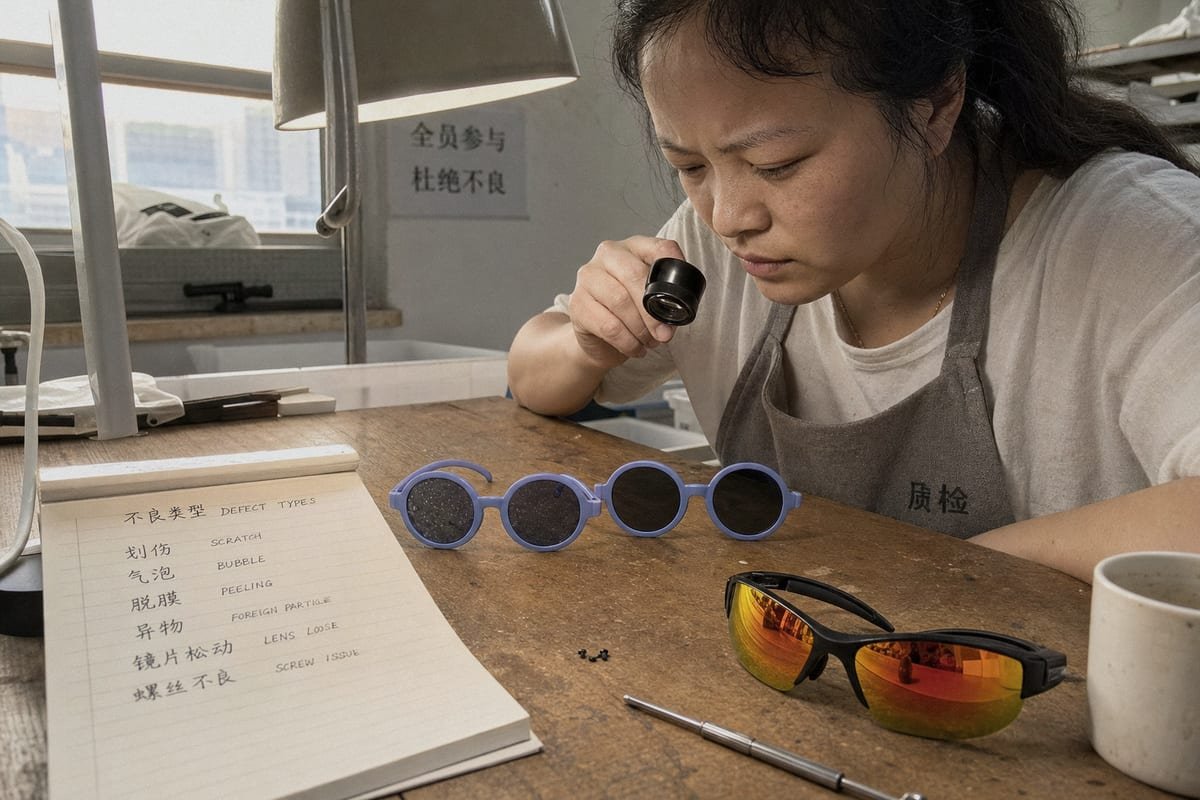
O princípio central por trás de qualquer garantia padrão é simples. Se o produto falhar devido à forma como foi feito, o fabricante é responsável. Se falhar devido à forma como foi usado, o fabricante geralmente não é. Essa linha parece clara no papel. Na prática, as crianças a borram todos os dias.
Defeitos Comumente Cobertos
Em nossos quinze anos produzindo óculos infantis, estes são os tipos de defeitos que a maioria das garantias cobre de forma confiável:
| Tipo de Defeito | Como Parece | Geralmente Coberto? |
|---|---|---|
| Falha da dobradiça | Parafuso solta ou junta quebra sem impacto | Sim |
| Falha do revestimento | Camada de UV ou antirreflexo descasca, bolha ou racha | Sim |
| Deformação da armação | Armação torce ou perde a forma em condições normais | Sim |
| Deslaminação da lente | Camadas da lente se separam sozinhas | Sim |
| Falhas de solda ou junta | Têmpora se solta no ponto de conexão | Sim |
| Arranhões de uso | Marcas na superfície de parquinhos ou mochilas | Raramente |
| Marcas de mordida | Criança pequena mastigando as pontas das têmporas | Não |
| Perda ou roubo | Óculos de sol deixados na praia | Não |
Por que a Escolha do Material Muda o Quadro de Defeitos
Aqui está algo que muitos compradores perdem. A taxa de defeitos depende muito do material. Construímos a maioria de nossas armações infantis em TR90 e TPEE precisamente porque plásticos rígidos 2 quebram em pontos de estresse. A durabilidade da armação flexível significa que uma armação dobra e retorna em vez de quebrar. Uma têmpora de TPEE bem feita pode sobreviver a torções que quebrariam uma armação barata moldada por injeção. Menos defeitos legítimos significam menos reclamações de garantia, o que importa enormemente quando você está vendendo milhares de unidades sob sua própria marca.
Revestimentos também merecem atenção especial. Um revestimento resistente a arranhões 3 que falha por conta própria, descascando ou turvando, é um defeito de fabricação. Um arranhão causado por areia em uma bolsa de praia não é. As garantias traçam essa distinção cuidadosamente, e o mesmo deve fazer a documentação do seu produto.
Quanto Tempo Devo Esperar Que Um Período de Garantia Dure Para Óculos Infantis?
Um distribuidor na Austrália uma vez nos perguntou se um período de garantia mais longo justificaria um preço de varejo mais alto. Nossa resposta o surpreendeu: a duração importa menos do que o que o período realmente cobre.
Garantias de óculos infantis geralmente duram de um a dois anos a partir da data de compra. Um ano é o padrão da indústria para óculos de sol infantis, enquanto marcas premium podem estender para dois anos ou oferecer uma garantia vitalícia limitada apenas para defeitos de fabricação. Planos de danos acidentais geralmente duram doze meses.
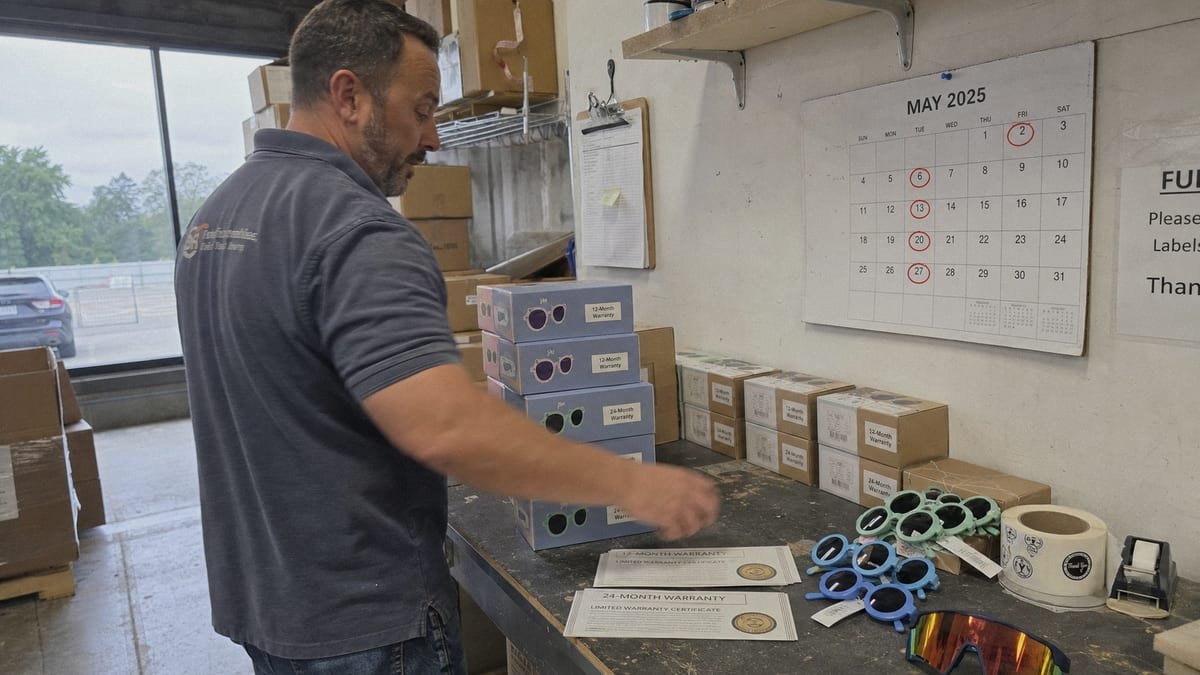
Limites de tempo existem porque os materiais envelhecem. Exposição aos raios UV 4, protetor solar, suor e calor degradam plásticos e revestimentos ao longo do tempo. Após um ou dois anos de uso intenso, torna-se quase impossível separar um defeito genuíno do desgaste normal. Assim, a indústria estabeleceu janelas que são justas para ambos os lados.
Durações Típicas de Garantia por Tipo de Cobertura
| Tipo de Cobertura | Common Duration | Observações |
|---|---|---|
| Standard defect warranty | 12 meses | The baseline across most kids' eyewear brands |
| Extended defect warranty | 24 meses | Common in EU markets due to consumer law |
| Limited lifetime warranty | Lifetime of product | Defects only; accidental damage still excluded |
| Accidental damage plan | 6–12 meses | Often one replacement per period |
| Prescription change window | 60–90 dias | Applies to kids optical frames, not plano sunglasses |
Why Kids' Products Sometimes Get Shorter or Different Terms
Interestingly, some youth lines carry shorter coverage than adult equivalents, capped at two years even when the adult line offers a limited lifetime warranty. The reasoning is blunt. Children outgrow frames, treat them roughly, and rarely keep a pair beyond two seasons. A lifetime promise on a product with a two-year usable life is mostly marketing.
There is one more timing detail buyers should know. Proof of purchase almost always starts the clock. Without a receipt or order record, most brands will refuse a claim outright. When we support our B2B clients, we recommend they build a simple registration step into their packaging insert. It protects the end customer and gives the brand a marketing touchpoint at the same time. Some brands even tie lost or stolen protection to that registration window, offering a discounted replacement only if the product was registered within thirty days.
Posso Negociar Termos de Garantia Personalizados ao Encomendar de um Fabricante?
Negotiating terms is one of my favorite conversations with new brand clients, because it forces both sides to define quality in numbers rather than adjectives.
Sim, compradores B2B podem negociar termos de garantia personalizados com um fabricante. Pontos comuns negociáveis incluem o limite de taxa de defeito, política de substituição, cota de peças sobressalentes, requisitos de evidência de reclamação e quem paga as taxas de processamento e envio. Os termos são tipicamente escritos no contrato de compra antes do início da produção.
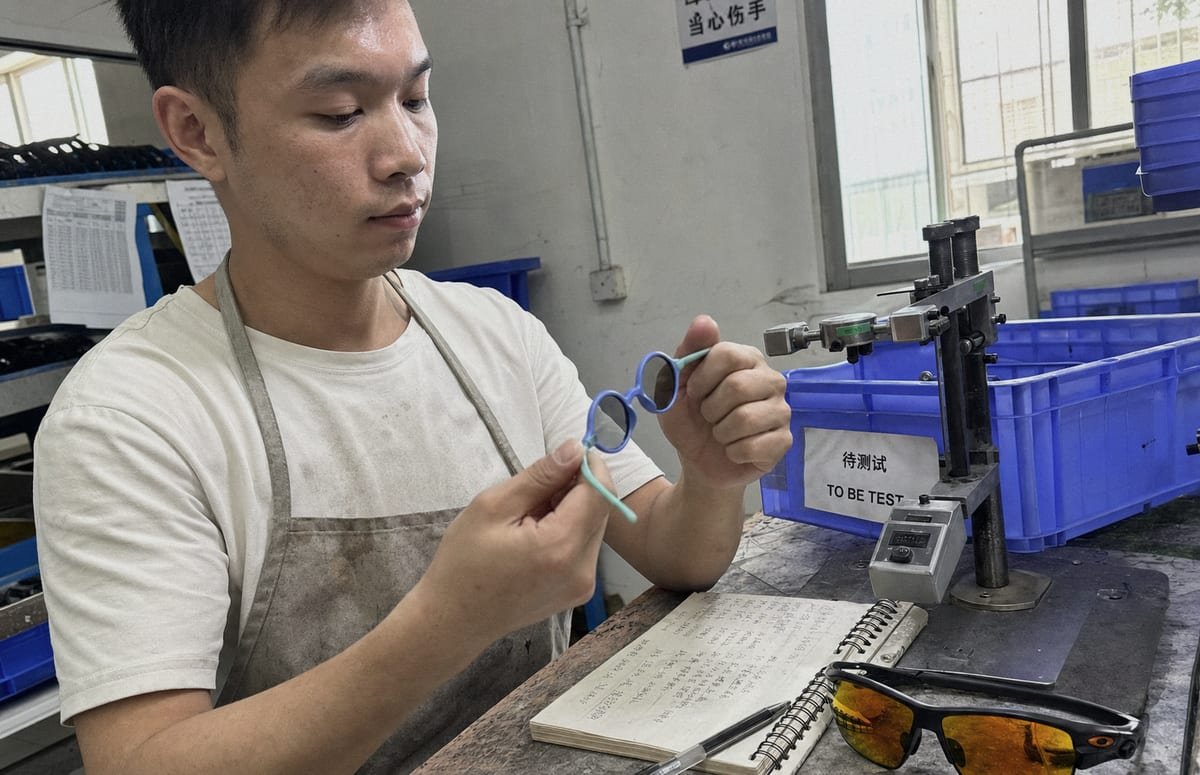
When you order from a factory rather than buy off a shelf, the warranty stops being a printed card and becomes a contract clause. That shift works in your favor. At our facility, warranty discussions happen during sampling, not after a problem appears. Here is how the negotiation usually unfolds.
The Five Levers You Can Negotiate
- Acceptable defect rate. Agree on an AQL standard for inspection. Anything above the threshold triggers factory responsibility.
- Remedy type. Decide whether defective units are replaced in the next shipment, credited against the next invoice, or refunded. Replacement in the next order is the most common and most efficient for both sides.
- Spare parts allowance. Many of our clients request a small percentage of extra units or spare temple arms shipped free with each order. This lets them handle end-customer claims instantly without waiting on international freight.
- Evidence standards. Define what counts as proof. Clear photos and batch numbers usually suffice. Requiring physical return of every broken pair across an ocean helps no one.
- Cost allocation. Specify who covers processing and shipping fees for replacements. Splitting freight on small claims and factory-paid freight on batch-level defects is a fair middle ground.
What a Factory Will and Will Not Accept
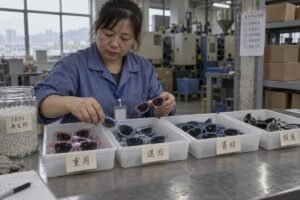
A serious factory will stand behind manufacturing defects without hesitation. Our QC process in a oficina gerenciada por 5S 6 exists precisely so we can make that commitment confidently. What no honest factory will accept is open-ended liability for accidental damage coverage at the consumer level. If your brand wants to market a kid-proof one-time replacement promise, that is a smart retail strategy, but it should be priced into your margin, not pushed back onto the unit cost. We often help clients model this: a slightly higher landed cost with spare inventory built in usually beats chasing individual claims across borders.
One lesson from years of exporting to twenty-plus countries: put everything in writing before the deposit. Verbal assurances evaporate. A one-page warranty annex to the purchase order saves both sides from awkward emails later.
O que devo procurar na política de garantia de um fornecedor antes de fazer um pedido em massa?
Early in my career, I watched a promising importer lose a retail contract because their previous supplier's warranty policy was two vague sentences. The retailer's lawyers walked away.
Antes de um pedido em massa, verifique a lista de defeitos definida pelo fornecedor, o limite da taxa de defeitos, o período de reclamação, os requisitos de evidência, o método de reparação, o prazo de substituição e a responsabilidade pelo custo do envio. Confirme se a política está escrita no contrato e verifique se os revestimentos das lentes e as dobradiças estão explicitamente cobertos.
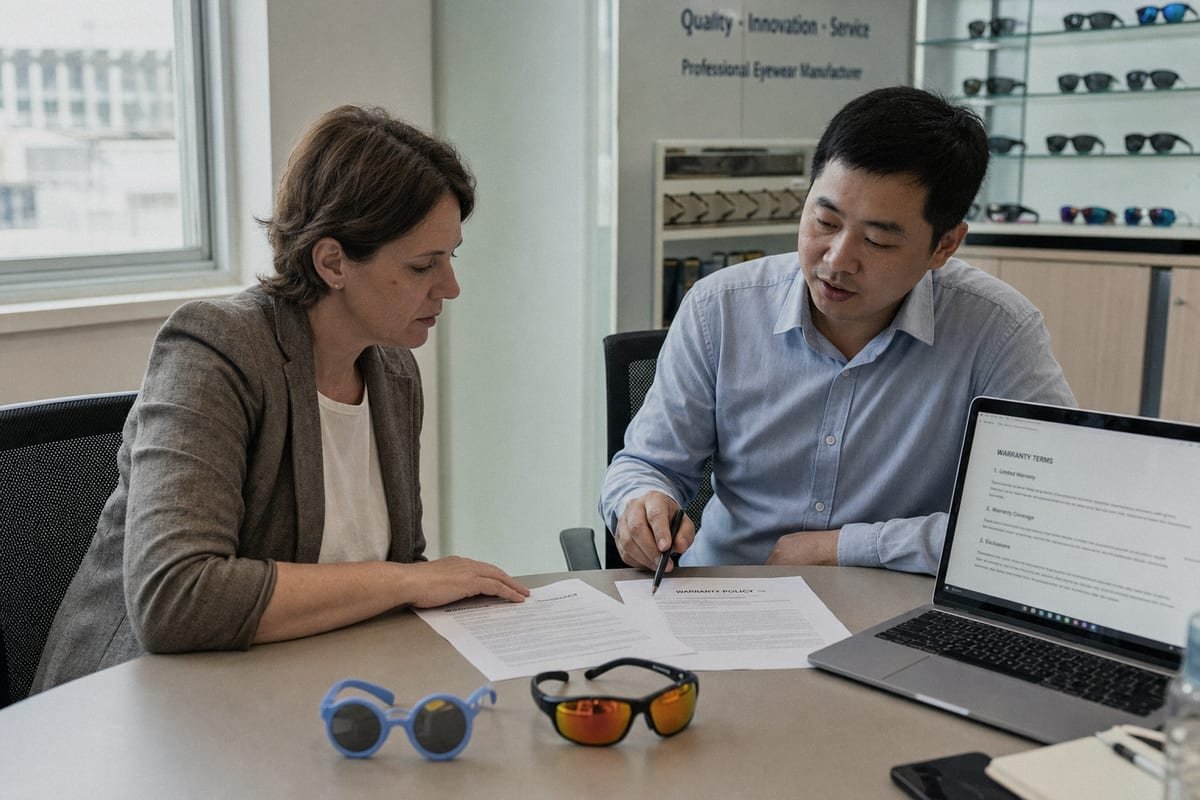
A supplier's warranty policy tells you more about their quality culture than any showroom visit. Vague terms usually signal a trader hoping problems never surface. Precise terms signal a factory that measures its own output. Use the checklist below when you compare quotes.
Bulk Order Warranty Evaluation Checklist
| Checklist Item | O Que Parece Bom | Bandeira Vermelha |
|---|---|---|
| Defect definition | Itemized list: hinges, coatings, frames, lenses | Defects handled case by case |
| Claim window | Stated in months from arrival, e.g., 12 months | No timeframe mentioned |
| Evidence required | Photos plus batch or PO number | Physical return of all units demanded |
| Solução | Replacement, credit, or refund clearly stated | Discount on next order only |
| Lead time for replacements | Defined days for spare parts or reshipment | We will see |
| Cost responsibility | Processing and shipping fees allocated in writing | Silent on freight costs |
| Coating coverage | Scratch-resistant coating failure explicitly included | Coatings excluded entirely |
| Lens standards | Lentes resistentes a impacto 7 meeting your market's norms | No safety standard referenced |
Look Beyond the Policy to the Prevention
A warranty is compensation after failure. Prevention is cheaper than compensation, always. So ask how the supplier avoids claims in the first place. Do they perform incoming material checks on TR90 and TPEE pellets? Do they test hinge cycles? Do they verify UV400 performance 8 batch by batch? Do they use impact-resistant lenses suited for active children? At our factory, we would rather catch a problem at the workbench than settle it by wire transfer six months later.
Also check whether the policy distinguishes between frame and lens coverage. Some suppliers quietly cover the frame only and exclude broken lenses. For children's products, that gap matters, because lenses take the most abuse. Finally, ask how the supplier supports your consumer-facing promises. If you plan to offer parents a one-time replacement policy or a growth-fit exchange, a supplier with roughly 800 existing styles and steady repeat production can restock matching frames quickly. A supplier with one mold and irregular runs cannot.
Conclusão
Unclear warranties create disputes, lost retail contracts, and unhappy parents. The fix is knowledge plus documentation: know what defect coverage means, then write precise terms with your supplier.
A standard warranty for kids sunglasses protects against manufacturing defects, not the chaos of childhood. Scratches, chewing, loss, and playground accidents fall under normal wear and tear or need a separate accidental damage plan. Coverage typically runs one to two years, starts with proof of purchase, and varies in whether frames, lenses, or both are included. For B2B buyers, the real opportunity is upstream. Negotiate defect thresholds, replacement mechanics, spare parts, and shipping cost allocation before production starts. Then choose a factory whose materials and QC reduce claims at the source. That is the approach we take with every brand we partner with, and it is the difference between a warranty that sells trust and one that only manages complaints. If you are developing a children's eyewear line and want warranty terms you can confidently print on your packaging, we are glad to talk through the details.
Notas de rodapé
1. Explanation of batch inspection and sampling procedures used to maintain quality standards in mass production. ↩︎
2. Overview of thermoplastic materials and their physical properties, including rigidity and stress-point failure. ↩︎
3. Professional overview of lens enhancement technologies, including scratch-resistant and anti-reflective coatings. ↩︎
<span id="
Mais Artigos que Você Pode Gostar

Procurando um Parceiro Confiável em Óculos Infantis?
Explore mais de 800 estilos prontos e suporte completo OEM/ODM adaptado à sua marca.
Entre em Contato English
  Español de México
  Deutsch
  Français
  日本語
日本語  العربية
  Português do Brasil