How Much Optical Center Deviation Affects a Child’s Visual Development in Eyewear?

Optical center deviation worries our buyers more than any other spec. On our production line, we treat a few millimeters as the difference between safe kids’ glasses and hidden harm.
Optical center deviation harms a child’s visual development when the induced prismatic effect exceeds the eye’s tolerance — generally deviations above 2–3mm in moderate prescriptions. Persistent prism and blur during childhood can trigger asthenopic symptoms, reduced stereopsis, suppression, and in severe cases amblyopia.
The risk is real, but it is also measurable and preventable. Let me walk you through what the numbers mean, why children are more vulnerable, and how you can verify accuracy before your order ships.
How do I know if my supplier's optical center tolerance is safe for children's eyes?
A buyer from Australia once asked me why our QC sheet listed prism tolerance instead of just millimeters. That question opened a two-hour call, because the answer decides child safety.
A supplier's optical center tolerance is safe when it is expressed as induced prism, not just millimeters, and stays within pediatric dispensing standards — typically under 0.25 prism diopters horizontally for children. Ask for tolerance documentation tied to lens power, verified against Prentice's Rule.

Here is the core physics, in plain terms. Every lens has one point where light passes straight through with no bending sideways. That is the optical center. If a child's pupil does not sit behind that point, the lens acts like a prism. The eye must fight that prism all day long. This is the induced prismatic effect, and it follows Prentice's Rule: prism equals decentration (in centimeters) multiplied by lens power (in diopters).
That formula matters for one big reason. The same millimeter of lens decentration 1 is harmless in a weak lens and harmful in a strong one. So a supplier who quotes "±2mm tolerance" for every prescription is not giving you a safe answer. They are giving you a lazy one.
What a competent tolerance sheet looks like
In our experience exporting to optical companies in over 20 countries, a trustworthy tolerance spec always links millimeters to diopters. Use this table as your benchmark:
| Lens Power | Decentration Causing 0.25Δ Prism | Practical Pediatric Tolerance |
|---|---|---|
| ±1.00 D | 2.5 mm | Comfortable margin |
| ±2.00 D | 1.25 mm | Tight but manageable |
| ±4.00 D | 0.6 mm | Precision fitting required |
| ±6.00 D | 0.4 mm | Near-zero tolerance |
The lesson is simple. Ask your supplier two questions. First, do they measure pupillary distance 2 requirements against actual frame geometry? Second, do they express tolerance in prism diopters? If the answer to either is no, their tolerance is a guess, not a standard.
One more nuance: vertical deviation is less forgiving than horizontal. Children's eyes can compensate for some horizontal prism through convergence. Vertical prism gives them almost no room to adapt, so vertical tolerance should be roughly half the horizontal figure.
What level of optical center deviation can actually harm a child's visual development?
The hardest trade-off we weigh in pediatric frame design is fashion versus fit. A wide, stylish frame can force lens decentration that no lab grinding can fully hide.
Deviations inducing more than 0.5 prism diopters — often just 1–2mm in prescriptions above 3.00D — can trigger eye strain, headaches, and reduced stereopsis. Sustained over months in a developing visual system, this stress risks suppression, binocular vision dysfunction, and amblyopia.
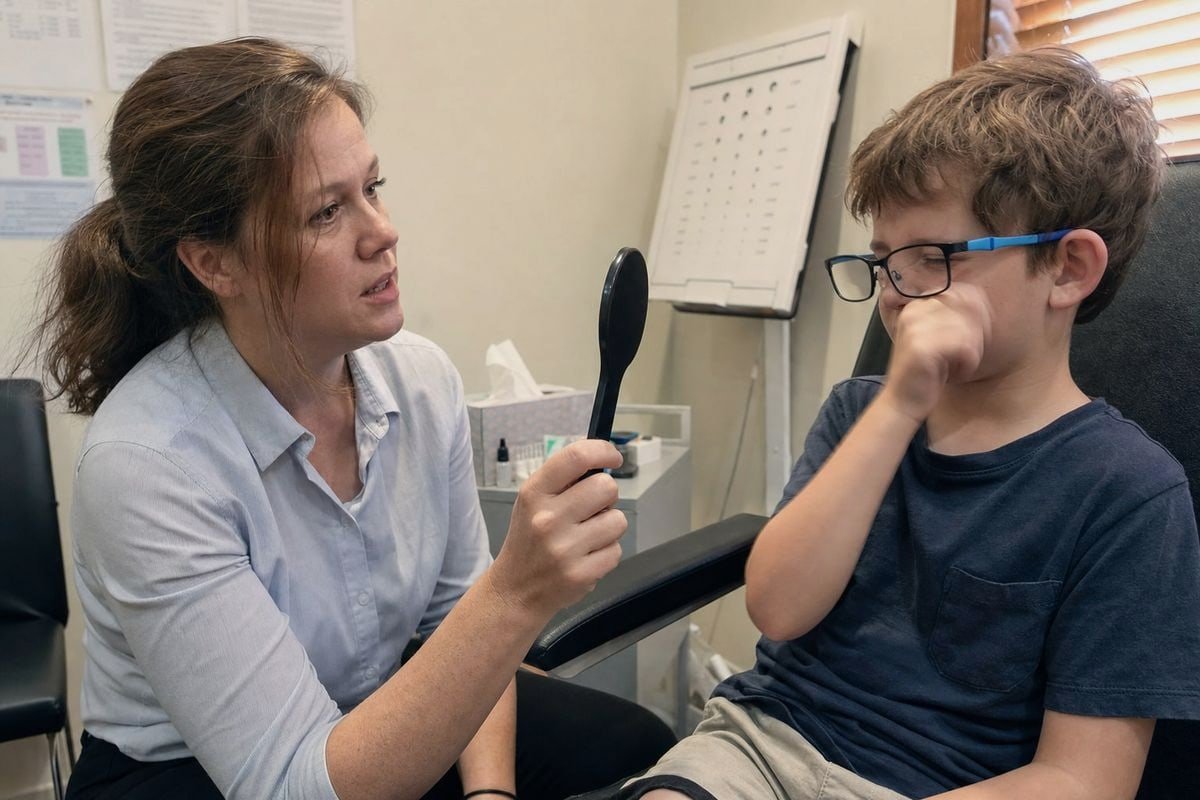
Children are not small adults. Their visual acuity 3, contrast sensitivity, and binocular skills keep maturing through childhood and into adolescence. This plasticity cuts both ways. It lets vision therapy work wonders. But it also means the brain can "learn" from bad optical input. Prolonged exposure to induced prism can push the visual cortex 4 to accept distorted spatial data, or worse, to suppress one eye's image entirely. That suppression pathway is how amblyopia begins.
The escalation ladder of harm
Damage from optical center deviation does not arrive all at once. It escalates:
- Asthenopic symptoms first. Eye strain, brow-ache headaches, rubbing eyes, avoiding reading. Parents often blame screens or school.
- Binocular stress next. Reduced fusional reserves, intermittent double vision, and measurable drops in stereopsis — the child's depth perception weakens.
- Adaptation or suppression. The visual system either strains to compensate or switches one eye off. Some children develop unexplained clumsiness because their visual and physical spatial maps stop matching.
- Structural consequences. In the worst cases — a young child, a strong prescription, months of wear — suppression consolidates into amblyopia, or an existing eye turn worsens.
Which children are most at risk?
Not every child reacts the same way. Risk multiplies for kids with anisometropia, where the two eyes carry different powers and induced prism differs between them. It multiplies again for children with accommodative esotropia 5, because their fragile visual axis alignment depends on precisely centered plus lenses. And for buyers sourcing myopia-control lenses 6 like DIMS designs, even a 1–2mm shift can move the therapeutic defocus zone into the central visual axis and blunt the treatment effect.
Honest nuance: some research on lens centration — including orthokeratology studies — shows small decentrations under 1.5mm can be tolerated when acuity and comfort stay good. So does that mean small errors are fine? Not quite. Tolerance in one child tells you nothing about the next child, and a manufacturer cannot know which child will wear each frame. That is why accurate centration remains the standard of care, and why we design our TR90 kids optical frames with realistic frame PDs rather than chasing oversized adult-style looks.
How can I check optical center accuracy before approving a bulk order?
Fifteen years of running our Taizhou workshop taught me a blunt lesson early on: a pre-shipment inspection without a lensmeter is just a packaging check.
Verify optical center accuracy by requesting golden samples measured on a lensmeter, checking dotted optical centers against the specified frame PD, and auditing an AQL-based sample from the bulk run. Require measurement reports showing deviation in both millimeters and induced prism diopters.

Most B2B buyers of children's eyewear are not opticians. You should not need to be one. But you should know which checks to demand, and in what order. Here is the process we recommend to procurement managers evaluating any factory, including ours.
A five-step verification workflow
| Step | What to Check | Tool / Method | Pass Criteria |
|---|---|---|---|
| 1. Spec review | Frame PD vs. target pupillary distance | Datasheet comparison | Frame PD matches age group range |
| 2. Golden sample | Optical center position on demo or Rx lenses | Lensmeter dotting | Within agreed prism tolerance |
| 3. Symmetry check | Left–right lens alignment | Layout gauge or ruler | Horizontal centers level and equidistant |
| 4. Bulk audit | Random units from production | AQL sampling + lensmeter | No unit exceeds tolerance |
| 5. Documentation | Measurement records per batch | QC report | Deviation logged in mm and prism diopters |
A few practical notes from our own inspection room. First, always check vertical alignment, not just horizontal. A frame that sits crooked on small noses shifts both centers upward or downward, and vertical prism is the kind children tolerate least. Second, for demo-lens sunglasses and plano UV400 lenses, optical center accuracy still matters — poorly centered plano lenses with surface power errors can create subtle distortion during a child's active play. Third, ask how the factory controls frame warpage after assembly. Flexible materials like TPEE and TR90 are wonderful for safety, but if temple tension or hinge assembly twists the front, the lens geometry moves with it. We stabilize this through jig-based assembly and a post-assembly alignment check, because a perfectly ground lens in a twisted frame is still a decentered lens on the child's face.
If a supplier resists sharing lensmeter data before shipment, treat that as your answer.
What quality control steps should I require from my manufacturer to prevent optical center errors?
When we set up our 5S-managed workshop, we mapped every station where centration could drift. There turned out to be seven — and most factories only control two of them.
Require documented controls at every drift point: incoming lens verification, mold and cutting calibration, jig-based lens insertion, post-assembly alignment checks, lensmeter audits per batch, AQL final inspection, and traceable QC records. Prevention across the process beats detection at the end.

Optical center errors are rarely one big mistake. They are usually several small drifts stacking up. A lens blank cut 0.5mm off. A frame front flexed during insertion. A bevel seated unevenly. Individually, each is invisible. Together, they can exceed the pediatric tolerance for lens decentration before the frame ever leaves the factory. That is why we tell brand buyers to audit the process, not just the product.
The seven drift points and their controls
| Drift Point | Risk | Required Control |
|---|---|---|
| Incoming lenses | Mismarked optical centers | Lensmeter verification on arrival |
| Frame molding | Eye-shape or bridge variance | First-article inspection per mold run |
| Lens cutting | Off-center edging | Machine calibration log, daily check |
| Lens insertion | Rotation or tilt in the groove | Jig-based insertion, trained operators |
| Assembly | Front warpage from temple tension | Post-assembly alignment gauge |
| Batch QC | Cumulative drift | Lensmeter audit per production batch |
| Final inspection | Escaped defects | AQL sampling with recorded results |
What this means for your supplier conversations
Ask your manufacturer three direct questions. Can they show calibration records 7 for their edging and cutting equipment? Do they perform post-assembly checks, or only pre-assembly ones? And can they trace a defective unit back to its batch? A yes to all three tells you their pediatric dispensing standards run through the whole line.
For OEM/ODM projects, add one more layer. Custom colors, logos, and lens upgrades — polarized, UV400, or Rx-ready — each introduce a new component that must be re-verified. When we run custom projects for kids' brands, we lock a golden sample with the buyer first, then measure every batch against it. That single habit prevents more optical center disputes than any final inspection ever could. It also protects something harder to measure: a young wearer's stereopsis, comfort, and trust in their first pair of glasses. Your brand's reputation with parents rides on exactly that.
Conclusão
Optical center deviation is small in millimeters but large in consequence for a child's developing vision. Demand prism-based tolerances, verified samples, and process-wide QC from your manufacturing partner.
Notas de rodapé
1. Authoritative Wikipedia page explaining how lens decentration creates prismatic effects via Prentice’s Rule. ↩︎
2. Explains the measurement of the distance between the centers of the pupils in both eyes. ↩︎
3. Provides context on the development of sharpness of vision in growing children. ↩︎
4. Standard Wikipedia entry for the visual cortex, the brain’s primary center for processing visual information. ↩︎
5. Defines a specific type of childhood strabismus that requires precise optical alignment. ↩︎
6. Discusses specialized lens designs used to slow the progression of nearsightedness in children. ↩︎
7. Wikipedia overview of ISO 9001, the international standard requiring documented calibration records for quality assurance. ↩︎
Mais Artigos que Você Pode Gostar



Procurando um Parceiro Confiável em Óculos Infantis?
Explore mais de 800 estilos prontos e suporte completo OEM/ODM adaptado à sua marca.
Entre em Contato English
  Español de México
  Deutsch
  Français
  日本語
日本語  العربية
  Português do Brasil