How Do Loss and Damage Rates for Kids’ Sunglasses Affect Repurchase and Inventory Decisions?
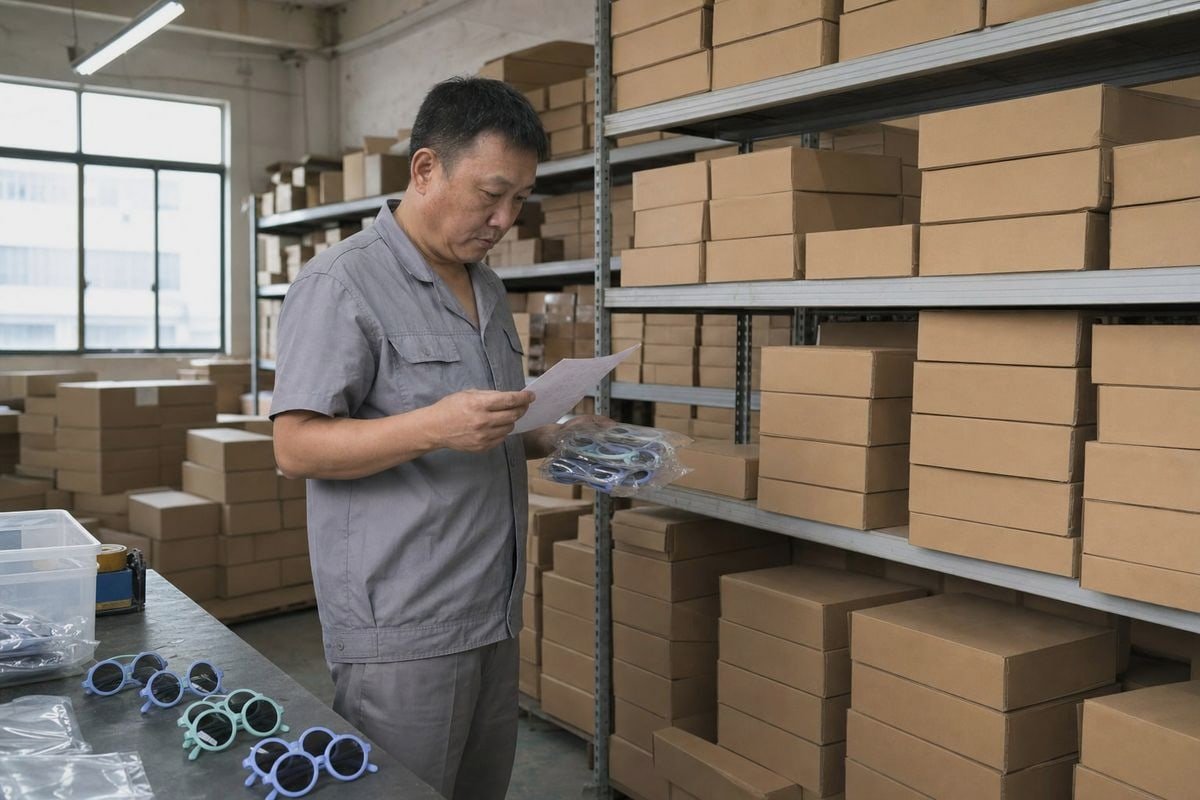
Loss and damage rates for kids’ sunglasses quietly drain margins. I see it constantly from our Taizhou production line — buyers underestimate breakage, then scramble mid-season while replacement demand outpaces stock.
High loss and damage rates turn kids’ sunglasses into a replacement-driven category. Frequent breakage and misplacement create repeat purchase demand within the same season, so retailers must stock core styles deeper, hold safety stock for peak-loss windows, and choose durable frames that reduce return costs.
This changes how you buy, price, and reorder. Below, I break down how to cut breakage, what durability features matter, how to calculate true inventory cost, and how a factory partner helps you plan.
How can I reduce breakage and loss rates for kids' sunglasses before they impact my reorders?
A distributor in Australia once told me half his customer complaints traced back to snapped temples. When our team examined the returned frames, the real culprit was rigid material, not rough kids.
Reduce breakage by specifying flexible frame materials like TPEE and TR90, enforcing product durability testing before shipment, and improving fit across age bands. Reduce loss by bundling cases and straps, since well-fitting, comfortable sunglasses stay on faces instead of being abandoned at transition moments.
Breakage and loss look like the same problem on a spreadsheet, but they have different causes and different fixes. Damage comes mostly from material choice and construction. Loss comes mostly from behavior — kids take sunglasses off at "transition moments" like leaving the pool, getting in the car, or ending a game, and the pair never comes home. Your prevention strategy needs to attack both.
Fix damage at the specification stage
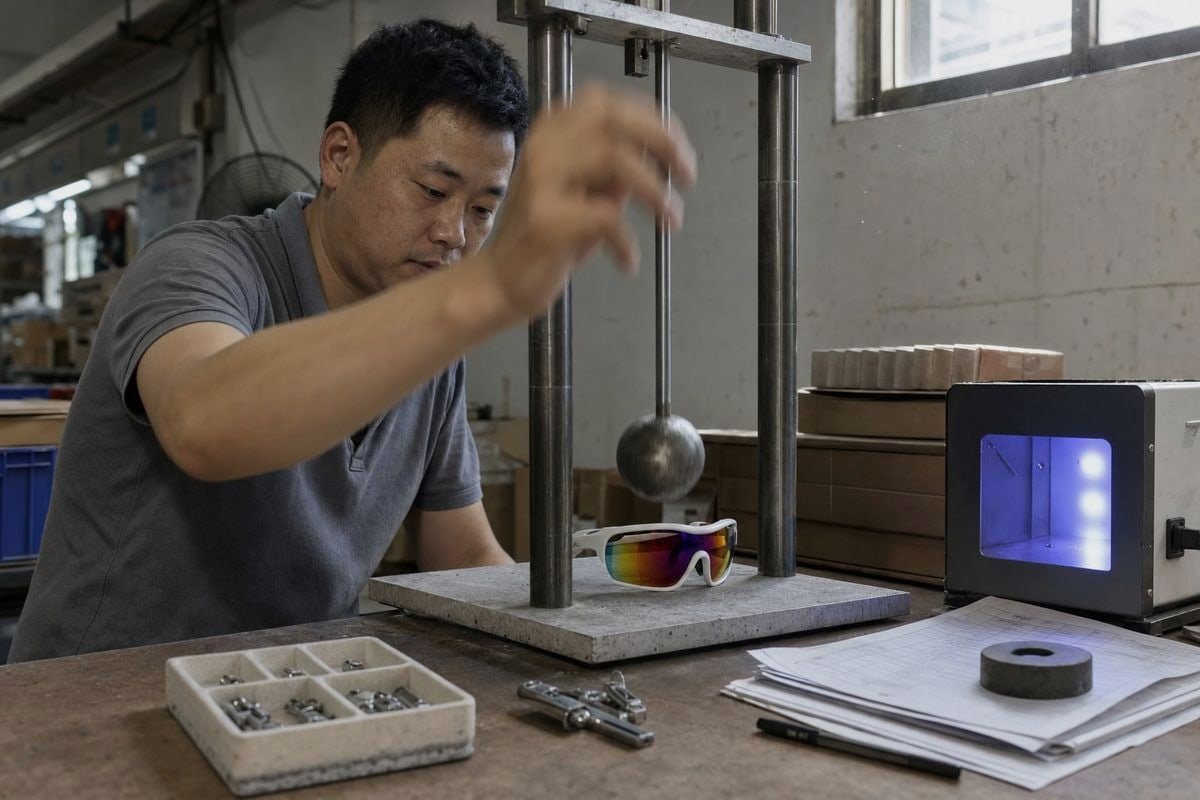
Most breakage happens at three points: the hinge, the temple, and the bridge. Rigid injection plastics crack there under twisting forces — exactly the forces a four-year-old applies daily. Flexible frame materials bend instead of snapping. In our workshop, we twist-test TR90 frames 1 with TPEE temples through full 180-degree flexes precisely because this is where cheap frames fail first. Impact-resistant lenses matter too; polycarbonate and similar options survive drops onto concrete far better than basic acrylic.
Fix loss through fit and accessories
A pair that pinches gets taken off. A pair that slides gets taken off. Once it is off the face, it gets lost. That is why fit is a loss-prevention tool, not just a comfort feature.
| Prevention lever | Targets | Practical action |
|---|---|---|
| Flexible frame materials | Breakage | Specify TPEE 2/TR90 instead of rigid plastic |
| Product durability testing | Breakage | Require twist, drop, and hinge-cycle tests pre-shipment |
| Age-band sizing | Loss by non-use | Stock at least two size bands per style |
| Straps and cases | Misplacement | Bundle retention accessories at point of sale |
| Comfort at contact points | Loss by rejection | Soft temple tips, lightweight builds under active use |
Every prevented break or loss protects your reorder budget and lowers your replacement frequency, which stabilizes your forecasting.
What durability features should I look for in a manufacturer to lower my return and replacement costs?
There is a trade-off I discuss with buyers every week: a slightly softer, more flexible frame costs a bit more to produce, but it cuts warranty claims sharply. Fifteen years of eyewear production has taught me which side wins.
Look for TR90 frames with TPEE temples, impact-resistant UV400 lenses, screwless or reinforced hinges, and documented product durability testing. A factory should show twist tests, drop tests, and hinge-cycle results, plus consistent QC — these features directly lower return rates and replacement costs.
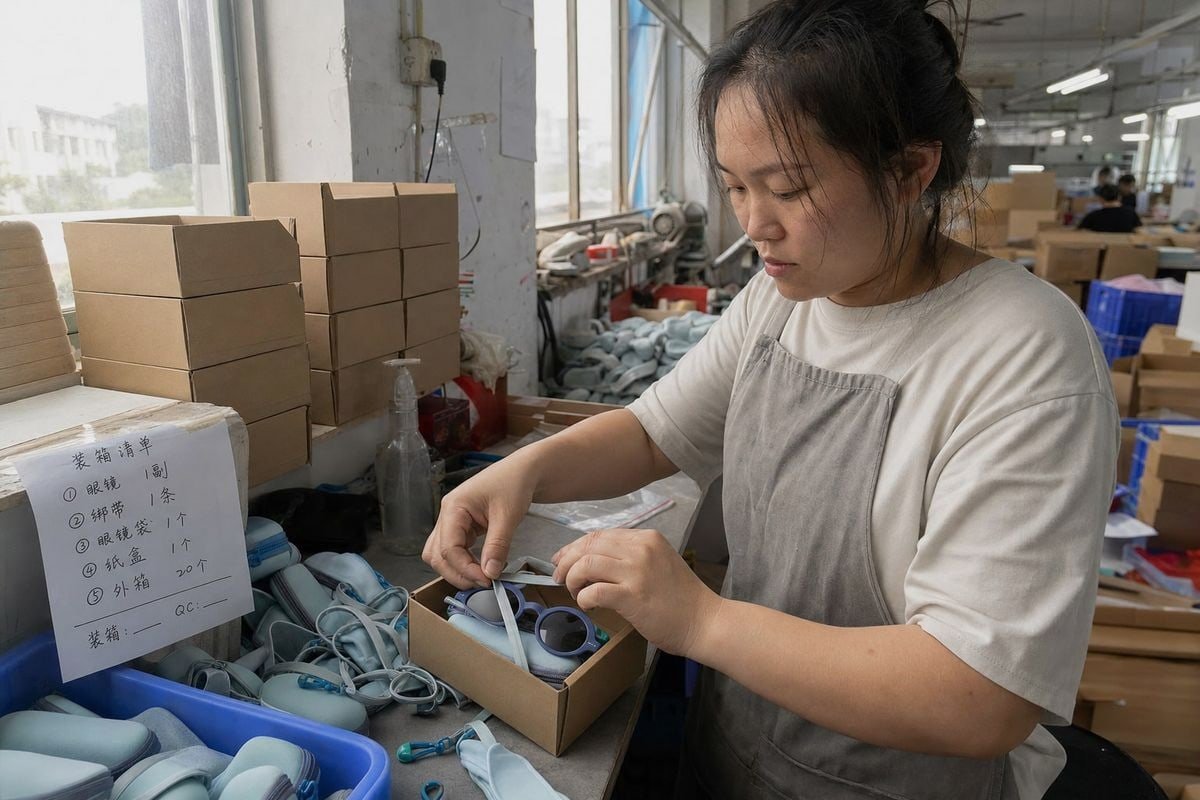
Durability is not one feature. It is a stack of decisions made at the factory level, and each one either adds or removes future returns from your P&L. When you audit a supplier, walk through this stack point by point.
The durability checklist that actually predicts returns
First, frame material. TR90 is a thermoplastic known for memory flexibility — it returns to shape after bending. TPEE adds softness and elasticity, which is why we pair TR90 fronts with TPEE temples on many of our children's styles. The combination survives sitting, stepping, and backpack-stuffing far better than standard plastics.
Second, lens quality. Impact-resistant lenses with genuine UV400 protection 3 prevent both breakage returns and safety complaints. Polarized options let you build a trade-up tier without changing the frame tooling.
Third, construction details. Hinges are the number-one failure point. Reinforced hinges, or flexible one-piece designs on toddler styles, remove the weakest link entirely.
| Feature | What it prevents | What to ask the factory |
|---|---|---|
| TR90 + TPEE construction | Snapped temples, cracked fronts | Material certificates and flex demonstrations |
| Impact-resistant UV400 lenses | Shattered lenses, safety returns | Lens spec sheets and UV test reports |
| Reinforced or screwless hinges | Loose or broken hinges | Hinge-cycle test counts |
| Soft temple tips | Discomfort returns | Contact-point material samples |
| In-line QC with 5S workshop discipline | Batch inconsistency | Inspection process documentation |
Fourth, process consistency 4. A beautiful sample means nothing if batch ten arrives with loose hinges. Our 5S-managed workshop exists because consistency, not the golden sample, determines your real return rate. Durability features lower your replacement frequency, which in turn improves your inventory turnover ratio 5 because fewer units cycle through as warranty replacements instead of full-margin sales.
How do I calculate the true inventory cost of low-quality kids' eyewear versus a slightly higher unit price?
A procurement manager from Europe once challenged me on price: our frame was forty cents higher than a competitor's. We ran her numbers together, including returns and re-shipping. The "cheaper" frame cost her more per sellable unit.
Calculate true cost by adding unit price, expected return and warranty costs, replacement shipping, customer service time, and lost customer lifetime value from bad experiences. Low-quality eyewear with a 10–15% failure rate often costs more per successful sale than durable frames priced 20% higher.
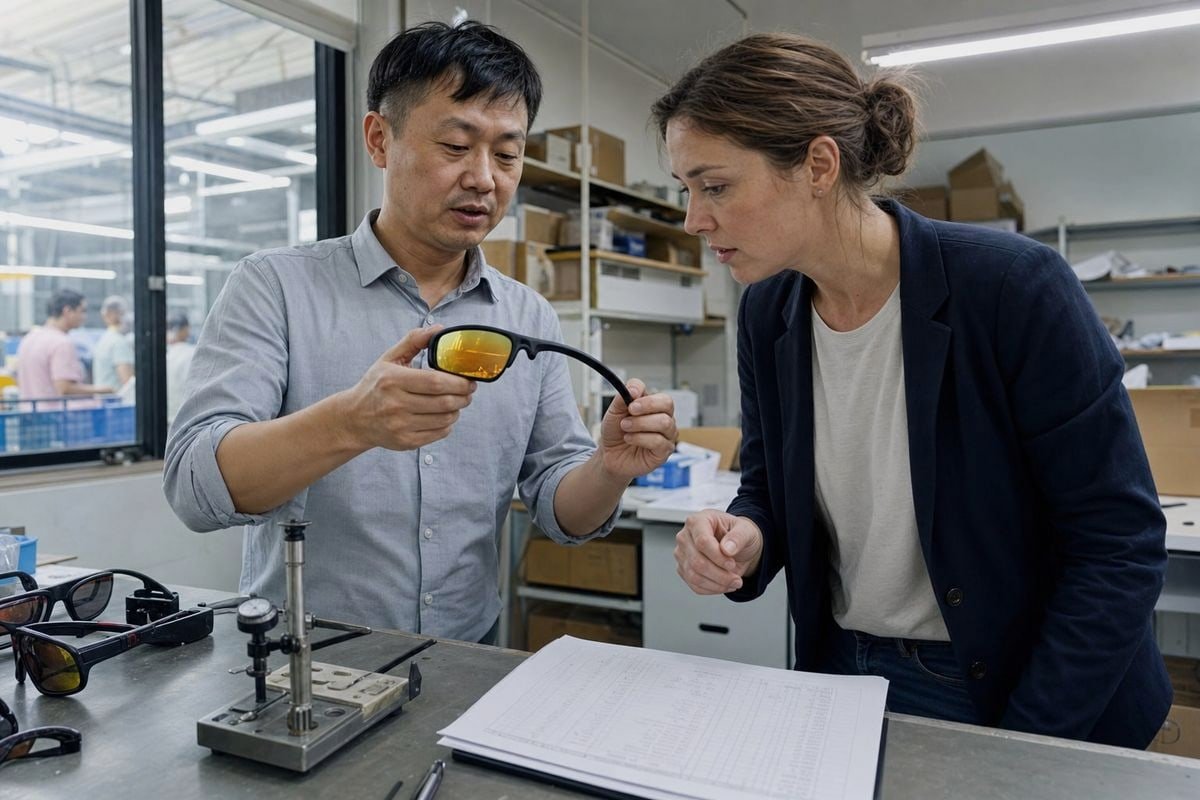
Unit price is the number on the invoice. True cost is what each successful, kept sale actually costs you. The gap between the two is where cheap kids' eyewear quietly destroys margin.
A simple worked comparison
Assume you buy 1,000 units. The cheap frame costs $1.80; the durable frame costs $2.30. Now layer in reality.
| Cost factor | Cheap frame ($1.80) | Durable frame ($2.30) |
|---|---|---|
| Units purchased | 1,000 | 1,000 |
| Expected failure/return rate | 12% | 3% |
| Units lost to returns/replacements | 120 | 30 |
| Replacement handling cost (est. $3/case) | $360 | $90 |
| Sellable full-margin units | 880 | 970 |
| Total cost (goods + handling) | $2,160 | $2,390 |
| True cost per sellable unit | ~$2.45 | ~$2.46 |
On paper, they land nearly even — before you count the invisible costs. A parent whose child's sunglasses snapped in week one rarely repurchases the same brand. That destroyed customer lifetime value 6 never appears on the invoice, but it is the largest line item. Add negative reviews, marketplace penalties for high return rates, and staff hours spent processing claims, and the durable frame wins decisively.
The inventory turnover angle
Failures also distort your inventory turnover ratio. Replacement units ship at zero margin, yet they consume the same warehouse space and freight as full-price sales. High failure rates force you to over-order as a buffer, which ties up cash and increases the risk of dead stock when the season ends. Retail stockouts get worse too, because warranty replacements silently eat inventory you had earmarked for new sales. When you model your next order, price the failure rate — not just the unit.
Can working with an experienced OEM/ODM factory help me plan smarter reorder cycles and safety stock levels?
Early in my export career, I learned a hard lesson: a buyer who ordered once in spring and went silent had not lost demand — he had lost sales to a stockout in July because neither of us planned for replacement demand.
Yes. An experienced OEM/ODM factory shortens reorder lead times, holds materials for repeat runs, shares seasonal demand forecasting insight from multiple markets, and offers existing styles for fast restocks — letting you carry leaner safety stock while avoiding retail stockouts during peak-loss windows.
Kids' sunglasses have two demand curves, not one. The first is the launch curve — new customers buying at the start of summer or back-to-school. The second is the replacement curve, driven by loss and damage rates, and it peaks weeks after the first. Parent purchasing behavior in this category is urgent: when a pair is lost before a beach holiday, the family buys whatever is in stock today. If your shelf is empty, a competitor gets the sale. Planning around both curves is where a factory partner earns its keep.
How a factory partnership changes the math
Here is what we do with repeat B2B buyers 7 across our 20+ export markets, and how each step affects your planning:
- Start from existing styles. With roughly 800 ready styles, buyers can test hero SKUs without mold investment. Micro-collection testing identifies winners before you commit deep stock.
- Lock reorder terms upfront. We agree on repeat-run lead times before the first order ships. Shorter, predictable lead times mean lower safety stock requirements — the two are mathematically linked.
- Reserve materials for proven SKUs. For established programs, we hold TR90 and TPEE material against forecast reorders. That compresses reorder cycles during peak season.
- Share cross-market seasonality. Because we serve brands in Australia, Japan, and Europe, opposite hemispheres give us early signals for seasonal demand forecasting that a single-market buyer cannot see alone.
- Structure the assortment for replacement demand. Core bestsellers in depth, a lower-priced backup tier for emergency repurchases, and multiple size bands to prevent fit-related loss by non-use.
There is one more layer: warranty and replacement programs. If you offer parents a low-friction replacement promise, your factory must supply consistent quality and continuity of styles across production runs. A parent replacing a lost pair often wants the identical frame. We keep colorways and tooling stable across seasons for exactly this reason — continuity turns a loss event into a retained customer instead of a churned one.
Conclusion
Loss and damage rates make kids' sunglasses a replacement-driven business. Choose flexible, tested frames, price in true failure costs, and partner with a factory that supports fast, consistent reorders.
Footnotes
1. Replaces 403 error with authoritative information on eyewear frame materials and durability standards. ↩︎
2. Background on thermoplastic elastomers explains why TPEE temples flex without breaking. ↩︎
3. WHO explains UV radiation risks that UV400 lens protection is designed to prevent. ↩︎
4. Replaces 403 error with a stable, authoritative overview of international quality management standards. ↩︎
5. Explains the inventory metric distorted by warranty replacements discussed in this section. ↩︎
6. Defines the metric used to quantify long-term losses from product failures and churn. ↩︎
7. Alibaba is a leading B2B sourcing platform connecting brands with OEM/ODM manufacturers. ↩︎
More Articles You Might Like
August 1, 2026
Should Factory Handle Kids Sunglasses Packaging & Labeling, or Use a Designated Supplier?
August 1, 2026
Own Warehouse vs Supplier Direct Fulfillment: Which Cuts Return Costs for Kids Sunglasses Brands?

August 1, 2026
Direct-to-Port Warehouse or Overseas Staging: Which Saves More on Kids Sunglasses Shipping?
Looking for a Reliable Kids Eyewear Partner?
Explore 800+ ready styles and full OEM/ODM support tailored to your brand.
Get in Touch English
  Español de México
  Deutsch
  Français
  日本語
日本語  العربية
  Português do Brasil