How to Judge Kids’ Optical Frames Quality by Appearance and Craftsmanship?
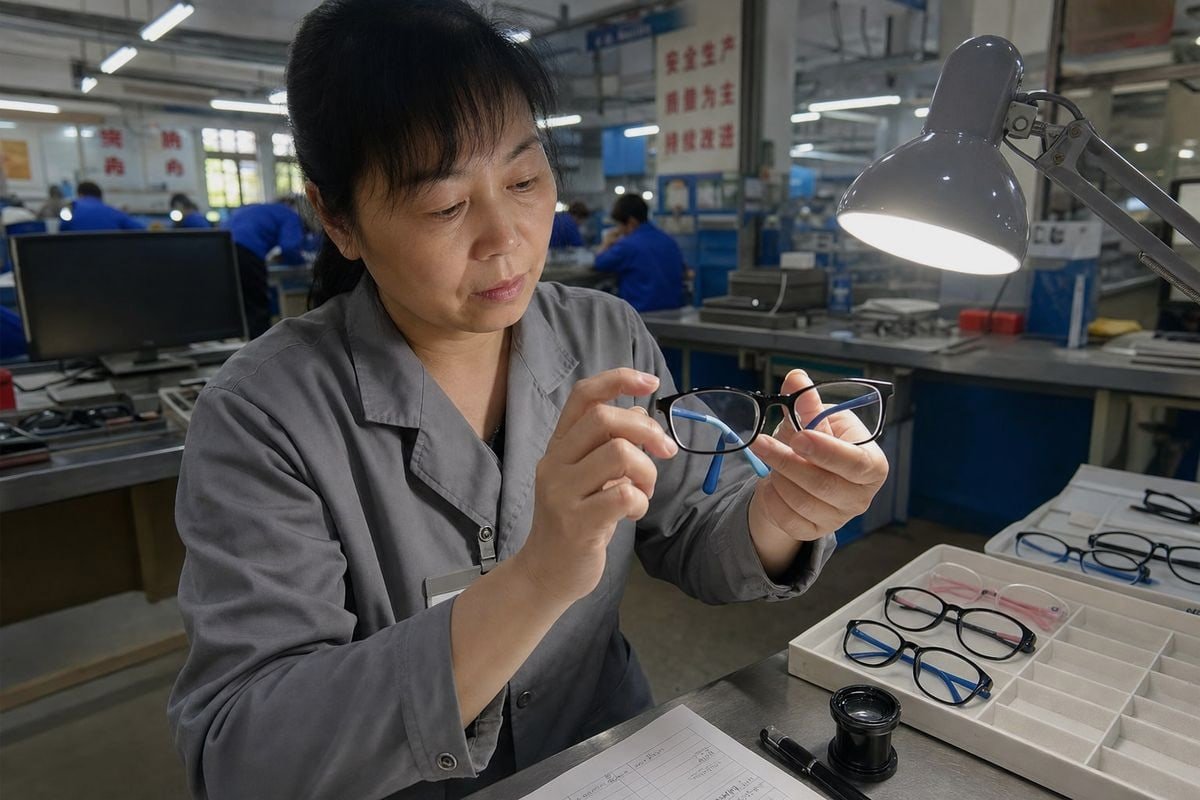
Kids’ optical frames quality can look fine in a photo and fail in a child’s hands. On our production line in Taizhou, I see why samples deceive buyers every week.
To judge kids’ optical frames quality by appearance, check surface finish under bright light, run fingers along edges for burrs, open hinges repeatedly for smooth resistance, confirm symmetry on a flat table, and verify a child-anatomy bridge. Visible workmanship reliably predicts hidden construction quality.
You do not need lab equipment to spot a weak frame. You need to know where factories cut corners. I will walk you through the exact checks we use in our own QC room.
What Should I Look for in the Frame's Surface Finish and Edges?
Last spring, a buyer from Australia sent me a competitor's sample with a visible mold line across the brow. That single flaw told me everything about that factory's polishing process.
Look for an even, streak-free finish under bright light, hand-polished rounded edges with no injection-mold lines, no leftover flashing or burrs, and consistent color depth. On acetate frame finish, edges should feel glassy-smooth; on TR90, seams should be nearly invisible.
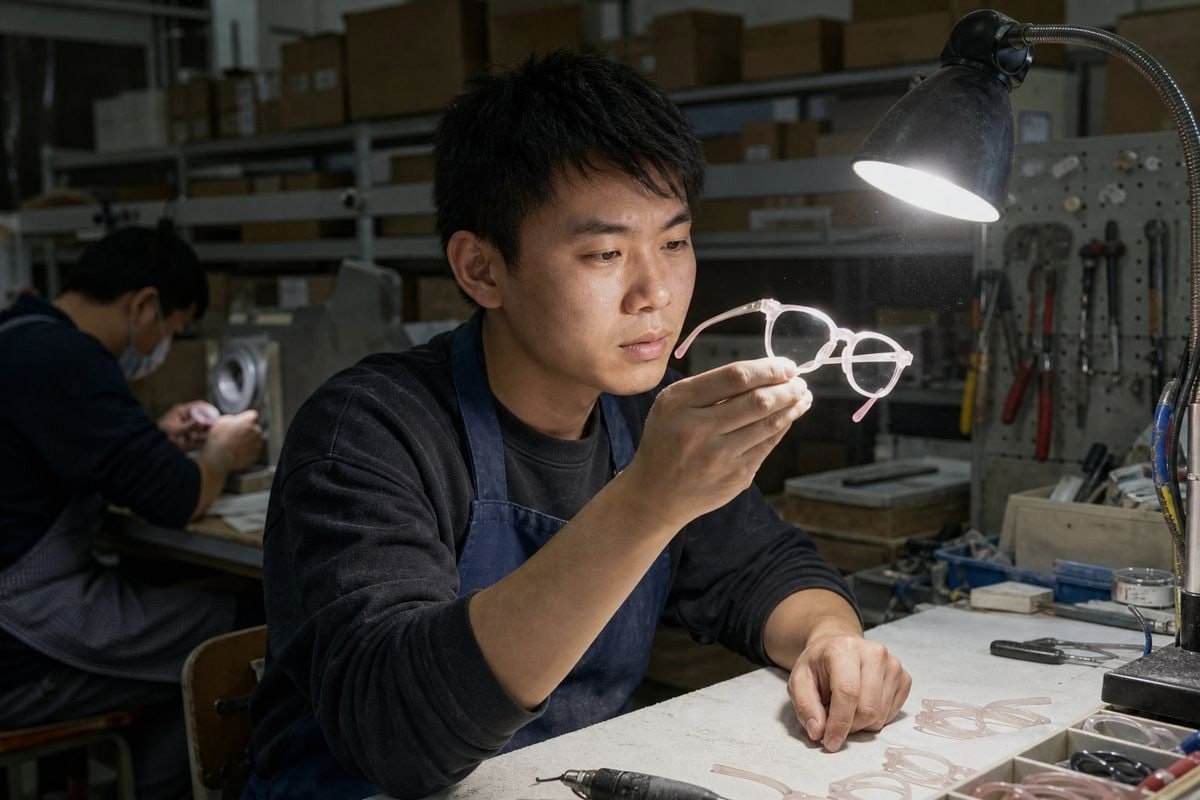
Surface finish is the first honest signal a frame gives you. In our 5S-managed workshop, polishing is a separate, timed station because rushed polishing is the most common shortcut in cheap kids' eyewear. A frame that skips proper tumbling and hand-finishing will show it, and a child's skin will feel it.
The Bright-Light Test
Hold the frame front under a strong lamp and tilt it slowly. A quality finish looks uniform. Watch for cloudy patches, orange-peel texture, uneven shine, or streaks in the color. On translucent acetate, look inside the material for bubbles or swirls that break the color consistency.
The Fingertip Test
Your fingers find what your eyes miss. Run a fingertip along the lens rim, the inner bridge, and the temple edges. You should feel nothing sharp. Plastic burrs, rough seams, or leftover flashing mean the deburring step was skipped. For children, that is a safety issue, not just a cosmetic one, because those edges sit against soft facial skin for hours.
| Finish Check | Good Sign | Warning Sign |
|---|---|---|
| Color under bright light | Even, deep, consistent | Cloudy spots, streaks |
| Edge rounding | Smooth, hand-polished radius | Sharp mold lines, flashing |
| Inner surfaces | Clean, no glue marks | Glue residue, rough seams |
| Material clarity | Uniform, refined shine | Cheap plastic gloss, bubbles |
Some suppliers now add integrated antimicrobial additives 1 to the frame resin, an emerging standard worth asking about since children touch their frames constantly. We also confirm BPA-free components 2 for every kids' material batch, because a beautiful finish means little if the substrate itself is not child-safe.
How Can I Tell if the Hinges and Joints Are Well-Made?
The trade-off I weigh most often in development is hinge cost versus hinge lifespan. A hinge that saves a few cents per unit is the part parents will complain about in month three.
Well-made hinges open and close smoothly with even resistance, no grit, wobble, or creaking. Spring hinges should flex beyond 90 degrees and snap back cleanly. Screws should be countersunk and tight, joints flush, and temples should stay aligned after twenty open-close cycles.
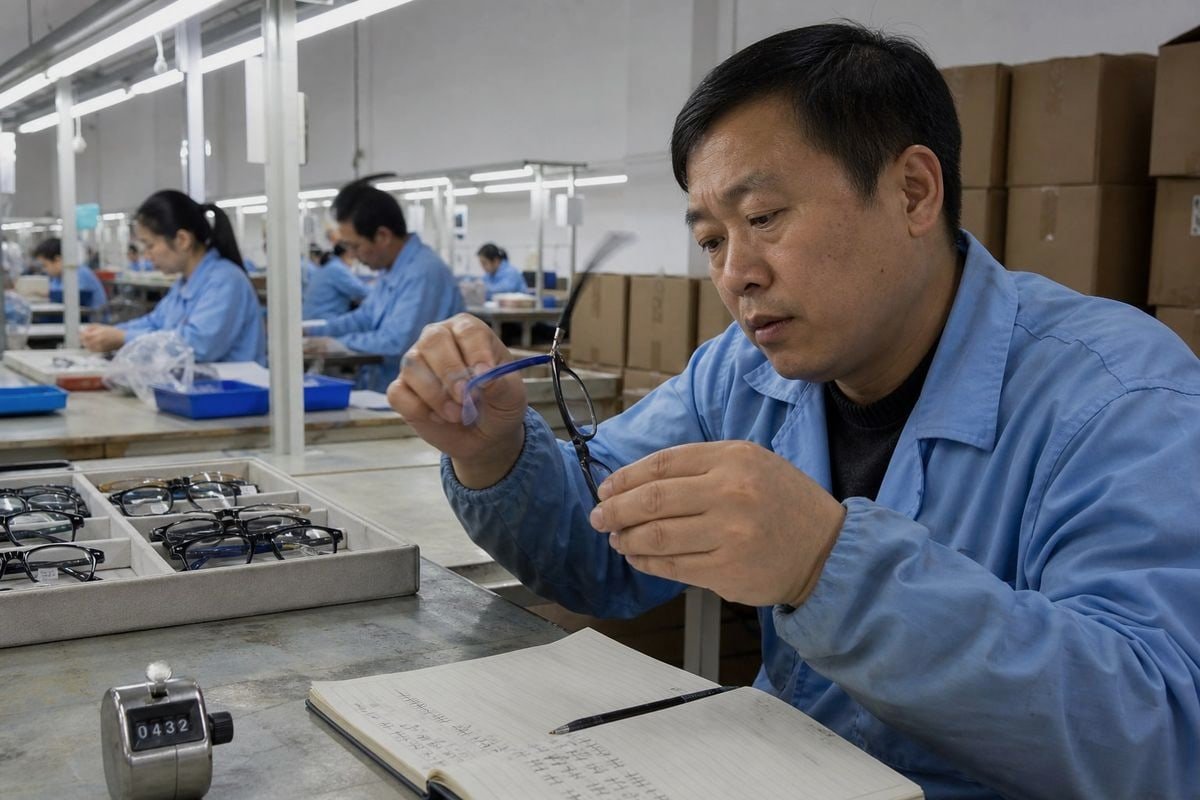
Hinge feel is the single best craftsmanship indicator you can test in under a minute. When we approve a pre-production run at our factory, every QC operator cycles the temples of sampled units and listens. A quality hinge is quiet. Grinding, clicking, or a loose rattle means poor tolerances or bad riveting.
Why Spring Hinges Matter for Kids
Children pull glasses off with one hand. They fall asleep in them. A spring hinge that flexes outward past 90 degrees absorbs that abuse instead of transferring it to the frame front. Spring hinge durability is why we specify them on most of our TR90 kids optical frames, even though rigid barrel hinges cost less. Test the spring by opening the temple past its stop: resistance should be firm, and the return should be immediate, with no lag or sticking.
Joints, Screws, and Screwless Designs
Look closely at where metal meets plastic. Countersunk screws and recessed hardware should sit flush, with no protruding heads that can snag hair or scratch skin. Screwless hinge technology is gaining ground in children's eyewear because there is nothing to loosen and nothing small to swallow; if a frame uses it, check that the snap-fit joint has zero side-to-side play. On acetate temples, an internal metal wire core 3 is a quality marker too. It lets an optician cold-bend the temple for a custom, permanent fit, something a hollow plastic temple cannot offer.
Finally, do the repeat test. Open and close both temples twenty times. Then set the frame on a flat table. If a temple has drifted out of alignment already, the joint will not survive a child's school year.
What Craftsmanship Details Reveal a Factory's True Quality Standards?
A procurement manager from Japan once asked me why our quote was higher than a rival's for a visually similar frame. I answered by handing her both samples and asking her to check five details. She placed the order.
Compare 2–3 samples from different batches for consistency, then inspect anatomical bridge design, temple curvature starting at the ear's peak, integrated nose pads or non-slip textures, material memory that returns to shape without creaking, and clean inner surfaces. Consistency across units reveals real quality control.
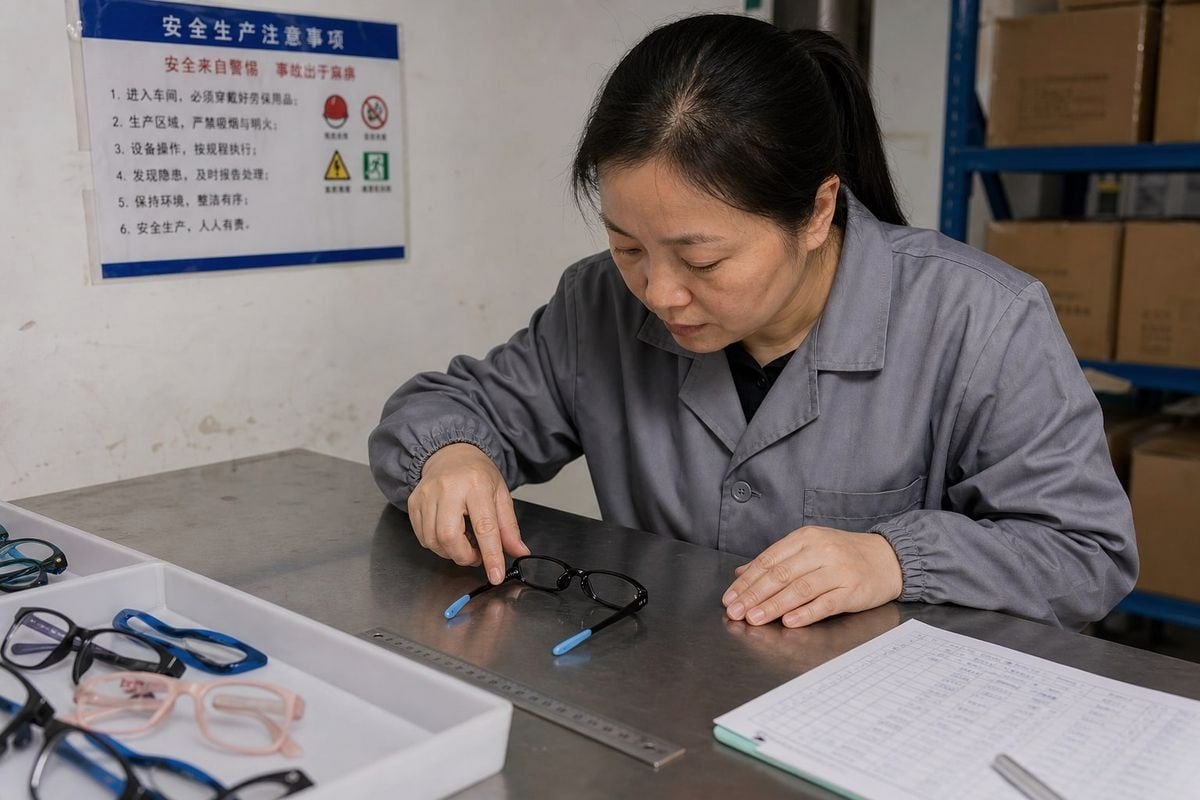
Cosmetic consistency is a proxy for process control. That is why I always tell buyers to request two or three samples, ideally from different pre-production batches, and compare them side by side. A factory with master samples, batch inspections, and color matching will hand you near-identical units. A factory without those controls cannot hide the variation.
Details That Separate Kids' Design From Shrunken Adult Design
A true children's frame is engineered for child anatomy, not scaled down. Here is what we build into our own designs and what you should look for in anyone's:
| Craftsmanship Detail | What It Reveals |
|---|---|
| Saddle bridge 4 with full, gap-free nose contact | Anatomical bridge design, not a resized adult mold |
| DBL in the 14–17 mm range | Correct child bridge spacing for stability |
| Temple curve beginning at the ear's peak | Anatomical balance; no pressure on the mastoid bone |
| Laser-etched micro-textures inside bridge and temples | Passive non-slip grip without sticky coatings |
| Modular temple-tip systems | Frame can grow with the child via longer or cable tips |
| Integrated nose pads molded into the front | Fewer parts to loosen, smoother skin contact |
A saddle bridge that hugs the nose without gaps spreads weight evenly and stops the constant slipping that makes kids abandon their glasses. Our TR90 frames with TPEE temples use flexible temple tips in soft silicone precisely because grip should come from geometry and material, not from adhesives. Material choice matters here too: TR90 memory plastic and hypoallergenic materials like TPEE show a factory prioritizing skin safety and comfort, not just unit cost.
The Material Memory Test
Gently flex the frame front and temples. Quality TR90 memory plastic or memory metal returns to shape instantly, silently, and completely. Creaking, whitening at the flex point, or a slow return signals degraded or blended resin.
Which Visual Defects Should Make Me Reject a Sample Batch?
Early in my fifteen years in eyewear, I learned an expensive lesson: a defect you excuse in the sample stage multiplies in mass production. Now our incoming and outgoing QC treats certain flaws as automatic rejections.
Reject batches showing glue marks, rattling or misaligned hinges, sharp edges or exposed burrs, frames that rock on a flat surface, asymmetrical temples, uneven polish, chipped metal coating, loose nose pads, or unit-to-unit color variation. These defects predict field failures and safety complaints.
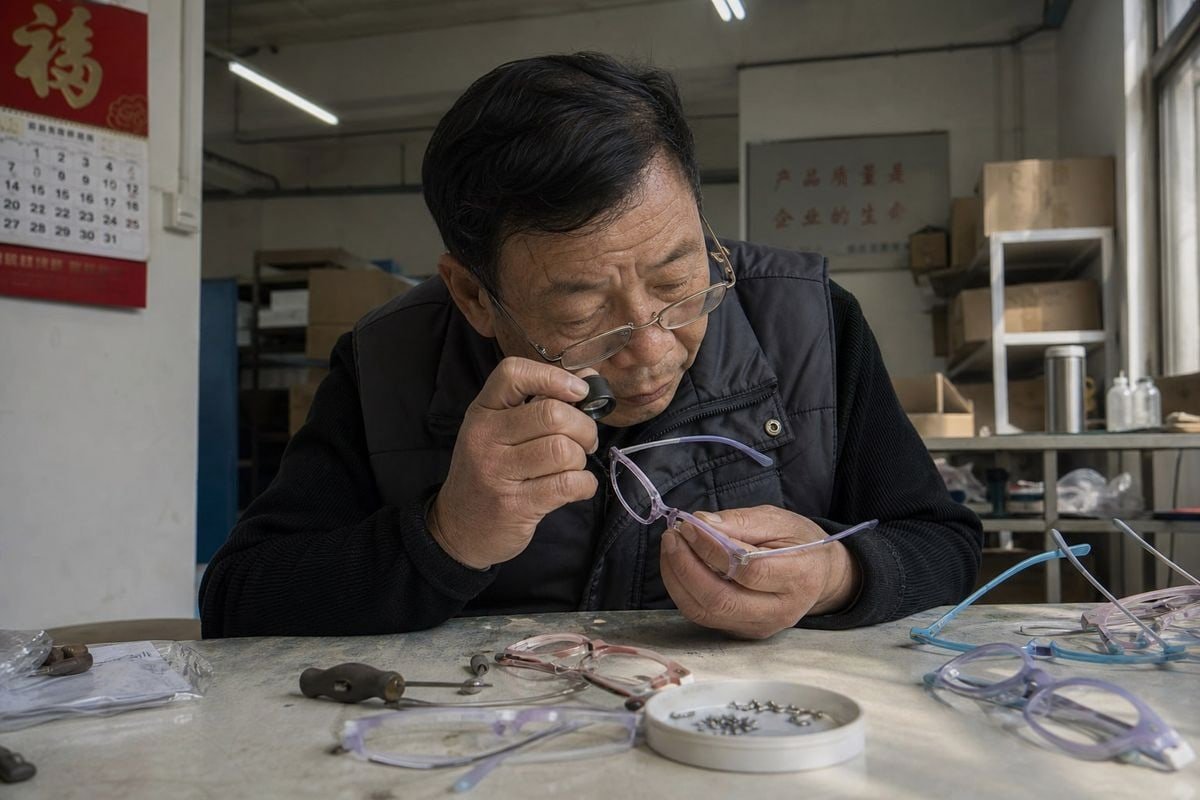
Some defects are cosmetic annoyances. Others are early warnings of returns, complaints, and safety risk. The skill is knowing which is which, and for children's products the threshold must sit lower than for adult frames. A rough edge on an adult frame is a nuisance. On a six-year-old's face, it is a liability.
A Practical Reject-or-Accept Framework
Run a frame alignment check first: place the frame upside down on a flat table. Both temples must touch evenly. Rocking means twisted geometry from poor molding tolerance or shipping damage, and either cause is disqualifying at the batch level if it repeats.
| Defect Found | Severity | Decision |
|---|---|---|
| Exposed burrs, sharp points, protruding hardware | Critical safety | Reject the batch |
| Frame rocks on flat surface; skewed bridge | Major structural | Reject the batch |
| Rattling, gritty, or binding hinges | Major functional | Reject the batch |
| Visible glue marks at joints or lens rims | Major cosmetic/process | Reject; signals rushed assembly |
| Chipped or thin metal coating | Major durability | Reject; will worsen with wear |
| Slight polish unevenness on one unit only | Minor | Query; check more units |
| Minor color-batch variation vs. master sample | Minor–major | Negotiate; require color match to master |
Why One Bad Unit Matters
Buyers sometimes tell me a single flawed sample is statistically meaningless. I disagree, and here is the nuance: a polished-looking frame can still hide weak internal construction, so appearance alone never proves durability. But the reverse is reliable. A factory that ships you a defective sample, its best foot forward, has no functioning outgoing inspection. Pair your visual screen with the hinge cycling, flex, and fit tests from earlier sections, and insist that production match the approved master sample. Country of origin and brand name prove far less than these concrete construction details do.
Conclusion
Judge kids' optical frames quality by what you can see and feel: even finish, rounded edges, smooth spring hinges, true symmetry, and a child-anatomy bridge. These visible details predict real durability.
Footnotes
1. The EPA regulates antimicrobial substances used in materials to ensure they are safe for human contact. ↩︎
2. Supports child-safety claim about BPA-free materials with authoritative FDA safety guidance. ↩︎
3. Wikipedia provides technical details on cellulose acetate, the primary material for high-quality hand-polished optical frames. ↩︎
4. The FDA regulates prescription eyewear and frames as medical devices to ensure safety and biocompatibility. ↩︎
More Articles You Might Like


Looking for a Reliable Kids Eyewear Partner?
Explore 800+ ready styles and full OEM/ODM support tailored to your brand.
Get in Touch English
  Español de México
  Deutsch
  Français
  日本語
日本語  العربية
  Português do Brasil