How to Fix Loose Temples or Screws on TR90 & TPEE Kids Sunglasses?
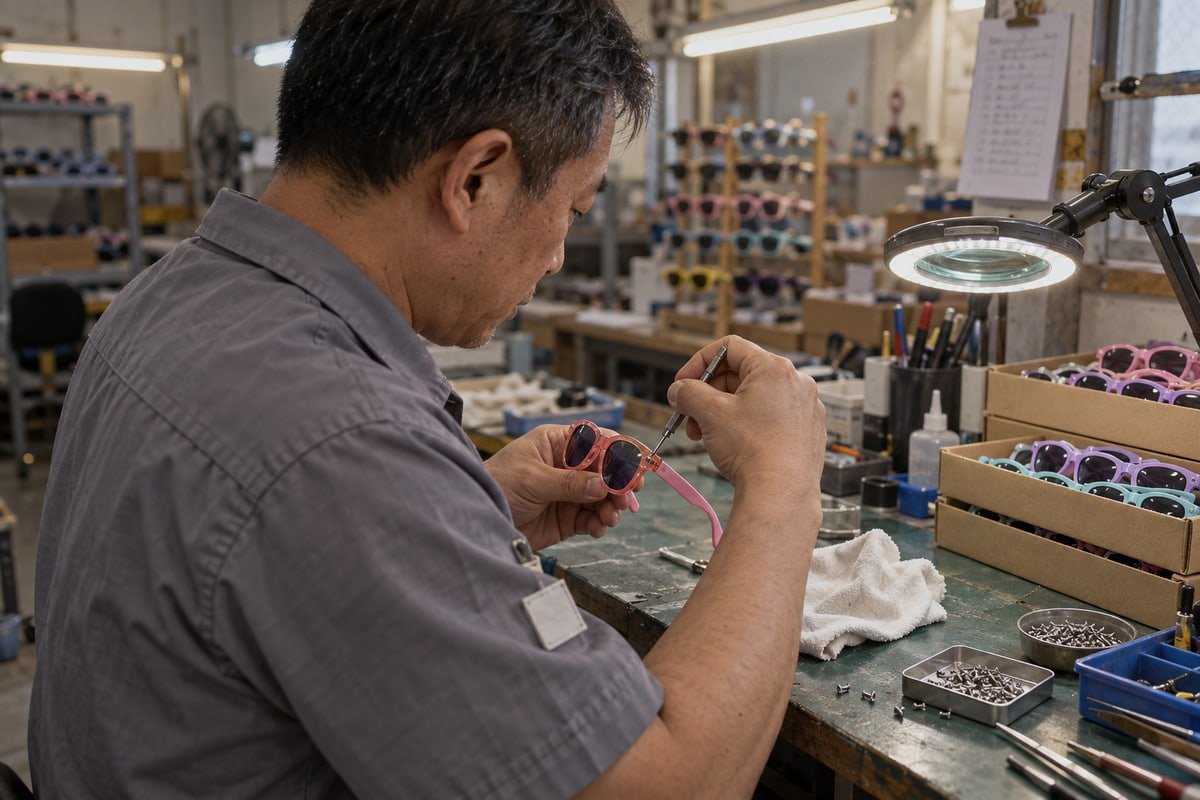
Loose temples or screws on TR90 & TPEE kids sunglasses annoy parents, trigger returns, and hurt your brand. Our Taizhou line taught me they are usually a two-minute fix.
To fix loose temples or screws on TR90 and TPEE kids sunglasses, tighten the hinge screw clockwise with a 1.0–1.4 mm precision screwdriver in half-turn steps until snug, then gently reshape the temple bend behind the ear by 1–2 mm. Never overtighten or overheat the flexible frame.
That is the short version. The longer version matters more if you sell these frames under your own brand. Below, I walk through the tools, the reasons TPEE temples loosen, how to spot a real defect, and what to ask your factory so the problem stops coming back.
What tools do I need to tighten loose screws on kids' TR90 sunglasses at home?
Last year our QC team opened a returned carton of translucent pink wayfarers. Every hinge was fine. The parents simply lacked the right screwdriver.
You need a micro screwdriver set with 1.0–1.4 mm flathead and Phillips tips, a white towel or high-contrast mat, a magnifier, spare replacement eyeglass screws, and a drop of clear nail polish or low-strength threadlocker. A basic optical repair kit covers most of these items.
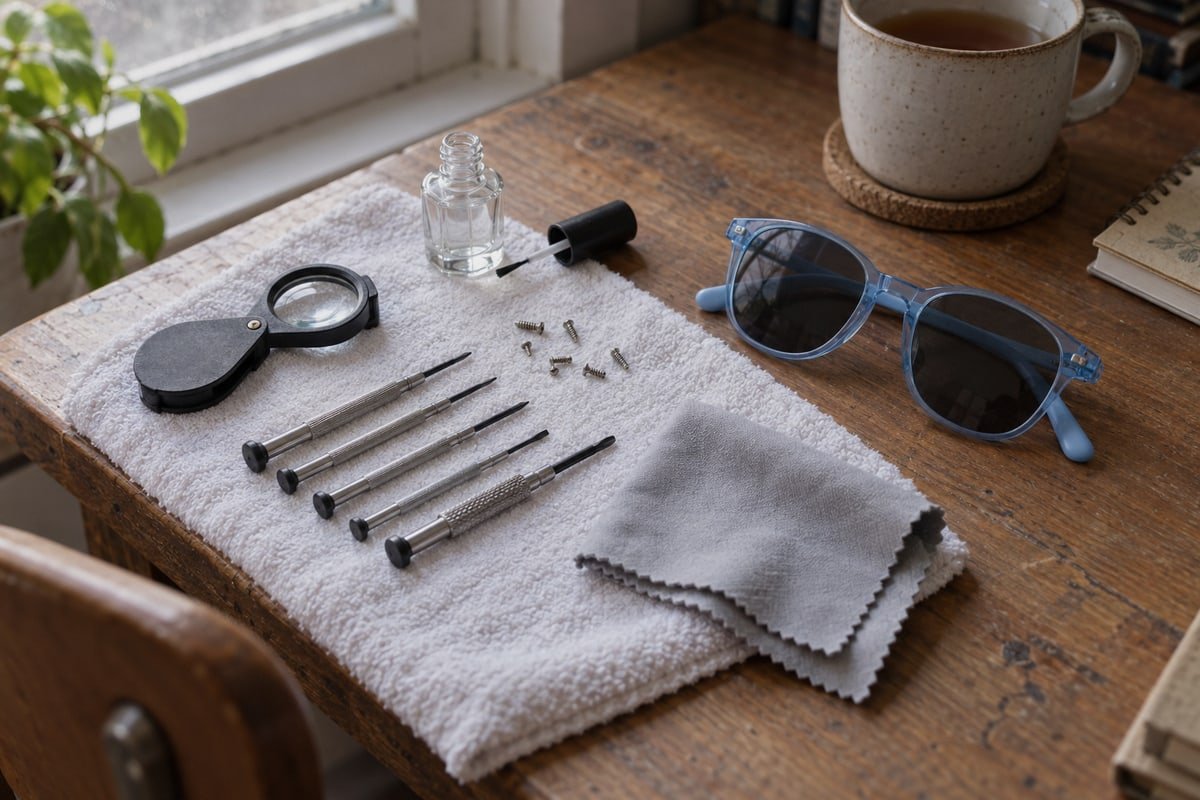
Kids' frames use smaller hardware than adult frames. On our TR90 fronts with TPEE temples, the hinge screws are noticeably thinner than what you find in a typical adult acetate frame. So a generic household screwdriver will not sit in the slot. It will slip, and it will chew the screw head. That is the number one reason a simple eyeglass hinge tightening job turns into a stripped screw.
The tool checklist
| Tool | Why it matters | Budget alternative |
|---|---|---|
| Micro screwdriver set (1.0–1.4 mm) | Fits the small hinge screws on kids' frames without slipping | A single 1.2 mm flathead from an optical repair kit |
| White towel or high-contrast mat | Screws are tiny and dark; a white surface makes a dropped screw easy to find | A sheet of white paper |
| Magnifier or phone camera zoom | Lets you see the slot direction and check thread condition | Reading glasses |
| Replacement eyeglass screws 1 | Needed if the original is missing or the head is damaged | Snap-It style screws with a breakaway feeder tab |
| Clear nail polish or low-strength threadlocker | Stops vibration from backing the screw out again | Skip it and recheck tightness weekly |
| Soft microfiber cloth | Protects the polarized lenses while you work | A clean cotton T-shirt |
The five-step tightening process
- Lay the sunglasses lens-down on the soft cloth, on top of the white towel.
- Look at both hinges under good light. Find which screw is loose.
- Seat the screwdriver fully in the slot. Turn clockwise in half-turn increments.
- Stop when the screw stops turning easily. Snug is the goal. Tight is not.
- Open and close the temple five or six times. It should move smoothly with light resistance.
Why half turns? The screw is metal. The hinge barrel on a kids' frame is often plastic, and plastic is softer than metal. If you crank the screw past snug, the metal threads cut the plastic threads, and the hole becomes oversized. After that, no amount of tightening holds.
If the screw is missing, Snap-It style replacement eyeglass screws are the easiest fix for a parent. The long feeder tab lets you guide the screw through both barrels, tighten it, and then snap the tab off. Before the final turns, touch a microscopic drop of clear nail polish or a purpose-made threadlocker for glasses to the threads. It sets a light seal that resists vibration but still lets you remove the screw later.
Why do my TPEE temples keep loosening even after I adjust them myself?
Every time we specify TPEE for a temple, we weigh softness against grip. Softer feels better on a child's ear, but softer threads hold a screw less firmly.
TPEE temples keep loosening because the elastomer is softer than the metal screw, so threads wear, skin oils lubricate the hinge, and heat makes the plastic expand faster than metal. Fix it by degreasing the hinge, adding threadlocker, and checking tightness after hot days.
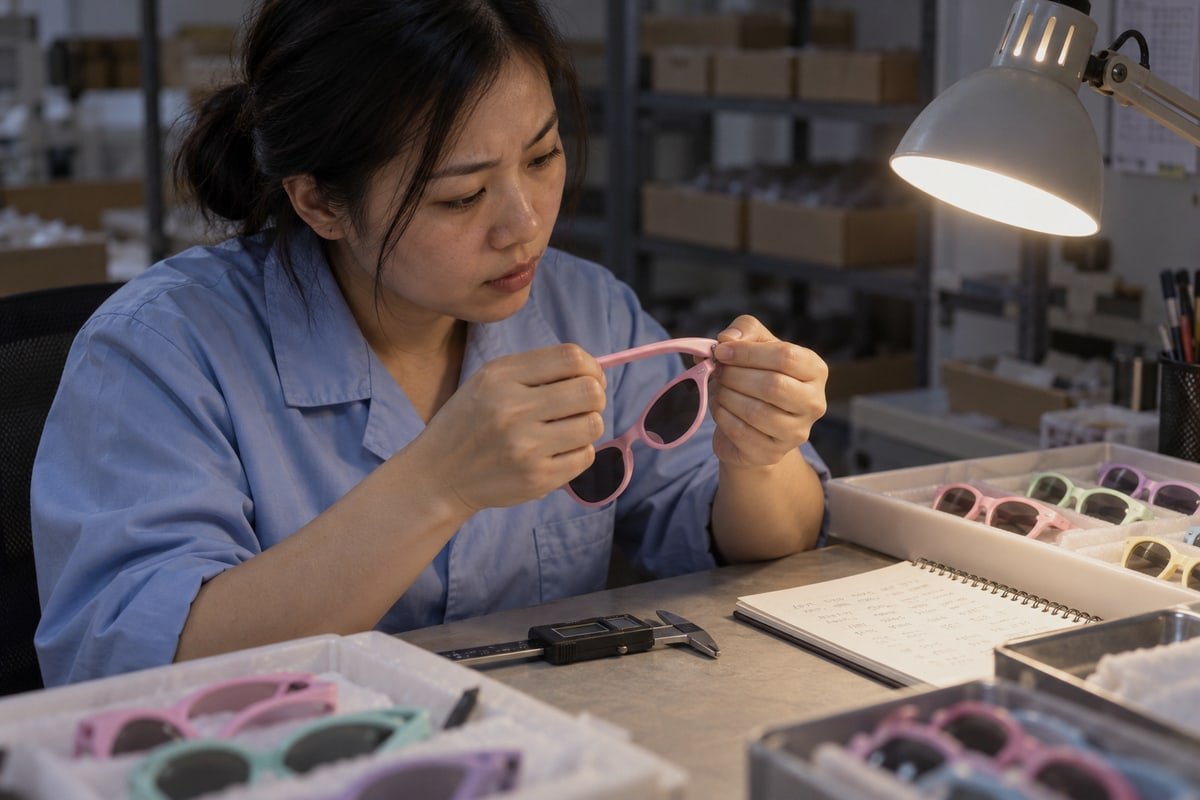
TPEE is a thermoplastic elastomer. TR90 is a thermoplastic nylon. Both bend instead of snapping, which is exactly why we use them on frames for active children. But those thermoplastic material properties also explain the repeat loosening that frustrates so many parents and brand owners.
The four real causes
| Cause | What is happening | Fix that actually lasts |
|---|---|---|
| Soft threads | Metal screw threads slowly widen the plastic barrel hole with each open-close cycle | Add threadlocker; if the hole is stripped, insert a thin sliver of wooden toothpick as filler so the threads can bite again |
| Skin oil build-up | Oils and sunscreen collect in the hinge and act as a lubricant, so the temple swings freely even with a snug screw | Degrease the hinge with a drop of dish soap and warm water, or an ultrasonic cleaner 2, then dry fully |
| Thermal float | TR90 and TPEE expand faster than metal in a hot car; the barrel grows, the screw loses preload, and backs out | Check tightness after any day the frames sat in high heat |
| Widened hinge socket | On TPEE, the friction-fit socket around the temple can stretch over time | Use padded pliers to gently compress the socket at room temperature; TPEE cold-forms and does not need heat for this |
The heat question, and where I land on it
Here is an objection I hear from buyers who have read different repair guides. Some guides say to soak plastic temples in water around 60°C before bending. Others say warm water near 120°F, roughly 49°C, or a low hair dryer setting. A few say no heat at all for flexible plastics.
My answer is the least heat necessary. For a flexible frame adjustment on TR90 or TPEE, start cold. Bend the temple tip 1–2 mm, test on the child, and repeat. Only if the temple resists do I move to lukewarm water for a short dip. I do not recommend going as high as 60°C on a kids' frame. Both materials keep their memory well, but too much heat can warp a thin temple or cloud a glossy translucent finish like our sky-blue crystal fronts. Cold TR90 can also be a little brittle, so never bend a frame straight out of a freezing car either.
One more caution. If the frame has a spring hinge, the tension comes from the spring, not the screw. Cranking the screw harder will not fix a tired spring. Spring hinge repair is a job for an optician or the factory, not a kitchen table.
How can I tell if a loose temple is a quality defect from my supplier?
A procurement manager in Australia sent me photos of three loose hinges and asked one fair question: is this your fault or normal wear? Here is how we answer it.
A loose temple is likely a supplier defect if it appears out of the box, affects many units in one batch, shows a stripped or off-center screw hole, or the hinge barrels are misaligned. Loosening after months of daily wear is usually normal and fixable.
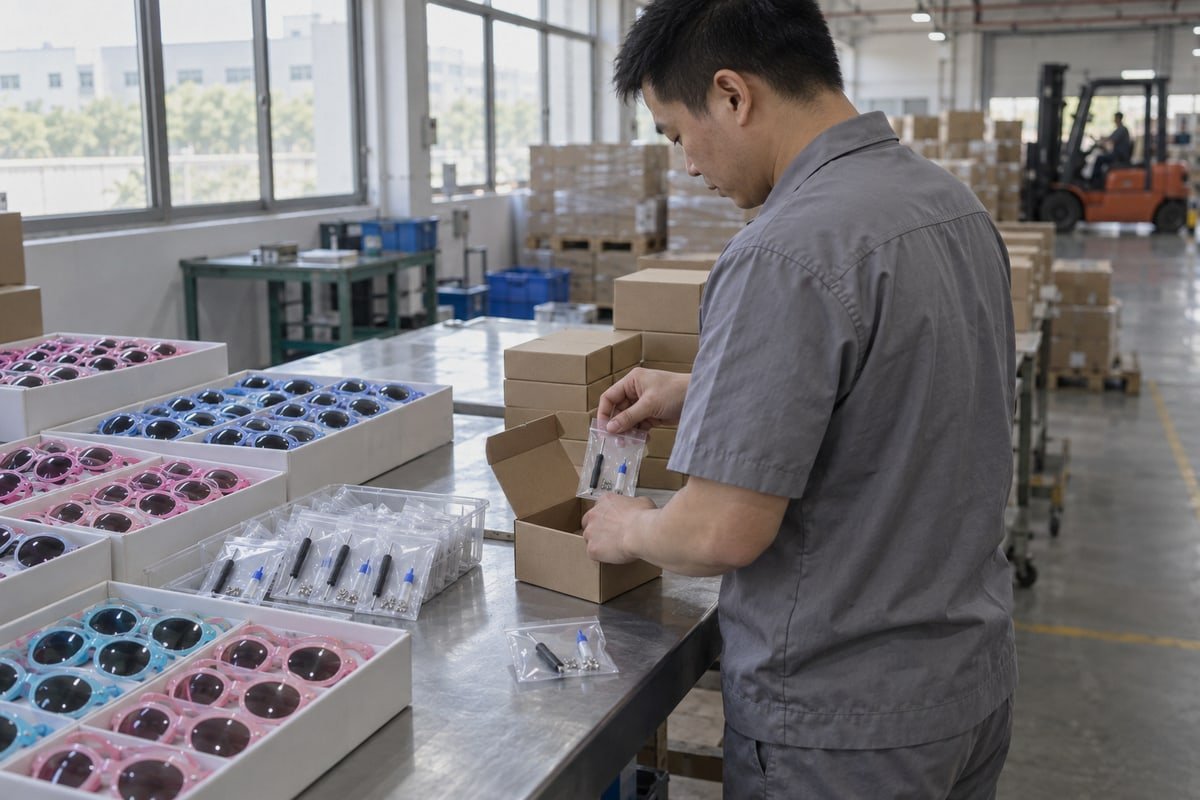
I want to be honest here. Some loose hinges are the factory's fault. Some are the result of a five-year-old sitting on the frames. The good news is that the two look different under a magnifier, and you can learn to tell them apart in a few minutes.
Defect versus wear: what to look for
| Sign | Points to supplier defect | Points to normal wear or misuse |
|---|---|---|
| Timing | Loose on arrival or within the first week | Loose after several months of daily use |
| Pattern | Many units in one carton, same hinge, same side | One unit, random hinge |
| Screw hole | Drilled off-center, oversized, or threads never cut cleanly | Threads worn smooth but originally centered |
| Barrel alignment | Front barrel and temple barrel do not line up, screw sits at an angle | Barrels aligned, screw straight |
| Screw itself | Wrong length, wrong thread pitch, or head already burred at delivery | Head burred by a wrong-size household screwdriver |
| Temple shape | Both temples splayed outward straight from the box | One temple bent from being pushed up on the forehead or sat on |
How we inspect on our side
At our 5S-managed workshop 3, hinge riveting and screw driving are separate stations. Each has a torque target 4 and a visual check. When a buyer reports loose temples, we ask for three things: the carton number, close-up photos of both hinge barrels, and a short video of the temple swinging. That lets us trace the batch and compare it to our retained samples from the same run.
One myth I want to clear up. Marketing copy sometimes calls TR90 frames unbreakable kids glasses. Flexible, yes. Unbreakable, no. A bendable frame survives drops and twists that would crack acetate, but its plastic barrels still wear. So a screw that loosens after a full summer on a busy child is not, by itself, a defect.
What to document before you contact the factory
- Batch or PO number and the style code, for example the slate-blue chunky square style.
- Number of affected units versus total units received.
- Photos under good light, hinge open and hinge closed.
- Whether the frames were stored or displayed in a hot location.
Clear documentation turns a blame conversation into a fix conversation. Most reputable factories will replace a true defect. They will also help you with eyewear maintenance tips for your customers if the cause is wear.
What should I ask my manufacturer to prevent recurring temple and screw issues in future orders?
The biggest lesson from fifteen years of making kids' frames is simple: most hinge complaints are decided at the drawing stage, long before the carton ships.
Ask your manufacturer for screw size and material, hinge type, thread locking during assembly, a hinge open-close cycle test, temple tension checks in final QC, spare screws in each pack, and a pre-shipment inspection report. Also confirm their heat-handling advice for TR90 and TPEE.
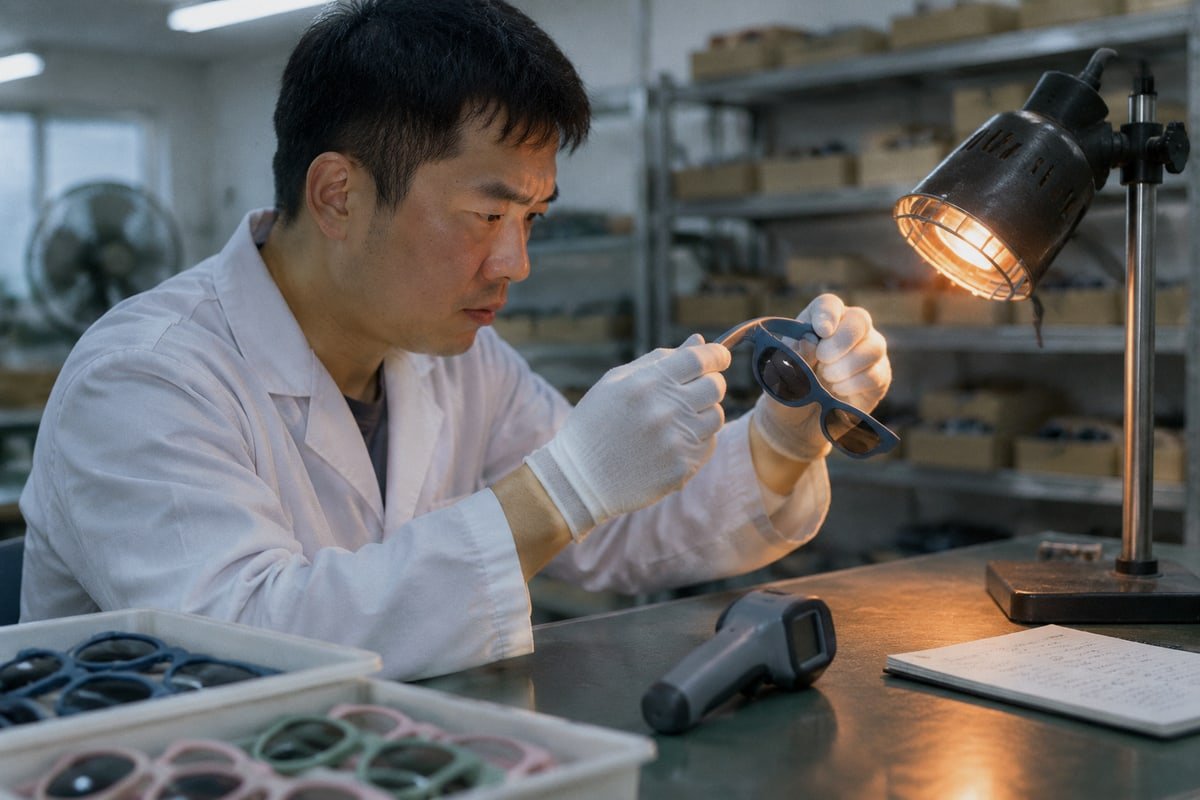
Buyers often ask us about lens options, colors, and logos first. Those matter. But the hinge is the one moving part on a pair of kids' sunglasses, and it takes more abuse than anything else. Here are the questions I would want answered before placing a repeat order, along with what a good answer sounds like.
Seven questions worth asking
- What screw size and material do you use on this style? A good answer names the diameter and length and states whether the screw is stainless steel 5. Vague answers like "standard screws" are a warning sign.
- Is the hinge a rivet hinge, a screw-through-barrel hinge, or a spring hinge? Each behaves differently. Simple riveted metal hinges, like the ones on our translucent wayfarer styles, have fewer failure points for small children.
- Do you apply any threadlocker during assembly? Some factories do, some do not. A light thread lock at the line reduces vibration loosening during shipping and early use.
- Do you run an open-close cycle test on the hinge? The exact count matters less than whether the test exists and whether results are recorded per batch.
- Is temple tension checked at final QC? A quick swing test on every unit catches free-swinging temples before packing.
- Can you include spare replacement eyeglass screws or a small optical repair kit in the retail pack? For us, this is part of the OEM/ODM accessory menu, alongside cases and cloths. It also gives parents a positive experience instead of a return.
- What storage and heat guidance should we print for consumers? A short care card noting that hot cars can loosen screws saves everyone a complaint.
What good looks like on paper
| Item you request | Weak supplier response | Strong supplier response |
|---|---|---|
| Screw spec | "Normal size" | Diameter, length, material, and drawing reference |
| Hinge QC | "We check everything" | Named station, torque target, sample size per carton |
| Spare parts | Not offered | Spare screws and cloth packed per unit on request |
| Inspection report | Photos only | Report with batch number, defect categories, and pass rate |
| Material advice | None | Written guidance on TR90 and TPEE heat limits for your care card |
We keep around 800 existing styles, so a brand can test a market without paying for molds. Even so, I encourage every buyer to ask these seven questions on the very first sample order. It costs nothing, and it tells you quickly whether you are dealing with a factory or a trading company that has never seen a hinge station.
Conclusion
Loose temples or screws on TR90 and TPEE kids sunglasses frustrate parents and cost brands returns. Tighten gently, adjust in millimeters, and partner with a factory that engineers hinges properly.
Interested in sourcing the products mentioned in this article? See details and request a quote here:
Footnotes
1. NIST provides technical standards for the dimensions and tolerances of micro-scale hardware and fasteners. ↩︎
2. Wikipedia explains the mechanism of using high-frequency sound waves to remove contaminants from hinges. ↩︎
3. The EPA defines 5S as a foundational lean manufacturing method for organizing productive environments. ↩︎
4. ISO standards cover the measurement and application of torque in precision assembly processes. ↩︎
5. Wikipedia provides the chemical composition and properties of corrosion-resistant stainless steel grades used in eyewear. ↩︎
More Articles You Might Like


Looking for a Reliable Kids Eyewear Partner?
Explore 800+ ready styles and full OEM/ODM support tailored to your brand.
Get in Touch English
  Español de México
  Deutsch
  Français
  日本語
日本語  العربية
  Português do Brasil