What to Do If Kids’ Sunglasses Temples Become Loose?
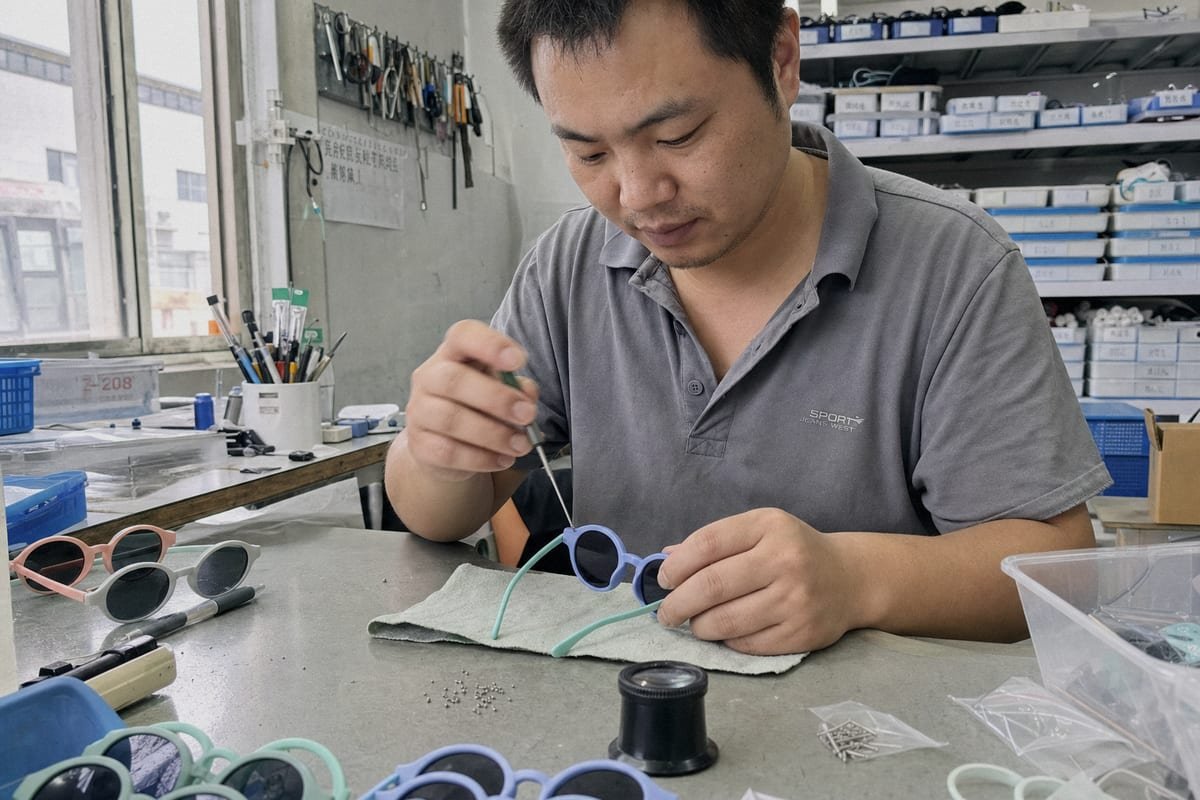
Kids’ sunglasses temples become loose faster than most parents expect polarized lens 1. On our production line in Taizhou, we see the same failure patterns buyers complain about every season — and fix them at the design stage.
If kids’ sunglasses temples become loose, first tighten the hinge screws with a precision screwdriver, turning clockwise in small increments. If the arms still slip, gently warm the temple tips and bend them slightly inward. Replace the frame if the screw hole is stripped or the hinge is cracked.
That is the short answer. Below, I will walk you through the causes, the safe home fixes, the materials that prevent the problem, and how to choose a supplier who designs it out completely.
What causes my kids' sunglasses temples to loosen over time?
A buyer from Australia once shipped us three worn samples from a competitor and asked why every hinge wobbled. When we opened them up, the answer was obvious within minutes.
Kids' sunglasses temples loosen for two main reasons: the hinge screw backs out from repeated opening and closing, or the temple arms lose their original shape from rough handling, heat exposure, and one-handed removal. Cheap materials and undersized hinges accelerate both problems.
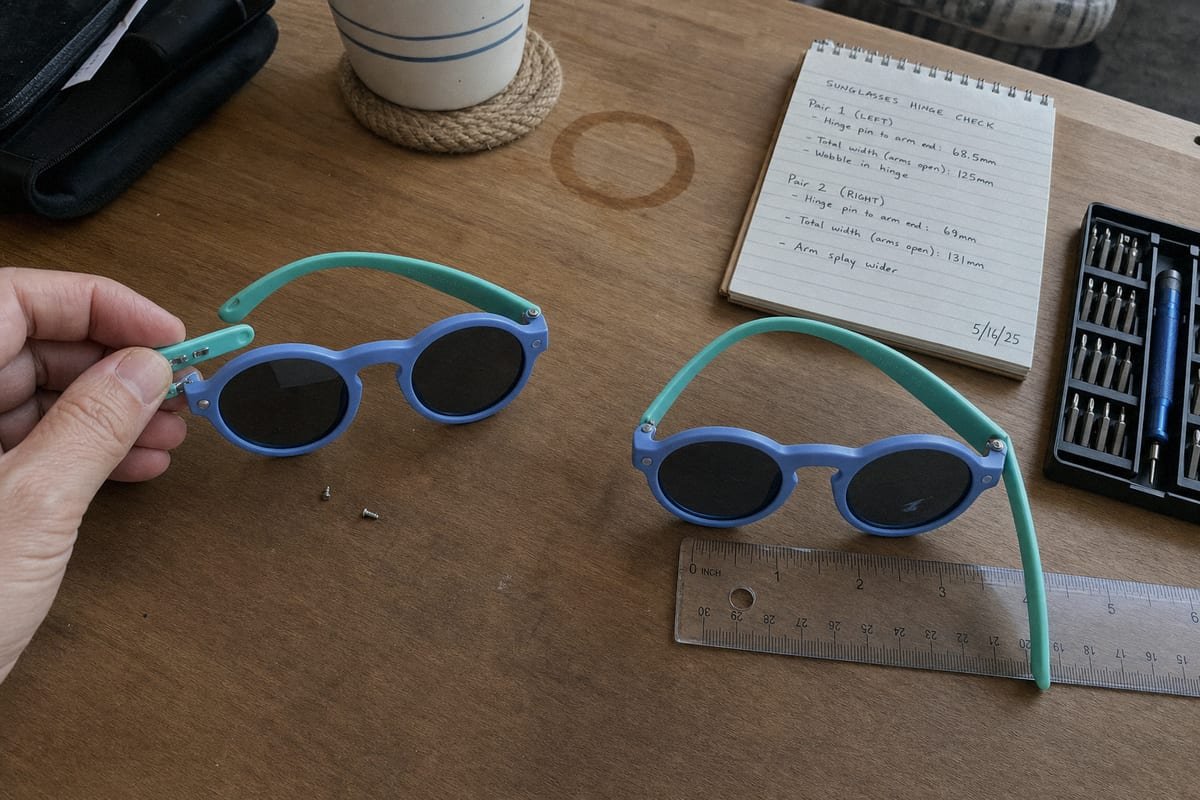
It helps to understand that "loose temples" is really two separate problems. The repair method depends on which one you have, so diagnosing correctly is the first step.
Problem one: the hinge screw loosens
Every time a child opens and closes the frame, the hinge screw experiences tiny rotational forces. Kids open their sunglasses far more roughly than adults do. They also fold them one side at a time, twist them, and stuff them into bags. Over hundreds of cycles, the screw slowly backs out. Once there is lateral wiggle at the joint, the movement gets worse fast, because a loose screw wears the screw hole wider with every swing.
Problem two: the temple arms lose their shape
Plastic temples hold a memory of their molded curve. Heat is the enemy here. A car dashboard in summer, a beach bag in the sun, or even a radiator shelf can soften cheap plastic enough for the arms to relax outward. Children also pull sunglasses off with one hand, which stretches one temple wider than the other. The result is a frame that sits crooked and slides down the nose.
How the two problems compare
| Symptom | Likely cause | First fix |
|---|---|---|
| Temple swings freely when you shake the frame | Loose hinge screw | Tighten hinge screws |
| Frame slips down but hinges feel firm | Deformed temple arms | Temple tip adjustment with gentle heat |
| Frame sits crooked on the face | Uneven stretching from one-handed removal | Symmetrical reshaping of both arms |
| Screw will not stay tight | Stripped screw hole or worn hinge | Professional repair or replacement |
In our 15 years making children's eyewear, we have found that low-cost frames usually suffer both problems at once. That is why we moved almost entirely to flexible TPEE frames and TR90 for our kids' lines — but more on that later.
How can I fix loose temples on children's sunglasses at home?
During quality checks in our 5S 2-managed workshop, our team performs the same simple adjustments I am about to describe — just with calibrated tools. You can replicate most of them at your kitchen table.
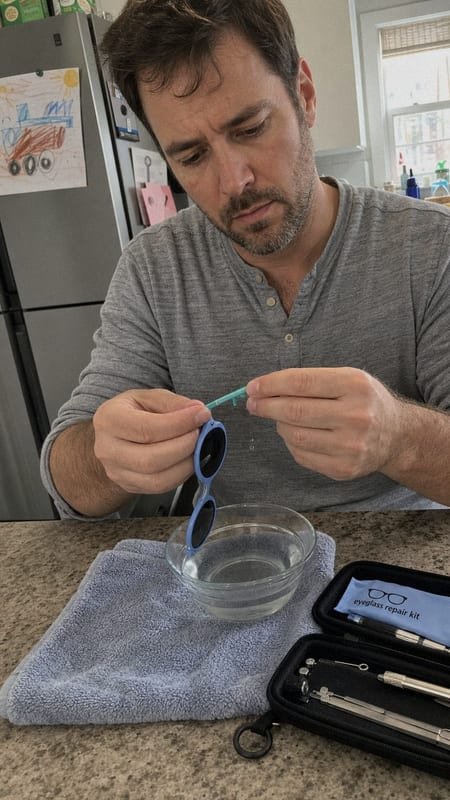
Tighten the hinge screw clockwise using a precision screwdriver from an eyeglass repair kit, testing after each small turn. If the arms are too wide, warm the temple tips in lukewarm water for 20–60 seconds, then bend them gently inward by 1–2 millimeters per adjustment.

Here is the process I recommend to parents, in the order our own technicians would follow.
Step 1: Gather the right tools
You need very little. An eyeglass repair kit with a precision screwdriver, a soft cloth, and a bowl of warm (never boiling) water or a hair dryer on low heat. Optical pliers with smooth jaws are optional; hand bending is safer for most parents.
Step 2: Tighten the hinge screws
- Hold the frame steady on a towel, lenses facing down.
- Match the screwdriver tip exactly to the screw head. A poor fit strips the head.
- Turn clockwise in tiny increments — a quarter turn at a time.
- Open and close the temple after each turn.
- Stop when there is no lateral wiggle but the arm still folds smoothly.
Do not overtighten. A screw forced too far can crack the hinge barrel or make the temple stiff, which frustrates a child and leads to more rough handling.
Step 3: Reshape the temple arms if needed
If the hinges are firm but the frame still slips, the arms need a small optical frame adjustment. Warm the last third of the temple — the part behind the ear — in lukewarm water for about 30 seconds, or with a hair dryer over a cloth barrier. Then bend the tip slightly downward and inward. Work in 1–2 millimeter increments. Adjust both sides symmetrically, then test the fit on your child.
Step 4: Run simple fit tests
Ask your child to shake their head, turn side to side, look down, and smile widely. The frame should stay put without pressure marks behind the ears. If the sunglasses pass all four tests, you are done. If not, repeat step 3 with another tiny adjustment.
What to avoid
Do not use boiling water, a soldering iron, or any concentrated heat near the lenses. Do not force-bend cold plastic — it can snap without warning. And do not reach for super glue on a loose hinge as a first move. Glue makes future repairs nearly impossible. If you truly need a longer-lasting screw fix, a drop of clear nail polish on the screw threads is a safer, reversible thread-locking trick.
Which materials help prevent temple loosening in kids' eyewear?
Material choice was the single hardest lesson from our early years of production. We once trialed a low-cost PC frame for a promotional order, and the return feedback on splayed temples convinced us to standardize on better polymers for children.
Flexible TPEE and TR90 are the best materials for preventing temple loosening in kids' eyewear. Both offer high shape memory, so temples spring back to their molded curve after bending. Combined with spring hinges and rubberized temple tips, they dramatically outlast rigid PC or acetate frames.
The physics is simple. A rigid material takes a permanent set when a child twists it. A flexible material with strong shape memory 4 absorbs the same twist and returns to its original geometry. That is why the material question matters more than any repair technique.
Comparing common frame materials for children
| Material | Shape memory | Impact resistance | Weight | Loose-temple risk |
|---|---|---|---|---|
| TPEE (flexible) | Excellent | Excellent | Very light | Very low |
| TR90 | Very good | Very good | Very light | Low |
| Polycarbonate (PC) 5 | Fair | Good | Light | Medium–high |
| Standard acetate 6 | Poor | Fair | Heavier | High |
| Cheap injection PVC-type blends | Very poor | Poor | Light | Very high |
Our best-performing construction pairs a TR90 front frame with TPEE temples. The front stays dimensionally stable to hold the lenses, while the temples flex freely when a child yanks them off with one hand. On the pastel round frames we produce — the kind with a soft periwinkle front and mint temples — you can twist the arms nearly flat and they snap back without whitening or creasing.
Hardware and add-ons matter too
Material is only half the answer. Spring hinges absorb outward pressure so the screw never carries the full stress of a rough pull. Rubberized temple tips, like the grips we mold onto our sport wraparound styles, add friction so the frame does not need to squeeze the head to stay on. For very active kids, anti-slip ear hooks in soft silicone slide onto the temple tips and keep frames secure during sports without any nose pad adjustment. On metal-free kids' designs, molded nose bridges shaped for smaller faces further reduce slipping, so the temples do not have to compensate.
All the flexible materials we use are environmentally friendly and lightweight, which also matters for comfort. A lighter frame generates less leverage on the hinges every time it is dropped — and kids drop their sunglasses constantly.
How do I choose a manufacturer that solves this loose-temple problem for good?
A procurement manager from Japan once asked me a question I still quote to my team: "Can you promise the hinge feels the same on unit one and unit ten thousand?" That question separates real factories from traders.
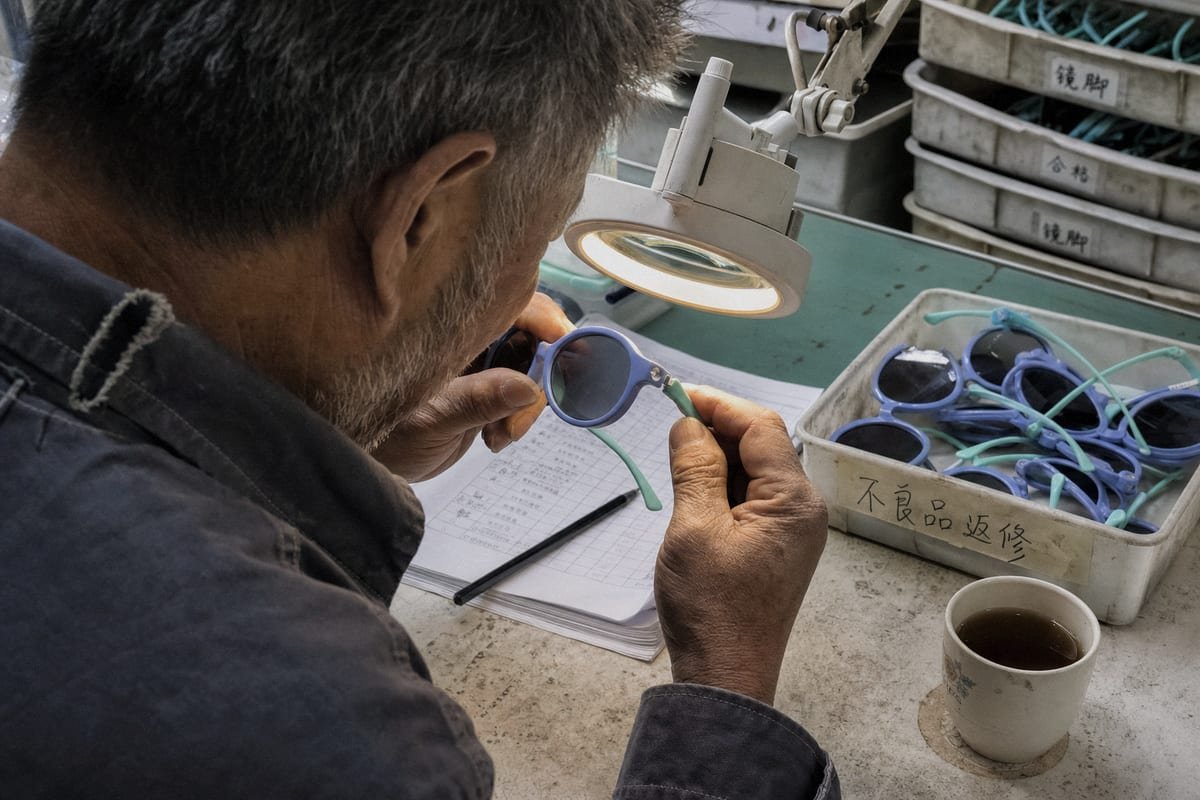
Choose a manufacturer with proven flexible-material expertise in TPEE and TR90, documented hinge torque and cycle testing, in-house quality control, and full OEM/ODM support. Ask for worn samples, factory audits, and an existing style catalog so you can verify durability before committing to molds.
Loose temples are ultimately a design and manufacturing problem, not a parenting problem. If you are a kids' brand, importer, or distributor, the supplier you choose determines how many hinge complaints reach your customer service inbox.
Questions to ask before you commit
- What materials do you actually mold? Many suppliers say "TR90" but outsource or substitute blends. Ask for material certificates and burn-test or flex-test evidence.
- How do you test hinges? A serious factory performs open-close cycle testing and checks screw torque during assembly, not just at final inspection.
- Do you offer spring hinges and rubberized tips on kids' lines? These features cost slightly more but cut field failures dramatically.
- Can I launch without mold investment? A deep existing catalog lowers your risk. We maintain roughly 800 existing styles precisely so new brands can test the market before paying for custom tooling.
- What OEM/ODM support is included? Custom colors, logos, UV400 7 or polarized lens options, packaging, and accessories should come with clear QC checkpoints and retail-ready presentation.
Red flags versus green flags
| Red flag | Green flag |
|---|---|
| "We can match any price" as the opening pitch | Talks about materials, safety, and fit before price |
| No factory photos or vague production claims | Verifiable factory with defined workforce and workshop management (ours runs 5S with about 120 workers) |
| Only generic PC frames for kids | Dedicated flexible TPEE frames and TR90 kids' optical frames |
| Screws hand-tightened with no standard | Documented screw torque, thread treatment, and hinge cycle checks |
| Trader relaying messages between you and an unknown factory | Direct factory communication with a named contact |
The best test is still physical. Request samples, give them to real children for two weeks, then inspect the hinges with a precision screwdriver. If the screws have backed out or the arms have splayed after fourteen days of playground use, imagine month six. When we develop a new style, we run exactly this kind of abuse simulation before it enters our catalog, because a hinge that fails in the field costs a brand far more than the frame is worth.
Conclusion
Loose temples frustrate kids and parents, and they quietly damage a brand's reputation. Fix the hinge first, fine-tune the fit second, and partner with a factory that engineers the problem away.
Footnotes
1. Authoritative ophthalmology source explaining polarized lens benefits mentioned for kids’ eyewear options. ↩︎
2. Explains the 5S workplace organization methodology referenced for factory quality control. ↩︎
3. Explains the thread-locking mechanism analogous to the nail polish trick described. ↩︎
4. Explains shape-memory polymer science behind temple materials returning to molded curves. ↩︎
5. Background on polycarbonate material properties referenced in the frame comparison table. ↩︎
More Articles You Might Like
Looking for a Reliable Kids Eyewear Partner?
Explore 800+ ready styles and full OEM/ODM support tailored to your brand.
Get in Touch English
  Español de México
  Deutsch
  Français
  日本語
日本語  العربية
  Português do Brasil