How Do I Communicate Size Requirements When Sourcing Kids Optical Frames?
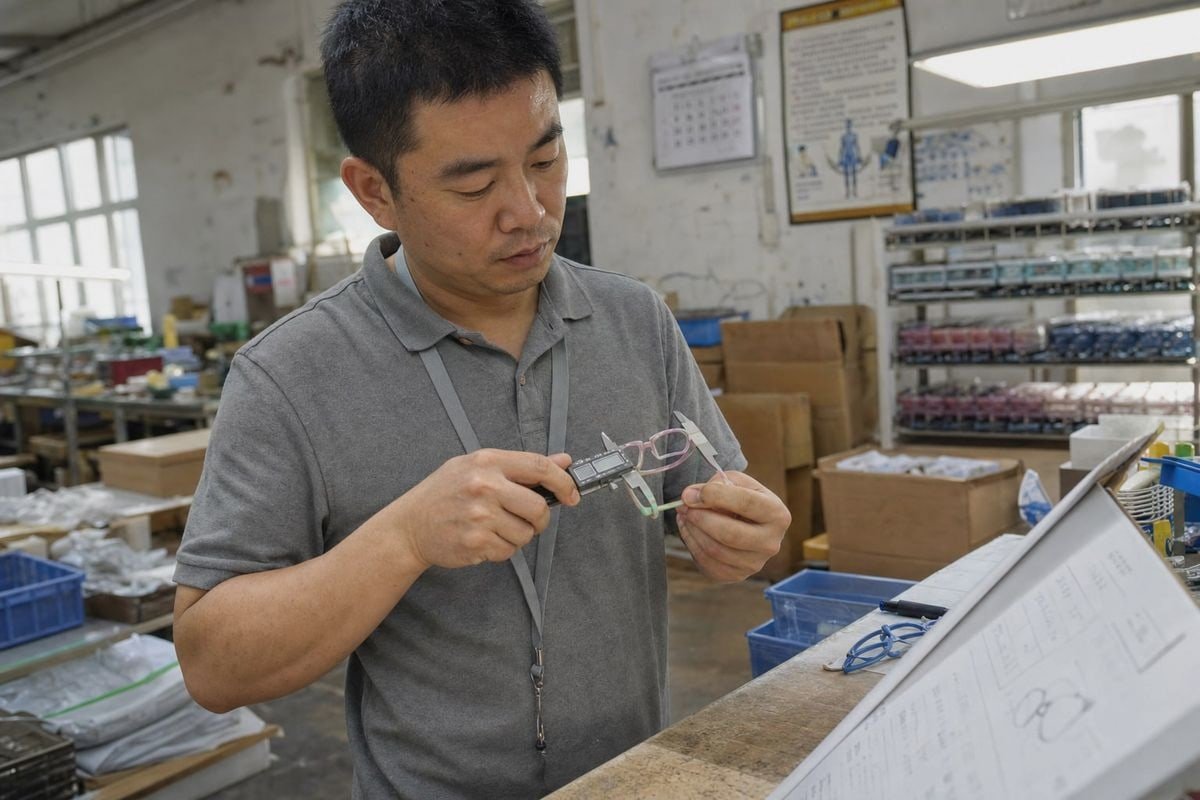
Communicating size requirements for kids optical frames sounds simple until a container of ill-fitting frames arrives. On our production line, vague sizing briefs are the number one cause of costly rework.
Communicate size requirements for kids optical frames by specifying exact millimeter measurements — lens width, bridge width (DBL), and temple length — plus the target age group, pupillary distance range, and functional fit rules such as centered pupils, no sliding, and no cheek or eyebrow contact.
That is the short answer. Below, I will break it down into the exact measurements, age ranges, charts, and tech pack details you should send to any supplier.
What Size Measurements Should I Provide When Requesting Kids Optical Frame Samples?
A buyer from Australia once emailed us asking for "frames for six-year-olds." That single sentence forced three rounds of sampling. Precise numbers would have solved it in one.
Provide three core measurements in millimeters: lens width (typically 35–52 mm for children), bridge width or DBL (14–18 mm), and temple arm length (115–130 mm). Add total frontal width, B-measurement, and target pupillary distance so the factory can confirm fit before sampling.
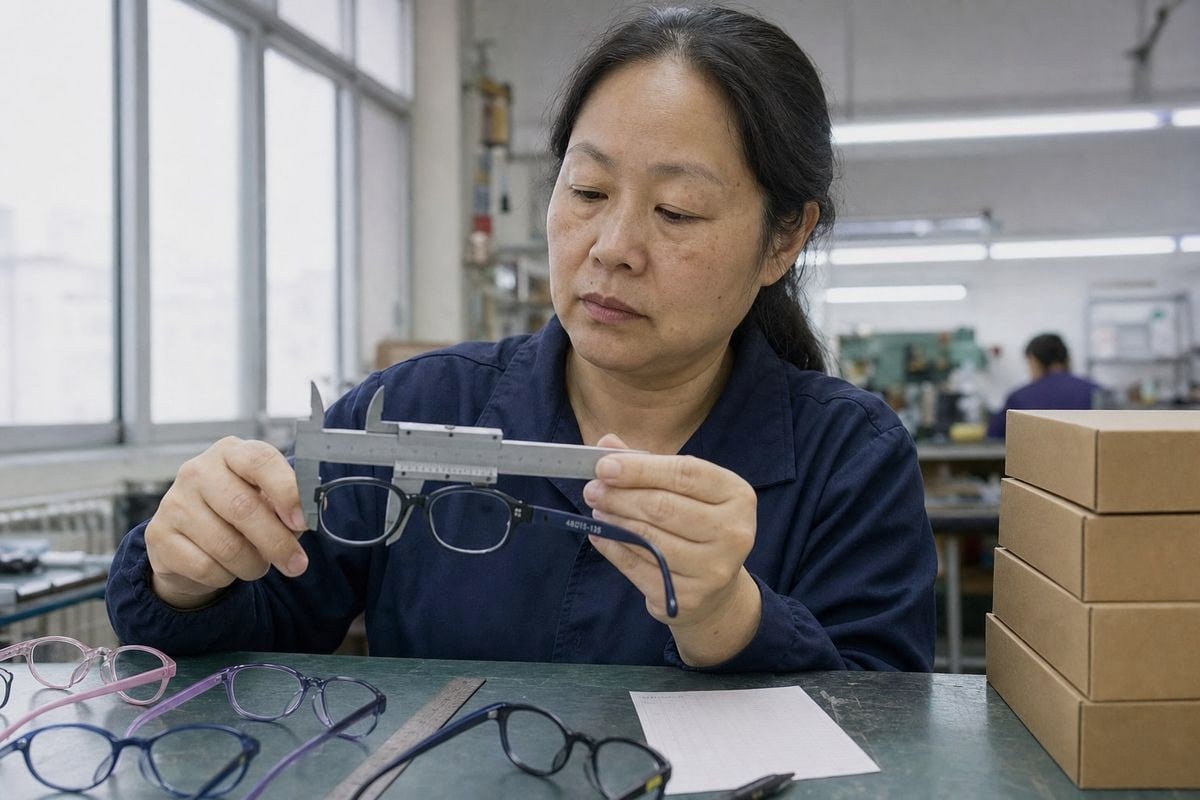
The optical industry uses a standardized language called the Boxing System 1. Every frame is described as A-DBL-Temple: the horizontal lens width (A), the distance between lenses (DBL), and the temple arm length. You will find this size code printed on the inside of the temple arm of almost any existing frame. When our sales team receives that code, we can quote and sample with confidence.
The Five Measurements That Matter Most
Here is what a complete sizing request should include, and why each number matters for a child's face.
| Measurement | Typical Kids Range | Why It Matters |
|---|---|---|
| Lens width (A) | 35–52 mm | Determines overall frame scale and lens sizing |
| Bridge width (DBL) | 14–18 mm | Children's flat nasal bridges make this the most common failure point |
| Temple arm length | 115–130 mm | Too long slips; too short pinches behind the ear |
| Total frontal width | End-piece to end-piece | Must not exceed the child's temporal width |
| B-measurement (lens height) | 30 mm+ recommended | Modern myopia-management lenses need vertical treatment zones |
The B-measurement deserves special attention right now. Many of our optical company clients in Japan and Europe are fitting myopia-control lenses 2, which need a vertical lens height of at least 30 mm to preserve the treatment zone. If you serve that market, state the minimum B-measurement explicitly.
Beyond raw numbers, tell your supplier the geometric center distance (GCD) target. When the frame's GCD sits close to the average pupillary distance 3 of your target age group, lenses cut thinner and peripheral distortion drops. A useful rule: frame size plus bridge size should not exceed the child's PD by more than 8 mm.
Finally, send a reference pair if one exists. Copying the printed size code from a well-fitting frame is the fastest, most reliable baseline for OEM eyewear manufacturing.
How Do I Know Which Frame Sizes Fit Different Children's Age Groups?
There is a real trade-off we weigh on every new mold: size the frame for today's fit, or leave room to grow? Oversizing quietly ruins lens alignment, so we lean toward precise fit with flexible materials.
Children's frame sizes scale roughly with age: 35–40 mm lens width for ages 0–3, 41–45 mm for ages 4–6, 46–48 mm for ages 7–9, and 49–52 mm for ages 10–13. Treat age charts as a starting point; actual face width, bridge fit, and PD are more predictive.
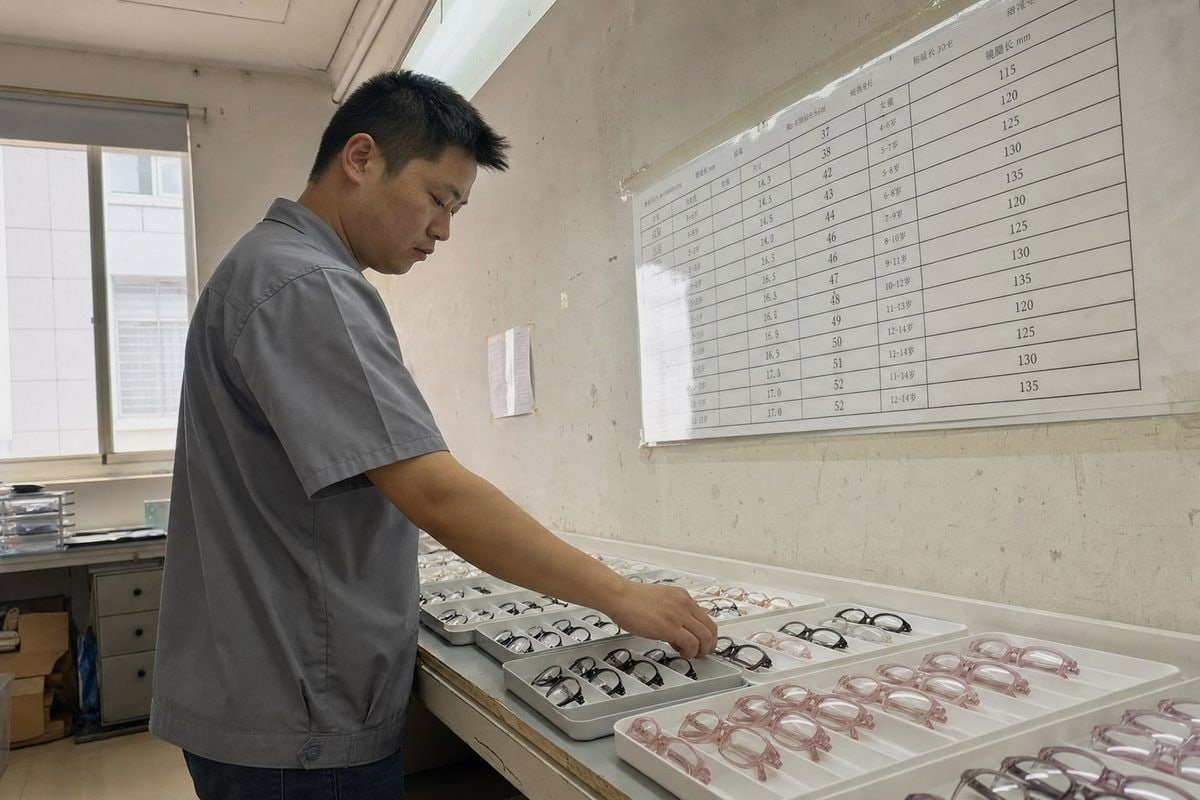
Age-based sizing is convenient for marketing, but it is only a proxy. Two seven-year-olds can need frames that differ by several millimeters in every dimension. In our fifteen years making children's eyewear, the buyers who succeed use age ranges to define a product line, then verify with real facial measurements before locking specifications.
A Practical Children's Eyewear Sizing Chart
| Age Group | Lens Width | Bridge (DBL) | Temple Length |
|---|---|---|---|
| 0–1 years | 35–37 mm | 14–15 mm | 110–115 mm |
| 1–3 years | 37–40 mm | 14–16 mm | 115–120 mm |
| 4–6 years | 41–45 mm | 15–16 mm | 118–125 mm |
| 7–9 years | 46–48 mm | 15–17 mm | 120–128 mm |
| 10–13 years | 49–52 mm | 16–18 mm | 125–130 mm |
Why the Bridge Is the Hidden Failure Point
A child-size label does not guarantee the bridge measurement will fit. Toddlers and preschoolers have flat, undeveloped nasal bridges, so a standard adult-style bridge slides straight down the nose no matter how correct the lens width is. For younger age groups, specify a saddle bridge or keyhole bridge design, or request adjustable silicone nose pads 4 on the frame. A DBL distance of 14–17 mm covers most pediatric cases well.
Handling the "Room to Grow" Objection
Buyers often push us to size up so parents feel they get longer wear. I understand the retail logic, but I push back. An oversized frame shifts during play, positions the optical center wrongly, and creates the "bug-eye" look parents dislike. The better answer is frame material flexibility. Our TR90 frames with TPEE temples flex with a growing face without permanent deformation, which gives real longevity without compromising optical alignment on day one.
Also account for pediatric anatomy in the tilt. Children have lower ear positions and flatter facial profiles, so we calibrate pantoscopic tilt near 0 degrees on our kids molds rather than copying adult geometry.
Can I Get a Size Chart or Fitting Guide From My Eyewear Manufacturer?
One lesson I learned early: buyers who launch without a fitting guide field endless returns and support emails. Now we prepare sizing documentation for clients as a standard part of OEM development.
Yes. Any professional children's eyewear factory should supply a size chart listing every SKU's A-DBL-Temple measurements, total frontal width, and B-measurement, plus a consumer-facing fitting guide with age recommendations and a functional fit checklist. If a supplier cannot provide this, treat it as a red flag.

A serious factory measures every style during quality control, so producing a size chart costs them nothing. When we onboard a new brand client, we send a spreadsheet covering all requested styles from our catalog of roughly 800 existing designs, with each dimension listed to the millimeter. That lets a procurement manager compare styles against their target age groups before ordering a single sample.
But ask for more than the chart. The strongest sourcing partnerships include two documents.
The Factory Size Chart
This is the technical document: A-DBL-Temple codes, total frontal width, B-measurement, lens shape, weight in grams, and material per style. Use it to shortlist styles. Cross-check the GCD against your target market's average PD so lens labs get frames they can glaze efficiently.
The Consumer Fitting Guide
This is the retail-facing document. Since most families now buy children's glasses online, they need remote fitting help. A good guide includes an age-to-size table, printable sizing tools, and a functional checklist: eyes centered in each lens, no red marks on the nose, temples straight without bowing, no contact with cheeks or eyebrows, and no slipping when the child looks down. We help clients adapt our internal fit standards into branded guides for their own websites and packaging.
One more forward-looking request: ask whether the factory can share 3D CAD files (.obj or .stl) of your chosen styles. These files feed Virtual Try-On tools, which increasingly drive online kids' eyewear sales and cut return rates further.
What Details Should I Include in My Tech Pack to Avoid Sizing Mistakes?
During a QC review last year, we caught a batch where a client's tech pack specified temple length but never mentioned the ear-hook drop. The frames measured perfectly and still slid on active kids. That gap taught us to demand functional fit language in every frame tech pack.
A complete frame tech pack should include all Boxing System measurements with tolerances, bridge design type, B-measurement minimum, pantoscopic tilt, material specification, hinge type, target PD range, and written functional fit requirements such as no sliding during play and pupils centered within 3–4 mm.
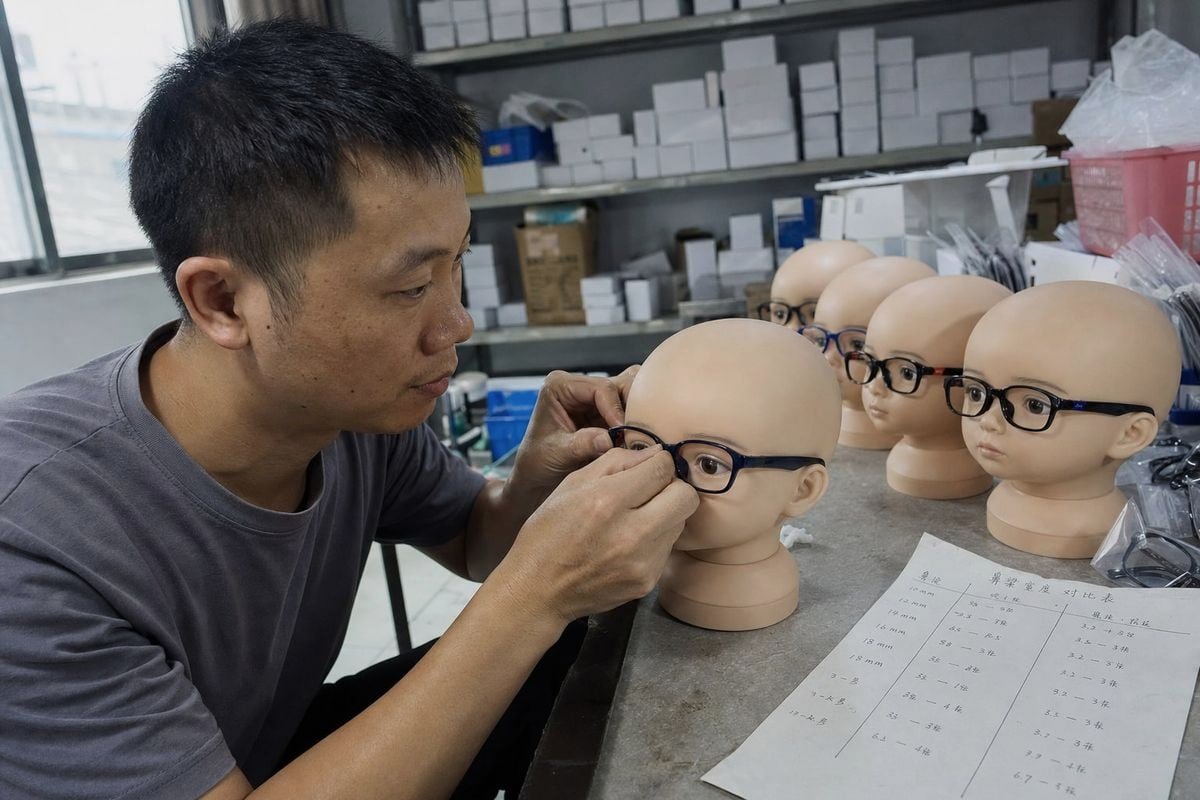
A frame tech pack does two jobs. It tells the factory exactly what to build, and it gives your QC team objective pass/fail criteria at inspection. Vague packs produce disputes; precise packs produce consistent shipments.
Tech Pack Checklist for Kids Optical Frames
| Section | What to Specify | Example |
|---|---|---|
| Dimensions | A-DBL-Temple with tolerance | 44-15-120, ±0.5 mm |
| Lens height | Minimum B-measurement | ≥30 mm for myopia-management lenses |
| Bridge | Design type and fit target | Saddle bridge, low nasal profile |
| Tilt | Pantoscopic angle | Near 0° for pediatric anatomy |
| Materials | Polymer type and certification | TR90 front, TPEE temples, food-grade certified |
| Hinges | Type and cycle expectation | Spring hinge durability tested to open-close cycles |
| Fit behavior | Functional requirements | No sliding, no cheek contact, pupils centered ±3–4 mm |
| Optical | Target PD alignment | GCD within 8 mm of target PD range |
Specify Materials and Safety Alongside Size
Size and material interact. Rigid acetate holds dimensions but snaps; flexible polymers like TR90 and TPEE 5 resist permanent deformation from twisting and support cold-glazing at the lens lab. For toddler lines, require food-grade certification 6 on all polymers, since young children chew temple tips. If sustainability matters to your market, request GRS traceability 7 on recycled materials. Add adjustable silicone nose pads or slip-resistant temple tips where the design allows — details like the silicone ear hooks on our sport-style kids frames exist precisely because measurements alone cannot guarantee fit on a moving child.
Include Sample Wording Your Supplier Can Act On
A single clear sentence prevents most sizing mistakes. Something like: "Child frame approx. 44-15-120, total frontal width suited to a narrow face, eyes centered in lenses, secure saddle bridge, no cheek contact, flexible temples, and no sliding during active play." Any experienced factory can build, sample, and inspect against that sentence.
Conclusion
Precise millimeter specs, age-appropriate ranges, factory size charts, and a complete tech pack turn kids optical frame sourcing from guesswork into a repeatable process. Communicate clearly, and returns disappear.
Footnotes
1. Background on standardized eyewear sizing conventions referenced by the Boxing System. ↩︎
2. NIH’s National Eye Institute explains myopia management relevant to lens height specs. ↩︎
3. NIH’s eye institute is an authoritative source on pupillary distance and vision measurement. ↩︎
4. Background on silicone material properties used for adjustable nose pads on kids frames. ↩︎
5. Explains thermoplastic elastomer properties behind flexible TR90 and TPEE eyewear materials. ↩︎
6. FDA guidance on food-contact substances supports certification requirements for chewed temple tips. ↩︎
7. ISO oversees traceability and recycling standards referenced for sustainable eyewear materials. ↩︎
More Articles You Might Like


Looking for a Reliable Kids Eyewear Partner?
Explore 800+ ready styles and full OEM/ODM support tailored to your brand.
Get in Touch English
  Español de México
  Deutsch
  Français
  日本語
日本語  العربية
  Português do Brasil