What Technical Documentation Should I Request from Kids’ Sunglasses Suppliers for Staff Training?

Buyers often ask me what technical documentation from kids’ sunglasses suppliers really matters. Miss the right papers, and your team recommends products they cannot verify. That risk grows fast with children’s eyewear.
Request a complete documentation pack from kids’ sunglasses suppliers: product specification sheets, third-party test reports, material declarations, a Declaration of Conformity, labeling artwork, fitting and care instructions, and traceability records. These documents give staff verifiable evidence for safety claims, compliance answers, and confident customer guidance.
Let me break this down document by document. I will show you what each paper should contain, why it matters, and how to turn it into practical staff training material.
What Safety and Compliance Certificates Should I Include in My Staff Training Materials?
A buyer from Australia once sent back our full compliance file with sticky notes on every page. Her team had turned it into training cards. That taught our factory something important: certificates are teaching tools, not just customs paperwork.
Include third-party UV400 protection rating reports, impact resistance test reports, chemical safety results covering BPA and phthalate testing, a Children's Product Certificate or Declaration of Conformity for your market, and ISO 12312-1 compliance evidence. Train staff to match each certificate to the exact model sold.
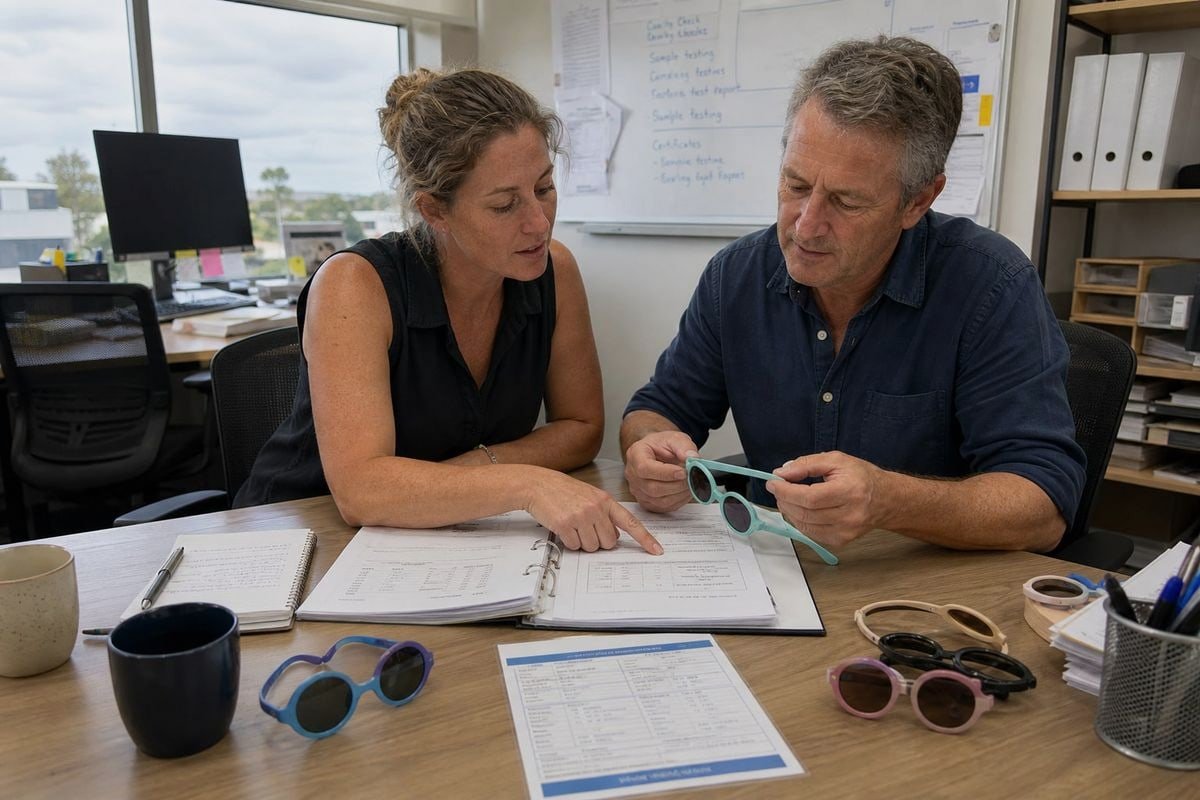
The first lesson I teach visiting buyers is the difference between a marketing brochure and auditable technical evidence. A supplier webpage that says "CE certified 1" or "UV400" proves nothing by itself. Your staff need the actual reports, tied to the exact product, colorway, and lens material they are selling. If your team cannot verify a claim on paper, they cannot safely recommend the product.
The Core Certificate Set by Market
Requirements shift depending on where you sell. Here is the baseline set I prepare for our export customers:
| Markt | Key Documents to Request |
|---|---|
| Zweck | Technical file, Declaration of Conformity, EN ISO 12312-1 test reports, REACH regulation compliance 2 results, labeling artwork |
| USA | FDA drop ball impact test reports (21 CFR 801.410), CPSIA chemical results (lead, phthalates, cadmium), Children's Product Certificate, FDA registration certificate |
| Australia | Proof of compliance with the mandatory sunglasses and fashion spectacles standard (AS/NZS 1067 based) |
| Global baseline | ISO 12312-1 compliance reports, UV transmittance data, material declarations |
Turning Certificates into Training Content
Do not hand staff a fifty-page lab report. Instead, build one-page summaries. Each summary should state the claim (for example, "blocks 99–100% UVA und UVB 3"), the test standard behind it, and the report number. Staff then learn to say, "This claim is backed by an accredited lab report," instead of vague reassurances.
Some buyers assume a single certificate covers everything. In my experience, it never does. Chemical safety, optical performance, and physical durability are tested separately. Train your team to know which document answers which question.
How Do I Explain Frame Material Properties Like TPEE and TR90 to My Sales Team?
Fifteen years of working with flexible polymers has taught our engineers one thing: parents do not buy materials, they buy peace of mind. Your sales team needs simple language that translates polymer science into safety benefits.
Request material data sheets covering flexibility, weight, impact behavior, and chemical safety. Explain TR90 as a lightweight, memory-flexible nylon that bends without snapping, and TPEE as a softer, rubber-like elastomer ideal for temples that flex safely against a child's head.
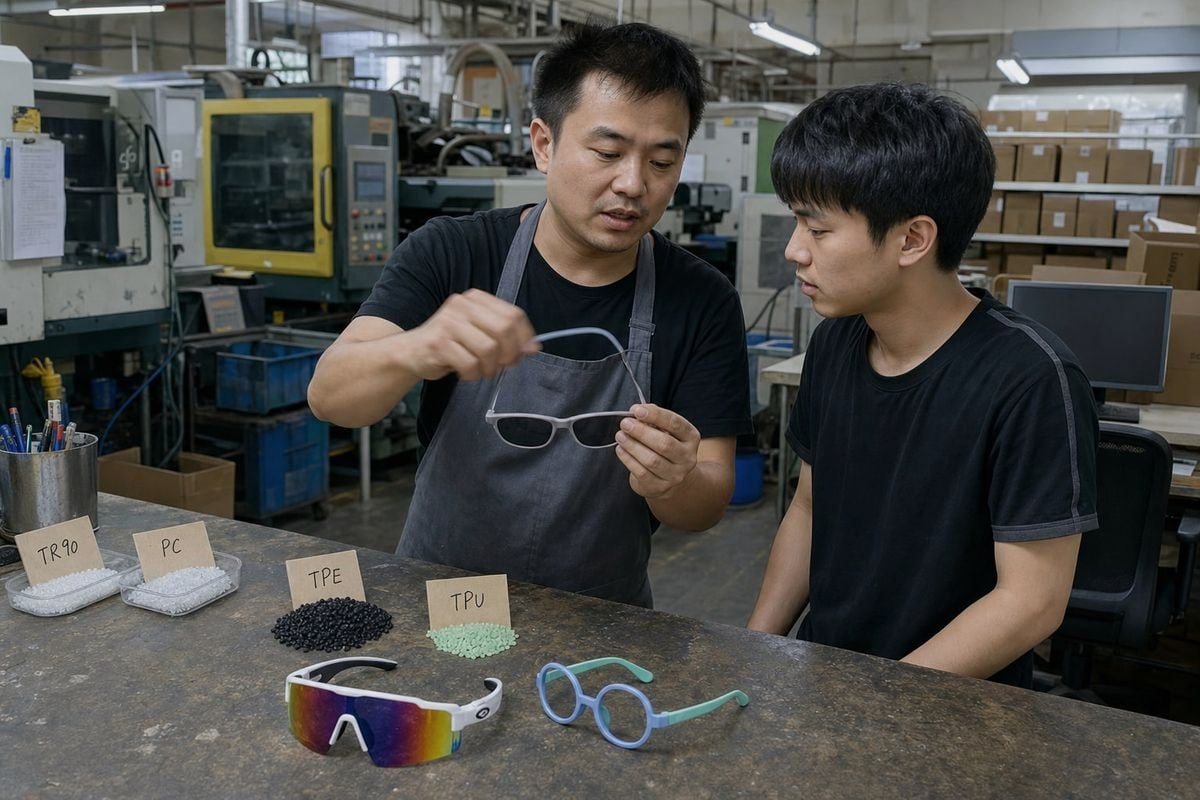
When we develop a new frame at our Taizhou workshop, the material choice drives everything: safety, comfort, and durability. Many of our best-selling children's styles combine a TR90 front frame 4 with TPEE temples. The front holds its shape and protects the lenses. The temples stay soft and forgiving where they touch the child's head. Your sales team should be able to explain that logic in one breath.
A Simple Comparison Staff Can Memorize
| Eigenschaft | TR90 | TPEE |
|---|---|---|
| Feel | Firm but flexible, memory effect | Soft, rubber-like, very flexible |
| Gewicht | Sehr leicht | Sehr leicht |
| Best use | Frame fronts, structure | Temples, full-flex baby frames |
| Safety behavior | Bends and returns, resists snapping | Twists without breaking, gentle on skin |
| Chemical profile | Request BPA and phthalate testing results | Request the same, plus skin-contact safety data |
The Documents That Back the Story
Ask your supplier for material declarations covering the frame polymer, lens material, coatings, tints, nose pads, and any decorative parts. These declarations matter because children's eyewear faces chemical requirements in most markets, including REACH regulation compliance in Europe and CPSIA limits 5 in the US. Environmentally friendly material claims should also appear in writing, not just in a sales pitch.
Some buyers push back here. They tell me the material name on the product page is enough. It is not. Two factories can both say "TR90" while using very different resin grades and additive packages. Only a written declaration, ideally with supporting lab results, tells you what your customers' children are actually wearing. I encourage buyers to build a short training exercise: hand staff two frames, let them bend both, then match the feel to the data sheet. It sticks far better than a slide deck.
What Product Specification Sheets Should I Request to Answer Common Customer Questions?
One of our long-term European distributors trains every new hire with our spec sheets before they ever touch a product. Her reasoning is simple: customers ask about sizes, lenses, and light conditions, and specs answer all three.
Request a technical data sheet showing model name, intended age group, frame and lens materials, lens width, bridge width, temple length, weight, UV claim, lens category classification, and visible light transmission. These fields answer the most frequent customer questions about fit, protection, and use conditions.
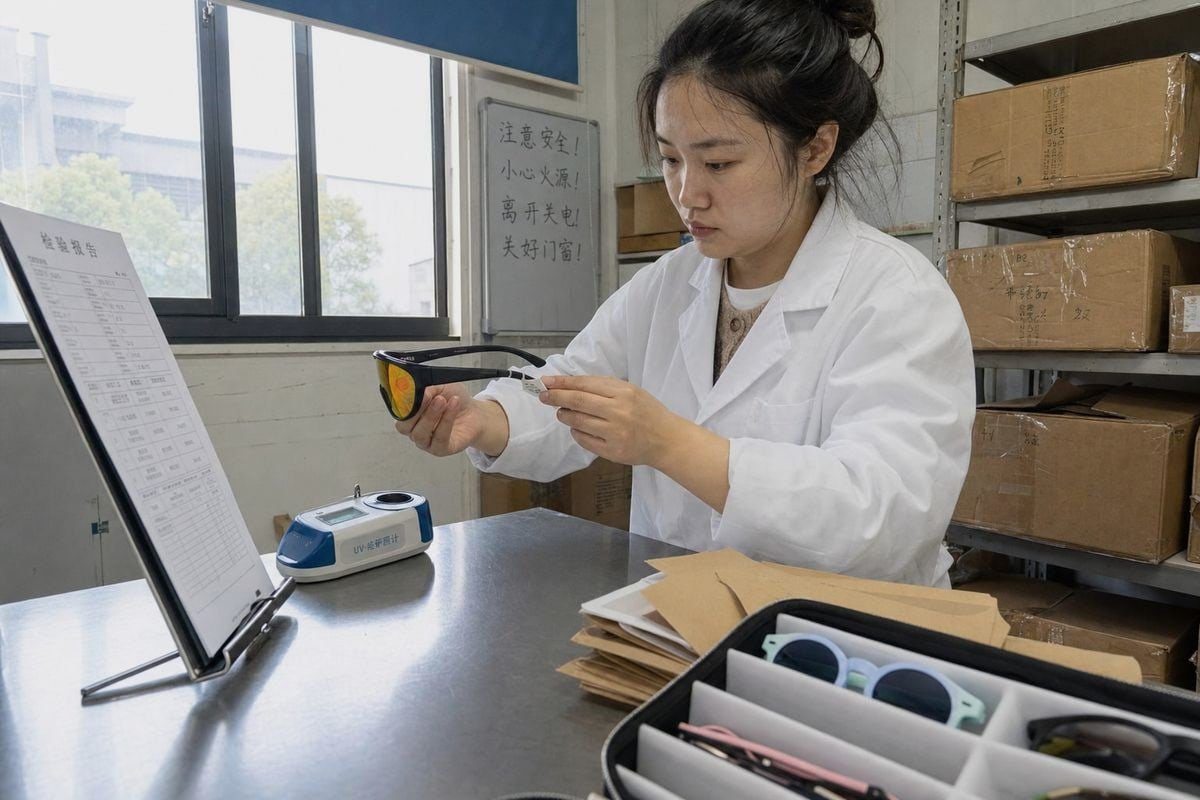
A good specification sheet is the single most useful training document you can request. It converts directly into answers at the counter or in customer service emails. Across our roughly 800 existing styles, every model carries a spec sheet, because buyers testing a market with lower risk still need full technical answers from day one.
Specification Fields Mapped to Customer Questions
| Customer question | Spec sheet field that answers it |
|---|---|
| "Will these fit my four-year-old?" | Intended age group, lens width, bridge width, temple length |
| "Do these actually block UV?" | UV400 protection rating, UV transmittance data |
| "Are they dark enough for the beach?" | Lens category classification (0–4), visible light transmission (VLT) |
| "Are they heavy on a small face?" | Overall weight in grams |
| "Will glare bother my child near water?" | Polarized lens benefits and polarization efficiency, if applicable |
| "What are they made of?" | Frame material, lens material, coating details |
Details That Separate Serious Suppliers
Beyond the basics, ask for optical quality standards data: lens centration and induced prism tolerance 6 reports matter because a developing child's vision is sensitive to optical misalignment. Durability metrics also help staff answer "will these survive my kid?" honestly. Hinge fatigue cycle results and coating adhesion or Bayer ratio scratch resistance figures give your team concrete talking points instead of hopeful guesses.
For children specifically, ask about fit geometry. Some children's standards define coverage requirements using precise ellipse dimensions, and pediatric fit data on bridge design matters because children's nasal bridges are still developing. Our sport-style wraparound shield models, for example, carry coverage and curvature data that a spec sheet for a small round frame would not need. Match the documentation to the product category, not a generic template.
How Can I Use Supplier Documentation to Train My Team on Fitting and Care Instructions?
There is always a trade-off I weigh when writing user instructions: shorter text gets read, but children's eyewear needs supervision warnings and age guidance. The best solution is layered documentation that your staff can teach from directly.
Request the supplier's full user instructions, fitting guidance by age group, cleaning and storage directions, warnings against wearing damaged lenses, and traceability records with batch numbers. Convert these into role-play training so staff can demonstrate fitting and explain care confidently.
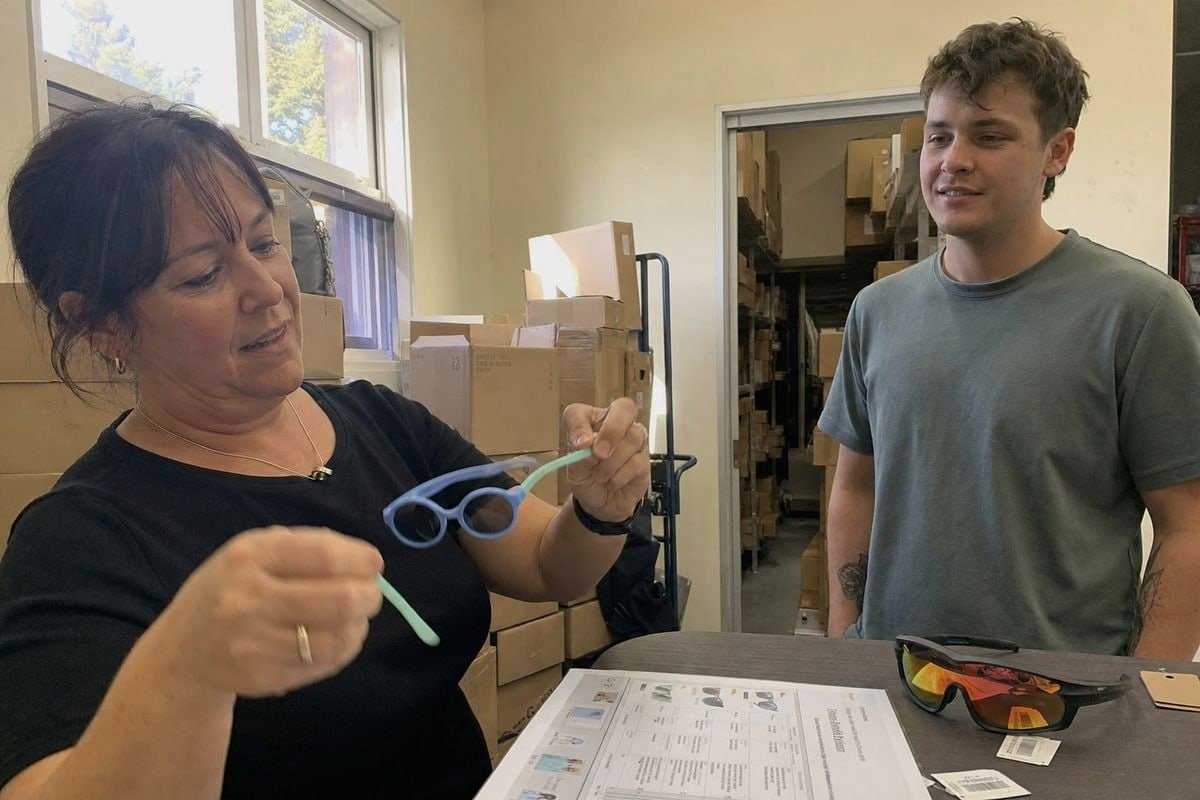
User instructions sound boring until a customer returns a scratched pair and your staff member has nothing to say. In our OEM/ODM projects, we prepare instruction inserts alongside custom packaging, and I always encourage buyers to treat those inserts as the seed of their internal training manual. A complete instruction set should cover intended use, age suitability, cleaning method, storage, supervision guidance for young children, and any limits on protection, such as lenses not being suitable for direct sun viewing.
A Four-Step Training Process Built on Supplier Documents
- Fit demonstration. Use the spec sheet dimensions and age grading to show how a frame should sit: temples level, no pressure points, bridge resting without sliding. Flexible TPEE temples 7 let staff safely demonstrate the bend-and-return behavior parents love to see.
- Care walkthrough. Teach the cleaning routine from the official instructions: rinse, use a microfiber cloth, avoid paper towels, and store in the case. Tie this to the coating adhesion data so staff understand why abrasion ruins lenses.
- Warning language. Have staff practice explaining warnings in friendly words. "Replace them if the lens gets scratched, because scratches scatter light into your child's eyes" works better than reading a label.
- Traceability drill. Show staff where to find batch or lot numbers and the production date. If a quality question ever arises, they can identify the exact batch, check the final inspection report, and respond fast. This traceability chain also supports recalls and supplier accountability, which is why we keep incoming material checks and final inspection records for every order leaving our workshop.
One more point: request the labeling artwork too. Staff should confirm that packaging claims match the test reports behind them. A UV claim on a hang tag with no matching report is a red flag your team should catch before the product reaches a shelf.
Schlussfolgerung
Complete technical documentation from kids' sunglasses suppliers protects your customers, your team, and your brand. Request it, verify it, and teach from it before anything reaches the shelf.
Fußnoten
1. Official EU source clarifying what CE marking actually certifies for compliance. ↩︎
2. Authoritative European Commission overview of REACH chemical safety and compliance requirements. ↩︎
3. WHO fact sheet on UV radiation health risks relevant to sunglasses protection claims. ↩︎
4. Background on nylon-based polymers used to make flexible TR90 frame components. ↩︎
5. US CPSC page detailing CPSIA chemical limits referenced for children’s products. ↩︎
6. Background on optical prism effects relevant to lens tolerance testing standards. ↩︎
7. Explains thermoplastic elastomers, the material family TPEE belongs to. ↩︎
Weitere Artikel, die Ihnen gefallen könnten

August 2026
Sollte die Fabrik die Verpackung und Kennzeichnung von Kinder-Sonnenbrillen übernehmen oder einen bestimmten Lieferanten nutzen?

August 2026
Eigenes Lager vs. Direktlieferung durch den Lieferanten: Was senkt die Retourenkosten für Marken von Kinder-Sonnenbrillen?

August 2026
Direkt zum Lagerhafen oder Lagerung in Übersee: Was spart mehr bei den Versandkosten für Kinder-Sonnenbrillen?
Auf der Suche nach einem zuverlässigen Partner für Kinderbrillen?
Entdecken Sie über 800 sofort verfügbare Modelle und umfassenden OEM/ODM-Support, der auf Ihre Marke zugeschnitten ist.
Kontakt aufnehmen English
  Español de México
  Deutsch
  Français
  日本語
日本語  العربية
  Português do Brasil