How to Schedule Split Shipments for Kids’ Sunglasses Before a Promotion?
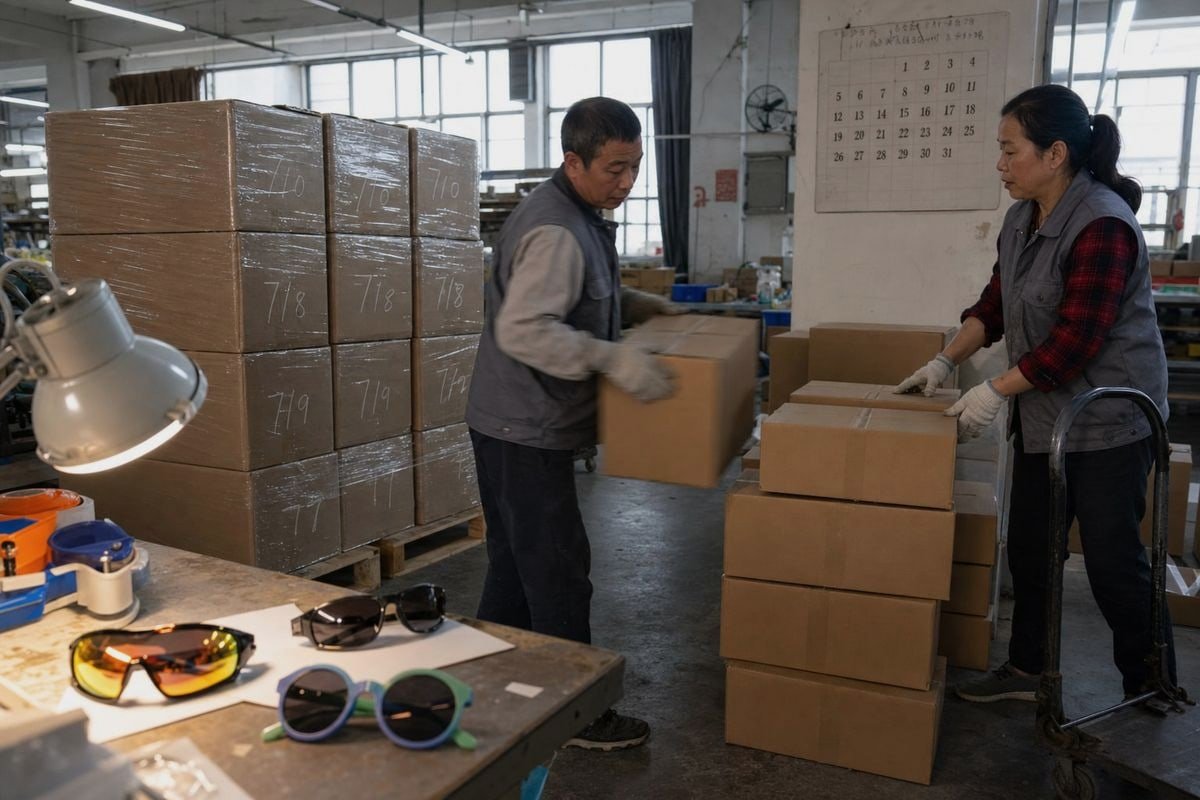
Scheduling split shipments for kids’ sunglasses before a promotion is a timing puzzle we solve weekly at our Taizhou factory. One late batch can sink an entire launch. Miss the window, and your discount runs on an empty shelf while ad spend burns. The fix is a staged shipping plan built backward from your promo date.
Schedule split shipments for kids’ sunglasses 4–6 weeks before your promotion. Ship 50–60% of stock early by sea, send a 20–30% air batch two weeks before launch, and hold a reserve batch for restock, keeping quality checks identical across all batches.
That is the short answer. Below, I break down each step: the timeline, the quantities per phase, quality consistency, and how we coordinate the whole schedule with your customs and warehouse plans.
How far in advance should I plan split shipments for my promotion launch date?
Last summer, a European kids' brand asked us to rush a full order two weeks before their beach-season sale. We managed it by air, but the freight cost erased half their promo margin. Planning earlier would have saved them.
Start planning split shipments 8–10 weeks before the promotion. Production of kids' sunglasses takes 3–5 weeks, sea freight 3–5 weeks, and customs plus warehouse check-in 1–2 weeks. Working backward from launch day protects you from any single delay.

The most reliable method is reverse scheduling. You take the promotion launch date and count backward through every step. Each step gets its own deadline. Then you split the order so the critical batch arrives with a buffer, not on the last possible day.
A reverse timeline you can copy
Here is the timeline we walk buyers through when they plan a seasonal push, such as summer or back-to-school:
| Weeks Before Launch | Milestone | Who Owns It |
|---|---|---|
| 10 | Confirm styles, quantities, and split plan | Buyer + factory |
| 8–9 | Production of batch one begins | Factory |
| 6 | Batch one ships by sea (50–60% of stock) | Freight forwarder |
| 4 | Batch two finishes production and QC | Factory |
| 2–3 | Batch two ships by air (20–30% of stock) | Freight forwarder |
| 1–2 | Customs clearance and warehouse check-in | Buyer + broker |
| 0 | Promotion launches with full stock available | Buyer |
Why children's eyewear needs extra buffer
Kids' sunglasses are not a generic product. Lenses must pass UV protection checks 1, and frames must meet children's safety standards in your market. If a batch needs retesting at a third-party lab, that alone can take 3–5 days. We build that buffer into every schedule, because a compliance hold right before launch is the worst kind of delay. There is no way to buy that time back.
Amazon sellers face one more wrinkle. FBA check-in 2 can take days during peak season, and inventory sits in "reserved" status before it becomes sellable. If your listing shows no sellable stock, the buy box can suffer just as your promotion starts. Shipping the first batch early keeps the listing healthy while later batches arrive.
What order quantities make sense for each shipment phase when I split a bulk order?
The trade-off we weigh most often with buyers is simple: ship too much early and you pay storage on slow stock, ship too little and you stock out on day one of the sale. The split ratio is where that tension gets resolved.
A practical split is 50–60% in the first sea shipment, 20–30% in a faster second batch timed to arrive just before launch, and 10–20% held as a restock reserve. Adjust the ratios using historical sales velocity and regional demand data.
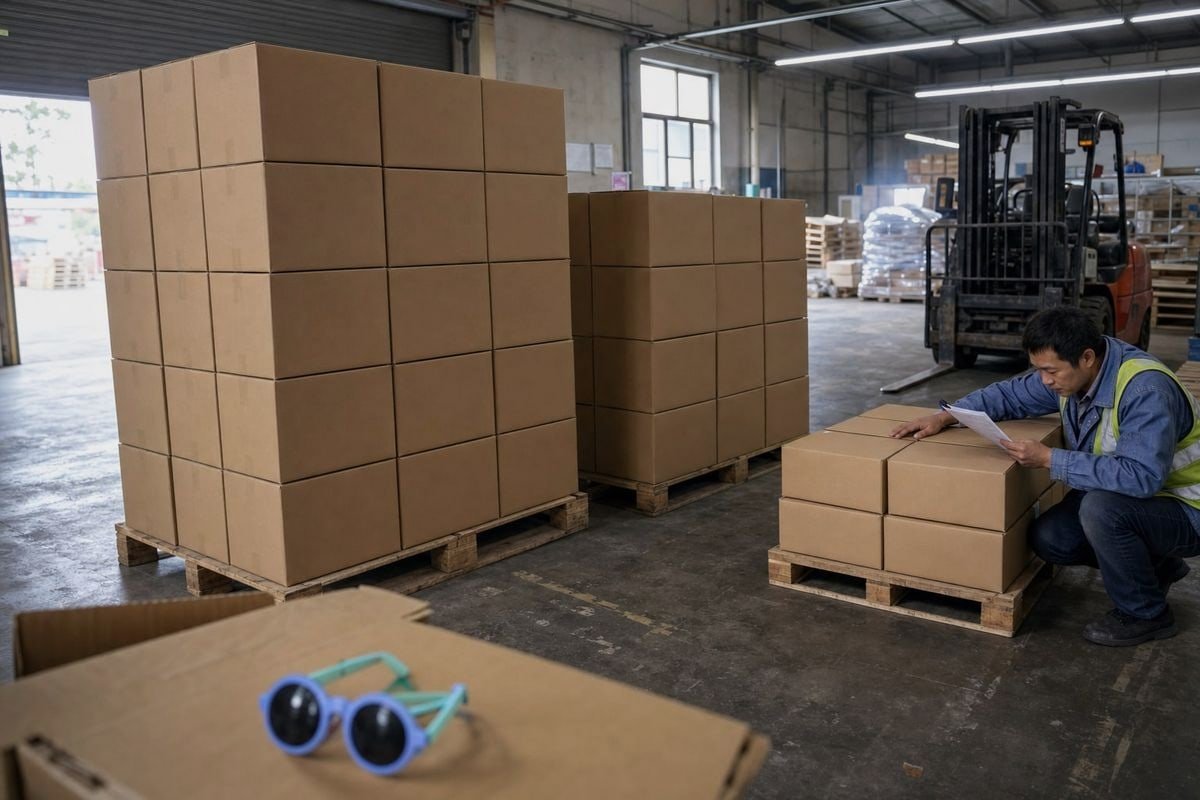
There is no single correct ratio. However, there is a correct method. You size each phase by its job, then adjust the numbers with your own sales data.
The job of each batch
- Batch one (the foundation) covers baseline sales before and during the first days of the promotion. It travels by the cheapest reliable route, usually sea. It should be big enough that a delayed batch two does not cause a stockout.
- Batch two (the surge batch) covers the demand spike a discount creates. It ships closer to launch, often by air, so your capital is not locked up too early.
- Batch three (the reserve) protects you if the promotion outperforms. It can sit at our warehouse or a domestic 3PL until you call it forward.
Adjusting the split for kids' sunglasses
Children's eyewear demand is seasonal and regional. A sunny-region warehouse should carry a heavier allocation than a cooler one. Uniform splits across fulfillment centers waste stock where demand is thin. Here is how we frame it with buyers:
| Faktor | If High | Suggested Adjustment |
|---|---|---|
| Historical promo sell-through | Strong past promos | Increase batch two to 30% |
| Demand uncertainty (new style) | Untested SKU | Increase reserve to 20% |
| Storage fees at destination | Expensive peak-season storage | Reduce batch one, lean on batch two |
| Regional sun-season demand | Sun-heavy states or regions | Allocate more units to those warehouses |
| Cash flow pressure | Tight working capital | Delay batch three production, keep molds and colors locked |
One more detail matters for lightweight items like kids' sunglasses: case-pack configuration. We optimize carton sizes so dimensional weight fees stay low when the order splits across regions. Small changes in packing can cut real money from a multi-warehouse split.
How do I make sure product quality stays consistent across multiple shipment batches?
A lesson our QC team learned years ago: batch-to-batch drift rarely shows up as a big defect. It shows up as a slightly different pastel shade, a hinge screw torqued a bit differently, a lens tint that photographs darker than the last run. On a two-tone kids' frame, customers notice.
Lock a golden sample before production, run identical inspections on every batch, and keep material lots consistent. Test UV400 lens performance and children's safety compliance per batch, not per order, so a later shipment never fails standards the first one passed.
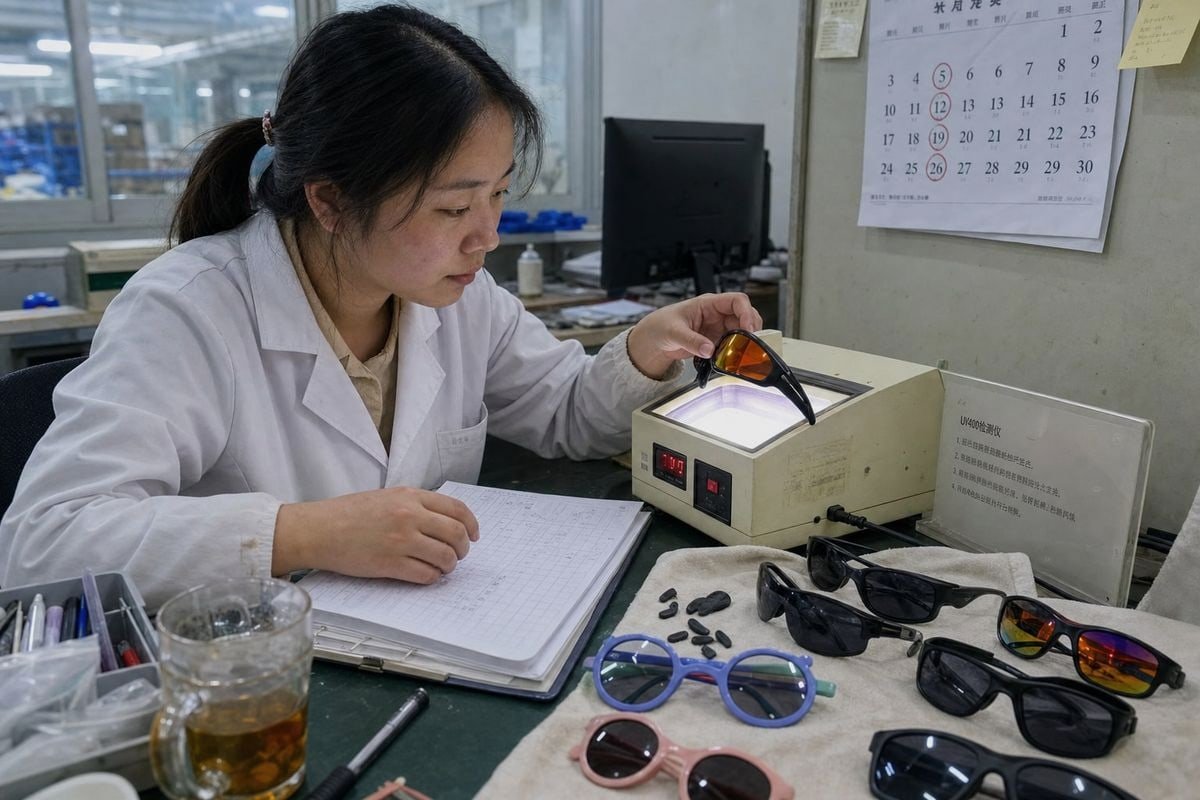
Consistency across batches is a process problem, not a luck problem. Here is how we handle it in our 5S-managed workshop, and what you should require from any supplier.
Fix the reference before you split anything
Everything starts with a signed golden sample. Frame color, lens gradient, temple flexibility, logo placement, and packaging are all frozen against that sample. Both batches then get judged against the same physical reference, not against each other. Without this, batch two gets compared to memory, and memory drifts.
Control the inputs, not just the outputs
Most batch variation comes from raw materials. TPEE und TR90 3 pellets vary slightly between resin lots, and mirrored lens coatings vary between coating runs. So we reserve material from the same lot for split orders whenever the schedule allows. When a lot change is unavoidable, we run a first-article comparison against the golden sample before mass production continues.
Inspect every batch as if it were the first
Each shipment batch gets the same checklist: dimensional checks, hinge torque 4, temple flex cycles, lens UV verification, coating adhesion, and drop-safety checks appropriate for children's products. For kids' eyewear headed to regulated markets, we also verify that documentation for standards like CPSIA or ASTM-type toy and eyewear requirements 5 travels with each batch. Customs and retail compliance teams check paperwork per shipment, not per purchase order. A missing certificate on batch two can hold your promo stock at the port even though batch one cleared smoothly.
Finally, keep batch traceability. We mark cartons by production batch so that if any issue appears, you can isolate it to one shipment instead of quarantining everything.
Can OKAY EYEWEAR help me coordinate shipping schedules with my customs and warehouse timelines?
A procurement manager from Australia once told me her biggest fear was not price or even defects — it was silence. She needed to know exactly where each batch stood so her warehouse and customs broker 6 could plan. That conversation shaped how we run split-shipment projects today.
Yes. OKAY EYEWEAR plans production and dispatch dates around your customs clearance and warehouse check-in windows. We stagger batches across sea and air, prepare compliance documents per shipment, apply your labels and barcodes, and give you batch-level status updates throughout.
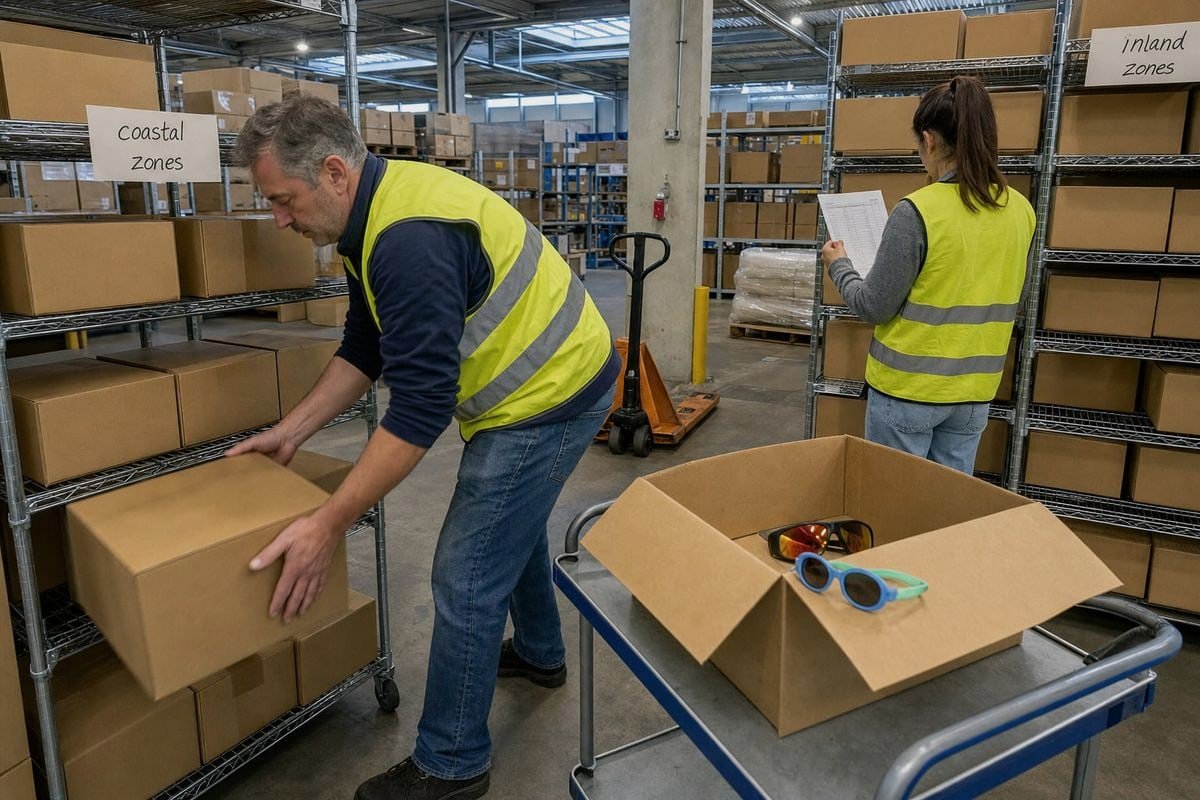
We are a factory of roughly 120 workers with 15 years in children's eyewear, and split shipments before promotions are a routine part of how we serve brands, importers, and promotional product companies in more than 20 countries. Here is what coordination looks like in practice.
What we handle on our side
- Production sequencing. We schedule your batches so batch one finishes early enough for sea freight, while batch two is timed for a faster route closer to launch.
- Shipment-ready compliance. Each batch leaves with its own document set — test reports, UV400 lens verification, and the safety paperwork your market requires — so customs holds do not stall a single batch and, with it, your launch.
- Labeling and barcoding. For FBA 7 or 3PL flows, we apply your FNSKU or carton labels at the factory. Mislabeled cartons are a common cause of receiving delays, and they are entirely preventable at our end.
- Retail-ready packaging per batch. As an OEM/ODM partner, we pack each shipment in your branded boxes, pouches, and inserts, so every batch arrives ready to sell, not ready to rework.
What we need from you
Coordination works when information flows both ways. We ask buyers for three things: the promotion launch date, the warehouse check-in cut-off dates, and the customs broker's document requirements. With those fixed points, we build the schedule backward and share batch-level milestones — production start, QC completion, handover to the forwarder — so your team is never guessing.
One practical advantage helps here: with around 800 existing styles in TPEE and TR90, buyers can often skip mold development entirely. That removes 4–6 weeks from the front of the timeline, which is frequently the difference between making a promo window and missing it.
Schlussfolgerung
A promotion with empty shelves is wasted money. Plan split shipments 8–10 weeks out, split roughly 60/30/10, hold quality steady per batch, and let us coordinate the rest.
Fußnoten
1. FDA guidance explains UV protection standards relevant to children’s sunglasses lens testing. ↩︎
2. Amazon’s official FBA page clarifies check-in and inventory status processes referenced here. ↩︎
3. Background on thermoplastic elastomer materials used in eyewear frame manufacturing. ↩︎
4. ISO develops international testing standards for eyewear frame durability including hinge performance. ↩︎
5. ASTM International sets the technical standards referenced for toy and eyewear testing compliance. ↩︎
6. US Customs and Border Protection outlines the official role of customs brokers in import clearance. ↩︎
7. Explains the Fulfillment by Amazon program and its check-in and inventory status process. ↩︎
Weitere Artikel, die Ihnen gefallen könnten

August 2026
Sollte die Fabrik die Verpackung und Kennzeichnung von Kinder-Sonnenbrillen übernehmen oder einen bestimmten Lieferanten nutzen?
August 2026
Eigenes Lager vs. Direktlieferung durch den Lieferanten: Was senkt die Retourenkosten für Marken von Kinder-Sonnenbrillen?
August 2026
Direkt zum Lagerhafen oder Lagerung in Übersee: Was spart mehr bei den Versandkosten für Kinder-Sonnenbrillen?
Auf der Suche nach einem zuverlässigen Partner für Kinderbrillen?
Entdecken Sie über 800 sofort verfügbare Modelle und umfassenden OEM/ODM-Support, der auf Ihre Marke zugeschnitten ist.
Kontakt aufnehmen English
  Español de México
  Deutsch
  Français
  日本語
日本語  العربية
  Português do Brasil