How to Request Lens Light Transmittance Data From Kids’ Sunglasses Suppliers?
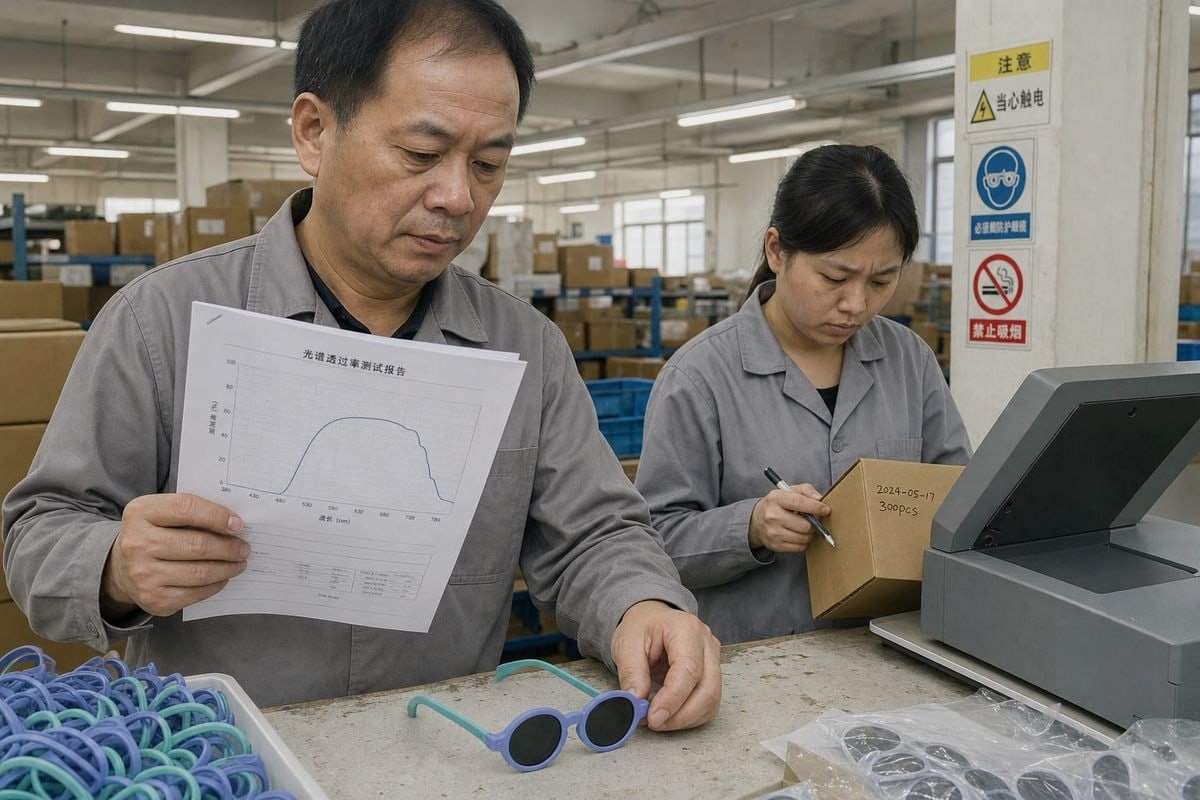
Requesting lens light transmittance data from kids’ sunglasses suppliers sounds simple until a factory sends you a one-line “UV400” claim. On our production line in Taizhou, I have seen how much that shortcut can hide. A dark lens that fails UV-Schutz 1, a mismatched batch, a report tied to a different coating — any of these can end up on a child’s face and, later, in a product recall 2. The fix is not more certificates. It is asking for the right evidence, tied to the exact lens you are ordering.
To request lens light transmittance data from kids’ sunglasses suppliers, ask for a spectral transmittance report for the exact lens model and batch, including the test date, wavelength range, Visible Light Transmission (VLT) value, test standard, and the name of the accredited laboratory.
That is the short answer. Below, I will walk through what to specify before ordering, how to verify the reports, which standards to pair with the data, and how to turn it all into a retail selling point.
What lens transmittance specifications should I ask my supplier to confirm before placing an order?
A buyer from Australia once asked me for "the UV certificate" on one of our TR90 kids' styles. I sent back a full spectrophotometer test report 3 instead — and explained why the difference matters.
Before ordering, confirm the lens VLT percentage, the filter category classification, UV transmittance up to 400nm, the spectral transmittance curve, lens material specifications, and whether the data applies to your exact lens color, coating, and production batch.
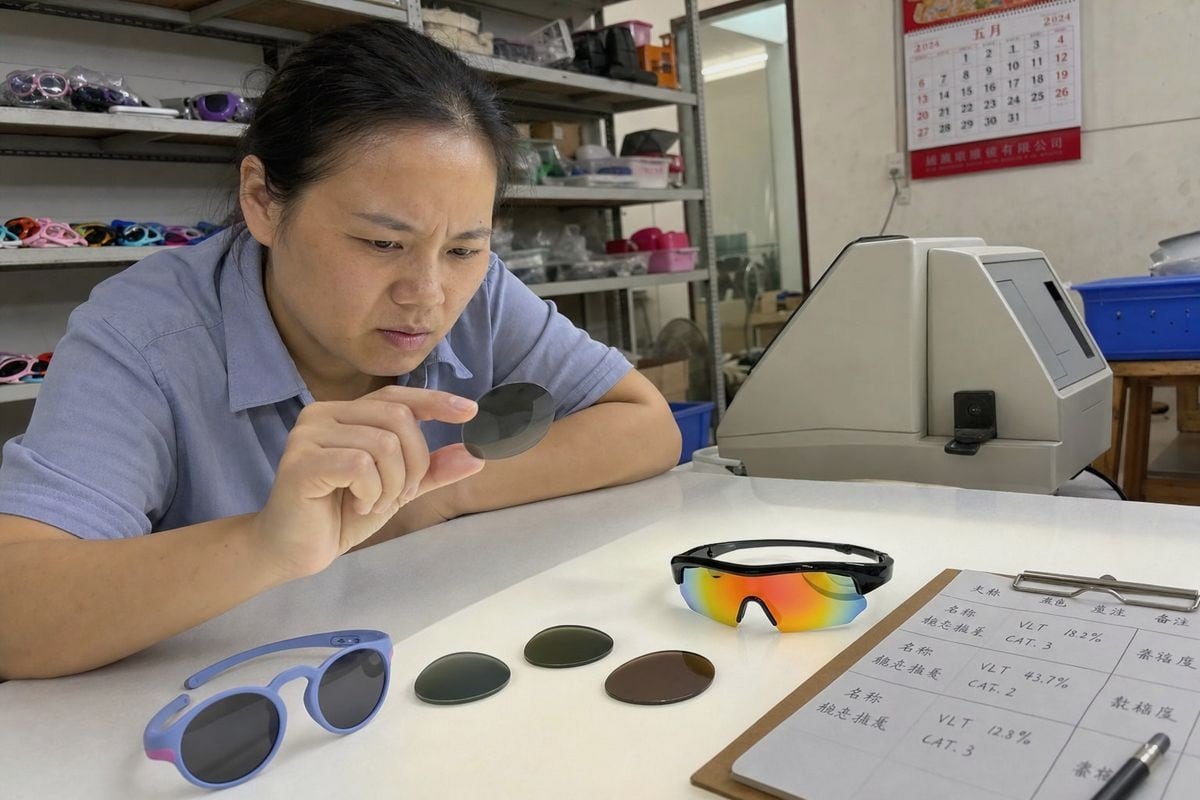
The phrase "light transmittance data" means different things to different suppliers, so your request needs to define terms. In our experience quoting for children's brands across 20+ countries, vague requests get vague answers. Specific requests get real documents.
The three measurements that matter
There are three distinct numbers hiding inside "transmittance," and you should name each one in your RFQ:
| Measurement | What it tells you | Warum es für Kinder wichtig ist |
|---|---|---|
| Visible Light Transmission (VLT) | The percentage of visible light passing through the lens | Sets tint darkness and outdoor comfort |
| Spektrale Transmission | Transmission plotted across each wavelength, typically 280–780nm or wider | Lets you verify every performance claim, not just accept it |
| UV-Durchlässigkeit | Light passing through below 400nm | Confirms real UV400 protection standards, not marketing language |
Here is the trap I warn every new buyer about: tint and UV protection are not the same thing. A lens can be very dark and still leak UV, which is worse than no sunglasses at all because the child's pupils dilate behind the dark tint. A lighter lens can block UV completely if the Polycarbonat 4 or coating is right. Only spectral data separates these cases.
Pin down the filter category
For children's outdoor sunglasses, most of our brand customers specify filter category 3 5, which corresponds to a luminous transmittance of roughly 8–18%. Confirm the category in writing. It defines the VLT band you should see on the report, and it gives you an instant sanity check when the document arrives. Also confirm lens material specifications — the base material, the dye, and the coating all shift the curve, so a report for a gray lens does not cover the mirrored gradient version of the same frame.
How do I verify that a factory's light transmittance test reports are accurate and trustworthy?
Early in my export career, a competitor's "test report" crossed my desk — dated three years earlier, for a different lens color. That document taught me exactly what buyers should check.
Verify a transmittance report by matching the lens model, color, and coating to your order, checking the test date is recent, confirming an accredited third-party lab performed the test, and reviewing the full wavelength range covered by the spectrophotometer scan.

A report is only as good as its connection to your actual shipment. At our factory, we keep batch testing results linked to production orders precisely because serious buyers ask for that link. Here is the checklist I recommend running on every document a supplier sends.
The seven-point report checklist
| Check | What a credible report shows | Rote Fahne |
|---|---|---|
| Lens model | Exact model, color, and coating tested | Generic "sunglass lens" description |
| Test date | Recent, ideally within the current production cycle | Report older than one or two years |
| Wavelength range | Full UV plus visible spectrum, e.g., 280–780nm | UV range missing entirely |
| VLT value | A clear luminous transmittance figure with filter category | Only a vague "dark tint" note |
| Test standard | Named method such as ISO 12312-1 clauses | No standard referenced |
| Laboratory | Independent, accredited lab with contact details | Unnamed in-house instrument only |
| Curve or table | Readable spectral transmittance data | A single summary number with no data behind it |
Master reports versus lot-specific data
One caveat worth raising honestly: not every supplier will have a fresh report for every batch, and that is not automatically disqualifying. A report for a similar lens in the same series can serve as preliminary reference data during sampling. But for the bulk order itself, ask for lot-specific spectrometer scans — a CSV file or PDF tied to your production run's dye mix — rather than a generic master-batch report. Dye concentration drifts between lots, and luminous transmittance levels drift with it. We run in-line transmission checks in our 5S-managed workshop for exactly this reason, and we tell buyers to expect the same discipline elsewhere. Finally, pair document review with physical samples. If a sample lens looks noticeably lighter or darker than the reported VLT band suggests, question the paperwork before you wire the deposit.
Which certifications or standards should I request alongside transmittance data for kids' sunglasses?
Every destination market changes the paperwork we prepare. When our team ships kids' sunglasses to Europe versus the United States, the transmittance data stays similar — but the surrounding documents do not.
Request test reports referencing EN ISO 12312-1 for the EU, ANSI Z80.3 for the USA, or AS/NZS 1067 for Australia, plus a Declaration of Conformity, FDA drop ball test documentation for the US, and CE marking evidence where applicable.
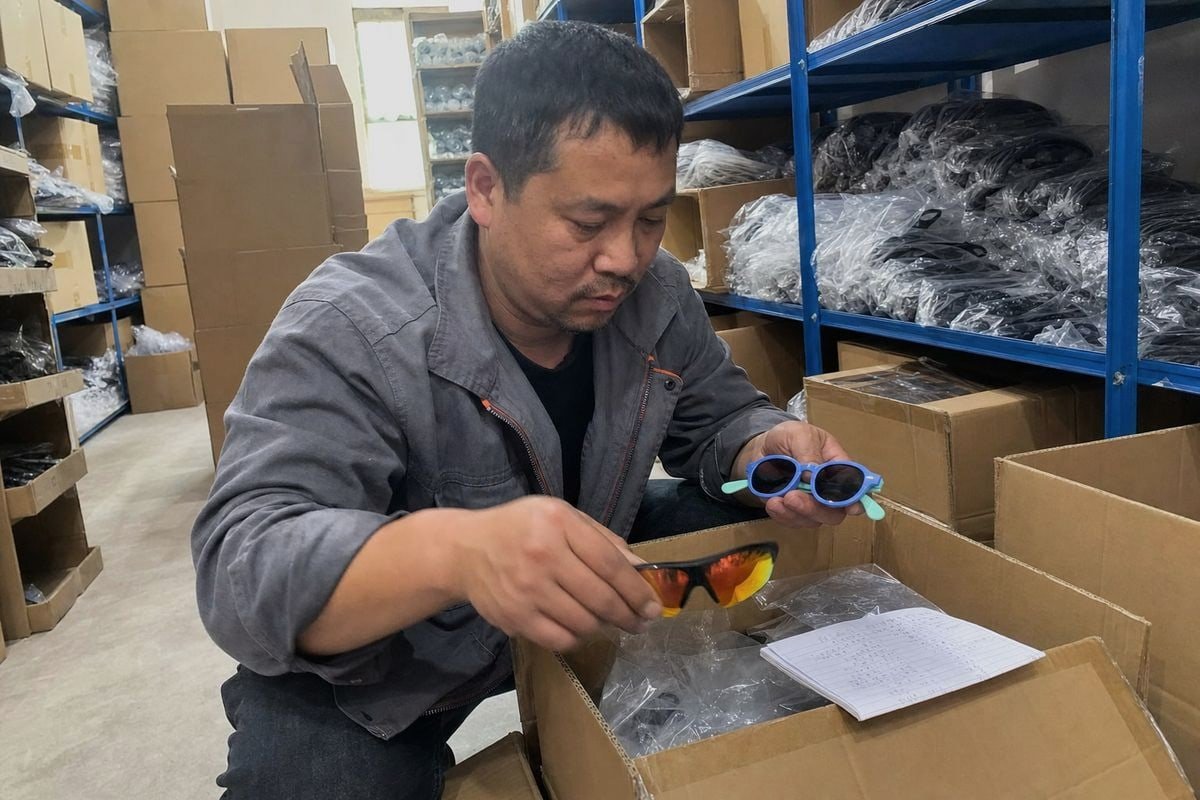
Transmittance data answers "how does this lens perform?" Standards documentation answers "is this product legal to sell in my market?" You need both, and they must reference each other.
Match the standard to your market
| Markt | Primary standard | Additional documents to request |
|---|---|---|
| Europäische Union | EN ISO 12312-1 compliance | Konformitätserklärung 6, CE marking evidence |
| Vereinigte Staaten | ANSI Z80.3 certification alignment | 21 CFR 801.410 drop ball test record, FDA guidance conformity |
| Australien / Neuseeland | AS/NZS 1067 | Mandatory category labeling documentation |
| Japan | JIS or accepted ISO equivalents | Import documentation per distributor requirements |
Two points deserve emphasis. First, the Declaration of Conformity is what legally links the specific product batch to the test results — without it, even a perfect spectrophotometer test report floats free of your actual shipment. Second, for the US market, light transmittance and Schlagfestigkeit 7 are the two regulatory pillars for kids' eyewear. The drop ball test certificate is not optional paperwork; it sits alongside transmittance data as core quality assurance documentation.
Extra data for specific claims
Some checks matter only when you make specific claims. If your listing mentions blue-light or screen protection, request High-Energy Visible (HEV) transmittance at wavelengths like 415nm and 455nm. If your kids cycle or walk near roads, ask about signal recognition data confirming the lens does not distort traffic-light colors. And for products meant to last more than one season, accelerated aging reports verify the UV protection does not degrade with sun exposure. We do not push every buyer toward every test — a basic beach sunglass does not need HEV data — but the claims on your packaging should always be backed by a matching measurement.
How can I use transmittance data to communicate safety and quality to my retail customers?
A brand founder we work with in Europe once told me her best-selling product page was the one showing our lens test data as a simple chart. Parents read it. Parents shared it.
Translate transmittance data into consumer language: state the filter category, the VLT percentage, and verified 99–100% UV blocking up to 400nm on packaging and product pages, backed by the named standard and accredited lab testing.

Verified data is a sales asset, not just a compliance cost. Parents buying kids' sunglasses are anxious buyers. They cannot test a lens themselves, so they look for proof signals. Your transmittance documentation gives you those signals — if you translate it well.
From lab report to shelf language
Raw spectral data means nothing to a parent. Here is the translation process we help our OEM/ODM customers work through when we prepare retail-ready packaging:
- Lead with the UV claim, backed by the standard. "Blocks 99–100% of UVA and UVB up to 400nm, tested to EN ISO 12312-1" is stronger than a bare UV400 sticker because it names verifiable evidence.
- Explain the filter category simply. "Category 3 lenses — the level recommended for bright outdoor sun" tells a parent what the number means for their child's day at the beach.
- Use the VLT figure for comfort framing. A 12% Visible Light Transmission figure becomes "reduces glare while keeping colors natural."
- Show, don't just tell. A simplified transmittance curve graphic on a product page or hang tag signals third-party rigor. Marketplace listings with lab-backed visuals consistently outperform generic claims.
- Keep the full report available. Retail buyers, distributors, and marketplace compliance teams increasingly request the underlying spectrophotometer test report. Having it ready in a shared folder shortens every wholesale conversation.
One honest caveat: never let marketing language outrun the data. If your batch testing results cover the gray lens, do not extend the claim to the mirrored gradient version until it is tested. We have seen listings pulled for exactly that gap. Consistency between your evidence and your claims is what builds the long-term trust that keeps a children's brand on shelves season after season.
Schlussfolgerung
Skip the blanket claims. Request spectral reports tied to your exact lens and batch, verify the details, pair them with market standards, and turn that proof into retail trust.
Fußnoten
1. WHO explains UV radiation health effects, supporting why verified UV blocking matters for children’s eyes. ↩︎
2. CPSC tracks consumer product recalls, relevant to risks from unverified children’s sunglasses lenses. ↩︎
3. Explains spectrophotometer function, the instrument producing the transmittance reports buyers
Weitere Artikel, die Ihnen gefallen könnten

August 2026
Sollte die Fabrik die Verpackung und Kennzeichnung von Kinder-Sonnenbrillen übernehmen oder einen bestimmten Lieferanten nutzen?

August 2026
Eigenes Lager vs. Direktlieferung durch den Lieferanten: Was senkt die Retourenkosten für Marken von Kinder-Sonnenbrillen?

August 2026
Direkt zum Lagerhafen oder Lagerung in Übersee: Was spart mehr bei den Versandkosten für Kinder-Sonnenbrillen?
Auf der Suche nach einem zuverlässigen Partner für Kinderbrillen?
Entdecken Sie über 800 sofort verfügbare Modelle und umfassenden OEM/ODM-Support, der auf Ihre Marke zugeschnitten ist.
Kontakt aufnehmen English
  Español de México
  Deutsch
  Français
  日本語
日本語  العربية
  Português do Brasil