How to Measure a Child’s Face Size for Kids’ Sunglasses?
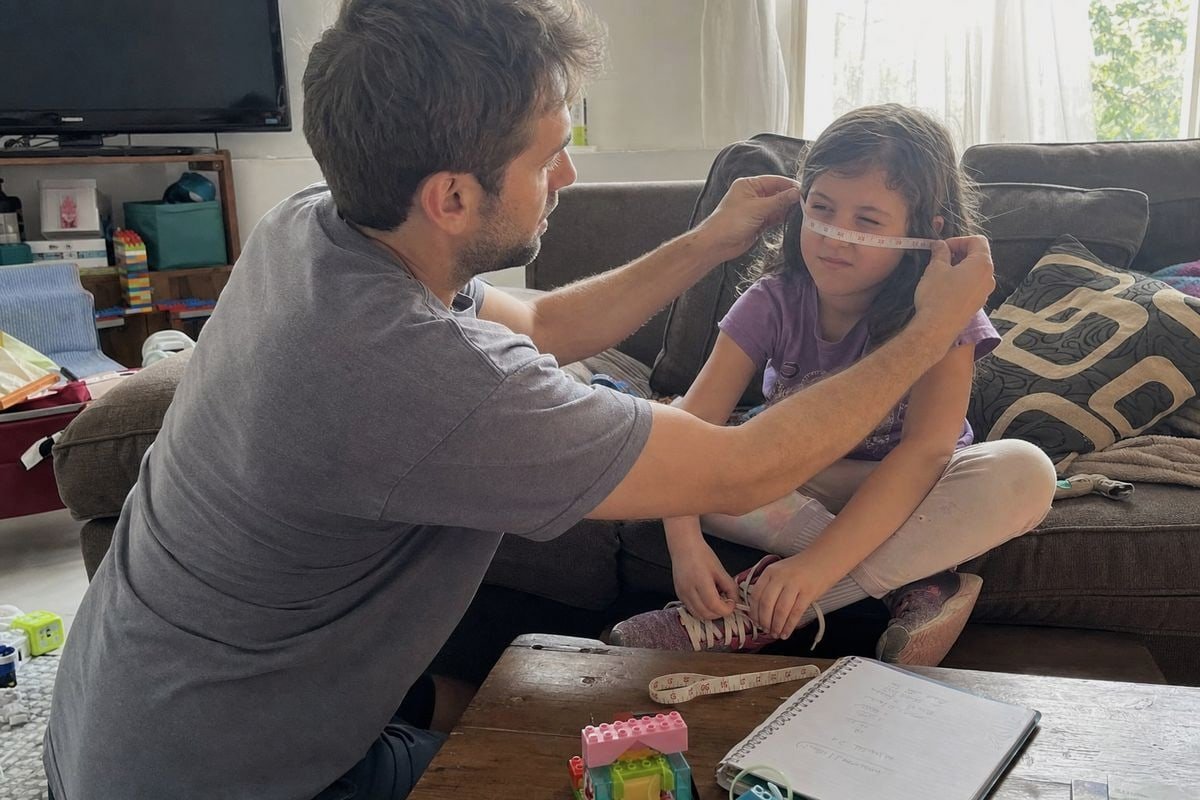
Knowing how to measure a child’s face size for kids’ sunglasses is a question our factory team in Taizhou answers almost weekly UV400 sunglasses 1. Buyers order frames, then kids reject them. Poor fit kills repeat sales fast. Accurate measurement solves this before production ever starts.
To measure a child’s face size for kids’ sunglasses, measure three dimensions in millimeters: face width across the temples at eye level, bridge width where the frame rests on the nose, and temple length from the hinge point over the ear. These three numbers determine frame fit.
Those three numbers sound simple. But each one has small details that decide whether sunglasses stay on during play or end up in a drawer. Let me walk you through each measurement, the tools you need, and how this connects to sourcing decisions.
What Are the Key Measurements I Need to Take Before Choosing a Frame Size?
During a QC session last year, our team compared thirty returned samples from a European buyer. Almost every fit complaint traced back to one of just three missing measurements, not the frame quality itself.
Before choosing a frame size, take three key measurements: face width (temple to temple at eye level), bridge width (the gap where the frame sits on the nose), and temple length (hinge to behind the ear). Pupillary distance is optional unless prescription lenses are planned.
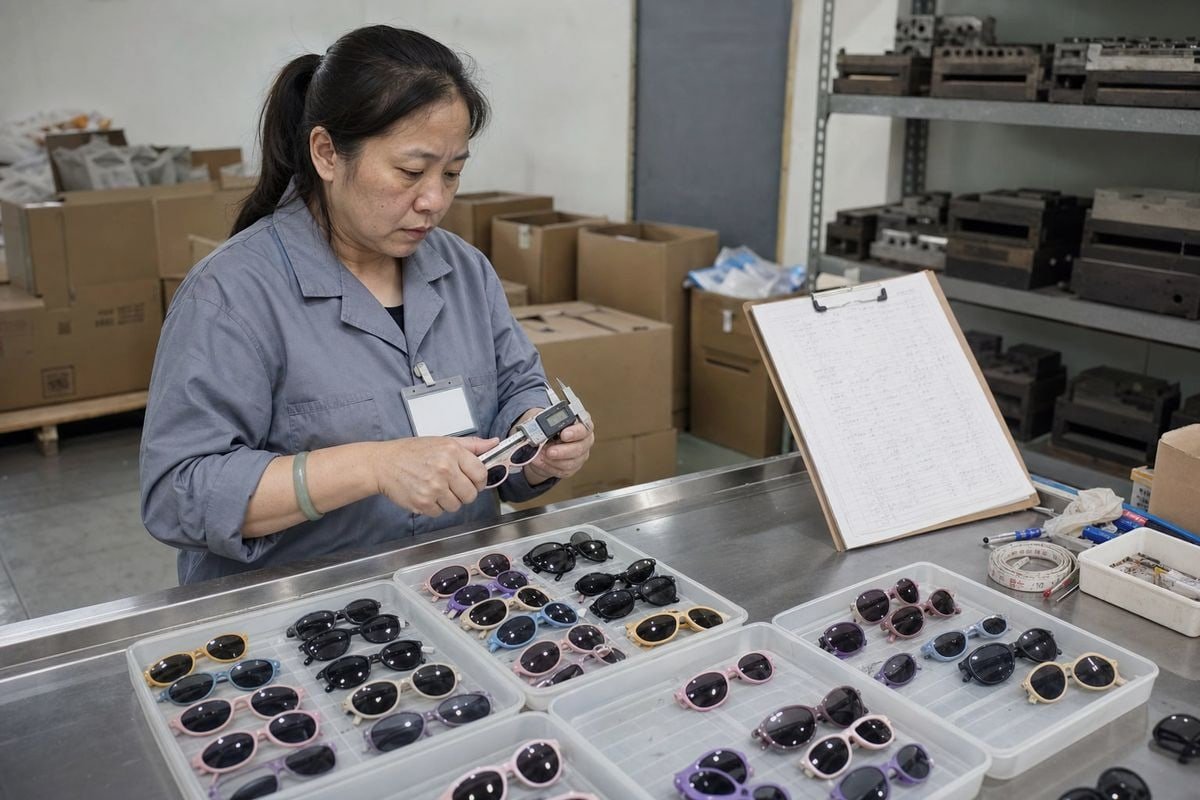
The goal is not to map the whole face like a portrait artist. The goal is to estimate the frame dimensions that will sit comfortably and stay put when a child runs, jumps, or rides a bike. Sunglasses sizing works on three numbers, so your measurements should mirror those three numbers.
Face Width
Face width is the distance across the widest part of the face, roughly just below the eyes and above the cheekbones. Measure temple to temple while the child looks straight ahead. This number tells you the total frame width you need. If the frame is too wide, sunglasses slide down. If it is too narrow, the arms pinch and leave red marks.
Bridge Width
The bridge is the part of the frame resting on the nose. Children often have flatter, less developed nose bridges than adults. This is exactly why our engineers spend so much time on bridge shapes when we develop TR90 and TPEE frames 2 for younger age groups. A bridge that is too wide lets the frame slip down; one that is too narrow perches the frame too high.
Temple Length
Temple length runs from the hinge, over the ear, to where the arm tip should rest, roughly an inch below the earlobe. Arms that are too long flap loosely. Arms that are too short press behind the ears.
| Measurement | Where to Measure | Warum es wichtig ist |
|---|---|---|
| Face width | Temple to temple, at eye level | Sets total frame width |
| Bridge width | Across the nose where frame rests | Prevents slipping or perching |
| Temple length | Hinge point to behind the ear | Keeps arms secure without pressure |
| Pupillary distance (optional) | Pupil center to pupil center | Centers lenses; key for prescriptions |
What About Pupillary Distance?
PD matters most for prescription eyewear 3, because lenses must be optically centered. For plain UV400 sunglasses 4, PD is a secondary check. Still, if your brand may add prescription lenses later, record it now.
How Do I Know Which Frame Width Fits My Child's Age Group?
One trade-off we weigh constantly when grading our 800-style catalog is age banding versus true head size. Two five-year-olds can differ by a full frame size, so age charts are a starting point, never the final word.
Frame width by age group: toddlers aged 1–3 typically need 38–42 mm lens width, children aged 4–7 need 42–46 mm, and kids aged 8–12 need 46–50 mm. Always confirm with an actual face-width measurement, since children's head sizes vary widely within each age band.
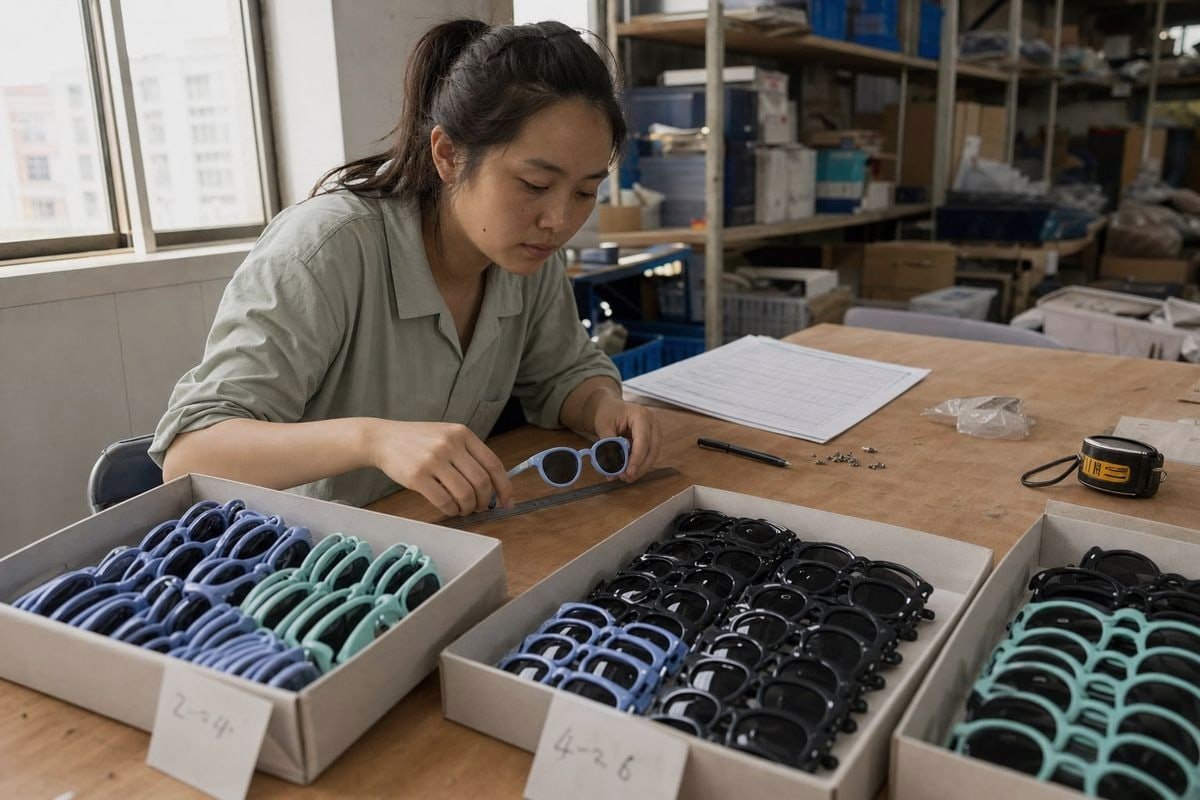
Age-based sizing exists because parents and buyers often cannot measure every child. It works as a fallback. But children grow at very different rates, so a measured face width always beats an age label. Here is the standard reference we share with new buyers who are building their first kids' sunglasses range:
| Altersgruppe | Frame / Lens Width | Bridge Width | Temple Length |
|---|---|---|---|
| Toddlers (1–3 years) | 38–42 mm | 12–15 mm | 110–120 mm |
| Young children (4–7 years) | 42–46 mm | 14–17 mm | 120–130 mm |
| Older children (8–12 years) | 46–50 mm | 15–18 mm | 125–135 mm |
How to Use the Chart Correctly
First, measure the child's face width. Then compare it to the total frame width, which is roughly two lens widths plus the bridge. A useful rule: the frame can be slightly wider than the face, by about 5–10 mm, but never narrower. A slightly wide frame still sits comfortably. A narrow frame squeezes and gets rejected within a day.
Growth Allowance
For children under six, faces change quickly. Adding a 2–3 mm allowance extends the usable life of the sunglasses. This is one reason we build most of our children's styles in flexible TPEE and TR90. The material flexes outward as the head grows, which forgives small sizing gaps that rigid frames cannot.
Reading the Size Code
If the child already owns a well-fitting pair, look inside the temple arm. You will often see a code like 46-16-125. That means 46 mm lens width, 16 mm bridge, 125 mm temple length. This code is the fastest sizing benchmark you can get.
What Tools Can I Use to Measure My Child's Face Accurately at Home?
A distributor in Australia once asked us how her retail customers could measure kids at home without special equipment. We tested every household method in our sample room, and the answer is simpler than most parents expect.
Use a soft measuring tape marked in millimeters as the primary tool. If unavailable, use a piece of string plus a ruler. A mirror keeps the child looking straight ahead, and a standard credit card (85.6 mm wide) works as a scale reference in photos.
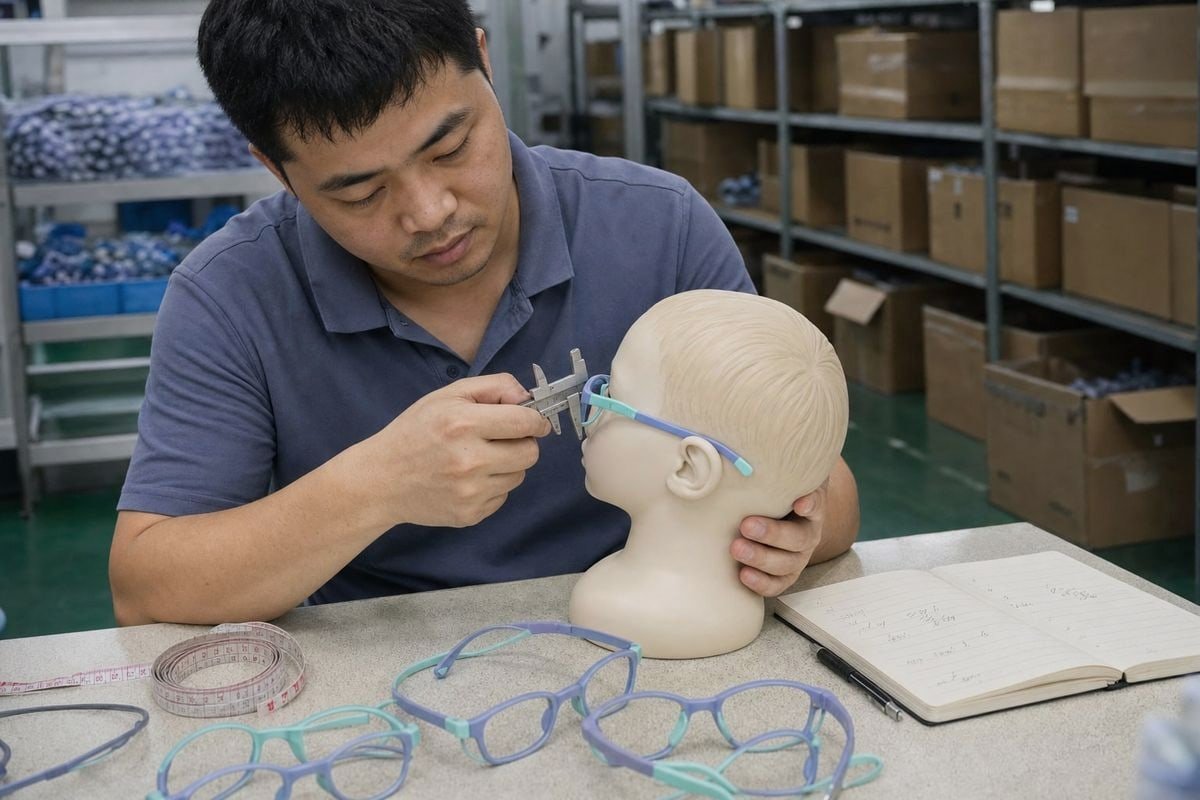
Accuracy at home is mostly about method, not equipment. Follow this simple process:
- Position the child. Have them stand naturally and look straight ahead into a mirror. Tilted heads distort every measurement.
- Measure face width. Lay a soft tape across the face at eye level, temple to temple. Do not pull the tape tight against the skin; keep it flat and straight. Record the number in millimeters.
- Measure the bridge. Estimate the width of the nose where a frame would rest. On small children this is often 12–17 mm.
- Measure temple length. Run the tape from the outer corner of the eye area (where a hinge would sit), over the top of the ear, to about an inch below the earlobe.
- Repeat once. Kids fidget. Take each measurement twice and use the average.
The String-and-Ruler Backup
No soft tape? Hold a piece of string across the face, mark the endpoints with your fingers, then lay the string flat against a ruler. It is slightly less precise but perfectly workable.
The Credit Card Photo Method
For remote sizing, take a front-facing photo with a standard credit card 5 held flat against the child's forehead. Because the card is exactly 85.6 mm wide, anyone can calculate face width from the photo by proportion. We sometimes ask overseas buyers to send photos like this when they want us to recommend styles from our existing catalog for a specific age range.
An Existing Pair Beats Everything
If the child owns glasses that fit well, measure the front frame width directly, or read the printed size code. This benchmark removes most guesswork.
How Can I Ensure the Right Fit When Sourcing Sunglasses from a Manufacturer?
Fifteen years of exporting Brillen für Kinder 6 taught our team one hard lesson: a buyer who skips the sample fitting stage almost always pays for it in returns. Fit verification belongs in the sourcing process, not after the container ships.
To ensure the right fit when sourcing, request the exact frame width, bridge width, and temple length for each style, order physical samples, and test them on real children in your target age group. Confirm flexible materials, adjustable features, and consistent tolerances before approving production.
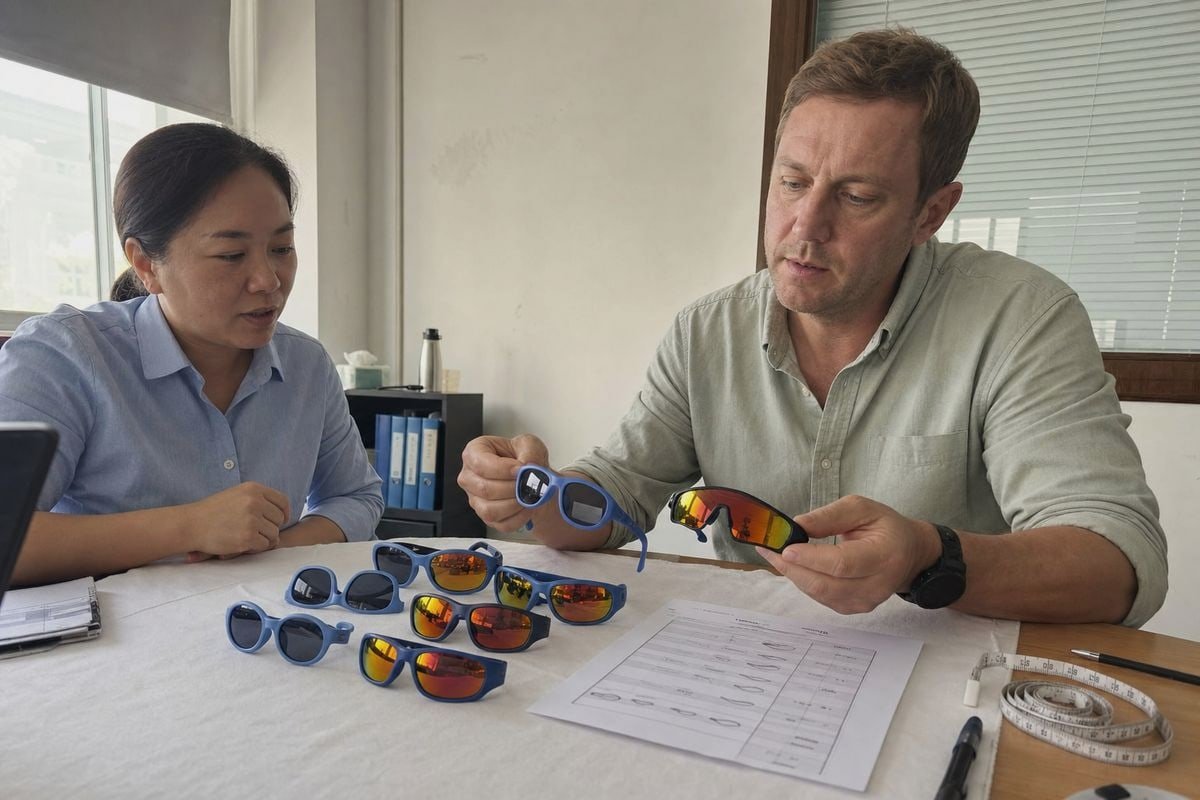
When you source at scale, you are not fitting one child. You are fitting thousands of different faces within an age band. That changes how you should think about fit.
Demand Full Dimension Sheets
Ask your supplier for the three sizing numbers on every style, plus lens height and total frame width. At our factory, every one of our roughly 800 existing styles carries a full dimension sheet, so brands can map styles to age bands before spending anything on samples or molds.
Choose Materials That Forgive Variation
No single frame size fits every child in an age group perfectly. Flexible materials close that gap. TR90 frames with TPEE temples bend outward for larger heads and spring back without deforming. Rigid metal or hard acetate frames tolerate almost no sizing error, which is why we rarely recommend them for active kids.
| Sourcing Checkpoint | What to Verify | Why It Reduces Fit Risk |
|---|---|---|
| Dimension sheet | Lens, bridge, temple sizes per style | Matches styles to measured age bands |
| Material flexibility | TPEE / TR90 flex and recovery | Absorbs head-size variation and impacts |
| Physical samples | Real-child wear testing | Reveals slipping, pinching, pressure points |
| Production tolerance | Consistency across the batch | Prevents random fit complaints at retail |
| Adjustable features | Nose fit, flexible hinges, curved tips | Extends usable life as children grow |
Run a Real-World Wear Test
Before approving a bulk order 7, put samples on children in your target market. The sunglasses should rest evenly on the face, stay centered when the child shakes their head, and leave no pressure marks on the nose, temples, or behind the ears after twenty minutes. Sport wraparound shields, round retro frames, and everyday styles each distribute weight differently, so test every silhouette separately.
Confirm QC on Dimensions
Finally, ask how the factory controls dimensional consistency. In our 5S-managed workshop, we check frame width and temple alignment during assembly, because a 2 mm drift across a batch turns a well-sized style into a returns problem. A supplier who cannot explain their tolerance checks is a supplier guessing at fit.
Schlussfolgerung
Guessing at kids' sunglasses sizes leads to slipping frames, pinched temples, and returns. Measure face width, bridge, and temple length in millimeters, verify against age charts, and test real samples before ordering.
Fußnoten
1. WHO explains UV radiation risks, supporting the importance of UV400 protection for children’s eyewear. ↩︎
2. Background on thermoplastic elastomer materials used in flexible children’s frames. ↩︎
3. Explains why prescription lenses need precise optical centering via pupillary distance. ↩︎
4. WHO fact sheet on UV radiation supports the need for UV-protective sunglasses. ↩︎
5. Confirms the standardized 85.6 mm card size used as a photo scale reference. ↩︎
6. CDC vision health resource supports importance of proper children’s eyewear fit. ↩︎
7. Illustrates standard B2B sourcing platform practices for bulk ordering eyewear. ↩︎
Weitere Artikel, die Ihnen gefallen könnten

August 2026
Sollte die Fabrik die Verpackung und Kennzeichnung von Kinder-Sonnenbrillen übernehmen oder einen bestimmten Lieferanten nutzen?

August 2026
Eigenes Lager vs. Direktlieferung durch den Lieferanten: Was senkt die Retourenkosten für Marken von Kinder-Sonnenbrillen?

August 2026
Direkt zum Lagerhafen oder Lagerung in Übersee: Was spart mehr bei den Versandkosten für Kinder-Sonnenbrillen?
Auf der Suche nach einem zuverlässigen Partner für Kinderbrillen?
Entdecken Sie über 800 sofort verfügbare Modelle und umfassenden OEM/ODM-Support, der auf Ihre Marke zugeschnitten ist.
Kontakt aufnehmen English
  Español de México
  Deutsch
  Français
  日本語
日本語  العربية
  Português do Brasil