How to Fix Loose or Bent Kids’ Sunglasses Temples at Home?

Loose or bent kids’ sunglasses temples are the most common complaint our factory hears from parents and brand buyers alike UV-Schutz 1. [The glasses slip](https://okayeyewear.com/which-slip-less-ear-hook-straight-temples-kids-sunglasses/), the child stops wearing them, and UV-Schutz 2 quietly disappears. On our production line in Taizhou, we hinge-test every frame precisely because of this — and the good news is most temple problems are fixable at home in ten minutes.
To fix loose or bent kids’ sunglasses temples at home, first diagnose the problem: tighten a wobbly hinge screw clockwise with a mini screwdriver, or warm bent plastic temples in 40–45°C water for 20–60 seconds and gently reshape them in small increments, testing fit often.
The trick is knowing which problem you actually have. A loose screw needs one fix. A bent temple needs another. Let me walk you through both, step by step.
How can I tighten loose screws on my child's sunglasses temples without special tools?
During a quality audit last year, our QC team traced most returned samples to one tiny part: the hinge screw. Kids open and close their sunglasses dozens of times a day, and screws slowly back out. I have seen this on frames from every factory, including our early production runs before we tightened our assembly torque standards.
Tighten loose temple screws by laying the sunglasses on a soft cloth, fitting a small flathead or Phillips screwdriver snugly into the hinge screw, and turning clockwise in tiny increments until you feel gentle resistance. Never force it — overtightening strips the screw or cracks the hinge.
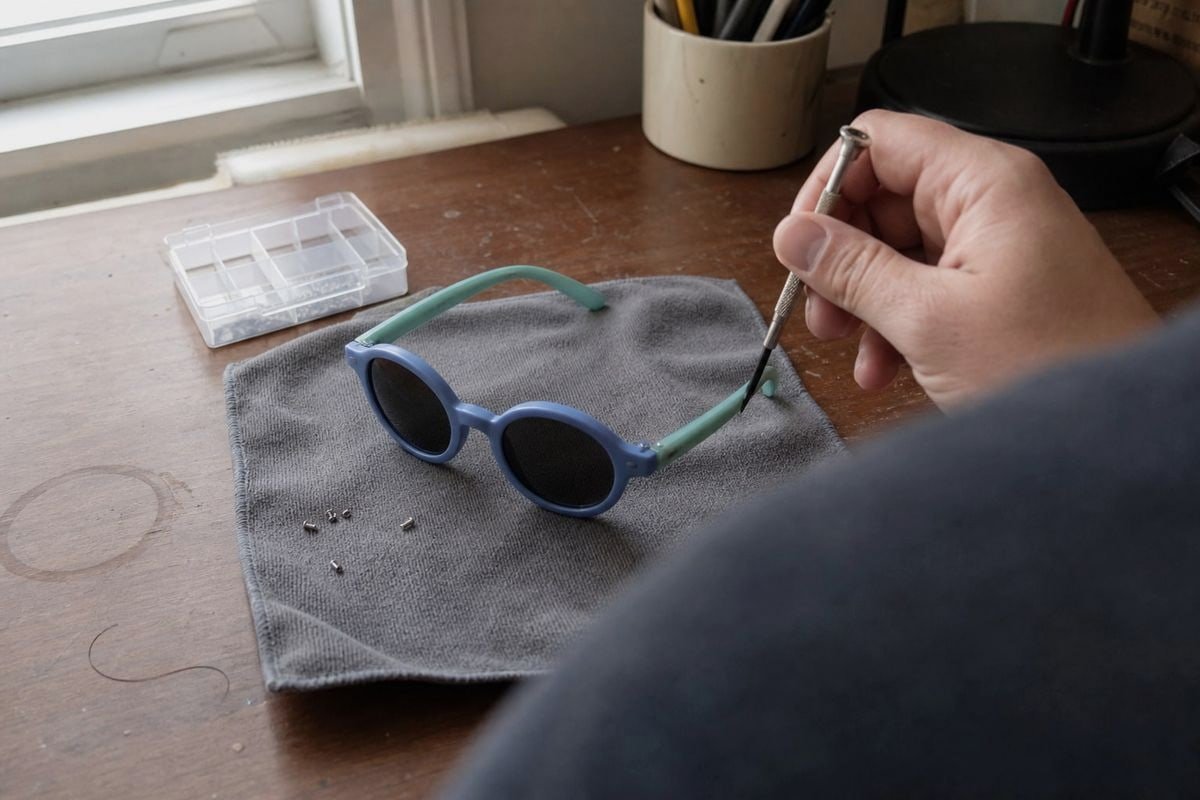
You do not need an optician's toolkit for this repair. Most homes already have what works. A small precision screwdriver from an electronics kit fits most eyewear screws. Even the tiny screwdriver from a battery-operated toy repair kit can do the job. If nothing fits, a cheap eyeglass repair kit costs very little and includes spare screws, which is worth having in a house with kids.
The safe tightening process
- Place the sunglasses lens-down on a microfiber cloth so the lenses cannot get scratched.
- Open the temple arm fully so the hinge barrel lines up.
- Fit the screwdriver tip firmly into the screw slot. A loose fit will chew up the screw head.
- Turn clockwise in quarter-turns. Stop the moment you feel resistance.
- Open and close the temple. It should swing smoothly but not flop.
Stopping the screw from loosening again
If the same screw keeps backing out, the threads are worn. A tiny dab of clear nail polish on the screw threads can act as a mild thread-locker 3. I frame this as a backup, not a first choice, for children's eyewear — keep the polish off any surface that touches skin, and let it dry fully before your child wears the glasses. On our own kids' frames, we prefer spring hinges and properly torqued screws at assembly, because chemical fixes on children's products always deserve extra caution.
| Symptom | Likely cause | Home fix |
|---|---|---|
| Temple flops open and closed | Loose hinge screw | Tighten clockwise in small turns |
| Screw spins but never tightens | Stripped threads | Replace screw from a repair kit |
| Screw is missing entirely | Screw fell out during play | Insert matching spare screw |
| Hinge is tight but temple wobbles | Cracked hinge barrel | Replace the frame |
What's the safest way to straighten bent TR90 or TPEE temples without cracking them?
Flexible-material expertise is the core of what we do in our workshop, so I can tell you exactly how TR90 and TPEE 4 behave under heat. These polymers are chosen for kids' eyewear precisely because they bend instead of snap — but they still have limits, and the wrong heat source will find those limits fast.
Straighten bent TR90 or TPEE temples by soaking the temple arm — not the lenses — in warm water around 40–45°C for 20 to 60 seconds, then bending it gently by hand, 1–2 mm at a time. Never use boiling water, open flames, or a stovetop.
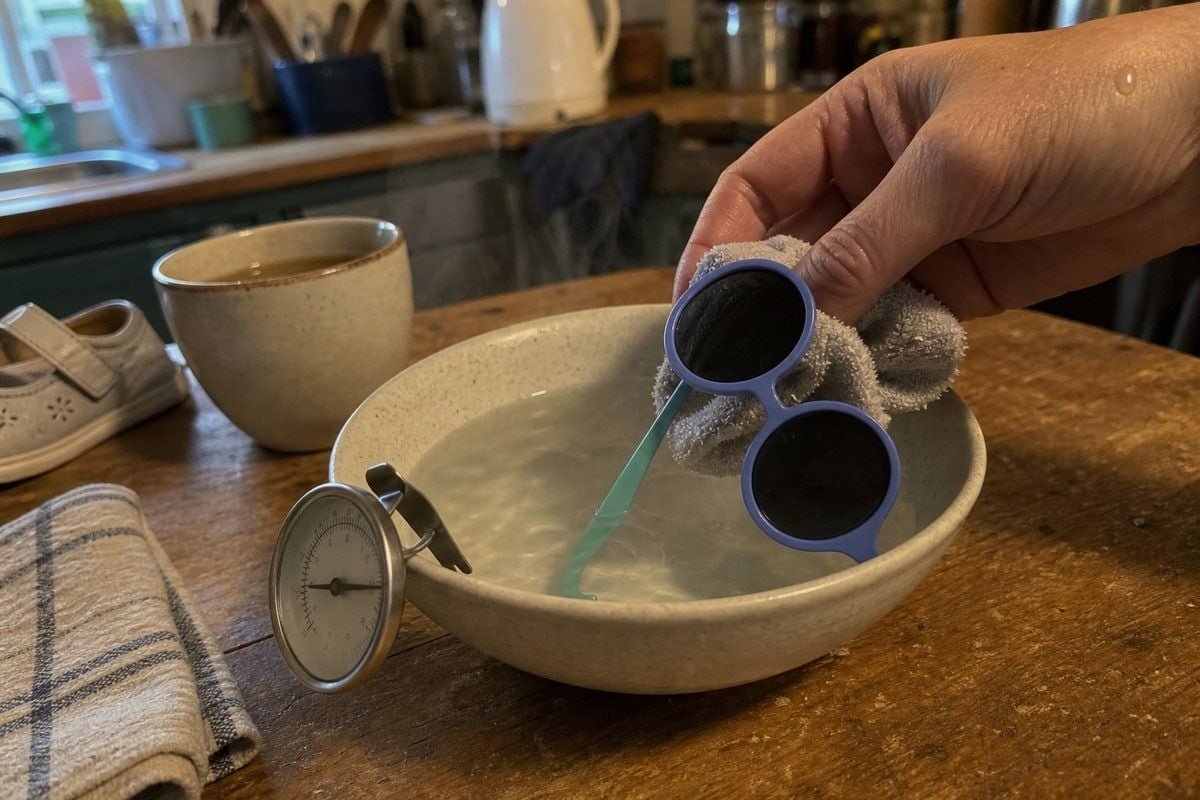
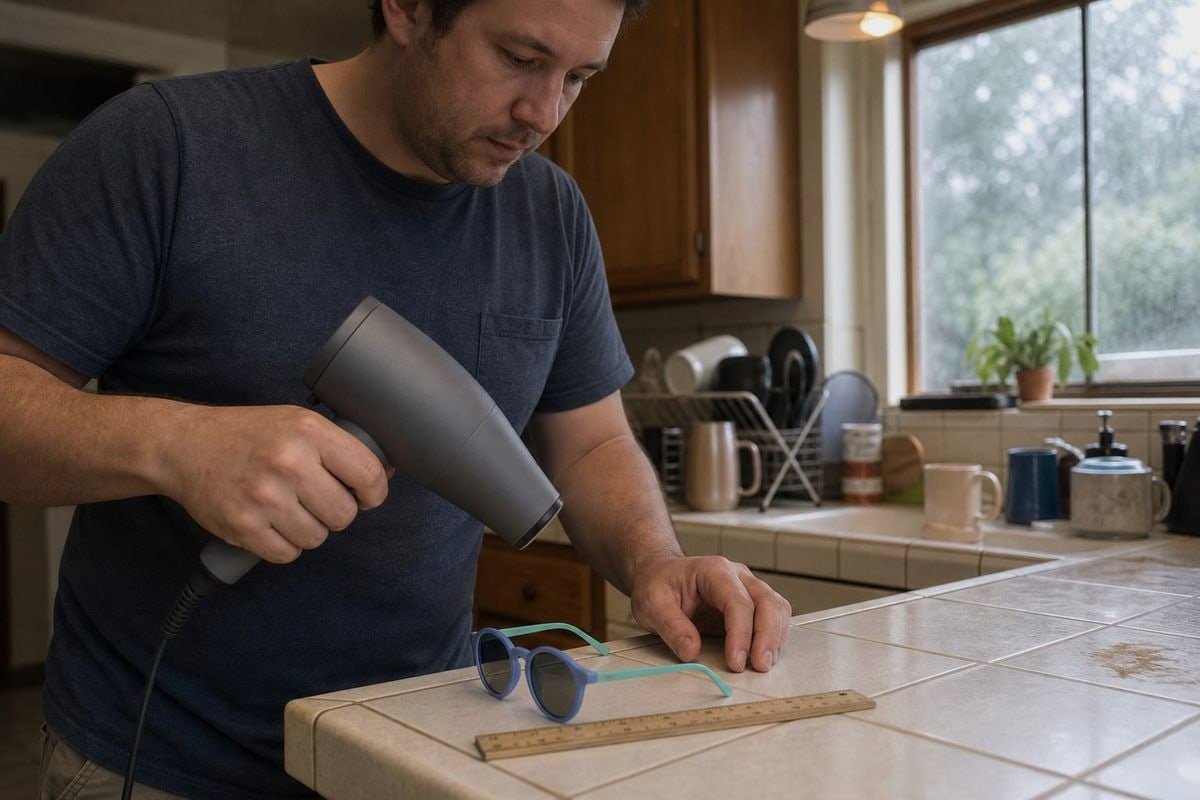
TR90 and TPEE are both thermoplastics 5. Warmth makes them slightly pliable. Cold makes them hold their shape. That is the whole science behind this repair, and it is why warm water is the beginner-friendly method. Water at 40–45°C — comfortably warm to the touch, like a hot bath — gives you slow, controllable softening. A hairdryer on low heat for 20–30 seconds also works, but it heats unevenly and can overshoot quickly, so I only recommend it if you keep the dryer moving and hold it at least 15 cm away.
Warm-water reshaping, step by step
- Fill a bowl with warm tap water. Test it with your wrist. It should feel warm, never scalding.
- Dip only the temple arm. Keep lenses out of the water, especially mirrored or coated lenses like those on wraparound sport shields.
- Hold for 20–60 seconds. Thicker sport temples need the longer end of that range.
- Bend gently with your thumbs, about 1–2 mm per attempt.
- Hold the new position until the plastic cools, roughly 30 seconds.
- Try the fit on your child. Repeat in small steps if needed.
Warning signs to stop immediately
Stop if you see the plastic turning white at the bend point. That whitening is stress-marking 6, and it means micro-cracks are forming. Stop if you hear any creak or crack. Stop if the frame feels brittle rather than springy. Cheap molded frames often cannot survive reshaping at all — this is one reason we insist on genuine TR90 and TPEE in our own kids' lines rather than generic recycled plastic.
| Heat method | Control level | Risk to lenses | Sie handhaben |
|---|---|---|---|
| Warm water (40–45°C) | Hoch | Low, if lenses stay dry | Beginners, TPEE temples |
| Hairdryer, low setting | Mittel | Medium, coatings can haze | Thick TR90 sport temples |
| Boiling water | Sehr niedrig | Hoch | Never recommended |
| Open flame / stovetop | Keine | Extreme | Never — weakens the polymer |
Why do my kids' sunglasses keep loosening even after I fix them at home?
A buyer from Australia once asked me why her customers reported temples loosening within weeks, even after home repairs. We pulled the samples apart together on a video call. The answer was not one cause — it was four small causes stacking up, and understanding them changed how she specified her next order with us.
Kids' sunglasses keep loosening because of repeated rough handling, hinge screws vibrating out during active play, head growth that changes the fit, and worn hinge threads that no longer grip. Cheap frames without spring hinges or quality screws loosen fastest of all.
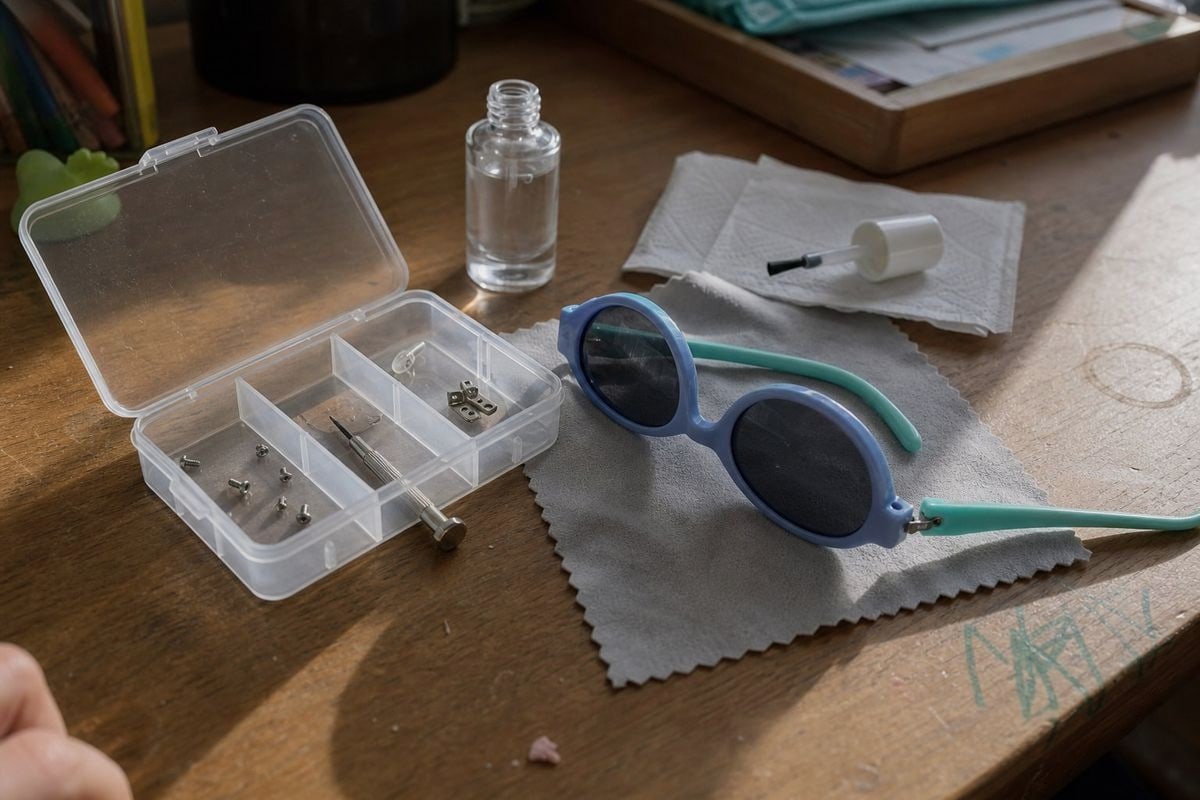
Children are simply harder on eyewear than adults. They pull glasses off with one hand, which twists the hinge sideways. They drop them, sit on them, and stuff them into bags. Each of those events puts stress on the hinge that adult glasses rarely face. So even a perfect repair faces the same forces the next day.
The four repeat offenders
First, one-handed removal. This is the biggest hidden culprit. Pulling from one side levers the opposite temple outward and gradually loosens both the screw and the temple angle. Teach your child to remove sunglasses with two hands. It genuinely helps.
Second, vibration. Running, cycling, and bouncing all create micro-vibrations 7 that slowly rotate screws counterclockwise. This is normal physics, not a defect — but quality frames resist it better with tighter thread tolerances.
Third, growth. A child's head widens noticeably over a year. Sunglasses that fit snugly in spring may sit wide by autumn. The frame did not fail; the child grew. This is why our design team builds flex into TPEE temples, so frames tolerate some growth before adjustment is needed.
Fourth, worn threads. Every time a screw loosens and gets retightened, the threads wear a little more. After many cycles, the screw simply cannot hold tension.
A practical habit fixes most of this: run a two-week sunglasses check. Wiggle each temple, look at the hinge screws, and check the ear bend. Two minutes of prevention beats another full repair. Some parents also add a slim strip of heat-shrink tubing over the hinge area for extra reinforcement on frames that see heavy sport use.
When should I stop trying a home repair and replace the frame instead?
Fifteen years of eyewear production has taught me one uncomfortable truth: some frames are not worth saving. In our 5S-managed workshop, we scrap any frame with a cracked hinge barrel rather than rework it, because a compromised hinge near a child's eye is a safety issue, not a cosmetic one.
Replace the frame instead of repairing it when the hinge barrel is cracked, the screw threads are fully stripped, the plastic shows white stress marks or cracks, a temple tip has broken off, or the frame loosens again within days of every repair.
Home repair has real limits, and pushing past them creates risk. A cracked frame can fail suddenly during play. A sharp broken temple sits right beside a child's temple and eye. When in doubt, retire the frame.
Repair or replace: a quick decision guide
| Condition | Repair at home? | Warum |
|---|---|---|
| Loose but intact hinge screw | Ja | Simple clockwise tightening solves it |
| Temple flared outward, plastic healthy | Ja | Warm-water reshaping works well |
| Stripped screw, hinge intact | Maybe | A matching replacement screw can save it |
| White stress marks at the bend | Nein | Micro-cracks mean imminent breakage |
| Cracked hinge barrel or lens rim | Nein | Structural failure; unsafe for a child |
| Broken or missing temple tip | Nein | Sharp edges and poor grip behind the ear |
| Loosens again within days, repeatedly | Nein | Worn-out hardware; repair is temporary |
Think about the frame's origin, too
Quality matters at the replacement decision. Ultra-cheap molded frames often use brittle recycled plastic that cannot tolerate heat reshaping even once. If a frame whitens or creaks on the first gentle bend, it was never repair-friendly. When brand buyers visit our factory, I always show them this difference side by side: a genuine TPEE temple bends 90 degrees and springs back, while a cheap frame snaps. For parents, the takeaway is simple. If the sunglasses cost very little and have already failed twice, replacement is safer and often cheaper than a repair kit. And when you do replace, look for flexible TR90 or TPEE construction, UV400 lenses, and a spring or well-torqued hinge — the features that prevent this whole cycle from repeating.
Schlussfolgerung
Loose or bent kids' sunglasses temples frustrate parents daily, but most cases need only a screwdriver or warm water. Diagnose first — screw, bend, or break — then fix or replace accordingly.
Fußnoten
1. Background on ultraviolet radiation explains why sunglasses need UV protection. ↩︎
2. Explains why UV exposure risk makes proper-fitting sunglasses important for children’s eye health. ↩︎
3. Background on threadlocker chemistry supports the nail-polish thread-fix explanation. ↩︎
4. Alibaba sourcing platform lists TR90 and TPEE material suppliers for eyewear manufacturers. ↩︎
5. Provides background on how thermoplastic polymers soften with heat, supporting the reshaping method. ↩︎
6. Explains mechanical stress concept behind plastic whitening and micro-cracks. ↩︎
7. IEEE covers engineering research on vibration-induced fastener loosening mechanisms. ↩︎
Weitere Artikel, die Ihnen gefallen könnten
August 2026
Sollte die Fabrik die Verpackung und Kennzeichnung von Kinder-Sonnenbrillen übernehmen oder einen bestimmten Lieferanten nutzen?
August 2026
Eigenes Lager vs. Direktlieferung durch den Lieferanten: Was senkt die Retourenkosten für Marken von Kinder-Sonnenbrillen?

August 2026
Direkt zum Lagerhafen oder Lagerung in Übersee: Was spart mehr bei den Versandkosten für Kinder-Sonnenbrillen?
Auf der Suche nach einem zuverlässigen Partner für Kinderbrillen?
Entdecken Sie über 800 sofort verfügbare Modelle und umfassenden OEM/ODM-Support, der auf Ihre Marke zugeschnitten ist.
Kontakt aufnehmen English
  Español de México
  Deutsch
  Français
  日本語
日本語  العربية
  Português do Brasil