How to Ask a China Factory to Pre-Sort Kids’ Sunglasses by Store?

Asking a China factory to pre-sort kids’ sunglasses by store sounds simple until mixed cartons 1 arrive scrambled. On our packing floor in Taizhou, we see why this request fails so often.
To ask a China factory to pre-sort kids’ sunglasses by store, send a store allocation sheet listing SKU, color, and quantity per store, define carton and label rules in the purchase order, confirm any extra packing fees, and approve a sample pack-out before mass production begins.
That is the short answer. The rest of this guide walks through each step, with the exact documents, questions, and QC checks you need.
How do I explain store-level pre-sorting requirements clearly to a Chinese factory?
Last spring, a buyer sent us one line: "Please sort by store." Our packing team had twelve questions before we could quote customs delays 2. Clear instructions would have saved a week of emails.
Explain store-level pre-sorting by sending a one-page allocation sheet that maps every SKU, color, and quantity to a store code, then state whether sorting happens at unit, inner-box, or carton level, and confirm labeling rules and shipping destinations in writing before production.

Factories think in production terms, not retail terms. We quote around styles, colors, molds, and lens options. Store logistics is a different language. So your job is translation. You must turn "Store 12 needs a spring assortment" into instructions a packing line can follow.
Start by deciding what "pre-sorted by store" actually means for your order. It can happen at three levels. Each level changes labor, cost, and error risk.
The three sorting levels
| Sorting Level | Was es bedeutet | Am besten geeignet für |
|---|---|---|
| Unit level | Each pair gets a store-specific barcode or tag | Retailers scanning at receiving |
| Inner-box level | Inner boxes are grouped and marked by store | Small store quantities, mixed cartons |
| Master-carton level | Whole cartons packed and marked per store | Cross-docking or direct store delivery |
Next, build the allocation sheet. Keep it to one page if possible. It should include store names or codes, SKU numbers, style and model names, color breakdown per store, quantity per store, units per inner box, inner boxes per carton, and consignee details 3. Add labeling requirements and any hangtags or inserts.
One more tip from our export experience: send a bilingual instruction sheet with a simple diagram of the carton mark. Our line workers pack faster and make fewer mistakes when they can see an example carton, not just read about one. A picture of the finished pack-out removes most ambiguity before it starts.
What packaging and labeling details help my factory sort orders by store correctly?
A trade-off we weigh on every pre-sorted order is speed versus traceability. Extra labels slow the line slightly, but they make every carton verifiable. In our workshop, traceability always wins.
Give the factory store-coded carton marks, SKU barcodes on each polybag or box, units-per-inner-box counts, and a packing list broken down by store. Color-coded polybags or sticker dots per store further reduce sorting errors on the factory floor.
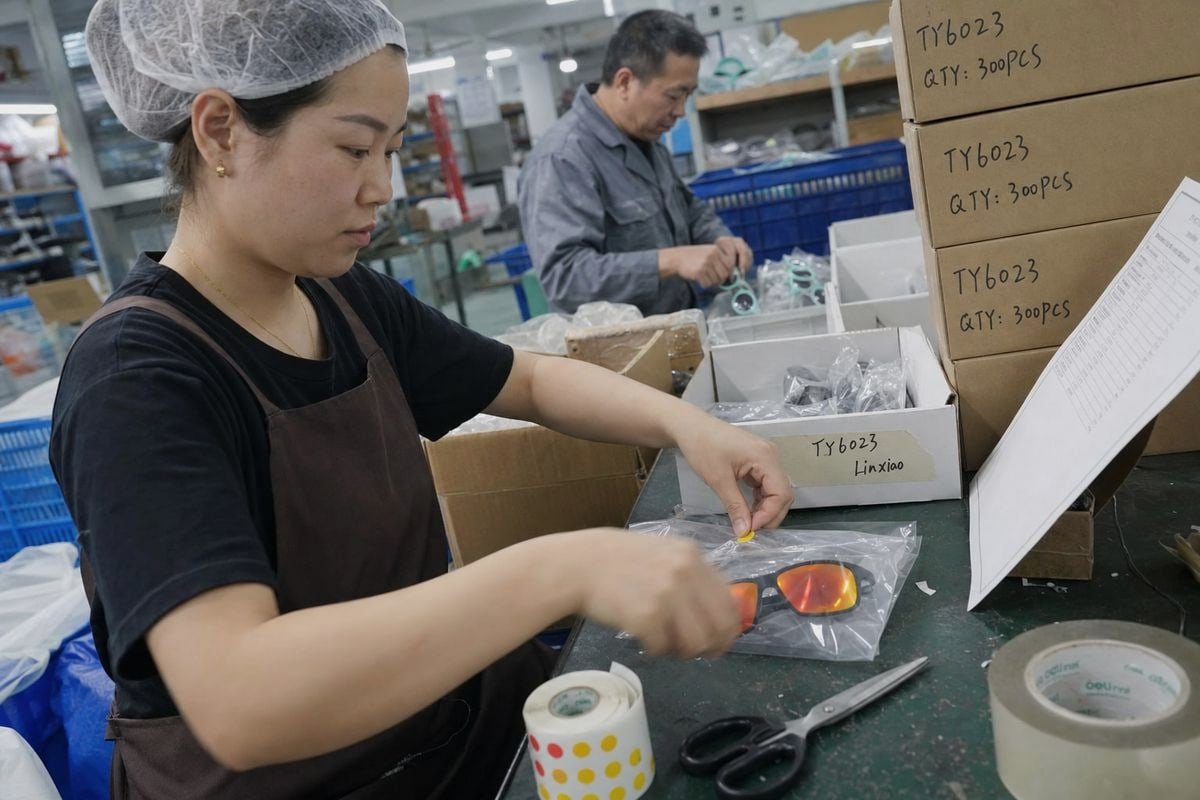
Labels do the sorting work long after your email is forgotten. When we pack our TR90 and TPEE kids' frames 4 for multi-store programs, every layer of packaging carries information. If one layer is missed, the warehouse pays for it later.
Here is how the layers should stack up, from the smallest unit outward.
Labeling from unit to carton
| Packaging Layer | Required Marking | Warum es wichtig ist |
|---|---|---|
| Polybag or individual box | SKU barcode, style number, color code | Enables scanning at store receiving |
| Hangtag | Brand info, optional store QR code | Allows electronic sort verification |
| Inner box | SKU, quantity, store code if mixed carton | Prevents mix-ups inside cartons |
| Master carton | Store code, carton number, quantity, destination | Drives correct routing and delivery |
A few practical details make a big difference. First, decide between single-store cartons and mixed cartons. Single-store cartons cost slightly more in space but remove all resorting at your warehouse. Mixed cartons save freight but need very clear inner-box marks.
Second, consider visual aids. Color-coded polybags, ribbons, or sticker dots matched to each store help our packers self-check as they work. A worker can spot a wrong-colored bag in a carton instantly. A wrong barcode is invisible without a scanner.
Third, match everything to your documents. The carton marks, the packing list, the PO, and the invoice must all agree. Mismatched paperwork causes customs delays 5 and receiving disputes. We always send a store-level packing list before shipment so the buyer can verify every carton against the allocation sheet.
Kids' sunglasses add one extra layer. Size and age band matter more than with adult accessories. If different stores get different frame sizes, mark the size band clearly on the inner box, not just the SKU.
How can I make sure pre-sorted shipments stay accurate through production and packing?
Fifteen years of eyewear production taught our team one hard lesson: every extra handling step adds an error chance. Pre-sorting multiplies handling, so it multiplies the need for checks.
Keep pre-sorted shipments accurate by approving a sample pack-out before bulk packing, requiring QC checks on model, quantity, and label placement per store carton, and requesting photos of final packed cartons matched against the allocation sheet before shipment.
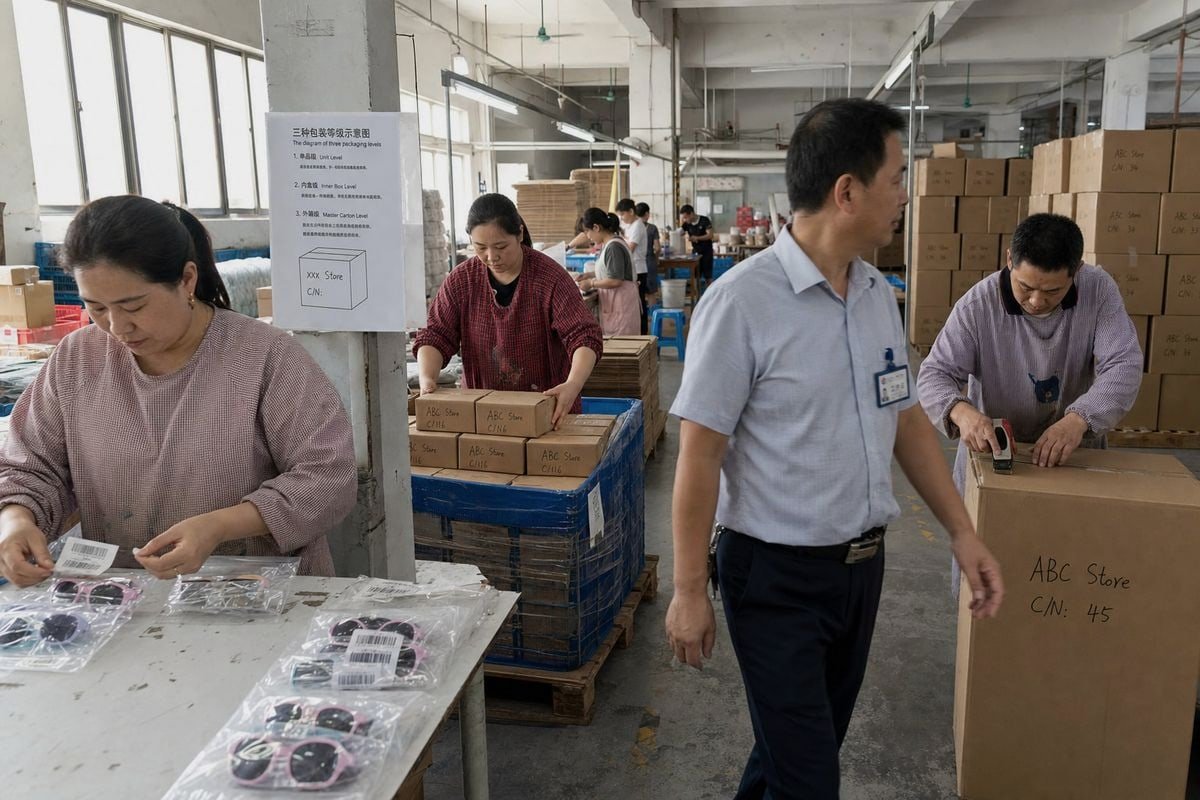
Pre-sorting is not a clerical task. It is a controlled fulfillment process. Treat it that way and your first multi-store order will arrive clean. Treat it casually and you will spend days resorting cartons in your own warehouse.
The strongest control point is the sample pack-out. Before we pack a full multi-store order, we build one complete example: one store's carton, fully labeled, with the correct mix of styles and colors inside. We photograph it from every angle and send it for written approval. Only after sign-off does bulk packing begin. This single step catches most misunderstandings about labels, counts, and carton marks.
A five-step accuracy process
- Lock the allocation sheet before production starts. No verbal changes afterward.
- Approve the sample pack-out with photos, in writing.
- Run in-line checks during packing: correct model, color, and size in each store carton.
- Verify counts and label placement against the allocation sheet at final QC.
- Review final pack-out photos and the store-level packing list before release.
Two error types deserve special attention with kids' sunglasses. Color mix-ups are the most common, because pastel frames like a periwinkle-blue front with mint-green temples can look similar to a nearby colorway under factory lighting. Size-band mix-ups are the most costly, because a store expecting toddler frames cannot sell junior sizes. We flag both risks on the packing instruction sheet so inspectors check them specifically.
Finally, agree on who inspects. Factory QC, your own inspector, or a third party 6 can all verify the pack-out. Whoever does it should work directly from your allocation sheet, not from memory.
What communication steps reduce mistakes when requesting store-by-store sorting from my supplier?
A buyer from Australia once asked me why her pre-sorting request went wrong at another supplier. I read her original email. It was polite, but it never confirmed cost, level, or labels. The gaps caused the failure, not the factory.
Reduce mistakes by sending a short, specific written request with the allocation sheet attached, asking direct questions about sorting capability, extra fees, MOQ, and lead-time impact, and getting written confirmation of all packing requirements before approving the quotation and starting production.

Good communication is short, specific, and operational. Long emails get skimmed. Vague emails get guessed at. From our side of the table, the best requests read like checklists, not letters.
Here is a message template that works. Adapt it for email or WhatsApp:
"Please pre-sort the kids' sunglasses by store before shipment. We will provide a store allocation sheet showing SKU, color, and quantity for each store. Please pack each store's order in separate cartons and mark cartons with the store code. Each unit needs the correct barcode and hangtag. Please confirm you can do this at the factory, advise any extra labor cost, and send a revised quotation based on this packing requirement."
Then ask your qualifying questions before you approve any quote. These are the ones that matter most.
Questions to ask before placing the order
| Frage | What the Answer Tells You |
|---|---|
| Can you pre-sort by store at the factory? | Whether the capability exists at all |
| Is there an extra fee for sorting or labeling? | The true landed cost of the order |
| Can you apply different barcodes per store or SKU? | Whether scanning at receiving will work |
| What is the lead-time impact of store sorting? | How to set realistic shipping dates |
| Can you provide a packing list broken down by store? | Whether verification will be possible |
| Will you send photos of packed cartons before shipment? | Your final control point |
Expect sorting to add labor days, and plan schedules accordingly. Sampling alone often takes ten to twenty days before bulk production 7, so build the sorting time into that timeline rather than discovering it later. And for a first multi-store program, frame the order as a trial. A smaller trial run lets both sides test the allocation sheet, the labels, and the QC flow before scaling to a full store network.
One last habit: confirm everything in writing before production starts. Changes made mid-production are the most expensive kind. A one-line written confirmation of the pack-out spec protects both buyer and factory.
Schlussfolgerung
Pre-sorting kids' sunglasses by store works when you send an allocation sheet, define labels, confirm fees, and approve a sample pack-out. Clear instructions turn a risky request into routine.
Fußnoten
1. General reference on packaging and labeling practices relevant to carton sorting decisions. ↩︎
2. Explains how trade facilitation rules relate to customs clearance and documentation accuracy. ↩︎
3. ICC Incoterms define consignee and shipping responsibilities referenced in allocation documentation. ↩︎
4. Background on thermoplastic elastomer materials commonly used in eyewear frame manufacturing. ↩︎
5. WTO resource on trade facilitation explains how documentation mismatches cause customs delays. ↩︎
6. Provides background on independent quality control inspections referenced for verifying pack-outs. ↩︎
7. Background concept on mass production timelines relevant to sampling before bulk manufacturing. ↩︎
Weitere Artikel, die Ihnen gefallen könnten

August 2026
Sollte die Fabrik die Verpackung und Kennzeichnung von Kinder-Sonnenbrillen übernehmen oder einen bestimmten Lieferanten nutzen?
August 2026
Eigenes Lager vs. Direktlieferung durch den Lieferanten: Was senkt die Retourenkosten für Marken von Kinder-Sonnenbrillen?

August 2026
Direkt zum Lagerhafen oder Lagerung in Übersee: Was spart mehr bei den Versandkosten für Kinder-Sonnenbrillen?
Auf der Suche nach einem zuverlässigen Partner für Kinderbrillen?
Entdecken Sie über 800 sofort verfügbare Modelle und umfassenden OEM/ODM-Support, der auf Ihre Marke zugeschnitten ist.
Kontakt aufnehmen English
  Español de México
  Deutsch
  Français
  日本語
日本語  العربية
  Português do Brasil