ANSI Z80.3 vs EN ISO 12312-1: What’s Different for Kids’ Sunglasses?
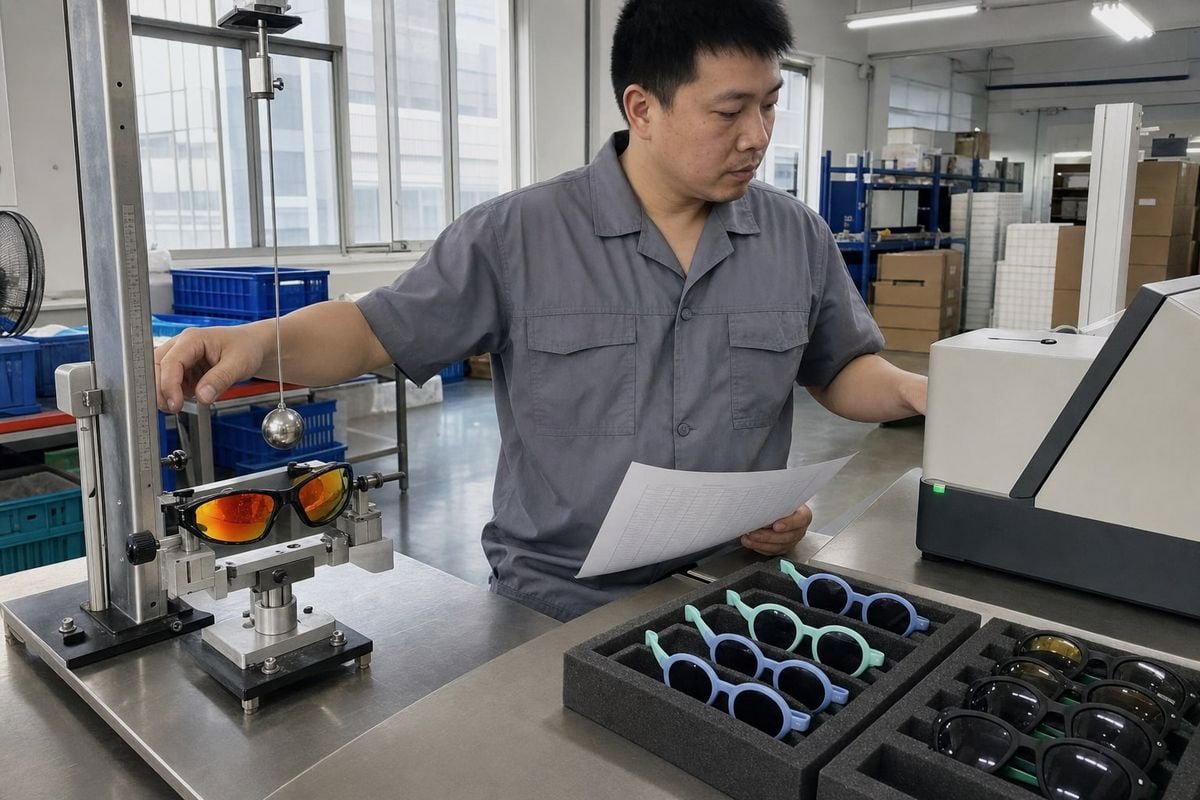
Buyers ask our factory about ANSI Z80.3 vs EN ISO 12312-1 1 almost weekly. Choosing wrong wastes testing budget, delays launches, and can even get kids’ sunglasses pulled from shelves.
ANSI Z80.3 is the US voluntary sunglasses standard, paired with FDA drop ball impact rules, while EN ISO 12312-1 is the European standard built on filter categories, luminous transmittance limits, and child-specific fit provisions. They share goals but differ in testing philosophy, labeling, and legal weight.
Neither standard is simply “better.” Each one fits a different market and a different legal system. Below, I break down the real differences, market by market, so you can brief your supplier with confidence.
How Do ANSI Z80.3 and EN ISO 12312-1 Differ in Their UV Protection Requirements?
During a lens sourcing review last year, our QC team compared transmittance reports from two lens suppliers. One quoted a 380nm cutoff, the other 400nm. That small gap matters more than most buyers realize.
EN ISO 12312-1 defines UV protection with attenuation requirements up to 380nm, tied to each filter category, while the US market and ANSI-aligned pediatric guidance push toward UV400 protection, blocking wavelengths up to 400nm. Both control UVA and UVB rays, but the cutoff points and verification methods differ.
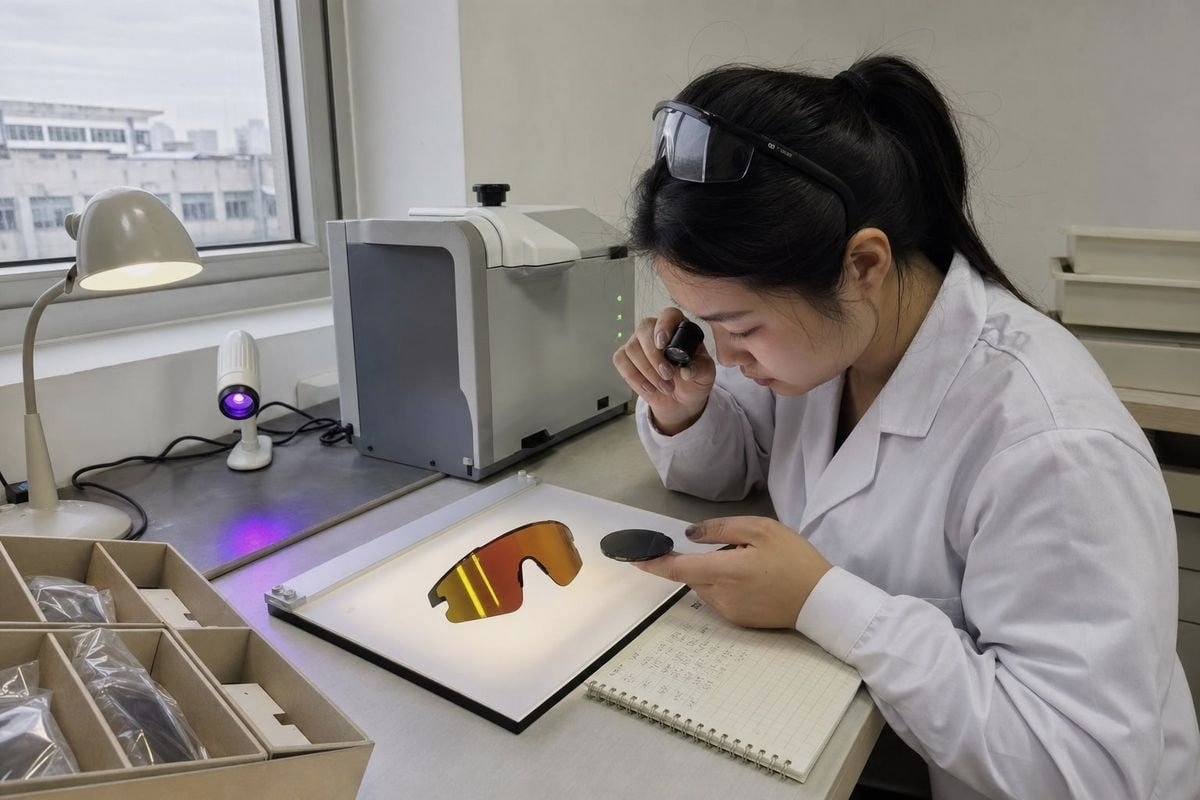
Let me unpack why this matters so much for children specifically. A child's crystalline lens is clearer than an adult's, so more UVA and UVB rays reach 2 the developing retina ultraviolet radiation 3. That is exactly why we specify UV400-Schutz as the baseline on our kids' lenses, even for orders shipping to Europe where 380nm would technically pass.
The 380nm vs 400nm Question
EN ISO 12312-1 links its UV requirements to the visible-light filter category of the lens. A darker lens must attenuate UV more aggressively relative to its luminous transmittance. ANSI Z80.3 expresses UV limits as maximum transmittance percentages across the UVB and UVA bands. In practice, the American conversation has converged on "UV400" as the consumer expectation, and the recent ANSI Z80.3-2025 revision even adds formal definitions for High Energy Visible (HEV) blue light — a direct nod to children's retinal vulnerability.
How the Two Standards Express UV Rules
| Aspect | ANSI Z80.3 (US) | EN ISO 12312-1 (EU) |
|---|---|---|
| UV cutoff reference | Commonly UV400 (up to 400nm) | Defined up to 380nm |
| UVB requirement | Strict maximum transmittance | Tied to filter category |
| UVA requirement | Percentage of visible transmittance | Scaled by category |
| HEV / blue light | Defined in 2025 revision | Not formally categorized |
| Typical claim | "UV400" or "100% UV" | "UV protection" + CE marking |
One caution I always share with buyers: "UV400" is marketing shorthand, not a certification. Only a lab transmittance report proves the actual attenuation curve of your lenses.
Which Certification Do I Need If I'm Selling Kids' Sunglasses in the US Versus Europe?
A procurement manager from a European baby brand once sent us an artwork file with an ANSI callout — for an EU-only launch. We flagged it before printing. Mixing up market requirements is a common and costly slip.
For the US, you need FDA compliance under 21 CFR 801.410, including the drop ball test, with ANSI Z80.3 as the voluntary performance benchmark. For Europe, sunglasses are PPE, so you need EN ISO 12312-1 testing, CE marking, a Declaration of Conformity, and filter category labeling.

Here is the part that surprises many first-time buyers: the legal frameworks are inverted between the two markets. In the US, ANSI Z80.3 is voluntary, but the FDA impact-resistance rule is mandatory. In Europe, EN ISO 12312-1 is the harmonized route to satisfying the mandatory PSA-Verordnung (EU) 2016/425 4.
Market-by-Market Requirements at a Glance
| . Schlagfestigkeitsprüfungen sind eine separate Verpflichtung von CPSIA-Prüfungen. Viele Importeure müssen sich auch bei der FDA als Erstimporteur registrieren und das Produkt als medizinische Klasse-I-Gerät auflisten, um eine Beschlagnahmung der Sendung an der Grenze zu vermeiden. | Vereinigte Staaten | Europäische Union |
|---|---|---|
| Rechtliche Grundlage | FDA 21 CFR 801.410 5 | PSA-Verordnung 2016/425 |
| Performance standard | ANSI Z80.3 (voluntary) | EN ISO 12312-1 (harmonized) |
| Impact test | Drop ball test (mandatory) | Robustness test within ISO standard |
| Consumer labeling | Tags/stickers citing compliance | CE marking + filter category (0–4) |
| Chemische Sicherheit | Die erste Frage ist immer die Klassifizierung. Sind Ihre Sonnenbrillen wirklich ein Kinderprodukt? Betrachten Sie die Größe, das Marketing, die Verpackung und den beabsichtigten Benutzer. Unsere kompakten runden Rahmen in Periwinkle-Blau mit mint-türkisen Bügeln sind eindeutig für kleine Gesichter konzipiert. Niemand würde argumentieren, dass es sich um Produkte für den allgemeinen Gebrauch handelt. Diese Klassifizierung löst den gesamten Satz von 6 (lead, phthalates) | REACH |
| Child-specific provisions | Begrenzt | Fit measurements, category 4 side protection |
Don't Forget Chemical Safety Layers
Optical compliance alone is legally insufficient for children's products. In the US, CPSIA regulates lead in frame paint and phthalates in flexible materials — including the soft TPEE we use in our kids' temples, which is why we run material-level chemical testing before mass production. In Europe, REACH plays the same role. And if you sell into Australia or New Zealand, AS/NZS 1067.1 applies, which closely mirrors the ISO framework but is mandatory there. Buyers in Australia, one of our regular export destinations, should treat it as their primary reference.
The Filter Category System
EN ISO 12312-1 sorts lenses into categories 0–4 by luminous transmittance. For kids' everyday sunglasses, category 3 is the sweet spot. Category 4 is too dark for road use and triggers extra side-protection requirements for children's frames in later revisions.
Can My Supplier Certify Children's Sunglasses to Both Standards Without Extra Cost?
One trade-off we weigh constantly on our production line is lens spec versus landed cost. Dual-market compliance is usually achievable, but "no extra cost" depends heavily on how the product was engineered from day one.
Yes, a capable supplier can build kids' sunglasses to satisfy both standards simultaneously, because the requirements overlap heavily. However, you cannot avoid two separate test reports, so expect modest additional lab fees — typically the only real added cost when the design is dual-compliant from the start.
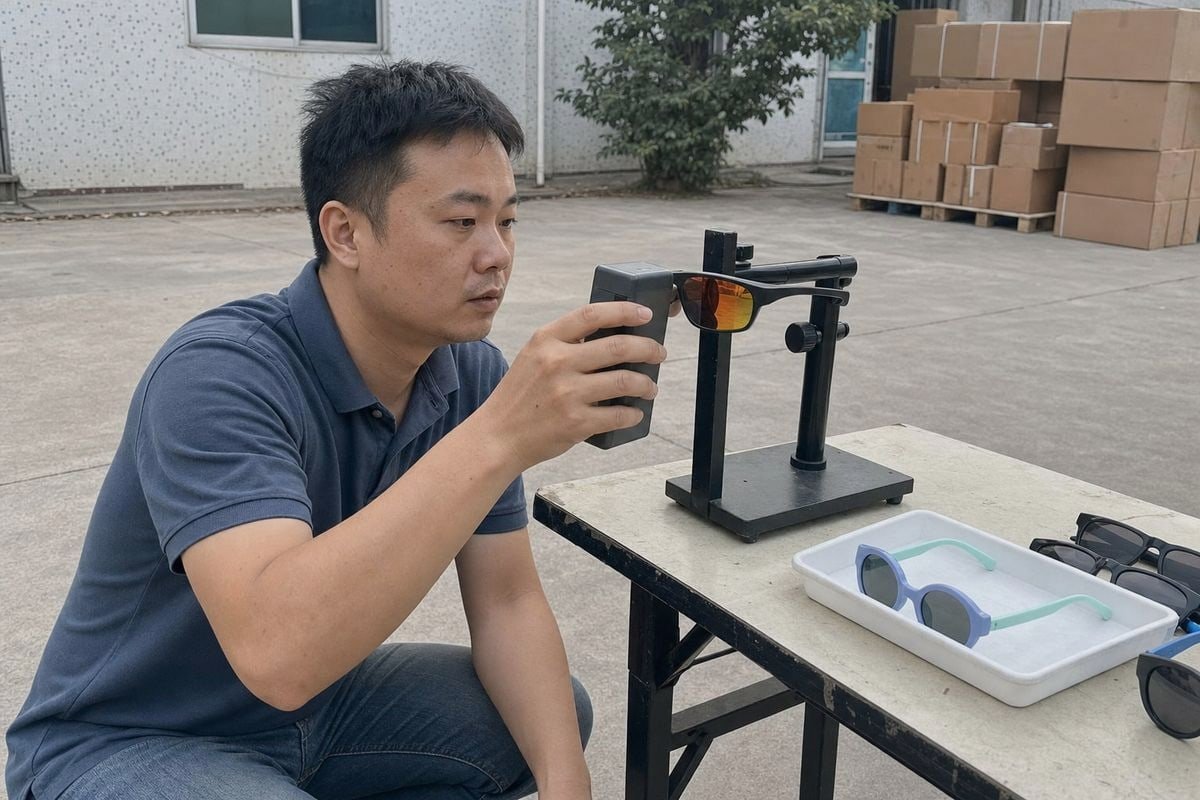
The good news first. Roughly eighty percent of the technical requirements overlap. Both standards control optical distortion, prismatic imbalance, traffic signal recognition, flammability, and UV attenuation. A lens that shows clean refractive power and low prismatic imbalance under ISO tolerances will almost always sit comfortably within ANSI limits too.
Where Dual Compliance Is Easy — and Where It Isn't
The genuinely divergent points are few but important:
- Impact resistance. The FDA drop ball test drops a 15.9mm steel ball from 127cm onto the lens. The ISO robustness test presses a smaller ball statically. Polycarbonat 7 lenses pass both comfortably, which is one reason we default to polycarbonate for children's styles — it also blocks 100% of UV inherently.
- UV cutoff. Specify UV400 protection and you satisfy both markets in one shot, since 400nm exceeds the European 380nm requirement.
- Labeling. This is where costs can creep in. EU units need CE-Kennzeichnung and filter category information; US units need different compliance language. We usually solve this with dual-market packaging artwork rather than separate production runs.
- Documentation. Two standards mean two report sets. A combined testing package at an accredited lab costs less than two separate submissions, but it is never zero.
From our fifteen years running eyewear production, the honest answer is this: dual compliance is a design decision, not a testing decision. If your supplier picks polycarbonate lenses, UV400 coatings, and CPSIA/REACH-safe materials upfront, certification to both standards becomes a paperwork exercise. If they engineer for one market and retrofit later, you pay in re-tooling, re-testing, and delays.
What Testing and Documentation Should I Ask My Manufacturer for to Prove Compliance?
Early in my export career, a buyer accepted a supplier's verbal "fully certified" claim and lost a container at customs. That lesson shaped the document checklist we now hand every new client before their first order.
Request accredited third-party test reports for EN ISO 12312-1 and ANSI Z80.3, the FDA drop ball test result, CPSIA or REACH chemical reports, a CE Declaration of Conformity, a Children's Product Certificate for the US, and batch-level QC records. Verbal claims prove nothing.

Documentation is where reliable factories separate themselves from traders. When we onboard a new brand, we walk them through exactly which paper trail each market demands, because customs officers and retail compliance teams will ask for these files — sometimes years after shipment.
The Essential Document Checklist
| Dokument | Markt | Was es beweist | Rote Flagge, wenn fehlend |
|---|---|---|---|
| EN ISO 12312-1 Prüfbericht | EU | Filter category, luminous transmittance, optics | Cannot legally CE-mark |
| Konformitätserklärung | EU | Manufacturer's legal PPE declaration | Product is non-compliant PPE |
| ANSI Z80.3 test report | EU / UK | UV, transmittance, traffic signal recognition | Weak performance evidence |
| Drop ball test record | EU / UK | FDA impact resistance | Import detention risk |
| CPSIA report + CPC | EU / UK | Lead, phthalates, children's product safety | Illegal to sell kids' product |
| REACH report | EU | Restricted chemicals in frames | Retailer rejection |
| AS/NZS 1067.1 report | AU/NZ | Mandatory local sunglasses compliance | Cannot enter market |
Questions Worth Asking Beyond the Paperwork
Ask which accredited lab issued the reports, and verify the report number directly with that lab. Ask whether reports cover your exact lens and frame combination — a report for a different colorway's lens batch is not proof for yours. Ask about ongoing batch testing, not just one-time golden-sample certification. And ask how frame geometry was evaluated: wraparound styles tested under ISO 12311 methods can block the side "light leak" that lets significant UV reach a child's eyes around flat frames. Finally, confirm the factory keeps records for the legally required retention period. A supplier who hesitates on any of these questions is telling you something important.
Schlussfolgerung
Choosing between these standards is not a ranking exercise — it is a market question. Get the right documents, specify UV400 and polycarbonate, and both markets open smoothly.
Our team at OKAY EYEWEAR has guided brands in over twenty countries through exactly this process, from choosing among our existing kids' styles to delivering fully documented, retail-ready products. If you are planning a children's sunglasses launch and want compliance handled properly from the first sample, reach out to Alan Kong at sales@okayeyewear.com — we will map the certification path with you before a single frame is molded.
Fußnoten
1. Official ISO reference for the sunglasses standard discussed throughout the article. ↩︎
2. Wikipedia overview of the EU chemical regulation mentioned as a compliance requirement. ↩︎
3. WHO background on UV radiation risks relevant to UV protection discussion for children’s eyes. ↩︎
4. EU official source clarifying personal protective equipment classification for sunglasses. ↩︎
5. Direct link to the official Electronic Code of Federal Regulations for impact resistance. ↩︎
6. Background on the US children’s product safety law referenced for chemical compliance. ↩︎
7. Wikipedia explains the impact-resistant lens material recommended for children’s sunglasses. ↩︎
Weitere Artikel, die Ihnen gefallen könnten
August 2026
Sollte die Fabrik die Verpackung und Kennzeichnung von Kinder-Sonnenbrillen übernehmen oder einen bestimmten Lieferanten nutzen?

August 2026
Eigenes Lager vs. Direktlieferung durch den Lieferanten: Was senkt die Retourenkosten für Marken von Kinder-Sonnenbrillen?

August 2026
Direkt zum Lagerhafen oder Lagerung in Übersee: Was spart mehr bei den Versandkosten für Kinder-Sonnenbrillen?
Auf der Suche nach einem zuverlässigen Partner für Kinderbrillen?
Entdecken Sie über 800 sofort verfügbare Modelle und umfassenden OEM/ODM-Support, der auf Ihre Marke zugeschnitten ist.
Kontakt aufnehmen English
  Español de México
  Deutsch
  Français
  日本語
日本語  العربية
  Português do Brasil