What Are Common Complaints About Kids’ Blue-Light Glasses When Sourcing?
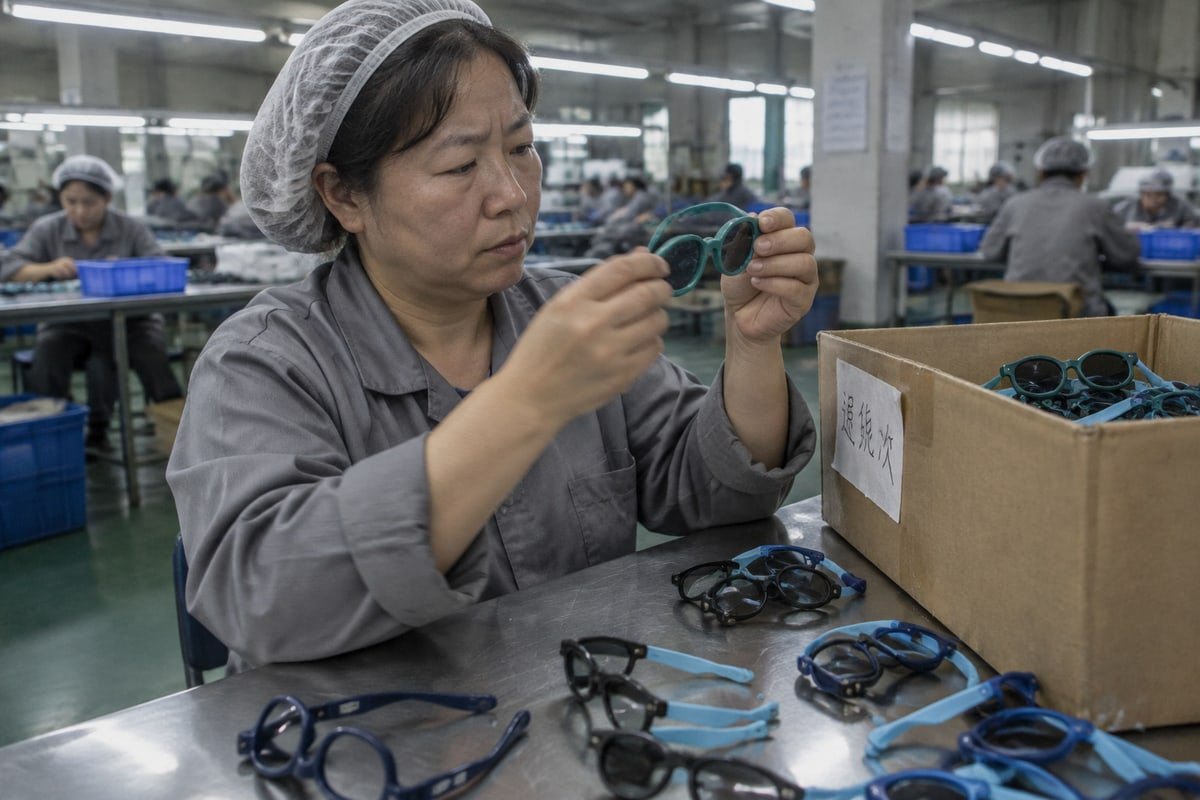
Common complaints about kids’ blue-light glasses reach my desk from buyers burned by past suppliers. Returns pile up and trust erodes. Our Taizhou production line was built to fix that.
Common complaints about kids’ blue-light glasses include filtration levels that miss advertised percentages, weak hinges and brittle frames, unsafe plastics containing BPA or phthalates, poor sizing for young faces, heavy yellow tints, peeling coatings, inconsistent batches, and marketing claims the science does not support.
Each of these complaints has a root cause. Most of them start at the sourcing stage, not in the child’s hands. Below, I walk through the four questions buyers ask us most often and explain what to check before you place an order.
How do I know if the lenses in kids' blue-light glasses actually meet safety standards?
Last spring our QC team pulled a carton of incoming blue-light lenses and ran a transmission check. Two trays read far below the supplier's spec sheet. We rejected the lot.
You verify kids' blue-light lenses by requesting a spectral transmission report showing actual HEV light filtration, impact resistance test results such as ANSI Z87.1, material reports confirming no BPA, lead, or phthalates, and UV400 confirmation, then re-testing samples through an independent lab.

The most frequent complaint I hear is simple. The box says "blocks 40% of blue light" and nobody can prove it. A spec sheet is a promise. A transmission curve is evidence. When we quote a blue-light lens option on our TR90 kids optical frames, we ask the lens supplier for the curve first and the marketing sheet second.
What the paperwork should show
| Check | What to request | Why it matters for children |
|---|---|---|
| HEV light filtration | Spectral transmission curve, 380–500 nm | Confirms the advertised blocking percentage is real, not rounded up |
| Impact resistance | ANSI Z87.1 or FDA drop-ball style test report | Kids run, fall, and throw glasses; lenses must not shatter near the eye |
| Material safety | Lead, phthalate, and BPA test results on frame and paint | Children chew temples and rub frames on skin |
| UV protection | UV400 confirmation | A blue-light tint does not automatically block UV outdoors |
| US market entry | FDA registration of the lens or importer records | Retailers in the US often ask for this before listing |
Be honest about what the lenses can do
Here is a buyer objection I hear often: "Some optometrists say blue-light glasses help kids with digital eye strain 1 and sleep, so we should promote that." I understand the appeal. A few small studies on teenagers suggest possible melatonin or evening alertness effects. But the 2023 Cochrane review found blue-light filtering lenses 2 probably make little to no difference for short-term eye strain, and found no evidence they improve long-term eye health or sleep. Pediatric and ophthalmology groups do not recommend them as a standard solution for children, and there is no evidence they prevent childhood myopia.
So how do I resolve this with buyers? Position the product as a comfort and lifestyle accessory, not a medical device. Say "reduces glare and softens screen brightness for a more comfortable viewing experience." Do not say "protects your child's eyes" or "cures headaches." Headaches, eye rubbing, and blurry vision often point to an uncorrected vision problem or too much screen time. A product page that pushes parents toward an eye exam builds more trust than one that oversells filtration.
Why do some kids' blue-light frames feel uncomfortable or break too easily during daily wear?
Every time we design a new kids' frame, I weigh temple thickness against flexibility. Thinner looks sleeker in photos. Thicker TPEE survives a seven-year-old sitting on it.
Kids' blue-light frames feel uncomfortable or break because many use rigid, low-grade plastic instead of flexible TR90 or TPEE, rely on tiny hinge screws that loosen, apply one adult-scaled size to all ages, and skip hypoallergenic nose pads, causing pressure points, slipping, snapping, and skin irritation.
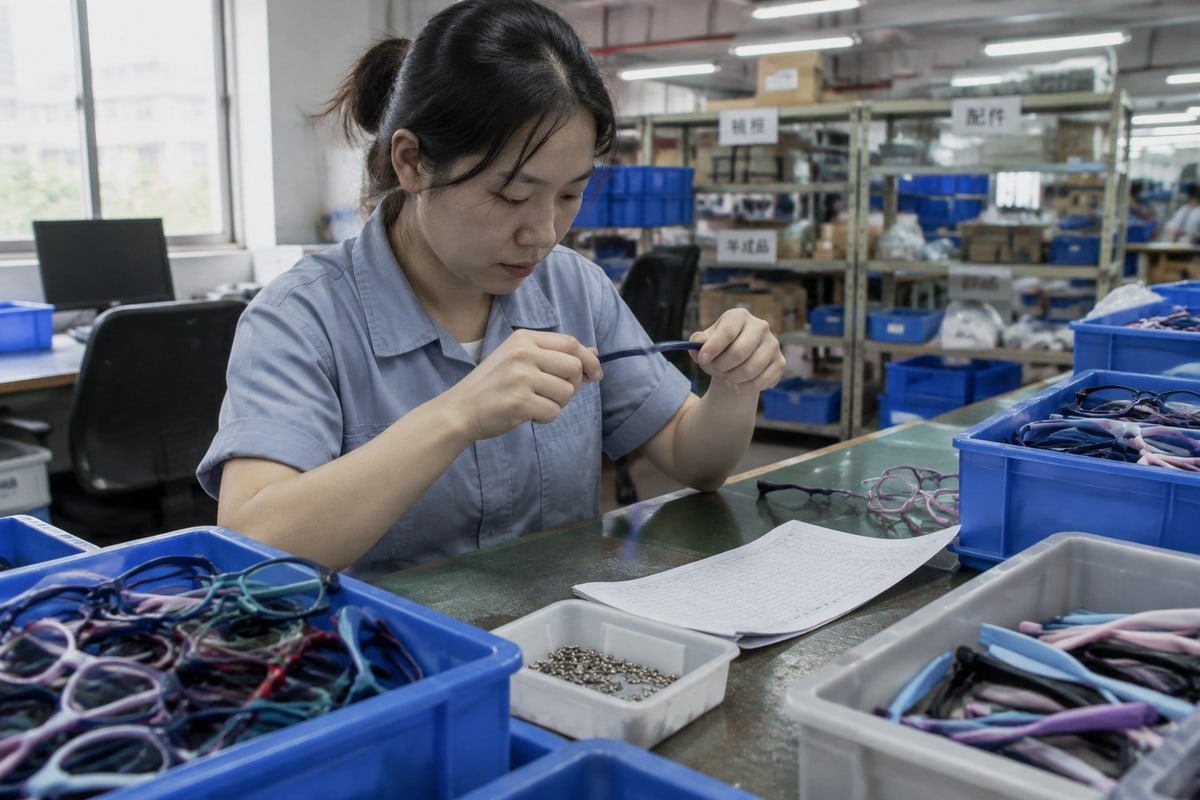
Frame complaints outnumber lens complaints in almost every review thread I read. Parents write about loose hinge screws, arms that crack at the joint, and glasses that slide down the nose during homework. None of this is about blue light. It is about material and fit. After 15 years making children's eyewear, I can say most of these failures are chosen at the quotation stage when a buyer accepts the cheapest plastic.
Material choice decides durability
| Frame material | Flexibility | Impact behavior | Typical complaint |
|---|---|---|---|
| Standard injection plastic | Low | Snaps at the bridge or hinge | Breaks within weeks of rough play |
| Acetate | Low to medium | Can chip, heavier on small faces | Slides down, feels heavy |
| BPA-free TR90 frames | High | Bends and returns to shape | Rare, mostly hinge screw loosening if hardware is poor |
| TPEE temples on a TR90 front | Very high | Twists without cracking | Almost none related to breakage |
Our navy soft-touch style and the matte teal-green retro frame both use this TR90 front with TPEE temple approach. The rubberized matte finish is not just for looks. It grips the side of the head so the frame does not migrate during reading.
Sizing inconsistencies across age groups
A five-year-old and an eleven-year-old do not share a bridge shape. Many suppliers sell one "kids" size and hope. The result is a frame that pinches a toddler and slips off a pre-teen. When buyers pick from our roughly 800 existing styles, I always ask for the target age band first. Then we narrow down by lens width and bridge width, not by how the frame looks in a render.
Hinges, nose pads, and skin contact
Small hinge screws loosen because kids open and close glasses hundreds of times a week. We prefer spring hinges or molded flex hinges on active styles. For nose pads and temple tips, ask for hypoallergenic material confirmation. Contact dermatitis behind the ear is a quiet return driver that most buyers never trace back to the temple tip.
What quality control issues should I watch for when sourcing kids' blue-light glasses overseas?
A procurement manager from Melbourne once asked me why her previous supplier's second order looked nothing like the first. My answer was simple: nobody had defined the inspection points.
Watch for undefined inspection standards, MOQ-to-quality traps where small orders get outsourced to weaker workshops, missing material and impact test reports, color drift from listing photos, loose hinge screws, flimsy cases, scratched or smudge-prone coatings, and factories that cannot show you their workshop or process controls.

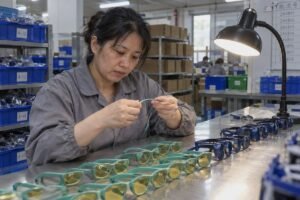
Quality control is not a final inspection. It is a chain of small decisions from raw material to carton. When I walk buyers through our 5S-managed workshop 3 in Taizhou, I point out that each station has a defined check. That is what separates a factory from a trading company that simply forwards your order.
Quality checkpoints to write into your order
| Stage | What to check | Common failure if skipped |
|---|---|---|
| Incoming material | TR90 and TPEE lot certificates, BPA and phthalate reports | Frames that pass the eye but fail a retailer's chemical test |
| Lens intake | Transmission spot check, scratch inspection, coating adhesion tape test | Lenses that peel or fall short on filtration |
| Assembly | Hinge screw torque, lens seating, temple symmetry | Loose screws and lenses popping out |
| Color and finish | Compare against approved color chip under daylight lamp | Red arriving pink, blue reading teal |
| Packaging | Case rigidity, cloth quality, insert accuracy | Flimsy cases crushed in transit |
| Pre-shipment | AQL sampling with a signed inspection report | Full cartons of undetected defects |
The MOQ-to-quality trap
This one is rarely discussed openly. A low minimum order quantity sounds friendly. But when a supplier accepts 200 pieces of a fully custom mold, the order is often pushed to a subcontractor with looser controls. Defect rates climb and batch consistency drops. Our solution is different. Because we already have around 800 stock styles, a brand can order modest quantities of an existing frame with custom colors and logos. The mold is proven, the workers know the part, and the quality risk stays low. Wholesale lead times also stay predictable because we are not waiting on new tooling.
Photos versus reality
Color mismatch is a top return reason for children's products because kids pick the color. Ask for a physical color chip, not a screenshot. Then approve a pre-production sample under a standard light source. Our two-tone matte black over sky-blue frame with the polarized clip-on is a good example. The glossy blue temple and matte black front photograph differently depending on lighting, so we ship the physical sample before any bulk run.
How can I avoid receiving inconsistent lens tints or coatings across production batches?
Years ago a repeat order taught me a hard lesson. The second lens batch arrived visibly warmer than the first. Now we lock a tint master sample for every SKU.
Avoid inconsistent tints and coatings by approving a sealed golden sample, specifying transmission curves and coating type in the purchase order, sourcing lenses from one qualified supplier per SKU, requiring batch transmission and adhesion tests before assembly, and comparing every shipment against the retained master under standard lighting.
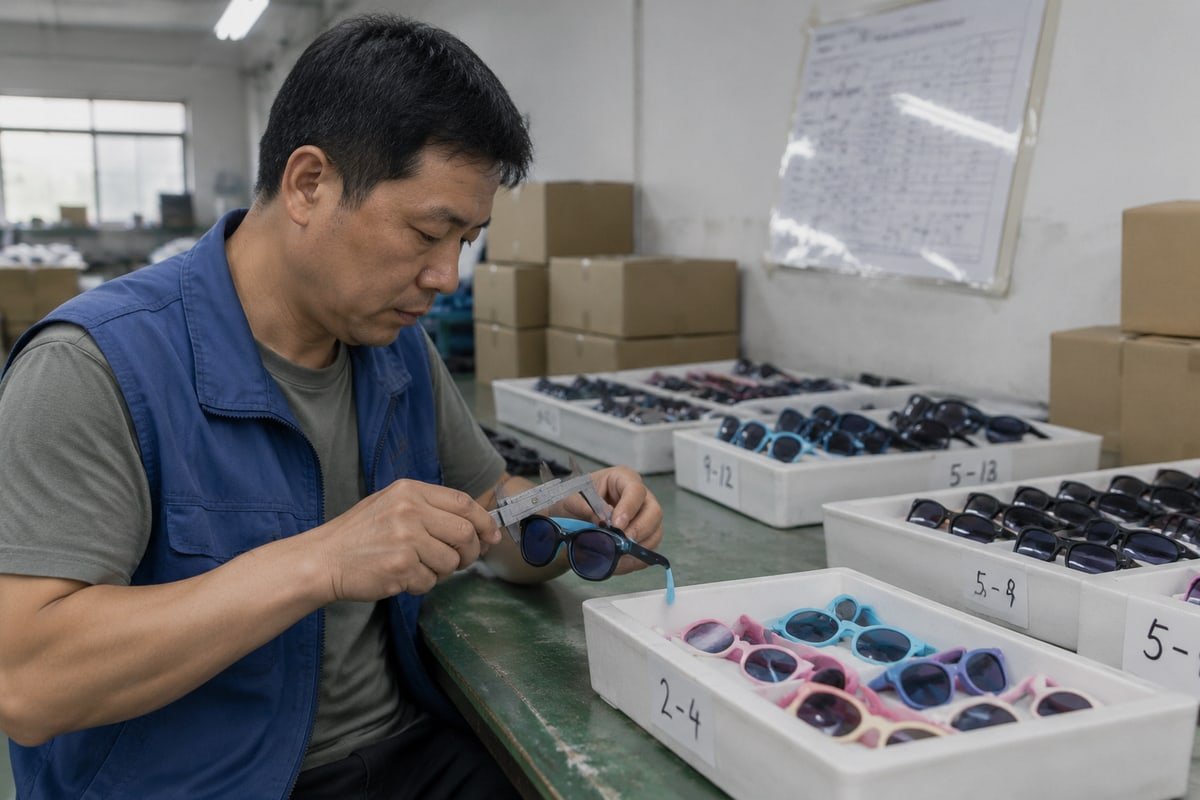
Tint drift is sneaky. Each batch looks fine on its own. Only when a retailer puts two shipments side by side does the pale yellow on one look noticeably deeper than the other. For kids' blue-light glasses this matters twice. First, heavy yellow tint causes lens color distortion that makes homework and games look muddy. Second, an aggressive tint worn in the morning can work against a child's circadian rhythm 4, because daytime blue light is part of what keeps sleep cycles regular. A lens meant for evening screen use is not a lens for a school day.
The process we follow for repeat orders
- Freeze a golden sample. Two sealed lenses per SKU stay in our office. One is for reference. One is never touched.
- Write the numbers down. The purchase order to the lens supplier states the transmission range, the coating type, and the base color code. "Light yellow blue-light lens" is not a specification.
- Use one lens source per SKU. Splitting a run between two suppliers is the fastest way to get two tints.
- Test every incoming batch. We spot-check transmission and run a cross-hatch adhesion test on the anti-reflective coating 5 before lenses reach the assembly line.
- Compare under controlled light. The new batch sits next to the golden sample in a light box. A pass is decided by the same two people each time.
- Retain a shipment sample. From each bulk order, we hold back finished pairs so the next reorder has a physical baseline.
Coating quality is part of consistency
Buyers often focus on tint and forget coating. A cheap anti-reflective coating smudges within minutes, attracts dust, and peels after a few wipes with a shirt sleeve, which is exactly how children clean glasses. Lens durability depends on the hardness layer beneath the coating as much as the coating itself. Ask for the coating stack description and a rub test result. A child's lens should survive a school term, not just the unboxing.
Conclusion
Complaints about kids' blue-light glasses trace back to weak lenses, fragile frames, loose QC, and drifting tints. Fix those four with a real factory partner, and returns drop.
Interested in sourcing the products mentioned in this article? See details and request a quote here:
Footnotes
1. Provides authoritative medical context from the American Academy of Ophthalmology on digital eye strain. ↩︎
2. Links to the specific 2023 Cochrane review cited regarding the efficacy of blue-light filtering lenses. ↩︎
3. Defines the 5S quality management system used in the production facility mentioned in the article. ↩︎
4. Explains the biological mechanism of circadian rhythms mentioned in relation to lens tint effects. ↩︎
5. Technical overview of anti-reflective coating properties and durability discussed in the sourcing guide. ↩︎
More Articles You Might Like

Looking for a Reliable Kids Eyewear Partner?
Explore 800+ ready styles and full OEM/ODM support tailored to your brand.
Get in Touch English
  Español de México
  Deutsch
  Français
  日本語
日本語  العربية
  Português do Brasil