What Certification Requirements Must Kids’ Sunglasses Meet for the EU Market?
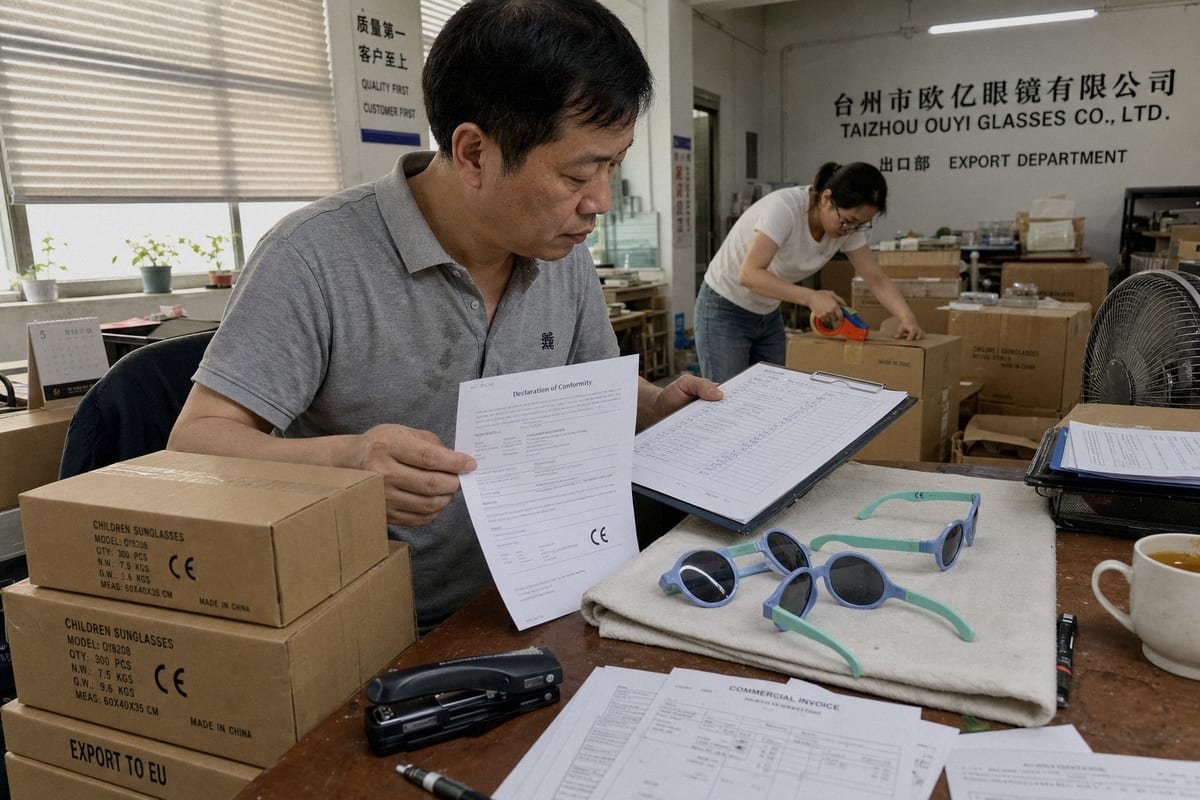
Kids’ sunglasses certification requirements for the EU market confuse many buyers we talk to. One missing document can freeze a shipment at customs. Our factory in Taizhou has helped brands avoid exactly that.
Kids’ sunglasses sold in the EU must comply with PPE Regulation (EU) 2016/425, meet the EN ISO 12312-1 standard for UV and optical safety, carry CE marking, and be backed by a Technical File and a signed EU Declaration of Conformity. No separate child-only certificate exists.
That short answer hides a lot of detail. Below, I break down each requirement step by step, so you can check your supplier’s paperwork with confidence.
What CE Marking Standards Do I Need to Verify Before Importing Kids' Sunglasses to the EU?
A German buyer once asked me why our flexible periwinkle-blue kids' frames carried a CE mark on the temple arm. She thought CE only applied to electronics. That conversation taught me how misunderstood eyewear compliance really is.
Before importing, verify the sunglasses fall under PPE Regulation (EU) 2016/425 as Category I PPE, confirm the CE mark is visible and indelible on the frame, and check the supplier holds a Technical File and EU Declaration of Conformity referencing EN ISO 12312-1.
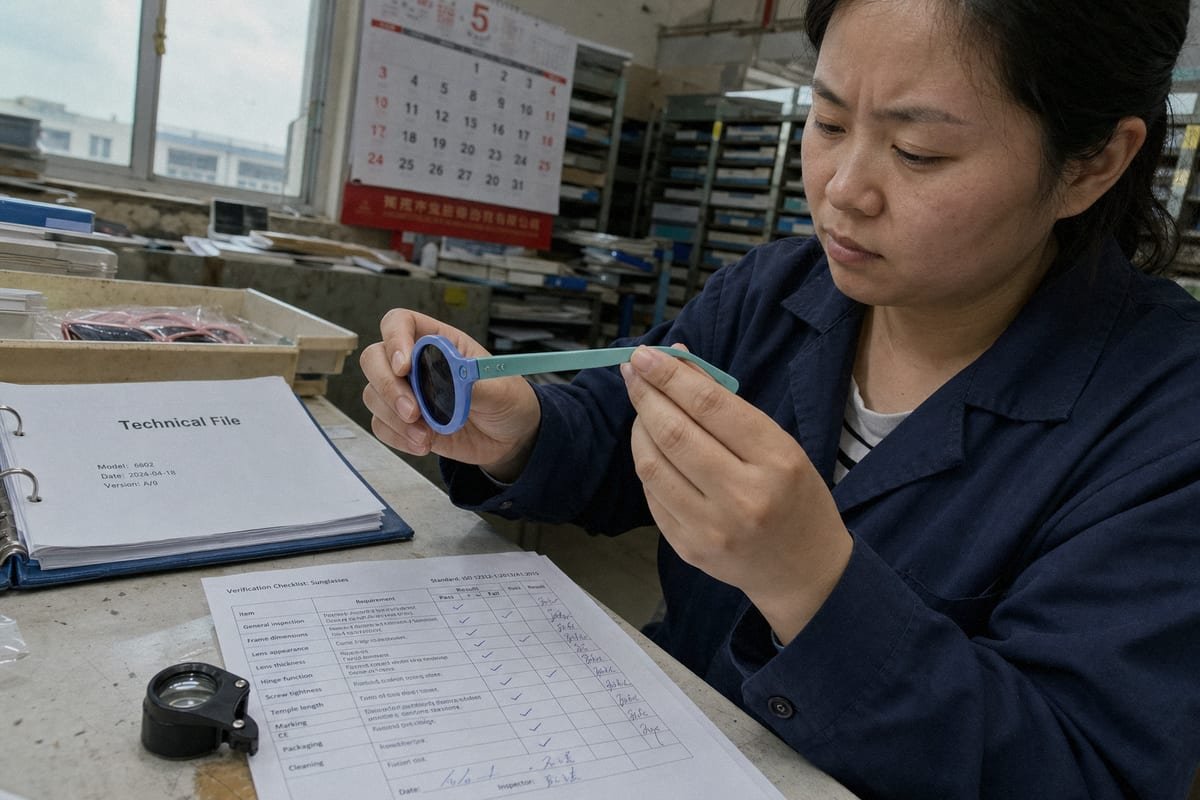
In the EU, sunglasses are not treated as fashion accessories. The law classifies them as personal protective equipment, because they protect the eyes from solar radiation. That means the PPE Regulation (EU) 2016/425 1 is the legal gate for market access. The good news is that ordinary sunglasses sit in Category I, the lowest risk class. So the conformity route is internal production control. No notified body needs to certify the product. But the manufacturer still has to do real work: testing, documentation, and correct marking.
What CE Marking Actually Means
CE marking compliance 2 is not a certificate issued by an authority. It is a declaration by the responsible party that the product meets the essential health and safety requirements. When we apply the CE mark on our TR90 kids' frames, it means we have already tested the lenses, built the file, and signed the declaration. The mark comes last, not first.
Your Verification Checklist
| Item to Verify | What Good Looks Like | Red Flag |
|---|---|---|
| CE mark on product | Visible, legible, indelible; usually on the inner temple | Sticker only, or no mark at all |
| Legal basis cited | PPE Regulation (EU) 2016/425 | Old PPE Directive 89/686/EEC |
| Standard referenced | EN ISO 12312-1 3 (current version) | No standard named, or wrong standard |
| Declaration of Conformity | Signed, dated, product-specific | Generic template covering "all sunglasses" |
| Responsible party | Named manufacturer or EU importer with address | Anonymous trading company |
One more point matters for importers. If you source from outside the EU, you often become the responsible legal actor for compliance. Authorities will ask you, not your factory, for the documents. So verify everything before the goods ship, not after they arrive.
Which UV400 and Lens Safety Tests Should I Request from My Sunglasses Manufacturer?
Every batch of mirrored sport lenses that leaves our workshop goes through transmittance checks first. We learned early that a beautiful orange-to-gold gradient coating means nothing if the UV numbers behind it fail.
Request a UV transmittance report proving UV400 protection, an optical quality test confirming optical class 1 lenses, filter category verification, impact resistance and lens retention results, plus REACH chemical testing for skin-contact frame materials. All tests should reference EN ISO 12312-1.
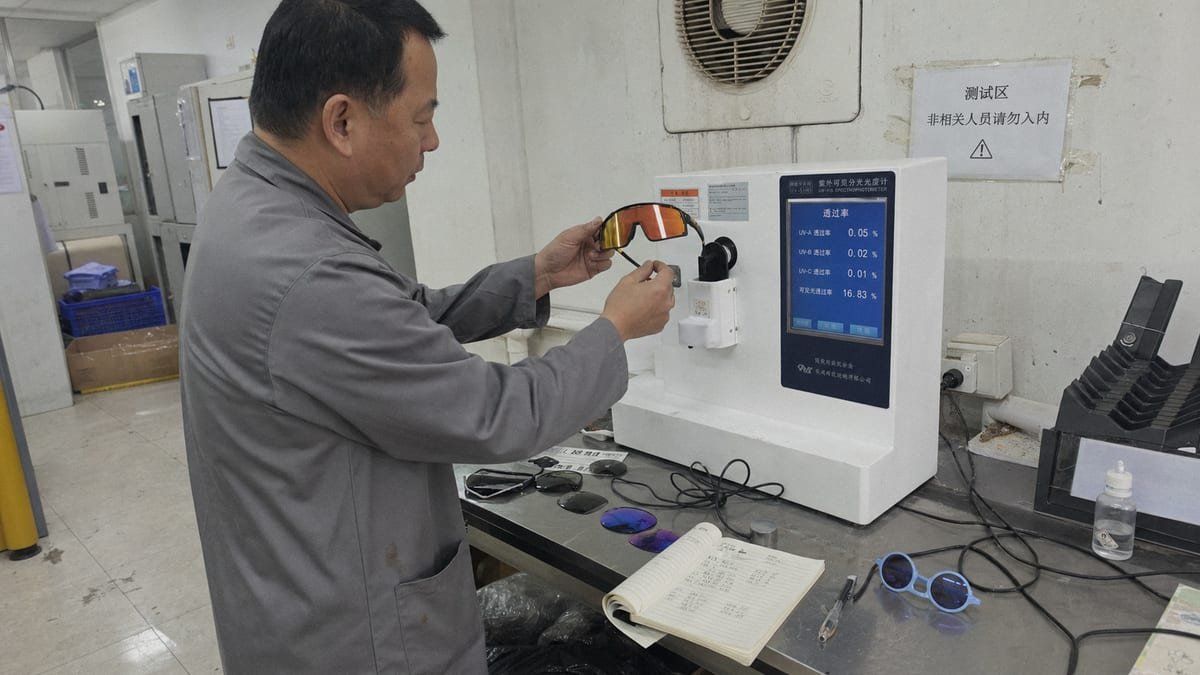
UV400 protection 4 means the lens blocks ultraviolet radiation up to 400 nanometers. That covers both UVA and UVB. For children, this matters even more than for adults. Kids' pupils are larger, their lenses are clearer, and more UV reaches the retina. So a lab report showing actual transmittance curves is worth far more than a "UV400" sticker on the lens.
But UV is only one part of lens safety. A compliant lens must also let your child see clearly and survive a fall onto playground concrete.
The Core Test Package
Here is the test set I recommend buyers request, in order of priority:
- UV transmittance test — confirms full UV blocking to 400 nm.
- Visible light transmission test — determines the filter category, usually filter category 3 for bright sunlight use.
- Optical quality test — checks refractive power and distortion; optical class 1 is the benchmark for general wear.
- Impact resistance and robustness test — verifies lenses do not shatter or pop out under mechanical stress.
- Lens retention test — critical for kids who pull, twist, and sit on their glasses.
- Chemical safety tests — REACH-related screening 5 on frame and temple materials.
Why Filter Category Matters for Kids
| Filter Category | Light Transmission | Typical Use | Suitable for Kids? |
|---|---|---|---|
| 0 | 80–100% | Fashion, indoor | Not sun protection |
| 1 | 43–80% | Overcast days | Limited |
| 2 | 18–43% | Average sunlight | Yes |
| 3 | 8–18% | Bright sun, beach, mountains | Yes, most common |
| 4 | 3–8% | Extreme glare, glaciers | Not for road use |
Most children's sunglasses we produce use filter category 3 lenses. Category 4 is too dark for everyday use and is not suitable for road environments. Ask your manufacturer to state the category on the report and on the product label, because EU rules require that information to reach the consumer.
How Do I Confirm My Supplier's Certifications Meet EN ISO 12312-1 Requirements?
There is a trade-off we weigh on every new project: buyers want fast lead times, but proper standard verification takes time. After fifteen years making children's eyewear, I always advise buyers to spend a few extra days checking the paperwork line by line.
Cross-check the supplier's test reports against the current EN ISO 12312-1 standard: confirm the report names your exact model, comes from a credible lab, covers UV transmittance, optical class 1, filter category, and robustness clauses, and matches the details in the EU Declaration of Conformity.
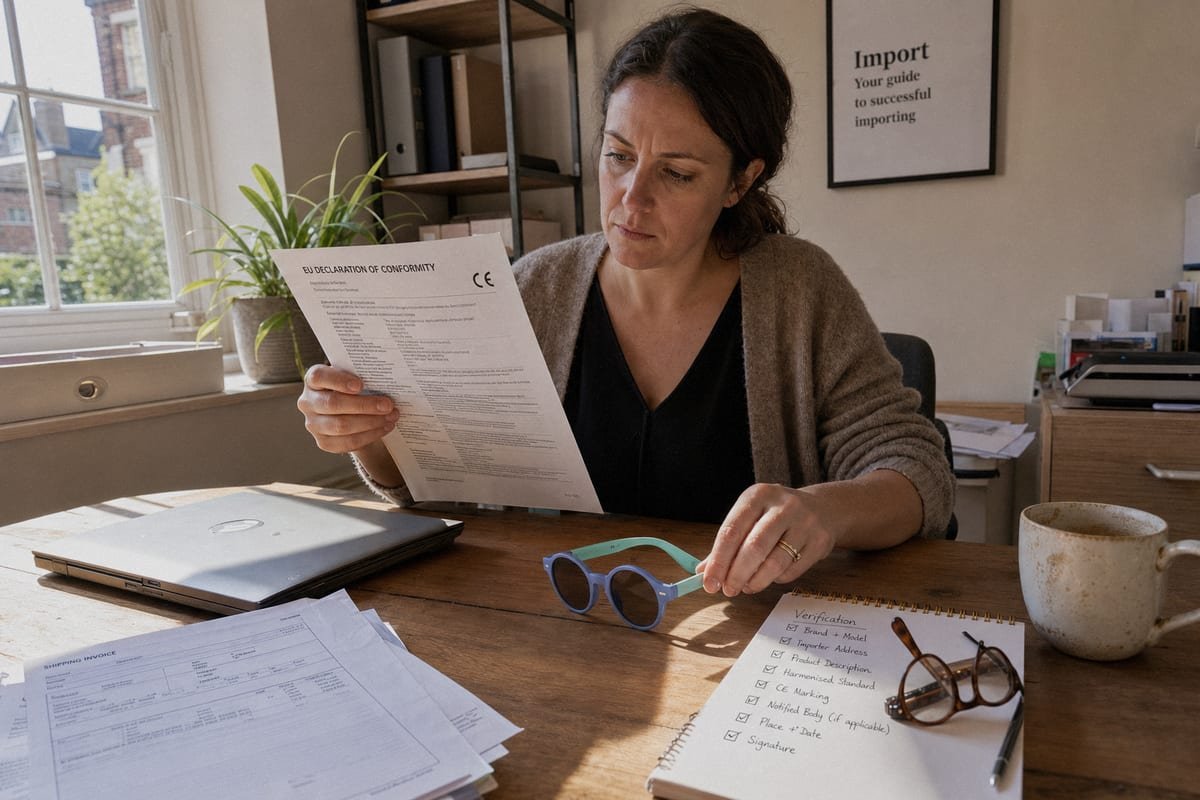
The EN ISO 12312-1 standard is the harmonized benchmark for sunglasses in the EU. When a product meets it, authorities presume conformity with the PPE Regulation's essential requirements. But "we meet the standard" is easy to say and hard to prove. Your job is to test that claim.
Step-by-Step Verification Process
First, ask for the full test report, not a one-page summary. A real report lists the standard clauses tested, the measured values, and the pass criteria. Then check these points:
- Model match. The report must name the exact model you are buying. A report for a different frame or lens does not cover your product. Lens material and coating changes can alter results.
- Standard version. The standard has been updated over the years. The current version should appear on the report. Reports citing very old versions deserve questions.
- Lab credibility. Reports from accredited third-party labs carry more weight than internal factory data, even though self-testing is legally allowed for Category I PPE.
- Scope of testing. The report should cover UV transmittance, luminous transmittance, optical quality, and mechanical robustness. A UV-only report is incomplete.
- Consistency across documents. The model number, standard, and manufacturer name on the test report, the Declaration of Conformity, and the product label must all match.
Children-Specific Checks Beyond the Standard
Kid-sized does not mean lower standard. In our workshop, we go further than the minimum because children handle glasses roughly. We check frame edges for sharpness, verify our TPEE temples flex without snapping into shards, and confirm hinge screws stay secure. Some sport styles also benefit from higher impact resistance testing, which is becoming a genuine market differentiator for active-kids brands. If your product targets children under 36 months and has play value, discuss whether the Toy Safety Directive 6 overlaps with the PPE framework. Getting that classification right early prevents disputes at customs later.
What Documentation Should I Collect From My Factory to Pass EU Customs Compliance Checks?
A lesson we learned years ago still shapes how we prepare shipments: a customer's container was held at Rotterdam because the Declaration of Conformity listed a different product name than the packing list. The goods were fine. The paperwork was not.
Collect the signed EU Declaration of Conformity, the complete Technical File with EN ISO 12312-1 test reports and risk assessment, REACH chemical test results including nickel release testing for metal parts, labeling artwork showing CE marking and filter category, and user instructions in target-market languages.
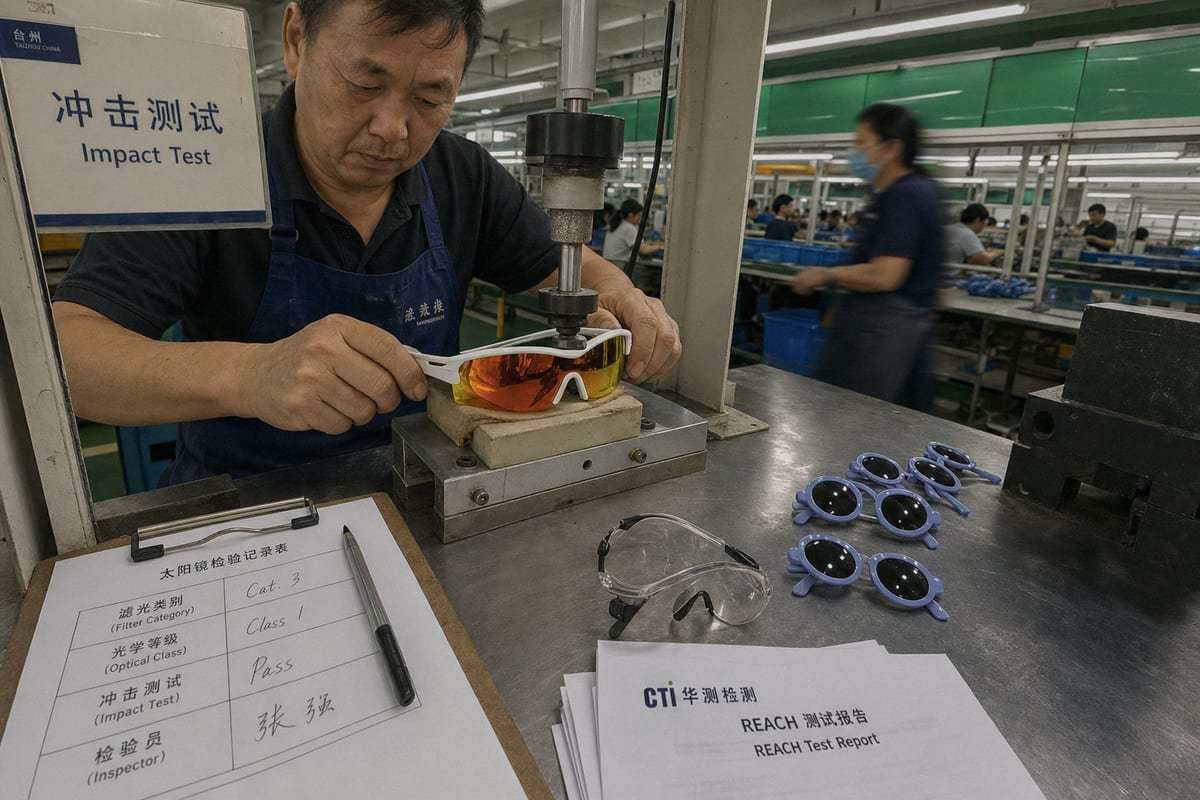
Customs officers and market surveillance authorities 7 do not test lenses at the border. They check documents. If the paperwork is complete, consistent, and product-specific, most checks pass smoothly. If anything is missing or mismatched, the shipment can be delayed, and delays cost far more than proper preparation.
The Complete Document Set
| Document | Purpose | Who Signs or Issues It |
|---|---|---|
| EU Declaration of Conformity | Legal declaration of compliance with PPE Regulation (EU) 2016/425 | Manufacturer or EU importer |
| Technical File | Evidence base: test reports, drawings, risk assessment, materials list | Compiled by manufacturer, kept 10 years |
| EN ISO 12312-1 test reports | Proof of UV, optical, and mechanical compliance | Testing laboratory |
| REACH regulation test results | Proof of chemical safety: phthalates, lead, cadmium | Testing laboratory |
| Nickel release testing report | Confirms metal parts like hinge screws meet migration limits | Testing laboratory per EN 1811 |
| Labeling and packaging artwork | Shows CE mark, filter category, manufacturer identity, road-use suitability | Manufacturer with buyer approval |
| User information leaflet | Care, use limits, warnings, in local languages | Manufacturer or importer |
Practical Tips From Our Export Experience
Keep every document aligned on three details: model number, manufacturer name and address, and the referenced standard. We prepare a matched document pack for each customer order, because one inconsistent field is the most common trigger for questions. Also, keep the file available for years after the last unit is sold. Authorities can request it long after import. Finally, watch emerging requirements. The EU Digital Product Passport will eventually push brands toward QR-coded packaging with material traceability, so building clean documentation habits now is an investment, not a burden.
Conclusion
EU compliance for kids' sunglasses is demanding but predictable: PPE Regulation, EN ISO 12312-1 testing, CE marking, and complete documentation. Get these right, and your launch avoids costly surprises.
Footnotes
1. Official EU legal text defining PPE classification requirements for sunglasses. ↩︎
2. Background explanation of what CE marking represents legally in the EU. ↩︎
3. Official ISO standard page defining sunglasses safety and optical requirements. ↩︎
4. Background reference on UV radiation types relevant to lens protection claims. ↩︎
5. Official European Commission overview of REACH chemical regulations. ↩︎
6. Official EU directive text explaining toy safety overlap with PPE rules. ↩︎
7. European Commission page describing market surveillance role in customs checks. ↩︎
More Articles You Might Like


Looking for a Reliable Kids Eyewear Partner?
Explore 800+ ready styles and full OEM/ODM support tailored to your brand.
Get in Touch English
  Español de México
  Deutsch
  Français
  日本語
日本語  العربية
  Português do Brasil