Qual é a VLT (Transmitância da Lente) Típica para Óculos de Sol Infantis?
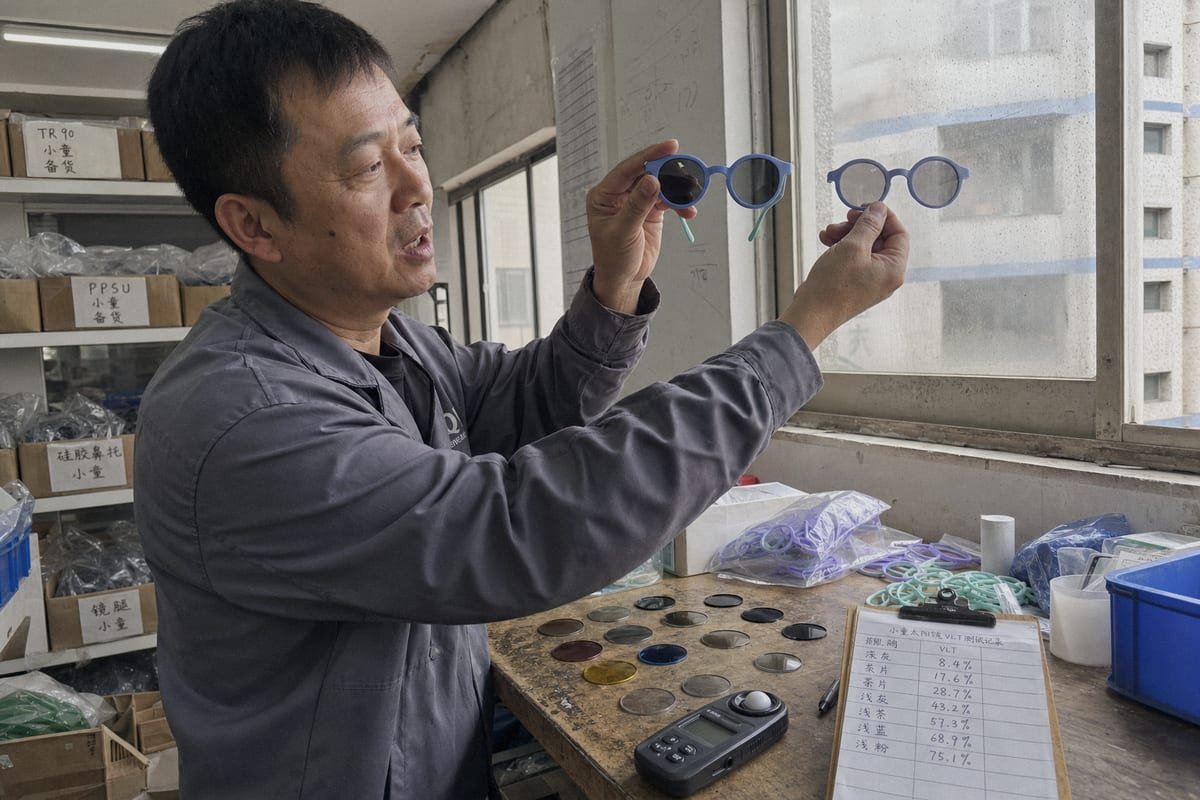
Compradores me perguntam sobre a VLT típica para óculos de sol infantis quase semanalmente revestimentos espelhados 1. Escolha a tonalidade errada, e as crianças apertam os olhos, reclamam ou se recusam a usar o produto. Em nossa linha de produção, resolvemos isso anos atrás.
A VLT típica para óculos de sol infantis é de 8–18% (Categoria 3) para condições de sol forte e de 18–43% (Categoria 2) para luz mista do dia a dia. A VLT controla apenas o escurecimento da lente; a proteção UV400 que bloqueia 100% dos raios UVA e UVB é um requisito separado e inegociável.
Essa resposta curta cobre o básico. Mas se você está adquirindo óculos infantis para uma marca, precisa de mais detalhes. Deixe-me guiá-lo.
Que faixa de VLT devo procurar ao adquirir óculos de sol infantis para uso externo?
Um distribuidor da Austrália enviou uma vez para nossa fábrica duas amostras de concorrentes e perguntou por que uma parecia "muito escura" para crianças pequenas. A resposta foi a VLT, e isso mudou toda a especificação do pedido dele.
Para uso externo, adquira óculos de sol infantis com um VLT entre 8% e 18% (Categoria de Lente 3) para sol forte, ou 18% a 43% (Categoria 2) para luz variável. A Categoria 3 é o padrão da indústria para praia, playground e brincadeiras ao ar livre no verão.
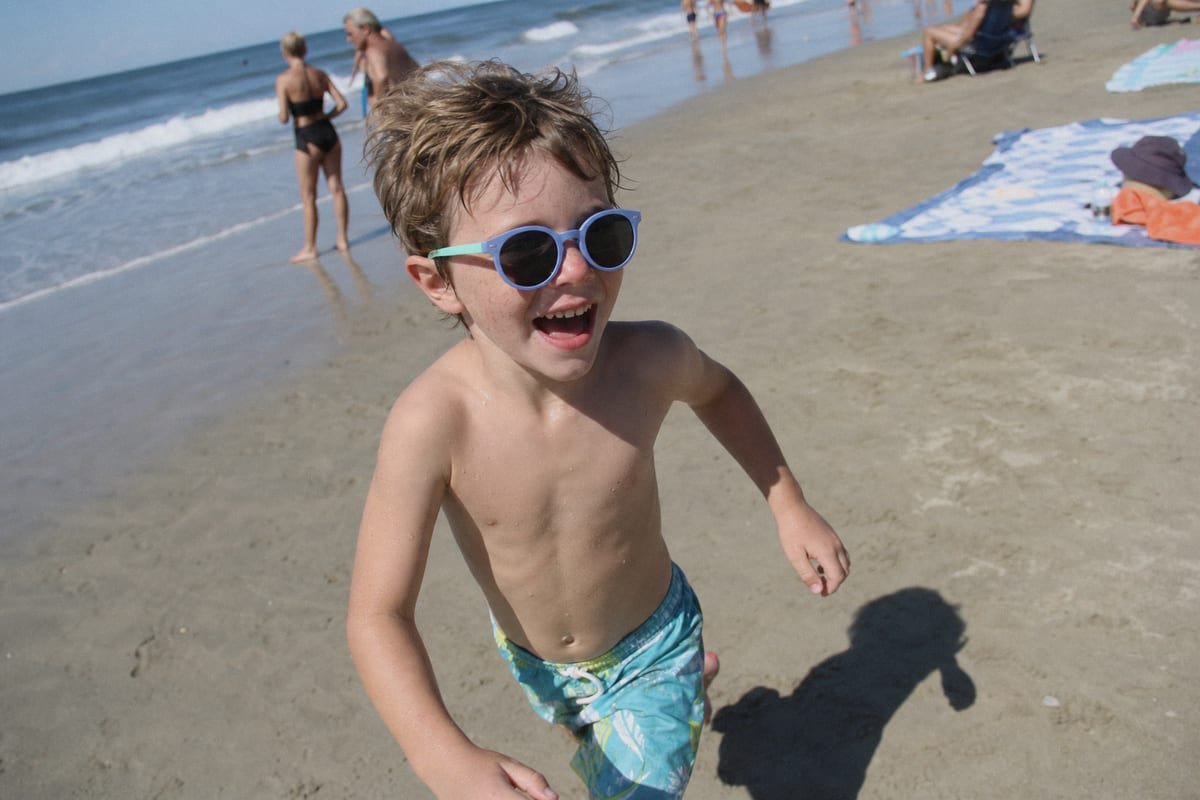
VLT significa Transmissão de Luz Visível. Mede quanta espectro de luz visível 2 passa pela lente. Uma lente com VLT de 0% bloqueia toda a luz visível. Uma lente com VLT de 100% é totalmente transparente. Números menores significam lentes mais escuras. Números maiores significam lentes mais claras. É simples assim.
Quando construímos especificações de lentes para as coleções infantis de nossos clientes, trabalhamos a partir do sistema de categorias padrão. Veja como ele se divide:
O Sistema de Categorias Padrão de VLT
| Categoria da Lente | Faixa Típica de VLT | Melhor Uso para Crianças | Quão Comum em Linhas Infantis |
|---|---|---|---|
| Categoria 0 | 80–100% | Interior, óculos de segurança | Raro |
| Categoria 1 | 43–80% | Nublado, pouca luz | Ocasional |
| Categoria 2 | 18–43% | Luz mista do dia a dia | Muito comum |
| Categoria 3 | 8–18% | Sol forte, praia, parquinho | Padrão da indústria |
| Categoria 4 | 3–8% | Geleiras, alta altitude | Apenas especializado |
A maioria dos ~800 estilos existentes em nosso catálogo é enviada com tonalidades de Categoria 3 de Lente. Isso não é um acidente. A Categoria 3 oferece forte redução de brilho sob luz solar intensa, que é quando os pais realmente colocam óculos de sol em seus filhos. A Categoria 2 funciona bem para marcas que visam mercados com clima mais variável, como o norte da Europa ou o Japão.
Uma nota importante sobre os limites. Fontes diferentes traçam as linhas de categoria de maneira ligeiramente diferente. Algumas descrevem a Categoria 2 como 20–40% de VLT em vez de 18–43%. O padrão amplo se mantém de qualquer maneira. Para fins de aquisição, especifique a porcentagem exata de VLT em seu pedido de compra, não apenas o nome da categoria. Sempre confirmamos a porcentagem alvo com os compradores antes que a produção da lente comece, porque "Categoria 3" sozinha deixa espaço para uma lente de 8% ou uma lente de 18% — e essas parecem notavelmente diferentes na prateleira.
Como sei se uma categoria VLT é segura o suficiente para a marca de óculos dos meus filhos?
Verificações de qualidade em nossa oficina gerenciada por 5S me ensinaram uma lição difícil no início: escuridão e segurança são dois testes completamente diferentes. Uma lente pode passar em um e falhar no outro.
Uma categoria VLT é segura para crianças quando combinada com proteção UV400 verificada que bloqueia 100% dos raios UVA e UVB. A VLT em si não é uma métrica de segurança; as categorias 2 e 3 são escolhas seguras se a filtragem UV e a resistência ao impacto forem certificadas.
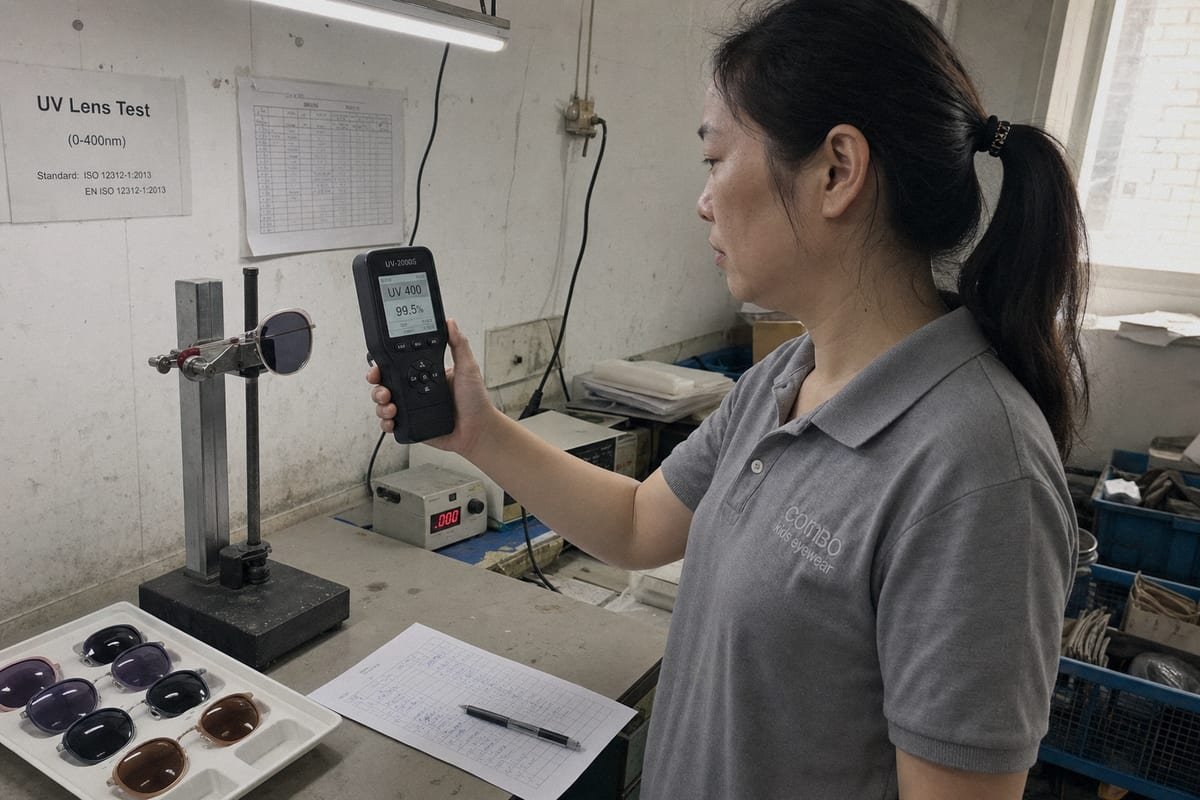
Este é o ponto que enfatizo com cada nova marca que integramos. A VLT é sobre conforto e visibilidade. A filtragem UV é sobre a saúde da retina. A lente cristalina de uma criança transmite mais UV para a retina do que a de um adulto, então cortar UVA e UVB 3 importa muito mais do que cortar a luz visível. De fato, uma lente escura sem filtragem UV adequada pode ser pior do que nenhum óculos de sol. A tonalidade escura faz com que a pupila se dilate e, se os raios UV passarem, mais deles atingem a retina.
Portanto, ao avaliar um fornecedor, separe sua lista de verificação em três camadas:
O Checklist de Segurança de Três Camadas
- Filtragem UV primeiro. Exigir Proteção UV400 4 on every lens, regardless of tint darkness. We apply this standard across our full kids' range, from pale Category 1 tints to dark Category 3 lenses.
- Impact resistance second. Polycarbonate lenses are the standard for children because they naturally block UV rays and resist shattering when a ball, elbow, or pavement gets involved. Ask your supplier what lens material they use and request drop-ball test 5 documentation.
- VLT category third. Once safety is locked in, choose the tint level based on your market's climate and the product's use case.
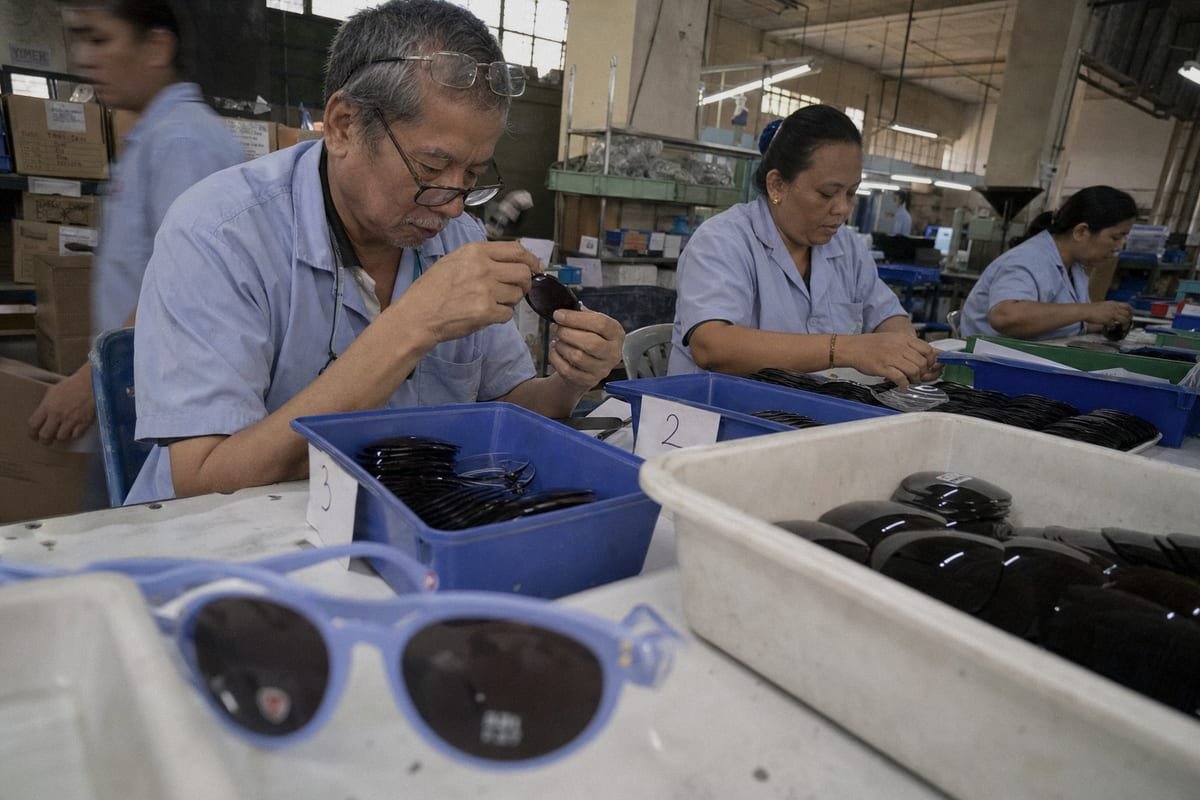
There is one more layer premium buyers should know about: uniformity of luminous transmittance. A quality lens must transmit light evenly across its surface. Uneven tinting creates visual ghosting and prismatic distortion. Children are far less tolerant of this than adults. In our experience, distorted optics are one of the fastest routes to a child refusing to wear the glasses — and to your brand getting returns. We inspect optical clarity and tint uniformity on every production batch for exactly this reason.
Avoid Category 4 lenses (3–8% VLT) for general children's lines. They are built for glaciers and high-altitude glare, and they are too dark for everyday play. They are also illegal for driving in many markets, which creates labeling complications you do not need.
Por que a VLT importa mais para crianças do que para adultos na escolha de lentes de óculos de sol?
During development of our TPEE-temple sunglasses line, a pediatric optician client made a comment that reshaped our lens sourcing: children's eyes are not small adult eyes. They behave differently under light.
A VLT é mais importante para crianças porque os olhos das crianças transmitem mais luz para a retina, elas se movem rapidamente entre o sol e a sombra, e a escuridão excessiva pode reduzir a exposição à luz natural ligada ao desenvolvimento ocular saudável. Uma tonalidade moderada e bem escolhida supera uma muito escura.
Let me break this down into the three factors that make VLT selection genuinely different for children.
Children's Eyes Let More Light Through
A child's ocular lens is clearer than an adult's. More visible light and more UV reach the retina. This makes UV400 protection non-negotiable, and it also means very bright glare feels more intense to a child. Good glare reduction, tuned to real-world conditions, reduces squinting and eye strain during long outdoor sessions.
Kids Change Environments Fast
Adults sit on a beach for two hours. Children sprint from bright sun into tree shade and back within seconds. An extremely dark lens leaves them nearly blind in the shaded moments, which is a trip-and-fall risk. This is why we often steer everyday kids' lines toward the higher end of Category 3 or into Category 2. It is a practical trade-off between glare control and visibility.
The Emerging Myopia Consideration
Pediatric research increasingly links time in bright natural light to slower a progressão da miopia 6 in developing eyes. Some researchers caution that habitually wearing excessively dark lenses during daily play may limit that beneficial light exposure. This does not mean skipping sunglasses. It means choosing a sensible VLT rather than the darkest available option, and reserving very dark tints for genuinely intense conditions.
| Fator | Adult Eyes | Children's Eyes | VLT Implication |
|---|---|---|---|
| Lens clarity | Yellows with age, filters more light | Very clear, transmits more light | UV400 essential at any tint |
| Environment shifts | Slow, predictable | Rapid sun-to-shade movement | Avoid extremely low VLT |
| Eye development | Complete | Ongoing, light-sensitive | Moderate tints for daily wear |
| Glare sensitivity | Moderado | Higher subjective discomfort | Category 3 for bright sun |
There is also a comfort dimension in lens color. Neutral gray tints reduce overall brightness without distorting color perception 7, which helps children accept the glasses. Some premium filters also target short-wavelength scattering — the so-called blue blur — which cuts squinting more effectively than simply making the lens darker. And for late-afternoon wear, a lighter tint allows the evening wavelengths that support a child's natural sleep-wake rhythm to reach the retina.
Posso solicitar níveis de VLT personalizados ao trabalhar com um fabricante de óculos infantis?
A promotional products buyer once asked our team for three tint depths of the same frame — light for retail in Scandinavia, medium for Central Europe, and dark for an Australian summer campaign. We delivered all three from one mold.
Sim, fabricantes de óculos infantis conceituados podem produzir níveis de VLT personalizados mediante solicitação. Os compradores normalmente especificam uma porcentagem de VLT alvo ou categoria de lente, e a fábrica a corresponde através de tingimento de lente, revestimentos ou opções de lente polarizada, geralmente confirmados com amostras de pré-produção.

Custom VLT is one of the most practical and lowest-cost customizations available in OEM/ODM eyewear. Unlike a new frame shape, it requires no new mold. At our Taizhou factory, adjusting lens transmittance is part of our standard ODM workflow, alongside custom colors, logos, and packaging. Here is how the process typically runs:
How Custom VLT Ordering Works
- Define the use case. Tell your supplier where and how the glasses will be worn. Beach retail in Queensland needs a different spec than school-run eyewear in Hamburg.
- Specify the target. Give a VLT percentage or a tight range, such as 12–15%, not just "Category 3." Precision here prevents surprises later.
- Choose the lens build. Options include standard tinted polycarbonate 8, gradient tints, mirrored coatings, and polarized lenses. Polarized lens benefits go beyond darkness — they cut reflected glare from water and pavement, which is valuable for beach and sport lines. Note that mirror coatings lower effective VLT slightly, so we factor that in.
- Approve pre-production samples. We send tinted samples for sign-off before mass production. Bright-light testing at your end is worth the extra week.
- Verify in QC. Transmittance and tint uniformity should be checked batch by batch, not assumed.
| Personalização | Affects VLT? | Mold Cost? | Typical Kids' Application |
|---|---|---|---|
| Standard tint depth | Yes, directly | Não | Everyday sunglasses |
| Gradient tint | Yes, varies top to bottom | Não | Fashion-led lines |
| Revestimento espelhado | Slightly lowers VLT | Não | Sport shield styles |
| Polarized lens | Set per spec | Não | Beach, water, sport ranges |
| Fotocromático | Variable VLT by light | Não | Premium all-day wear |
One honest note from fifteen years in this trade: not every buyer needs custom VLT. Many new brands do better selecting from existing tested styles — we keep roughly 800 on hand for that reason — and reserving customization for logos, frame colors, and packaging. Test the market first. Refine the lens spec in your second order, once real customer feedback tells you whether your VLT choice matched your market's light conditions.
Conclusão
Getting VLT wrong means squinting kids and returned stock. The typical VLT for kids' sunglasses is 8–18% for bright sun, 18–43% for mixed light — always paired with UV400 protection.
Notas de rodapé
1. Corrected Wikipedia entry for mirrored sunglasses, detailing reflective coatings and their light-blocking properties. ↩︎
2. Wikipedia entry explaining the physics of transmittance and light passing through materials. ↩︎
3. CDC guide on UV radiation types, including UVA and UVB, and their effects. ↩︎
4. FDA resource explaining ultraviolet radiation and the importance of UV protection for health. ↩︎
5. Official FDA regulation regarding the impact resistance requirements for eyeglasses and sunglasses. ↩︎
6. Peer-reviewed study on the relationship between outdoor light exposure and myopia development in children. ↩︎
7. American Academy of Ophthalmology guide on choosing sunglasses for optimal eye health and color clarity. ↩︎
8. Wikipedia page detailing the properties and safety applications of polycarbonate plastic. ↩︎
Mais Artigos que Você Pode Gostar


Procurando um Parceiro Confiável em Óculos Infantis?
Explore mais de 800 estilos prontos e suporte completo OEM/ODM adaptado à sua marca.
Entre em Contato English
  Español de México
  Deutsch
  Français
  日本語
日本語  العربية
  Português do Brasil