What Is the Typical VLT (Lens Transmittance) for Kids’ Sunglasses?
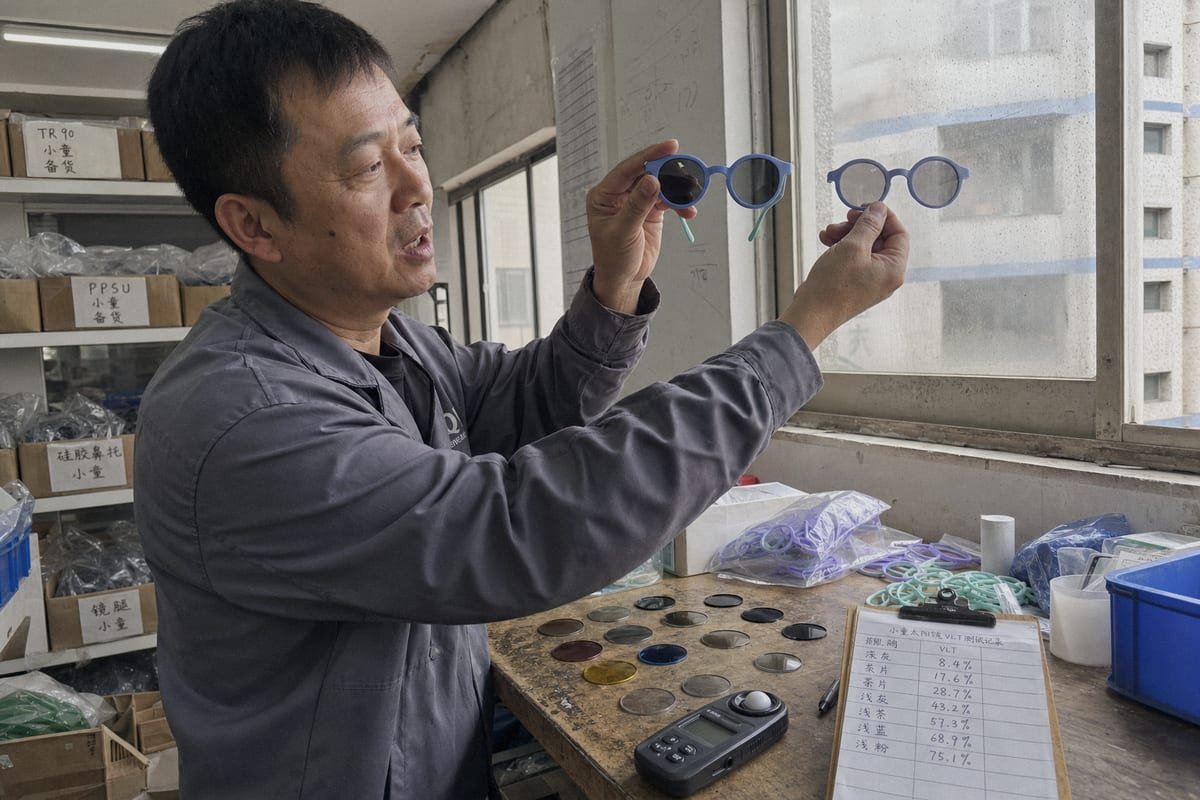
Buyers ask me about the typical VLT for kids’ sunglasses almost weekly mirrored coatings 1. Choose the wrong tint, and children squint, complain, or refuse to wear the product. On our production line, we solved this years ago.
The typical VLT for kids’ sunglasses is 8–18% (Category 3) for bright sunny conditions and 18–43% (Category 2) for everyday mixed light. VLT controls lens darkness only; UV400 protection blocking 100% of UVA and UVB rays is a separate, non-negotiable requirement.
That short answer covers the basics. But if you are sourcing children’s eyewear for a brand, you need more detail. Let me walk you through it.
What VLT range should I look for when sourcing kids' sunglasses for outdoor use?
A distributor from Australia once sent our factory two competitor samples and asked why one felt "too dark" for toddlers. The answer came down to VLT, and it changed his entire order spec.
For outdoor use, source kids' sunglasses with a VLT between 8% and 18% (Lens Category 3) for strong sun, or 18% to 43% (Category 2) for variable light. Category 3 is the industry standard for beach, playground, and summer outdoor play.
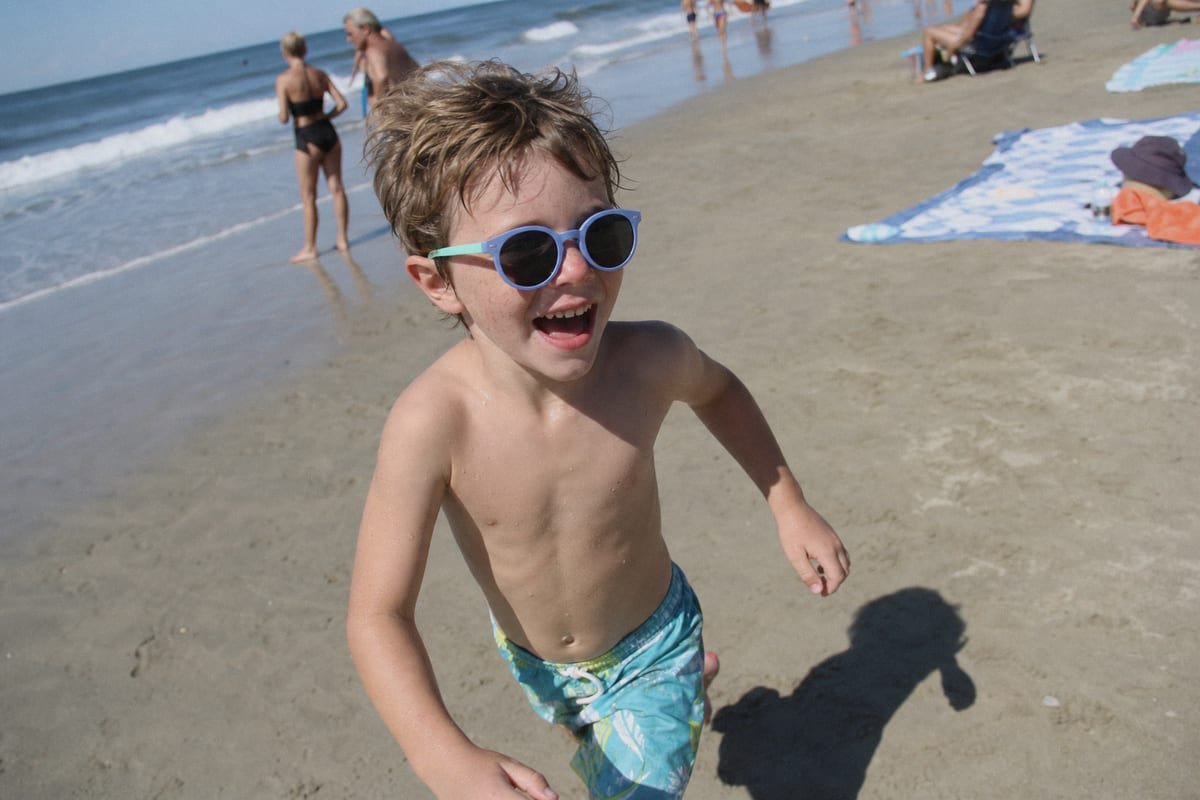
VLT stands for Visible Light Transmission. It measures how much of the visible light spectrum 2 passes through the lens. A 0% VLT lens blocks all visible light. A 100% VLT lens is fully transparent. Lower numbers mean darker lenses. Higher numbers mean lighter lenses. It is that simple.
When we build lens specs for our clients' children's collections, we work from the standard category system. Here is how it breaks down:
The Standard VLT Category System
| Lens Category | Typical VLT Range | Best Use for Kids | How Common in Kids' Lines |
|---|---|---|---|
| Category 0 | 80–100% | Indoor, safety glasses | Rare |
| Catégorie 1 | 43–80% | Overcast, low light | Occasionnel |
| Catégorie 2 | 18–43% | Everyday mixed light | Très courant |
| Catégorie 3 | 8–18% | Soleil éclatant, plage, aire de jeux | Industry standard |
| Catégorie 4 | 3–8% | Glaciers, high altitude | Specialized only |
Most of the ~800 existing styles in our catalog ship with Lens Category 3 tints. That is not an accident. Category 3 delivers strong glare reduction in bright daylight, which is when parents actually put sunglasses on their children. Category 2 works well for brands targeting markets with more variable weather, like Northern Europe or Japan.
One important note on cutoffs. Different sources draw the category lines slightly differently. Some describe Category 2 as 20–40% VLT rather than 18–43%. The broad pattern holds either way. For sourcing purposes, specify the exact VLT percentage in your purchase order, not just the category name. We always confirm the target percentage with buyers before lens production begins, because "Category 3" alone leaves room for a lens at 8% or a lens at 18% — and those look noticeably different on the shelf.
How do I know if a VLT category is safe enough for my children's eyewear brand?
Quality checks in our 5S-managed workshop taught me a hard lesson early on: darkness and safety are two completely different tests. A lens can pass one and fail the other.
A VLT category is safe for children when it is paired with verified UV400 protection blocking 100% of UVA and UVB rays. VLT itself is not a safety metric; Categories 2 and 3 are both safe choices if the UV filtration and impact resistance are certified.
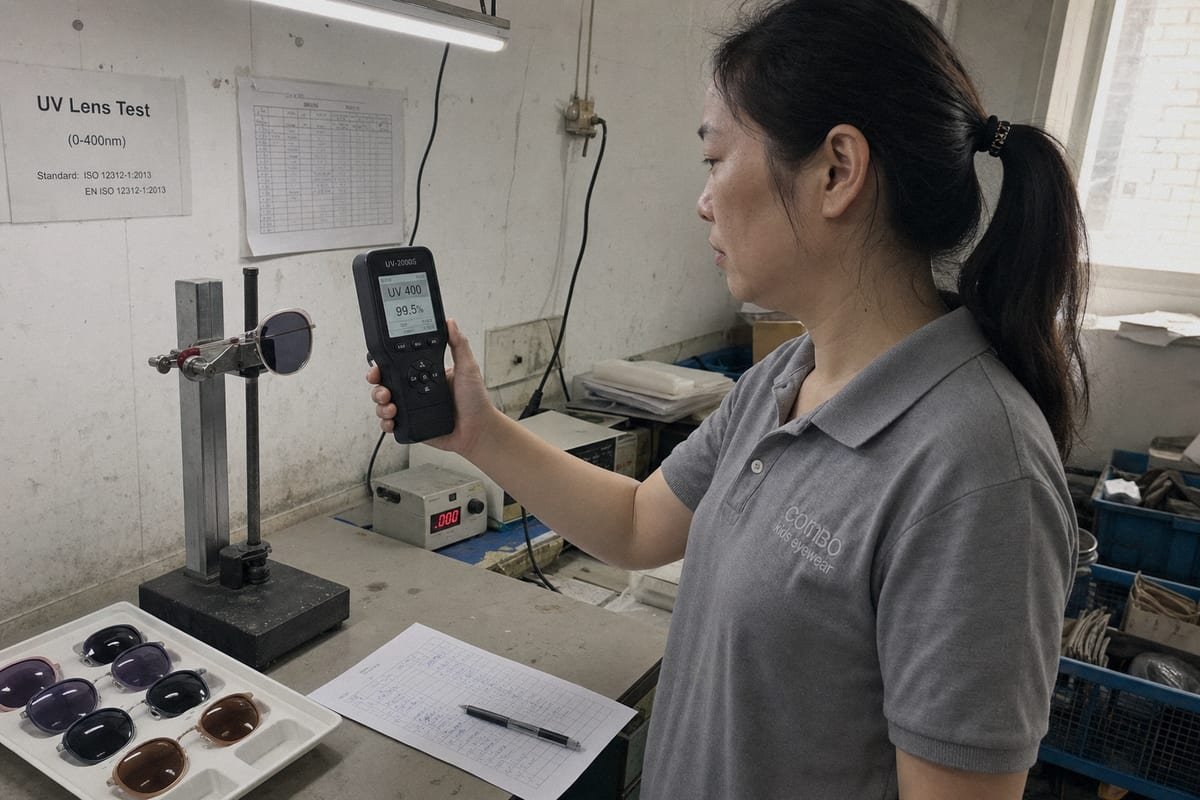
Here is the point I stress with every new brand we onboard. VLT is about comfort and visibility. UV filtration is about retinal health. A child's crystalline lens transmits more UV to the retina than an adult's does, so cutting les UVA et UVB 3 matters far more than cutting visible light. In fact, a dark lens without proper UV filtration can be worse than no sunglasses at all. The dark tint causes the pupil to dilate, and if UV rays pass through, more of them reach the retina.
So when you evaluate a supplier, separate your checklist into three layers:
The Three-Layer Safety Checklist
- UV filtration first. Demand protection UV400 4 on every lens, regardless of tint darkness. We apply this standard across our full kids' range, from pale Category 1 tints to dark Category 3 lenses.
- Impact resistance second. Polycarbonate lenses are the standard for children because they naturally block UV rays and resist shattering when a ball, elbow, or pavement gets involved. Ask your supplier what lens material they use and request drop-ball test 5 documentation.
- VLT category third. Once safety is locked in, choose the tint level based on your market's climate and the product's use case.
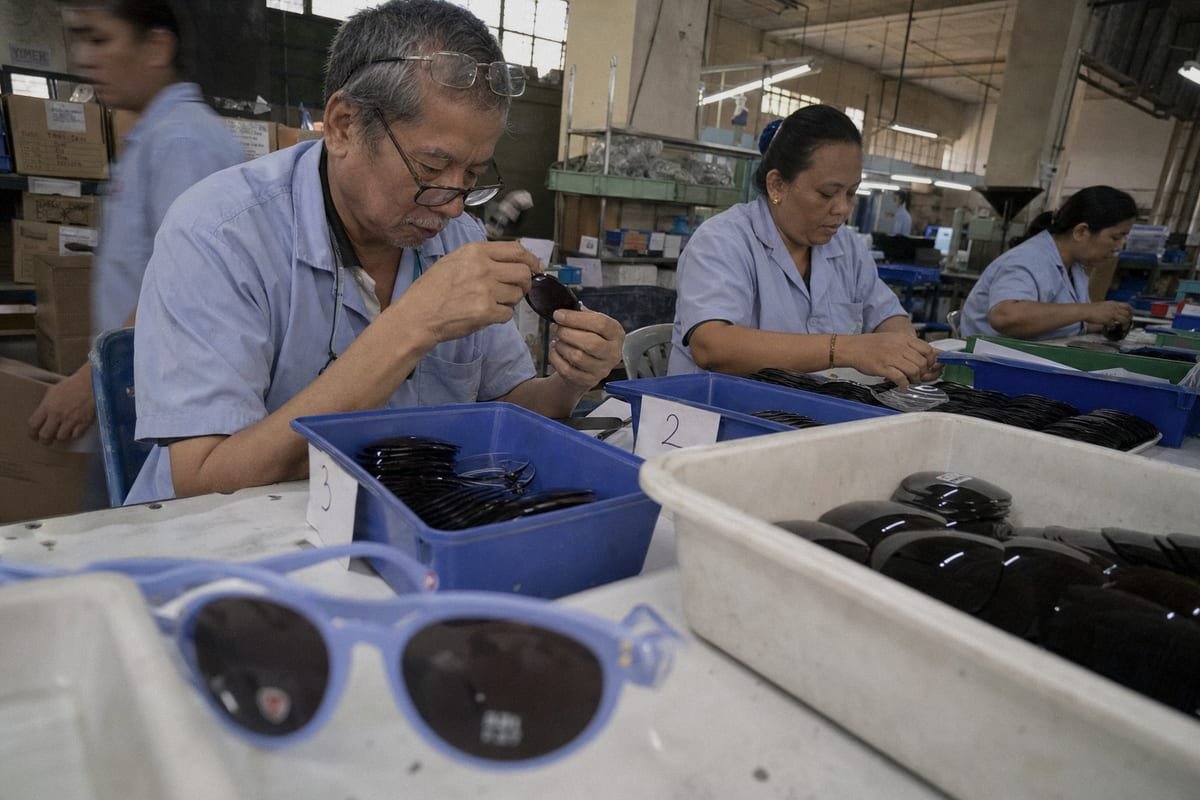
There is one more layer premium buyers should know about: uniformity of luminous transmittance. A quality lens must transmit light evenly across its surface. Uneven tinting creates visual ghosting and prismatic distortion. Children are far less tolerant of this than adults. In our experience, distorted optics are one of the fastest routes to a child refusing to wear the glasses — and to your brand getting returns. We inspect optical clarity and tint uniformity on every production batch for exactly this reason.
Avoid Category 4 lenses (3–8% VLT) for general children's lines. They are built for glaciers and high-altitude glare, and they are too dark for everyday play. They are also illegal for driving in many markets, which creates labeling complications you do not need.
Why does VLT matter more for kids than adults when choosing sunglasses lenses?
During development of our TPEE-temple sunglasses line, a pediatric optician client made a comment that reshaped our lens sourcing: children's eyes are not small adult eyes. They behave differently under light.
VLT matters more for kids because children's eyes transmit more light to the retina, they move rapidly between sun and shade, and excessive darkness may reduce the natural light exposure linked to healthy eye development. A moderate, well-chosen tint outperforms a very dark one.
Let me break this down into the three factors that make VLT selection genuinely different for children.
Children's Eyes Let More Light Through
A child's ocular lens is clearer than an adult's. More visible light and more UV reach the retina. This makes UV400 protection non-negotiable, and it also means very bright glare feels more intense to a child. Good glare reduction, tuned to real-world conditions, reduces squinting and eye strain during long outdoor sessions.
Kids Change Environments Fast
Adults sit on a beach for two hours. Children sprint from bright sun into tree shade and back within seconds. An extremely dark lens leaves them nearly blind in the shaded moments, which is a trip-and-fall risk. This is why we often steer everyday kids' lines toward the higher end of Category 3 or into Category 2. It is a practical trade-off between glare control and visibility.
The Emerging Myopia Consideration
Pediatric research increasingly links time in bright natural light to slower la progression de la myopie 6 in developing eyes. Some researchers caution that habitually wearing excessively dark lenses during daily play may limit that beneficial light exposure. This does not mean skipping sunglasses. It means choosing a sensible VLT rather than the darkest available option, and reserving very dark tints for genuinely intense conditions.
| Facteur | Adult Eyes | Children's Eyes | VLT Implication |
|---|---|---|---|
| Lens clarity | Yellows with age, filters more light | Very clear, transmits more light | UV400 essential at any tint |
| Environment shifts | Slow, predictable | Rapid sun-to-shade movement | Avoid extremely low VLT |
| Eye development | Complete | Ongoing, light-sensitive | Moderate tints for daily wear |
| Glare sensitivity | Modéré | Higher subjective discomfort | Category 3 for bright sun |
There is also a comfort dimension in lens color. Neutral gray tints reduce overall brightness without distorting color perception 7, which helps children accept the glasses. Some premium filters also target short-wavelength scattering — the so-called blue blur — which cuts squinting more effectively than simply making the lens darker. And for late-afternoon wear, a lighter tint allows the evening wavelengths that support a child's natural sleep-wake rhythm to reach the retina.
Can I request custom VLT levels when working with a kids' eyewear manufacturer?
A promotional products buyer once asked our team for three tint depths of the same frame — light for retail in Scandinavia, medium for Central Europe, and dark for an Australian summer campaign. We delivered all three from one mold.
Yes, reputable kids' eyewear manufacturers can produce custom VLT levels on request. Buyers typically specify a target VLT percentage or lens category, and the factory matches it through lens tinting, coatings, or polarized lens options, usually confirmed with pre-production samples.

Custom VLT is one of the most practical and lowest-cost customizations available in OEM/ODM eyewear. Unlike a new frame shape, it requires no new mold. At our Taizhou factory, adjusting lens transmittance is part of our standard ODM workflow, alongside custom colors, logos, and packaging. Here is how the process typically runs:
How Custom VLT Ordering Works
- Define the use case. Tell your supplier where and how the glasses will be worn. Beach retail in Queensland needs a different spec than school-run eyewear in Hamburg.
- Specify the target. Give a VLT percentage or a tight range, such as 12–15%, not just "Category 3." Precision here prevents surprises later.
- Choose the lens build. Options include standard tinted polycarbonate 8, gradient tints, mirrored coatings, and polarized lenses. Polarized lens benefits go beyond darkness — they cut reflected glare from water and pavement, which is valuable for beach and sport lines. Note that mirror coatings lower effective VLT slightly, so we factor that in.
- Approve pre-production samples. We send tinted samples for sign-off before mass production. Bright-light testing at your end is worth the extra week.
- Verify in QC. Transmittance and tint uniformity should be checked batch by batch, not assumed.
| Personnalisation | Affects VLT? | Mold Cost? | Typical Kids' Application |
|---|---|---|---|
| Standard tint depth | Yes, directly | Non | Everyday sunglasses |
| Gradient tint | Yes, varies top to bottom | Non | Fashion-led lines |
| Mirror coating | Slightly lowers VLT | Non | Sport shield styles |
| Lentille polarisée | Set per spec | Non | Beach, water, sport ranges |
| Photochromique | Variable VLT by light | Non | Premium all-day wear |
One honest note from fifteen years in this trade: not every buyer needs custom VLT. Many new brands do better selecting from existing tested styles — we keep roughly 800 on hand for that reason — and reserving customization for logos, frame colors, and packaging. Test the market first. Refine the lens spec in your second order, once real customer feedback tells you whether your VLT choice matched your market's light conditions.
Conclusion
Getting VLT wrong means squinting kids and returned stock. The typical VLT for kids' sunglasses is 8–18% for bright sun, 18–43% for mixed light — always paired with UV400 protection.
Notes de bas de page
1. Corrected Wikipedia entry for mirrored sunglasses, detailing reflective coatings and their light-blocking properties. ↩︎
2. Wikipedia entry explaining the physics of transmittance and light passing through materials. ↩︎
3. CDC guide on UV radiation types, including UVA and UVB, and their effects. ↩︎
4. FDA resource explaining ultraviolet radiation and the importance of UV protection for health. ↩︎
5. Official FDA regulation regarding the impact resistance requirements for eyeglasses and sunglasses. ↩︎
6. Peer-reviewed study on the relationship between outdoor light exposure and myopia development in children. ↩︎
7. American Academy of Ophthalmology guide on choosing sunglasses for optimal eye health and color clarity. ↩︎
8. Wikipedia page detailing the properties and safety applications of polycarbonate plastic. ↩︎
Plus d'articles que vous pourriez aimer


Vous recherchez un partenaire fiable en lunetterie pour enfants ?
Explorez plus de 800 styles prêts et un support OEM/ODM complet adapté à votre marque.
Contactez-nous English
  Español de México
  Deutsch
  Français
  日本語
日本語  العربية
  Português do Brasil