How to Design Kids Optical Frame Packaging for Multi-Region Language Labeling Compliance?

Kids optical frame packaging looks simple until a shipment gets held at customs. At our Taizhou factory, we have watched beautiful boxes fail over one missing French warning line.
To design kids optical frame packaging for multi-region language labeling compliance, list your target markets first, map each market’s mandatory languages and warnings, separate regulated text from marketing copy, build a modular artwork master with reserved language zones, then verify every regional version before print approval.
That answer sounds tidy. In practice, it means treating packaging as a compliance system, not a graphic design exercise. Let me walk you through how we handle it with our brand customers, step by step.
What Language and Labeling Requirements Should I Check Before Designing Kids Optical Frame Packaging?
A buyer from Montreal once approved our English-only carton for a TR90 kids optical frame, then called us in a panic three weeks later. Canadian retailers had rejected the entire batch because the mandatory information was not bilingual.
Before designing kids optical frame packaging, check each destination market's mandatory language rules: Canada requires English and French for mandatory label information, the U.S. baseline is English, and each EU member state sets its own accepted languages for safety and consumer information.

The core mistake I see is assuming translation is the whole job. It is not. The real question is which statements must appear, in which language, on which packaging component, for each destination market. Language rules are market-specific, not universal, and one label rarely satisfies every jurisdiction by accident.
The Big Three: U.S., Canada, and the EU
Start with the three regions that trip up most kids' eyewear brands. In Canada, mandatory label information on prepackaged products must generally appear in both English and French, though some business-identification details can stay in one official language. In the United States, English is the baseline, but Puerto Rico and other territories may require the predominant local language. In the EU, the required language is decided by the member state where the product is actually sold, so a single pan-European label often fails unless you adapt it market by market.
| Região | Language Rule | Key Extras to Check |
|---|---|---|
| Estados Unidos | English baseline; territories may need local language | FDA labeling requirements 1 for impact resistance, Children's Product Certificate (CPC) 2 for kids' products |
| Canada | English + French for mandatory information | Bilingual warnings, importer identity, limited exceptions |
| UE | Official language(s) of each member state | Marcação CE 3, Declaration of Conformity, EU MDR compliance where frames qualify as medical devices |
| UK | English | UKCA marking 4, UK importer address |
| Gulf markets | Arabic typically required alongside English | GCC conformity marks, local importer details |
Regulated Text Goes Beyond Marketing Copy
Mandatory content is broader than your tagline. For kids' optical frames, it can include product identity, manufacturer and importer name and address, country of origin, care instructions, choking hazard warnings 5 for small parts, UV protection labeling if lenses make protection claims, and conformity marks. In our fifteen years supplying brands in more than twenty countries, we always separate this regulated text from promotional text early. That way, the compliance-critical copy stays controlled while the fun, kid-friendly design elements stay flexible.
How Can I Design One Packaging Structure That Works for Multiple Regions Without Costly Redesigns?
The trade-off we weigh most often with new brand clients is this: one universal pack keeps inventory simple, but local variants keep the design clean. Our packaging team has learned that the smart answer usually sits in the middle — a modular system.
Design a modular packaging structure with three zones: a fixed brand zone, a fixed regulatory zone for symbols and traceability data, and a variable language panel. One artwork master then generates regional variants by swapping only the language panel, avoiding full redesigns.
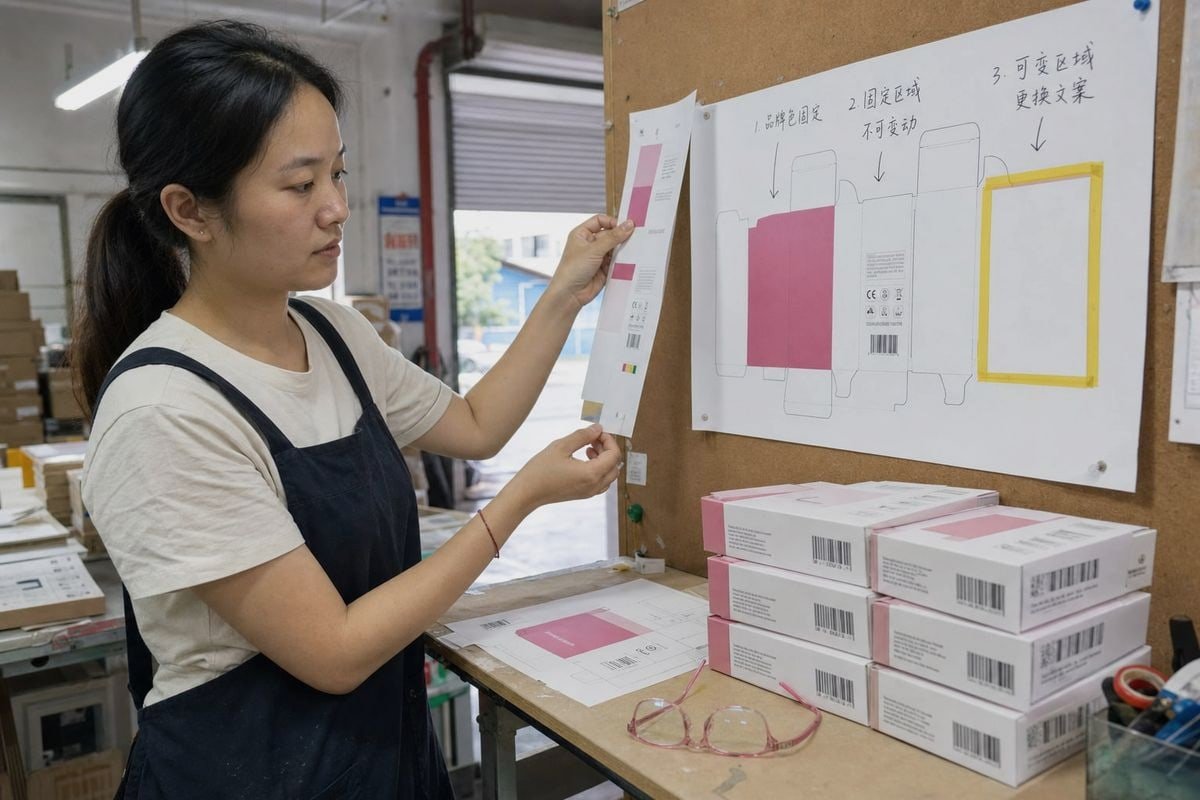
Here is why the universal-pack-versus-local-variant debate matters for your budget. A single universal pack means fewer SKUs and a simpler supply chain. But it also means more text crammed onto small panels, more clutter, and a higher risk of noncompliance when one jurisdiction demands specific phrasing. Local variants fit each market perfectly but multiply your artwork files, inventory lines, and approval cycles. Some buyers push us hard for the universal option to save money. We usually push back — gently — because a rejected shipment costs far more than a second artwork version.
The Modular Middle Ground
Multilingual packaging design works best when you plan the structure before any translation happens. We recommend this approach:
- Fix the brand zone. Logo, hero image, and style name stay identical across all versions.
- Fix the regulatory symbol zone. CE marks, recycling symbols, and standardized ISO 15223-1 symbols 6 where applicable need no translation, so they anchor one panel permanently.
- Reserve a variable language panel. This is where mandatory text changes per region or language cluster.
- Plan for text expansion. French, German, and other languages can run 30–50% longer than English. Reserve that space now, not after the design is finished.
Language Clustering to Control SKU Count
Instead of one version per country, group languages by sales channel and region. This keeps SKU counts manageable while staying compliant.
| Cluster | Languages | Caso de Uso Típico |
|---|---|---|
| North America | English + French (+ Spanish) | U.S. and Canada combined distribution |
| Western EU | English, French, German, Italian, Spanish | Amazon EU and multi-country retail |
| Nordics | English, Swedish, Danish, Finnish, Norwegian | Scandinavian distributors |
| Gulf | English + Arabic | GCC importers |
Design first, translate second. Brands that try to squeeze translation into a finished layout almost always end up with illegible six-point type or a full redesign.
What Safety and Compliance Symbols Do I Need to Include on Children's Eyewear Packaging?
During a pre-shipment inspection last year, our QC team caught a carton missing its choking hazard warning for a frame with detachable silicone temple tips. We stopped the line, reprinted, and shipped two days late — a cheap lesson compared to a recall.
Children's eyewear packaging typically needs choking hazard warnings for small parts, UV protection labeling for lens claims, CE or UKCA marks for European markets, manufacturer and importer identification, country of origin, batch traceability codes, and material or recycling symbols required by the destination market.

Kids' products raise the readability stakes. Parents, retailers, and regulators all handle this packaging, so warning prominence and scannability matter more than on adult eyewear. Our flexible TPEE and TR90 frames are built around child safety, and the packaging has to communicate that same care.
Core Symbols and Statements by Category
Think of compliance marks in four groups. First, safety warnings: choking hazard warnings for products aimed at children under three, plus lens usage warnings such as "demo lenses — not for vision correction" on optical frames shipped with plano lenses. Second, conformity marks: CE marking backed by a Declaration of Conformity in the EU, UKCA for Britain, and — where frames are regulated as medical devices — EU MDR compliance 7 documentation and potentially Unique Device Identification (UDI) 8 data carriers. Third, protection claims: UV protection labeling like UV400 must match actual lens test performance, because parents treat it as a primary purchase signal. Fourth, traceability: batch traceability codes, production dates, and manufacturer/importer name and address enable efficient recalls and are increasingly a hard requirement in global regulatory affairs.
| Element | Where It Applies | Placement Tip |
|---|---|---|
| Choking hazard warning | Products with small detachable parts, under-3 positioning | Front or top panel, high contrast, all required languages |
| CE mark + Declaration of Conformity reference | EU market entry | Fixed regulatory zone, minimum size rules apply |
| Children's Product Certificate (CPC) support data | U.S. children's products | Certificate held on file; tracking label on product/packaging |
| Batch code + production date | Nearly all markets | Back panel or base, machine-readable where possible |
| Material claims (non-toxic materials eyewear) | Parent-facing reassurance | Only claim what test reports support |
One more point on U.S. requirements: FDA labeling requirements around impact-resistant lenses sit alongside CPSC children's product rules, and your Children’s Product Certificate (CPC) must be backed by third-party testing. We keep test reports on file for our standard styles so our brand customers can build their certificates quickly.
How Do I Work With My Manufacturer to Get Multi-Language Packaging Right the First Time?
What changed our packaging process most was a single lesson: never let translators work from scattered emails. Years ago, two artwork versions for the same client carried contradictory French warnings because the source files disagreed. Now everything flows from one locked master file.
Send your manufacturer a market matrix listing every destination country and its mandatory languages, a locked master glossary of regulated terms, and approved translations. Then review a physical or digital proof of each regional artwork version against local rules before authorizing print.
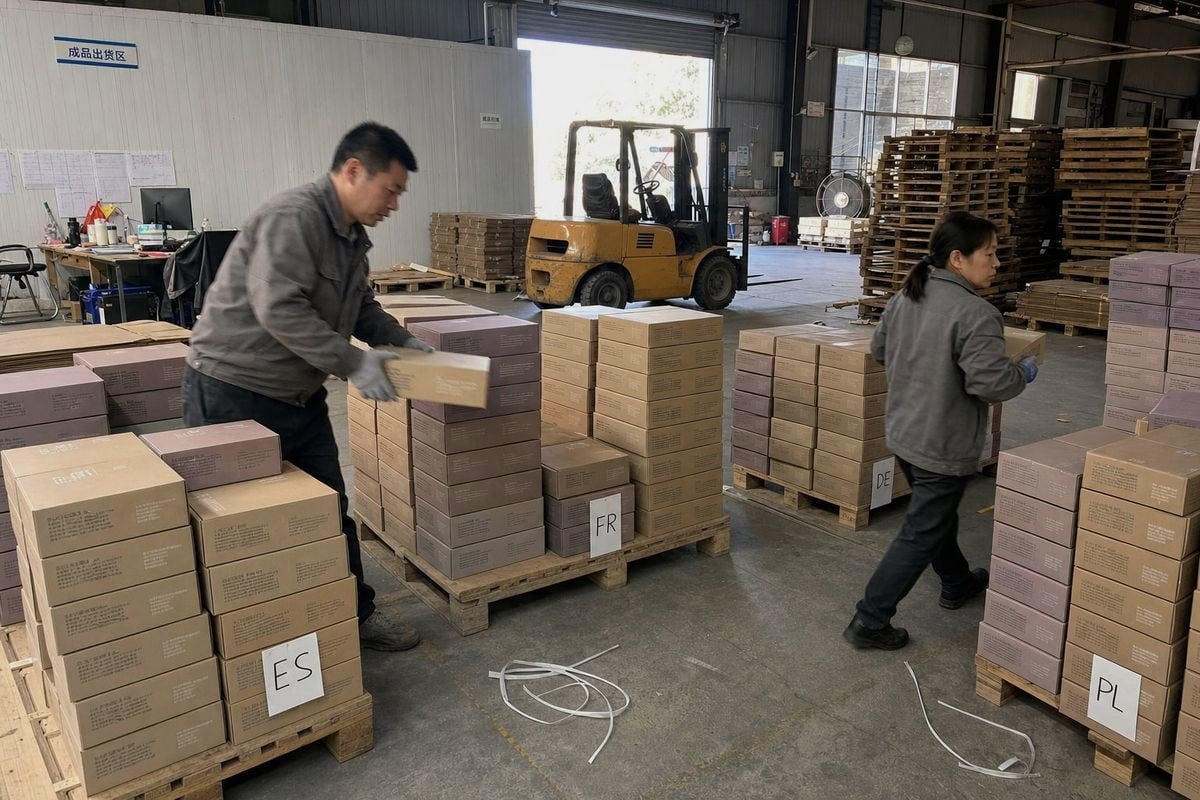
A good factory partner should make this easy, not painful. At our workshop, packaging development runs in parallel with frame sampling, so the carton is retail-ready when the eyewear is. Here is the workflow we use with brands launching from our catalog of roughly 800 existing styles — which, incidentally, lets new brands test markets without heavy mold investment while still getting fully customized, compliant packaging.
A Five-Step Compliance Workflow
- Build the market matrix. List every destination country before design starts. Confirm the final market list first — packaging designed before this decision almost always gets redone.
- Create the master labeling file. One controlled document holds all regulated copy: warnings, identity, origin, care instructions. Marketing copy lives separately.
- Localize, don't just translate. Literal translation can satisfy language presence but miss regulatory nuance. Approved terminology and local legal review catch phrasing that a translator alone would miss.
- Run regional artwork review. Check each version against its jurisdiction: language completeness, symbol sizes, warning prominence, importer details.
- Proof and lock version control. Prepress verification is a formal approval gate. We match text, graphics, and version codes before anything hits the press, and we archive every approved version for reorders.
Inserts, QR Codes, and What They Can and Cannot Do
Buyers often ask whether a multilingual insert can replace on-box text. Be careful here. Inserts and QR codes are excellent for extended care instructions, fitting guides, and user education. But mandatory information — core warnings, identity, origin — generally must appear on the label or packaging itself in many markets. Use digital and supplemental materials to reduce clutter, not to relocate legally required text. Also think about accessibility: clear, high-contrast fonts help visually impaired parents scan critical information quickly. Done well, kids' packaging can even carry playful educational elements alongside its compliance zones — our clients' most successful boxes do both.
Conclusão
Compliant kids optical frame packaging starts with a market list, a master labeling file, and a modular design — not a finished box you translate later. Plan first, and print once.
Notas de rodapé
1. Provides specific FDA labeling requirements for various medical devices, including impact-resistant lenses. ↩︎
2. Official CPSC guidance on the Children’s Product Certificate requirements. ↩︎
3. Replaced HTTP 404 link with the official European Commission page on CE marking. ↩︎
4. Official UK government guidance on the UKCA marking for products in Great Britain. ↩︎
5. Official CPSC information on small parts ban and choking hazard labeling for children’s products. ↩︎
6. Explains the purpose and application of ISO 15223-1 symbols for medical device labeling. ↩︎
7. Replaced HTTP 404 link with the official European Commission page on new medical device regulations, relevant for MDR compliance. ↩︎
8. Official FDA information on the Unique Device Identification system for medical devices. ↩︎
Mais Artigos que Você Pode Gostar

5 de agosto de 2026
Acetato de Celulose Bio-Baseado vs. Regular: Qual a Diferença para Armações Infantis?

5 de agosto de 2026
Quão Recicláveis São os Materiais de Armações Ópticas Infantis e Quais Alternativas Ecológicas Existem?
5 de agosto de 2026
As Armações Ópticas Infantis Branqueiam ou Envelhecem em Armazenamento e Como Controlar as Condições do Armazém?
Procurando um Parceiro Confiável em Óculos Infantis?
Explore mais de 800 estilos prontos e suporte completo OEM/ODM adaptado à sua marca.
Entre em Contato English
  Español de México
  Deutsch
  Français
  日本語
日本語  العربية
  Português do Brasil