How to Handle Varying Labeling Requirements When Sourcing Kids Optical Frames?
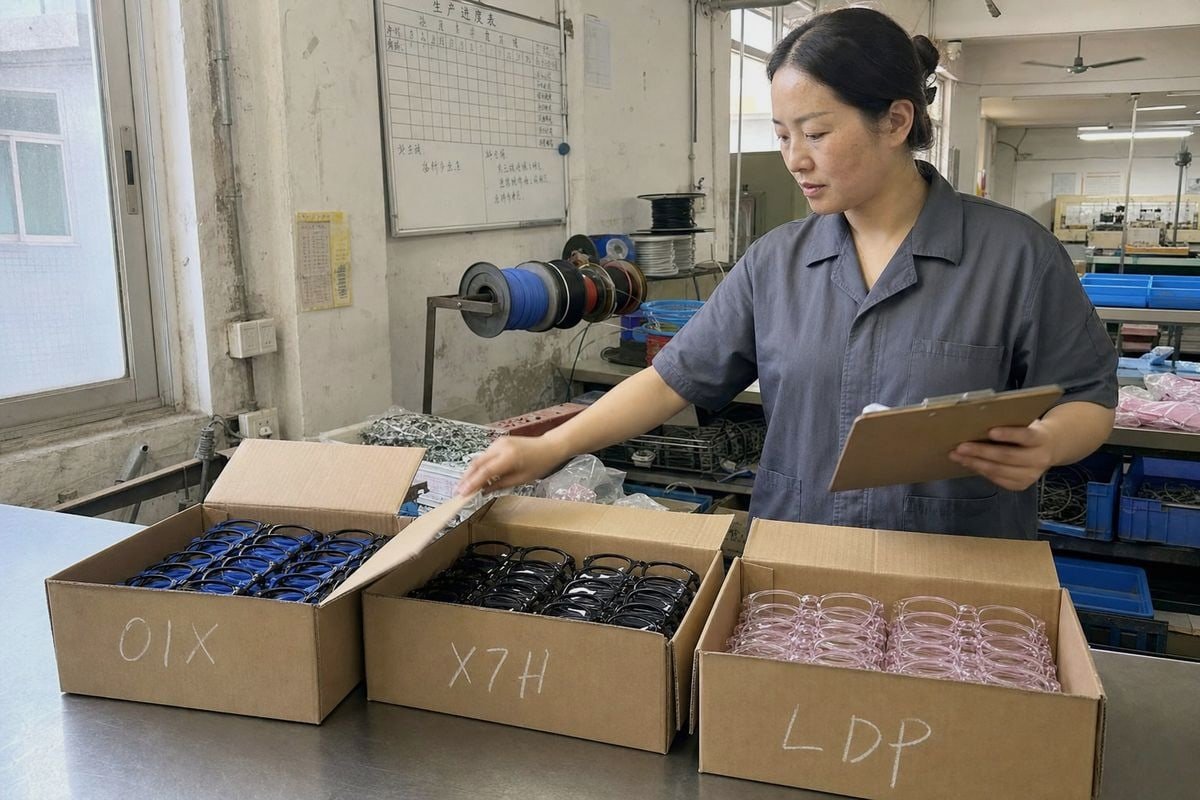
Labeling requirements for kids optical frames nearly derailed one of our first multi-market orders. Three destinations, three different rules, one production line — and a shipment sitting at customs.
To handle varying labeling requirements when sourcing kids optical frames, build a country-by-country label matrix for each SKU, confirm age grading before production, approve label artwork at the sampling stage, and work with a manufacturer that can apply market-specific markings, warnings, and traceability codes.
That is the short answer. But the real work sits in the details. Below, I will walk through how we manage this for buyers in 20+ countries, and how you can avoid the traps we learned the hard way.
How do I know which safety and compliance labels my kids optical frames need for each target market?
A buyer from Australia once sent us artwork copied from a US-focused competitor. Our compliance check flagged it within a day — the label referenced FDA rules but missed the AS/NZS references her local retailers demanded.
Identify your target market, product classification, and age grade first. Then map the rules: FDA eyewear requirements and CPSIA in the US, CE marking certification and EN ISO standards in the EU, UKCA in the UK, and AS/NZS standards in Australia. Each market defines its own mandatory label content.

The first thing I tell every new buyer is this: labeling is not one universal checklist. It changes based on three variables. Where you sell. How the product is classified. And what claims you make on the packaging.
The three variables that drive label content
Kids optical frames sit at an unusual intersection. They can be a children's product, a medical device, or both at once. In the US, a prescription-ready frame falls under FDA eyewear requirements 1, while its status as a children's product triggers CPSC regulations and CPSIA compliance obligations 2. In the EU, the same frame may need CE marking certification and conformity with EN ISO standards 3. One frame, one factory, several legal identities.
Age grading matters just as much. In Korea, for example, children's eyewear guidance applies an explicit age band of 13 years or under. Fix the age grade before production starts. It determines the warnings, the testing, and the tracking-label content. Changing it after tooling is expensive.
A quick market comparison
| Mercado | Key frameworks | Typical label elements |
|---|---|---|
| USA | FDA labeling rules, CPSIA, CPSC regulations | Tracking label, importer name, batch code, choking hazard warnings 4 where applicable |
| UE | CE marking certification 5, EN ISO standards | CE mark, importer/EU representative details, local-language warnings |
| UK | UKCA 6 | UKCA mark, UK importer details |
| Australia/NZ | AS/NZS standards 7 | Standard reference, supplier details, UV category for sun lenses |
| Korea | Children's eyewear guidance | Engraved or printed marks, age grade, manufacture date, importer address |
My advice: build a labeling matrix that maps every SKU to its destination market, age grade, intended use, and packaging format. We prepare this document with buyers before we cut a single frame front. It becomes the single source of truth for artwork, QC, and shipping documents across your eyewear supply chain.
Can my manufacturer help me manage multiple country-specific labeling requirements without delaying my order?
The trade-off we weigh most often at our Taizhou factory is speed versus label accuracy. Buyers want fast lead times. Regulators want correct, durable, market-specific marks. Both are achievable — if labeling starts early.
Yes, an experienced manufacturer can manage multiple country-specific label versions in one production run without delays. The key is agreeing on a label allocation plan during sampling, freezing artwork before pre-production approval, and using flexible marking methods like pad printing, laser engraving, and versioned packaging.

Here is what actually causes delays: labeling treated as a packaging-stage afterthought. When a buyer sends final label text after molds are frozen and temples are printed, we have to rework. That costs weeks. When labeling is handled as a design-stage input, it costs nothing extra.
How we run multi-market labeling in one production cycle
We follow a simple numbered process, and I recommend you ask any supplier to describe theirs:
- Label matrix agreement. Before sampling, we confirm which markets each SKU serves and what each market requires on the frame, the box, and the leaflet.
- Marking method selection. Slim pediatric temples have limited space. We choose between pad printing, laser engraving, molded-in marks, or durable adhesive labels based on the material. Our TR90 and TPEE frames each behave differently under laser marking, so we test first.
- Artwork proof at sampling. You approve the actual printed label on a real sample — not a PDF mockup. Some required fields simply do not fit once the frame design is frozen.
- Versioned packaging. One frame style, several box and insert versions. We batch these on the line so US cartons, EU cartons, and Australian cartons ship from the same run.
- Pre-shipment label audit. Our QC team checks label legibility, adhesion, and version-to-destination matching before packing.
Because we hold around 800 existing styles, most buyers skip mold development entirely. That shortens the timeline and leaves room for careful label work. Full OEM/ODM support means custom logos, warnings, importer blocks, and multi-language inserts are part of the standard workflow, not a special request that slows things down.
Marking method suitability by frame component
| Componente | Best marking method | Observações |
|---|---|---|
| TR90 temple arm | Laser engraving or pad printing | Most durable; survives daily handling by active kids |
| TPEE soft temple | Molded-in mark or pad printing | Flexible surface needs elastic-compatible inks |
| Frame front (inner rim) | Pad printing | Limited space; prioritize size and traceability code |
| Demo lens | Removable sticker | Never place permanent required marks here |
| Box and hangtag | Printed artwork | Carries warnings, importer details, and barcode |
One more practical option worth considering: serialized QR codes on packaging. They let you deliver declarations of conformity and multi-language instructions digitally, support recall management, and add an anti-counterfeiting layer — all without cluttering a small child-sized frame.
What labeling mistakes should I avoid when importing kids optical frames into a new market?
A lesson we learned years ago still shapes our QC checklist today: a buyer's earlier supplier had shipped frames with only a hangtag for traceability. A US retailer rejected the entire lot because CPSIA tracking labels must be permanently affixed to the product itself.
Avoid these mistakes: relying on hangtags where permanent product marking is required, copying adult eyewear labels, using the wrong age grade, making unsupported claims like shatterproof, omitting choking hazard warnings, skipping local-language text, and shipping without the test reports that back your label claims.

Let me break down the mistakes we see most often, because each one carries a different kind of risk — customs holds, retailer rejection, or recall exposure.
Mistake 1: Treating hangtags as sufficient
Many rules require a durable mark on the product itself. Korean guidance, for example, says product markings should be engraved or printed in principle; a sticker is only acceptable if it does not easily fall off. In the US, CPSIA tracking labels must be visible, legible, and permanently affixed to both product and packaging where practicable. A hangtag alone fails both.
Mistake 2: Copying adult eyewear labels
Adult frames need far less. Children's products demand traceability: manufacturer or importer name, production location and date, and batch or run details. Copy an adult label and you strip out exactly the fields regulators check first.
Mistake 3: Making claims the paperwork cannot support
Labels are not independent from testing. If your label says impact-resistant lenses, FDA guidance requires actual impact testing — typically the drop-ball test — behind that claim. And the words matter: shatterproof and shatter-resistant are not equivalent to impact resistant. Similarly, a UV protection eyewear claim like UV400 needs lens test data. In the US, a Certificado de Produto Infantil 8 backed by third-party lab testing must exist before your tracking label means anything. Product safety standards and label text must always match.
Mistake 4: Missing warnings and material declarations
Choking hazard warnings are mandatory for products aimed at children under three with small detachable parts. Buyers increasingly ask us to document non-toxic materials too — lead-free, phthalate-free, BPA-free — because chemical compliance and labeling travel together in any serious compliance file.
| Mistake | Typical consequence | Prevention |
|---|---|---|
| Hangtag-only traceability | Retailer rejection, recall exposure | Permanent on-product marking |
| Adult label on kids frame | Failed CPSIA compliance audit | Children's-product label template |
| Unsupported performance claims | Regulatory action, listing removal | Test reports before artwork approval |
| No local-language warnings | Customs hold in destination market | Market-specific label versions |
| Wrong age grade | Wrong test scope, invalid Children's Product Certificate | Fix age grade before production |
How do I keep packaging and labeling consistent with my brand while still meeting local regulations?
When we developed a translucent pink acetate-look frame line for a European kids' brand, their founder had one worry: that mandatory marks would ruin the soft, minimalist aesthetic she had built. It did not have to.
Separate branding zones from compliance zones. Keep your logo and design language on visible surfaces, place mandatory marks on inner temples and box bases, use a shared master template with market-specific compliance panels, and shift bulky information to QR codes and inserts where regulations allow.

There is a real tension here, and I will not pretend otherwise. Design teams want the shortest possible label. Regulators and retailers want full traceability. Both sides have a point — but for children's products, compliance must win the argument on mandatory fields. The good news is that smart allocation lets your brand win everywhere else.
The label allocation chart
The tool we use is a label allocation chart. It assigns every required element to a specific surface: inner temple arm, frame front, lens sticker, box, master carton, or instruction leaflet. Required durable marks go where kids and parents rarely look — the inside of the temple. Brand elements own the outside. On our playful silicone-temple styles with embossed dot patterns, we position the compliance mark so it never interrupts the decorative texture.
One master template, many compliance panels
For multi-market brands, we recommend a master packaging design with a swappable compliance panel. The box structure, colors, logo placement, and unboxing experience stay identical worldwide. Only one printed panel changes per destination — carrying the CE mark, UKCA mark, importer block, or local-language warnings as international labeling laws require. This keeps your shelf presence consistent while satisfying every regulator.
Digital labeling helps too. A single QR code can host declarations of conformity, care instructions in ten languages, and lens specifications. It also supports the growing traceability trend without adding a single line of clutter. And if sustainability is part of your story — recycled content, bio-based or environmentally friendly materials like our TPEE — eco-claims can live on the branded side, provided they are truthful and documented like any other claim.
Our retail-ready packaging service exists precisely for this: custom boxes, cases, and cloths that carry your brand, with compliance built in quietly underneath.
Conclusão
Varying labeling requirements are a sourcing risk, not a packaging detail. A label matrix, early artwork approval, supported claims, and a compliance-fluent factory partner keep kids optical frames moving through customs and onto shelves.
Notas de rodapé
1. Official FDA guidance on eyewear regulations and compliance. ↩︎
2. Official CPSC information on CPSIA compliance for children’s products. ↩︎
3. BSI Group provides information on EN ISO standards relevant to medical devices. ↩︎
4. Official CPSC guidance on choking hazard warnings for children’s products. ↩︎
5. Official European Commission guidance on CE marking requirements. ↩︎
6. Official UK government guidance on the UKCA marking for products. ↩︎
7. Official website for Standards Australia, covering AS/NZS standards. ↩︎
8. Official CPSC explanation of the Children’s Product Certificate requirements. ↩︎
Mais Artigos que Você Pode Gostar

5 de agosto de 2026
Acetato de Celulose Bio-Baseado vs. Regular: Qual a Diferença para Armações Infantis?

5 de agosto de 2026
Quão Recicláveis São os Materiais de Armações Ópticas Infantis e Quais Alternativas Ecológicas Existem?
5 de agosto de 2026
As Armações Ópticas Infantis Branqueiam ou Envelhecem em Armazenamento e Como Controlar as Condições do Armazém?
Procurando um Parceiro Confiável em Óculos Infantis?
Explore mais de 800 estilos prontos e suporte completo OEM/ODM adaptado à sua marca.
Entre em Contato English
  Español de México
  Deutsch
  Français
  日本語
日本語  العربية
  Português do Brasil