How to Verify UV400 Labeling on Kids’ Sunglasses Meets the Standard?
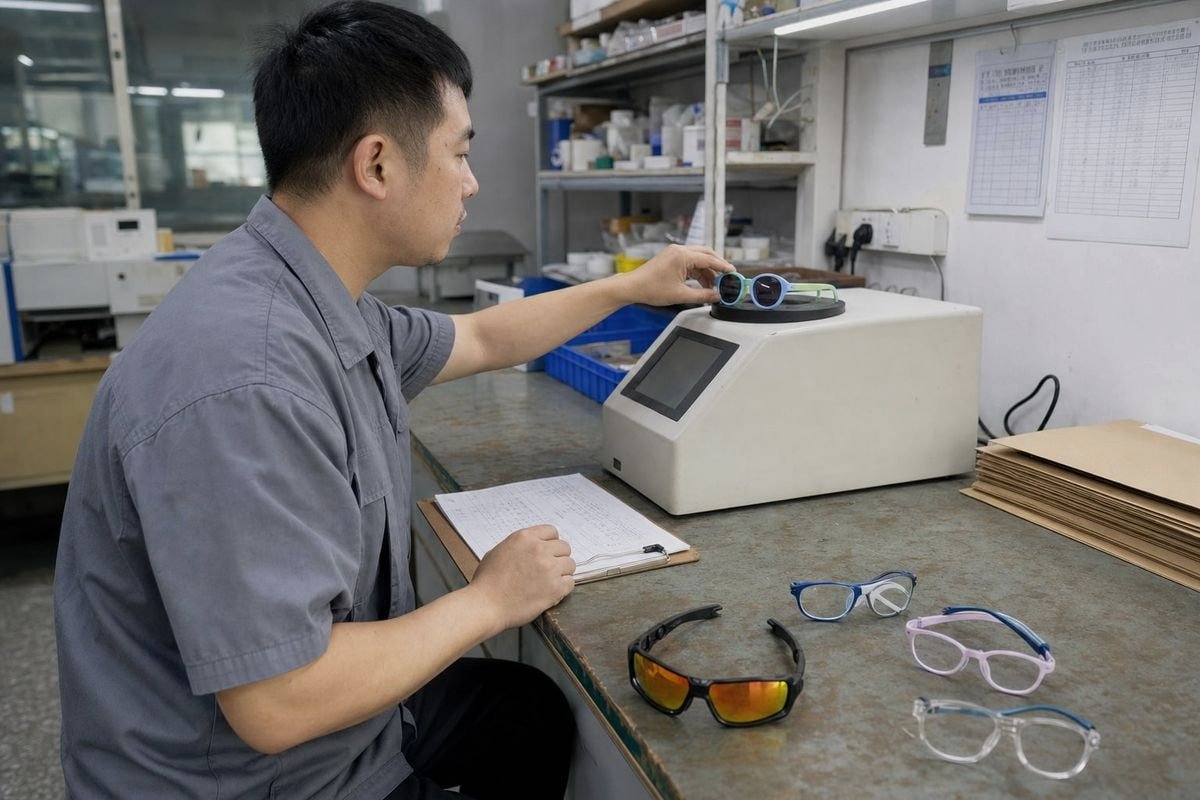
Verifying UV400 labeling on kids’ sunglasses is a question I answer weekly at our Taizhou factory. A fake sticker costs pennies; a recall costs your brand everything. Real verification protects both.
To verify UV400 labeling on kids’ sunglasses, request a spectral transmission report from an accredited lab showing near-zero UV transmission from 280–400 nm, confirm compliance with ISO 12312-1, EN, ANSI Z80.3, or AS/NZS 1067.1, and cross-check test reports against your actual production batch.
That is the short answer. But the details matter, especially when you are buying children’s eyewear at scale. Let me walk you through exactly how we handle this, step by step.
How can I confirm a supplier's UV400 claims are backed by actual lab testing?
A buyer from Australia once sent me a competitor's "UV400 certified" sample. We ran it through our spectrophotometer 1. It leaked UV badly above 380 nm. The label meant nothing.
Confirm UV400 claims by requesting a spectral transmission curve from a third-party accredited lab, verifying the report matches the exact lens material and model number you are ordering, and checking that measured transmission stays near zero across the full 280–400 nm UVA and UVB range.

The most reliable evidence is spectrophotometer testing. A spectrophotometer shines light through the lens across a range of wavelengths. It then records how much light passes through at each wavelength. For a genuine UV400 lens, the transmission curve should sit at or near zero from 280 nm all the way up to 400 nm. That range covers both UVA and UVB protection. If the curve rises before 400 nm, the lens does not meet the claim, no matter what the sticker says.
What a Real Test Report Looks Like
At our factory, we test incoming lens batches before assembly. A credible report should include several things. Here is what I tell buyers to check:
| Report Element | Why It Matters |
|---|---|
| Lab name and accreditation | Confirms the lab is recognized, not an in-house printout |
| Sample description and model number | The report must match your actual product, not a "similar" one |
| Spectral transmission curve (280–400 nm) | The core proof of UV blocking performance |
| Visible light transmission value | Determines the lens category and driving suitability |
| Test standard referenced | Ties the result to ISO 12312-1 2, ANSI Z80.3, or AS/NZS 1067.1 |
| Test date | Old reports may not reflect current material sourcing |
Watch for the "Golden Sample" Trick
Some suppliers test one perfect sample, then produce with cheaper lens stock. So we encourage buyers to do two things. First, ask whether the supplier tests per batch or per model. Second, pull random units from your shipped goods and send them for independent testing. A quick spectrophotometer check at a local optical lab is inexpensive compared to the risk. Dark tint alone proves nothing; a dark lens without a UV filter actually dilates a child's pupils and lets in more radiation.
What documentation should I request to verify UV400 compliance before placing an order?
Before we ship a single carton, our sales team assembles a document pack for each buyer. Fifteen years of exporting kids' eyewear taught us that paperwork gaps surface at customs, never before.
Request a third-party test report with a spectral transmission curve, a Declaration of Conformity naming the applicable standard, material safety documentation for lenses and frames, batch-level QC records, and clear supplier identification that matches the labeling on the finished product.

Documentation is your legal shield. If a customs officer, retailer, or parent questions your UV400 claim, you need a paper trail that starts at the lens supplier and ends at your warehouse. Here is the pack I recommend every buyer request before wiring a deposit.
The Core Document Checklist
- Third-party lab test report. It must reference the correct standard for your market and include the transmission data, not just a "pass" verdict.
- Declaration of Conformity (DoC). For the EU, this supports the CE certification mark CE marking 4. For the UK, it supports UKCA marking. The DoC must name the manufacturer, the product model, and the standard applied.
- Material safety documents. For children's products, buyers often ask us for chemical compliance evidence covering the frame material. Our TPEE and TR90 materials are chosen partly because they support these requirements.
- Impact resistance evidence. Kids drop, sit on, and throw sunglasses. Polycarbonate lenses 5 have inherent UV-blocking and impact resistance built into the material itself, which is why we recommend them for most children's styles.
- Batch QC records. Ask how the factory links a test report to a production run. We keep batch traceability in our 5S-managed workshop for exactly this reason.
Match the Paperwork to the Product
One warning from experience: check that the model number, lens color, and lens material on the report match your order. A report for a gray polycarbonate lens does not automatically cover a mirrored gradient lens on a sport shield style. Different coatings and base materials can behave differently. When we develop custom colors or mirrored lenses for a client, we treat them as new test items, not carryovers.
Which international standards should my kids' sunglasses actually meet for UV protection?
Buyers from twenty-plus countries ask us this, and the answer always depends on destination. A shipment bound for Melbourne faces different rules than one heading to Munich or Chicago.
Kids' sunglasses should meet ISO 12312-1 for the EU with CE marking, ANSI Z80.3 for the United States, AS/NZS 1067.1:2016 as a mandatory standard in Australia and New Zealand, and the applicable BS EN version with UKCA marking for the United Kingdom.

UV400 is a consumer-friendly shorthand. The real authority comes from the standard behind it. Each major market has its own framework, and they overlap heavily but not perfectly. Here is how they compare at a glance:
| Market | Standard | Marking | Mandatory? | Key UV Requirement |
|---|---|---|---|---|
| EU | ISO 12312-1 (EN version) | CE | Yes, as PPE | UV limits tied to lens category |
| UK | BS EN 12312-1 | UKCA / CE (transition) | Yes | Same technical basis as EU |
| USA | ANSI Z80.3 | None required on product | Voluntary but expected | UVA/UVB transmittance limits |
| Australia / NZ | AS/NZS 1067.1:2016 | Supplier labeling required | Yes, mandatory | Protection across 280–400 nm |
| Japan | Generally follows ISO-based specs | Varies by retailer | Retailer-driven | UV transmittance per ISO methods |
What These Standards Actually Test
These standards go beyond UV. They also cover optical clarity, so a child does not get distorted vision through a cheap lens. They set visible light transmission categories, which tell parents how dark the lens is and whether it suits driving or bright sun. Several include mechanical robustness requirements as well. Recent revisions, including the updated EN ISO 16321 family and ANSI Z80.3 work, push testing toward a wider range of headforms so frames fit real faces without UV leaking around the edges. That matters enormously for children, whose faces are smaller. This is one reason our design team favors wraparound sport shields and close-fitting rounded frames for kids: coverage is part of protection, not just the lens itself.
Why Australia Deserves Special Attention
Australia treats sunglasses under a mandatory consumer standard. Products must protect across the 280–400 nm range and carry clear, legible supplier identification. If Australian retail is in your plan, build AS/NZS 1067.1 compliance into your spec sheet from day one. Retrofitting it after production is painful and expensive.
How do I make sure UV400 labeling stays accurate through production and packaging?
The hardest lesson from my early years in this trade: compliance can be perfect at sampling and broken by week six of mass production. Labels drift, lens stock changes, packaging gets substituted.
Keep UV400 labeling accurate by locking the approved lens supplier in your contract, requiring incoming lens inspection with spectrophotometer checks per batch, approving label and packaging artwork before printing, and running pre-shipment inspections that verify labels match the tested product.
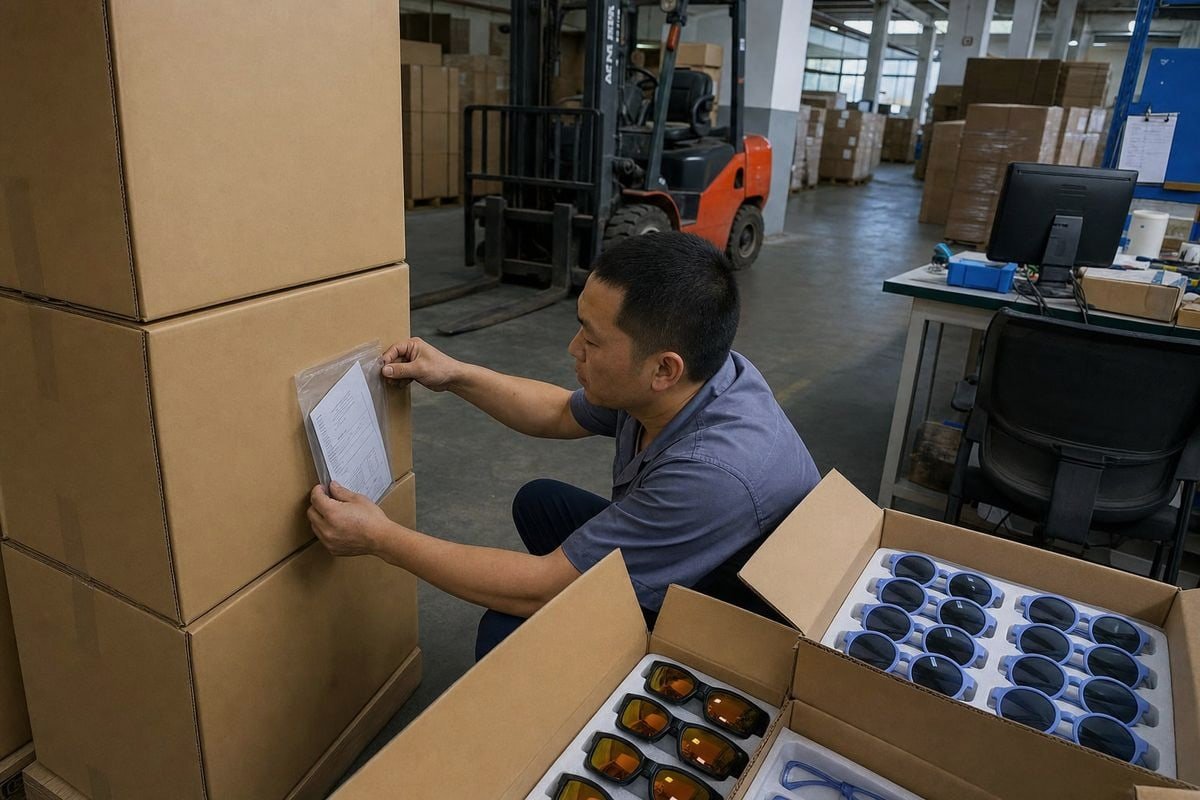
Accuracy is not a one-time event. It is a chain of controls that runs from raw material to the retail shelf. If any link breaks, the label on the hang tag no longer describes the lens inside the frame. Here is the control sequence we apply on our own lines, and what you as a buyer should demand.
The Production Control Chain
| Stage | Control Point | What Can Go Wrong Without It |
|---|---|---|
| Lens sourcing | Approved supplier locked in the contract | Factory swaps in cheaper untested lens stock |
| Incoming inspection | Batch UV transmission check | A bad lens batch slips into thousands of units |
| Assembly | Model and lens pairing verification | UV400 lenses go into one SKU, plain lenses into another |
| Labeling | Artwork approval with standard references | Vague claims like "blocks UV" replace precise UV400 wording |
| Packaging | Label-to-product matching check | Correct labels end up on the wrong products |
| Pre-shipment | Random sampling and re-testing | Drift over a long production run goes undetected |
Practical Steps for Buyers
First, write the lens specification into your purchase order. Name the material, such as polycarbonate lenses, the UV requirement, and the standard. Second, approve every piece of printed material yourself: hang tags, lens stickers, box copy, and inserts. Insist on precise language like "UV400" or "100% UVA and UVB protection" rather than soft phrases. Third, schedule a pre-shipment inspection, either your own or third-party, that includes pulling random units for UV re-testing. Fourth, think about longevity. Surface coatings can degrade over two to three years of heat, salt, and micro-scratches, which is another argument for lenses where UV blocking lives in the material, not on it. Finally, some of our brand clients now add QR codes on packaging that link to their test documentation. It reassures parents, deters counterfeits, and supports pediatric eye health 7 messaging at the point of sale.
Conclusion
A UV400 label without proof is just ink. Demand spectral data, standard-based documentation, and batch-level QC — and partner with a factory that treats children’s eye protection as non-negotiable.
Footnotes
1. Wikipedia background explains the spectrophotometer testing method used to verify UV400 claims. ↩︎
2. Authoritative Wikipedia section detailing international sunglasses safety standards including ISO 12312-1. ↩︎
3. WHO reference explains UV radiation health risks relevant to children’s eye protection standards. ↩︎
4. Background on CE marking process referenced for EU compliance of children’s sunglasses. ↩︎
5. Explains polycarbonate material properties relevant to impact resistance and UV blocking in lenses. ↩︎
6. EU official page explains Declaration of Conformity requirements under the New Legislative Framework. ↩︎
7. Official National Eye Institute resource for maintaining children’s vision and eye health. ↩︎
More Articles You Might Like


Looking for a Reliable Kids Eyewear Partner?
Explore 800+ ready styles and full OEM/ODM support tailored to your brand.
Get in Touch English
  Español de México
  Deutsch
  Français
  日本語
日本語  العربية
  Português do Brasil