How to Request Mid-Production Inspection Photos and Videos for Kids Sunglasses Suppliers?
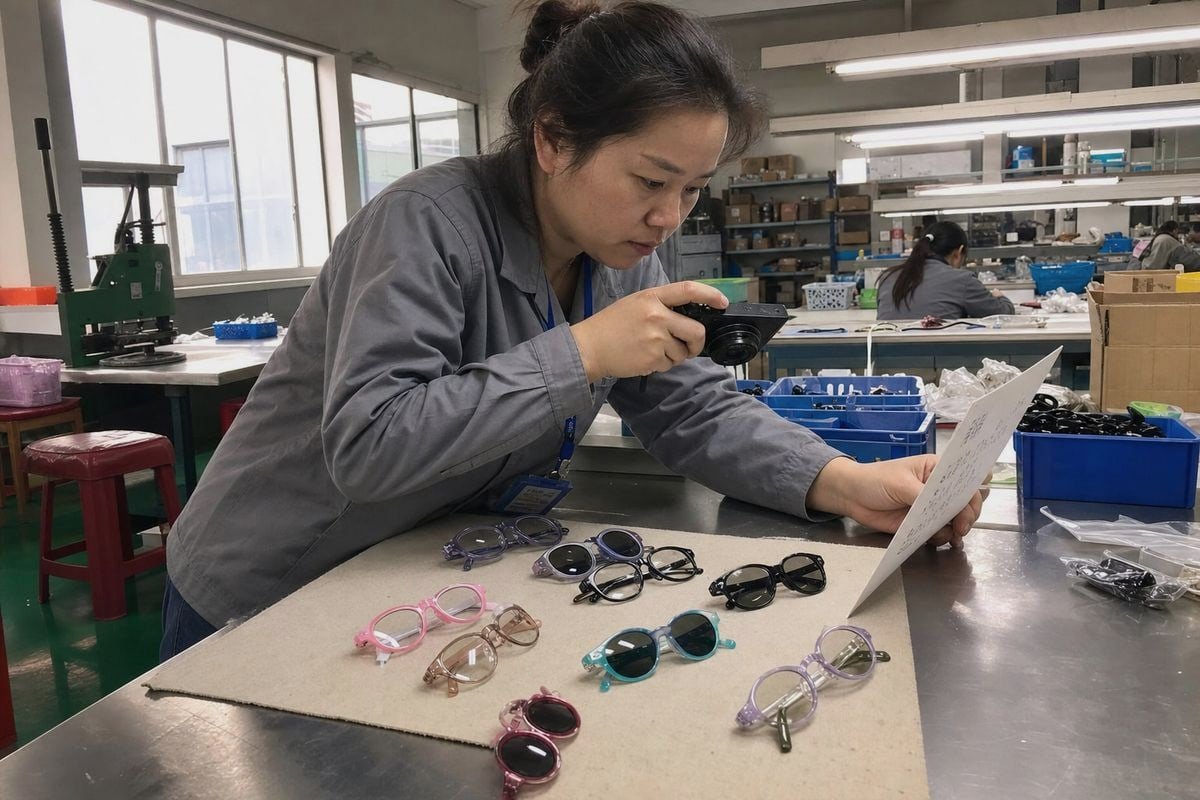
Buyers ask me weekly how to request mid-production inspection photos and videos from kids sunglasses suppliers UV400 Protection Testing 1. On our own production line, vague requests always produce vague, useless evidence.
To request mid-production inspection photos and videos from kids sunglasses suppliers, define the exact production stage, specify random units, list required shots of hinges, lenses, and logos, require timestamps or handwritten date notes, and set a 24-hour delivery deadline.
That answer sounds simple. But most buyers still get catalog images instead of real batch evidence pre-shipment inspection 2. Below, I break down exactly what to ask for, when to ask, and how to verify what you receive.
What Should I Ask My Supplier to Include in Mid-Production Inspection Photos?
Last spring, a buyer from Australia sent our factory the clearest photo request I have ever seen. It listed six shots, one deadline, and one rule: no marketing images. We answered it in three hours.
Ask for timestamped batch shots of your exact order, macro close-ups of hinges, lens seating, nose bridges, and printed logos, wide shots of the production area, side-by-side comparisons with the approved sample, and packaging photos showing labels and inserts.
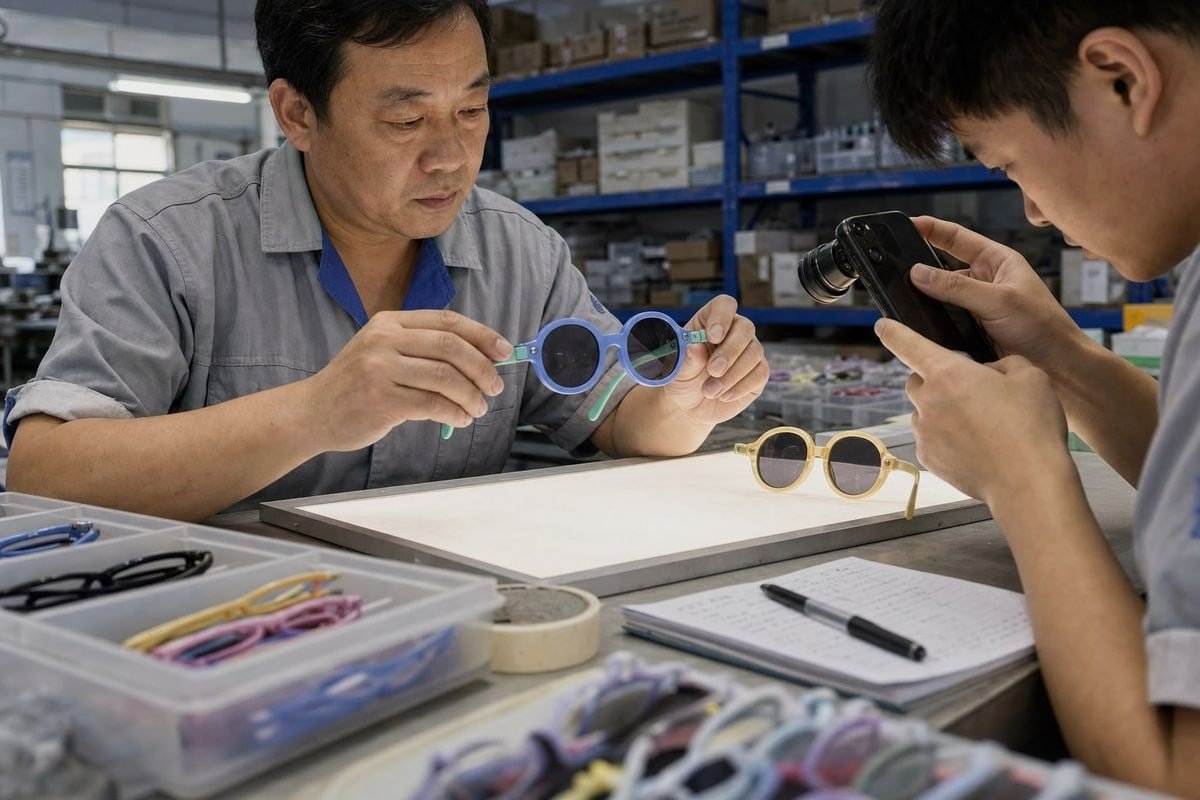
The core idea is this: your supplier should shoot from a Quality Control Checklist 3, not from memory. When we run a during production check in our own workshop, our QC team follows a written shot list. It maps every photo to a real inspection point. You should demand the same discipline from any factory.
The Photo Shot List That Works
Here is the shot list I recommend to every buyer. It is the same structure we use internally for our TR90 and TPEE frame material orders.
| Photo Type | What It Proves | Why It Matters for Kids Sunglasses |
|---|---|---|
| Wide production-area shot | Your order is actually on the line | Prevents stock or recycled images |
| Batch shot (20+ units together) | Volume and color consistency | Catches color drift across the run |
| Macro of hinges and screws | Assembly quality and hinge security | Loose hinges are a child-safety risk |
| Macro of lens edges and seating | Correct lens insertion | Poorly seated lenses pop out during play |
| Logo and printing close-up | Placement, size, color accuracy | Protects your brand presentation |
| Golden sample side-by-side | Batch matches the approved sample | Detects material or finish drift |
| Packaging and label shots | Cartons, inserts, barcodes correct | Avoids retail-ready packaging errors |
Make the Photos Impossible to Fake
Require identification in every frame. Ask for a handwritten note showing your order number and today's date, placed next to the units. Some buyers now go further and require batch-specific QR codes 4 or carton labels visible in the shots. When we photograph an order for a client, we place the purchase order sheet directly beside the frames. It costs us nothing, and it builds real supply chain transparency.
Also ask for random units. Ten random pairs pulled from different cartons tell you far more than one polished hero pair. Randomness is the entire logic behind AQL Standards, and it applies to photos just as much as to formal sampling.
How Do I Know if My Kids Sunglasses Supplier Is Being Transparent During Production?
There is a trade-off I weigh honestly with every client: sending raw, unedited footage sometimes shows an imperfect workshop moment, but polished videos destroy trust faster than any minor flaw ever could.
A transparent supplier sends unedited, timestamped visuals of random units within 24 hours, shows defect-prone areas without being asked twice, holds the golden sample beside production units, accepts live video calls, and replies to defect findings with a written corrective-action plan.
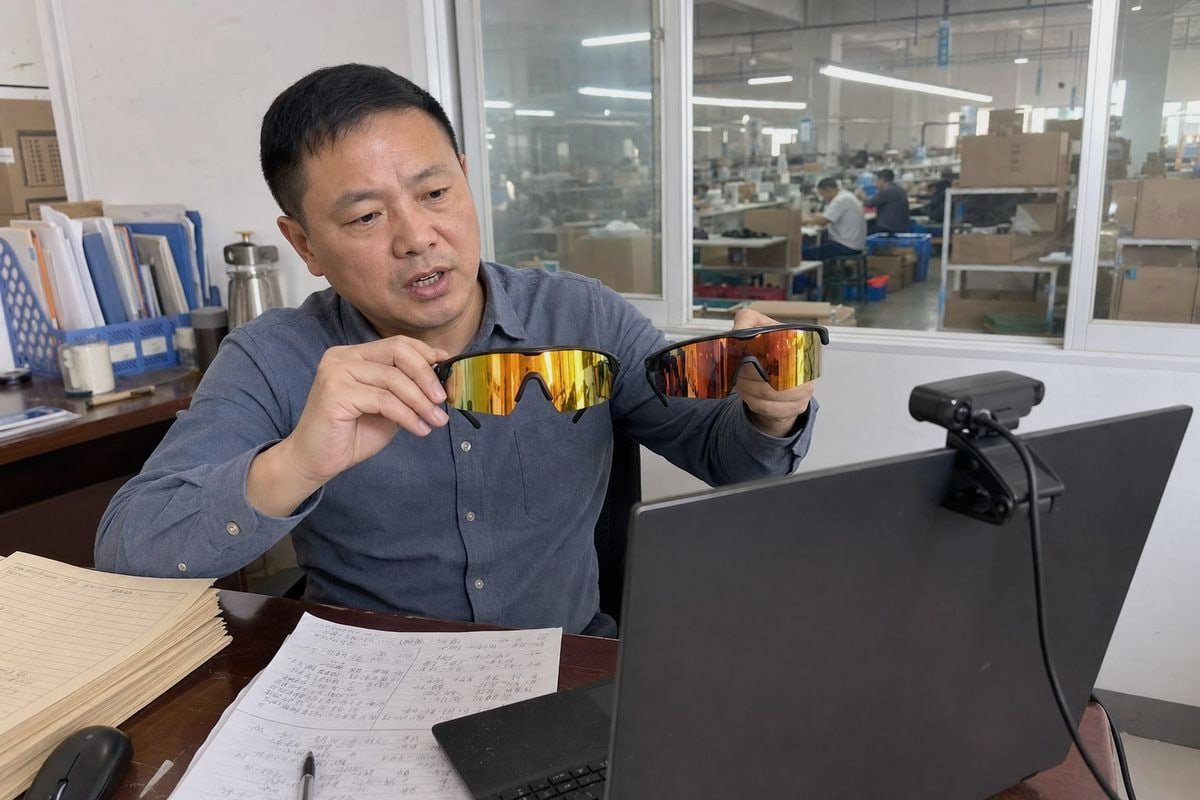
Transparency is a pattern of behavior, not a single photo. Over fifteen years of running our Taizhou factory, I have learned that honest factories behave in predictable ways. They answer fast. They show the ugly angles. They never argue about a live call.
Green Flags Versus Red Flags
Use this quick comparison when you review supplier responses.
| Behavior | Green Flag | Red Flag |
|---|---|---|
| Response time | Same day or within 24 hours | Days of silence, then excuses |
| Image quality | Raw phone shots of real workstations | Studio-lit, edited, watermark-free perfection |
| Unit selection | Random pairs from multiple cartons | The same "best" pair in every photo |
| Live call | Accepted and scheduled quickly | Repeated rescheduling or refusal |
| Defect discussion | Written corrective-action reply | Denial or topic changes |
| Documentation | Willing to share a factory audit report | Claims documents are "confidential" |
Ask for Evidence Tied to Compliance, Not Just Looks
For children's eyewear, transparency must extend to safety claims. Ask how the factory supports CPSIA Compliance 5 for the US market, and ask for UV400 Protection Testing evidence tied to your lens batch, not a generic certificate from years ago. A supplier who genuinely runs defect rate monitoring can also tell you their current internal reject rate for your order. If they cannot answer that question at all, they are probably not tracking it.
One more practical test: ask the supplier to flex a temple arm on camera. Flexible TPEE temples should bend and recover smoothly. A factory that hesitates to demonstrate its own material on video is telling you something important.
When Is the Right Time in the Production Schedule to Request Inspection Videos?
A procurement manager from Japan once asked us for inspection videos two days after placing her order. I had to explain gently that filming empty molds helps nobody. Timing decides whether your footage has any value at all.
Request inspection videos once at least 10% of your order is completed, ideally during the lens-fitting and assembly stages. This timing reveals real batch quality early enough to correct defects before the full run finishes, avoiding rework and shipping delays.
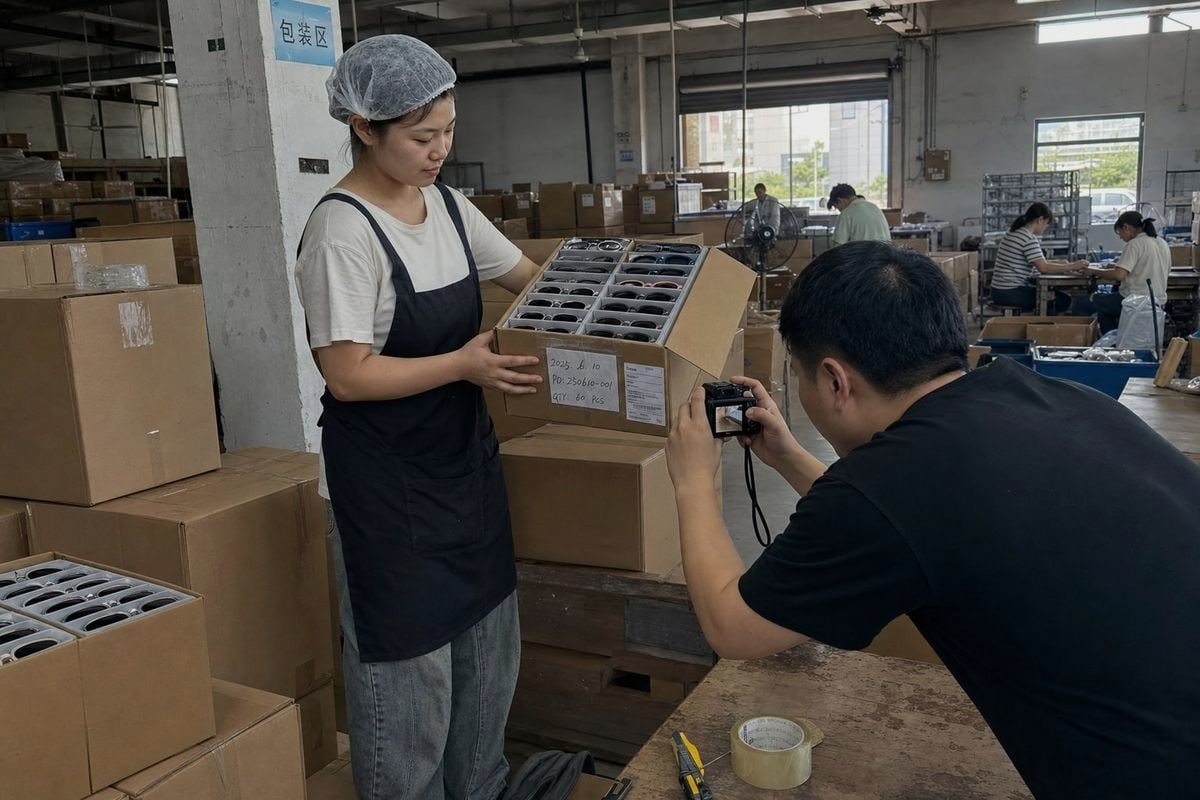
Mid-production visuals sit inside a larger QC system. For sunglasses, the typical flow runs from first-article inspection, through the during production check 6, to pre-shipment inspection and container loading. Each stage answers a different question. Your video request should match the stage.
A Practical Timing Map
- First articles complete (day 1–3 of production). Request photos of the first finished units against your golden sample. This confirms color, dimensions, and logo before volume ramps up.
- 10–20% of the order complete. This is the sweet spot for a full video package. The batch is large enough to show consistency, and small enough that corrections are cheap.
- Lens-fitting stage. Ask for footage here specifically. Frame warping and lens misalignment are easiest to catch and fix before final assembly locks them in.
- Assembly and hinge installation. Request hands-on manipulation video showing hinges opening and closing with correct tension.
- Packaging start. Ask for carton, insert, and barcode shots before the packing line moves too fast to change anything.
What Each Video Should Contain
Keep the ask specific: a two-to-three-minute unedited clip, slow panning across the batch, then close manipulation of five random units. On our line, we film this with a phone in one continuous take. Any factory can do the same. If your order is small or the supplier is far away, a live-stream walkthrough of the active line beats a recorded file, because you can direct the camera in real time and ask them to zoom in on specific pairs.
Tie the timing to your payment milestones. When the mid-production video is a condition for releasing the next payment, suppliers rarely miss the deadline.
What Quality Issues Can I Catch Early by Reviewing Mid-Production Footage?
Years ago, a client's mirrored-lens order taught our team a lasting lesson. A coating supplier changed one parameter mid-run, and only a batch comparison video caught the gradient shift before five thousand units were finished.
Mid-production footage catches lens misalignment, loose or over-tight hinges, sharp edges and burrs, frame asymmetry, color and coating drift, scratches, logo printing errors, and packaging mistakes — all while the defects are still cheap and fast to correct.
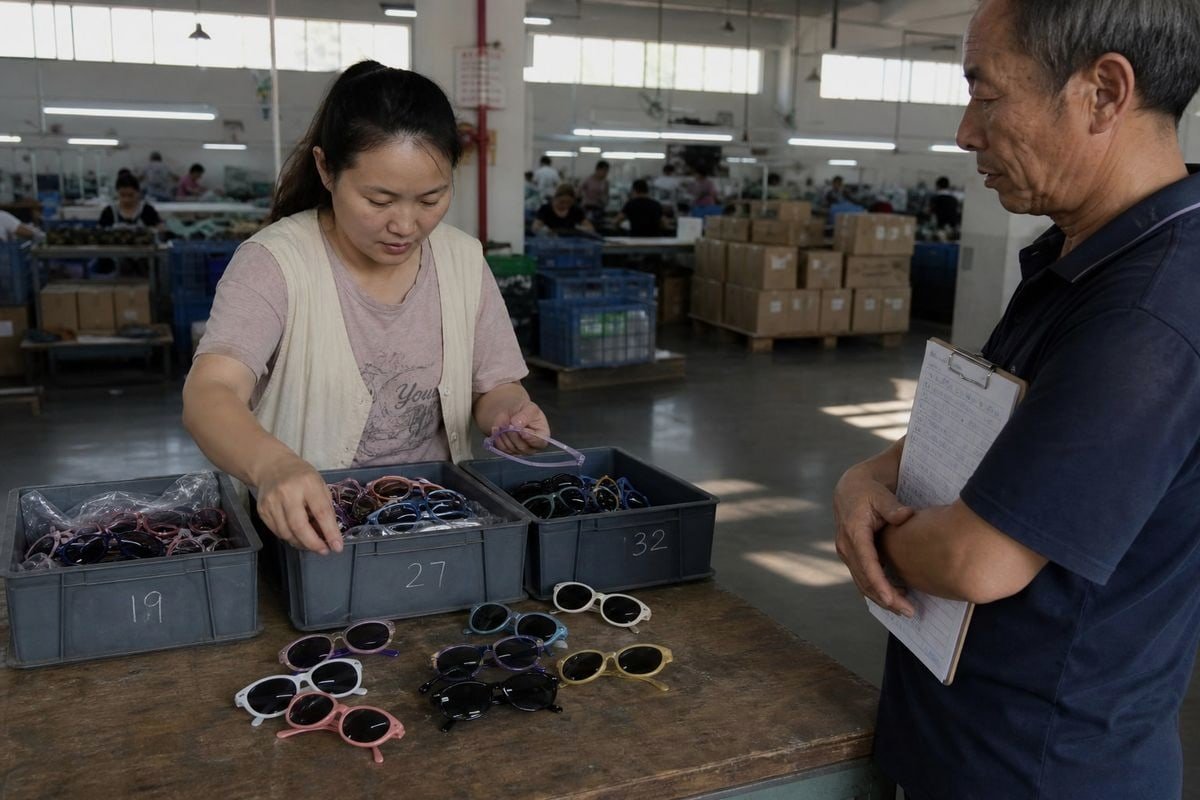
For children's eyewear, some defects matter far more than others. A minor scratch annoys an adult. A sharp burr on a nose bridge can hurt a child. That is why our QC team weights child-safety defects as major issues under AQL Standards, even when a generic checklist might call them minor.
Defects Ranked by Risk for Kids Sunglasses
| Defect | Visible in Footage? | Risk Level for Children | Typical Fix Cost at Mid-Production |
|---|---|---|---|
| Sharp edges or burrs on frame | Yes, with macro video | High — skin injury | Low — re-polish remaining units |
| Loose or stiff hinges | Yes, with manipulation video | High — parts detach | Low — adjust assembly torque |
| Lens misalignment or poor seating | Yes, at lens-fitting stage | High — lenses pop out | Low — refit before assembly ends |
| Frame asymmetry | Yes, with front-view shots | Medium — poor fit, discomfort | Medium — sort and rework |
| Coating drift or color mismatch | Yes, with sample comparison | Medium — brand consistency | Medium — recoat or replace |
| Scratches, specks, bubbles | Yes, with close-ups | Low to medium | Low — improve handling |
| Logo placement or color error | Yes, with macro shots | Low — brand issue | Low — reprint remaining units |
What Footage Cannot Catch
Be honest about limits. Video confirms finish, assembly, and packaging well. It cannot verify impact resistance, true optical clarity, or lens UV performance. Those need physical testing — a drop ball test 7, a spectrometer reading, and lab reports. For high-value orders, a third-party inspection service should visit the factory, pull samples under proper AQL sampling, run functional checks, and issue a formal report. We actively welcome these visits at our own workshop, because independent verification protects both sides. Treat supplier footage as your early-warning system and the independent inspection as your final gate.
Conclusion
Vague requests invite staged photos. Staged photos hide defects until it is too late. Specific, timestamped, stage-linked requests — backed by live calls and independent inspection — protect your kids sunglasses order and your brand.
Footnotes
1. Technical overview of UV protection standards and categories for protective eyewear. ↩︎
2. Authoritative Wikipedia entry explaining the pre-shipment inspection process and its importance in international trade. ↩︎
3. General overview of how checklists ensure consistency and quality in complex manufacturing processes. ↩︎
4. Explains the use of matrix barcodes for tracking and identifying specific production batches. ↩︎
5. Official government resource for the safety regulations governing children’s products in the United States. ↩︎
6. Explains the specific inspection stage performed when 20-50% of production is completed. ↩︎
7. Federal regulation defining the impact resistance requirements and testing methods for eyeglass lenses. ↩︎
More Articles You Might Like
Looking for a Reliable Kids Eyewear Partner?
Explore 800+ ready styles and full OEM/ODM support tailored to your brand.
Get in Touch English
  Español de México
  Deutsch
  Français
  日本語
日本語  العربية
  Português do Brasil