How to Request Assembly Data (A, B, ED, DBL) for Kids’ Optical Frames From Suppliers?
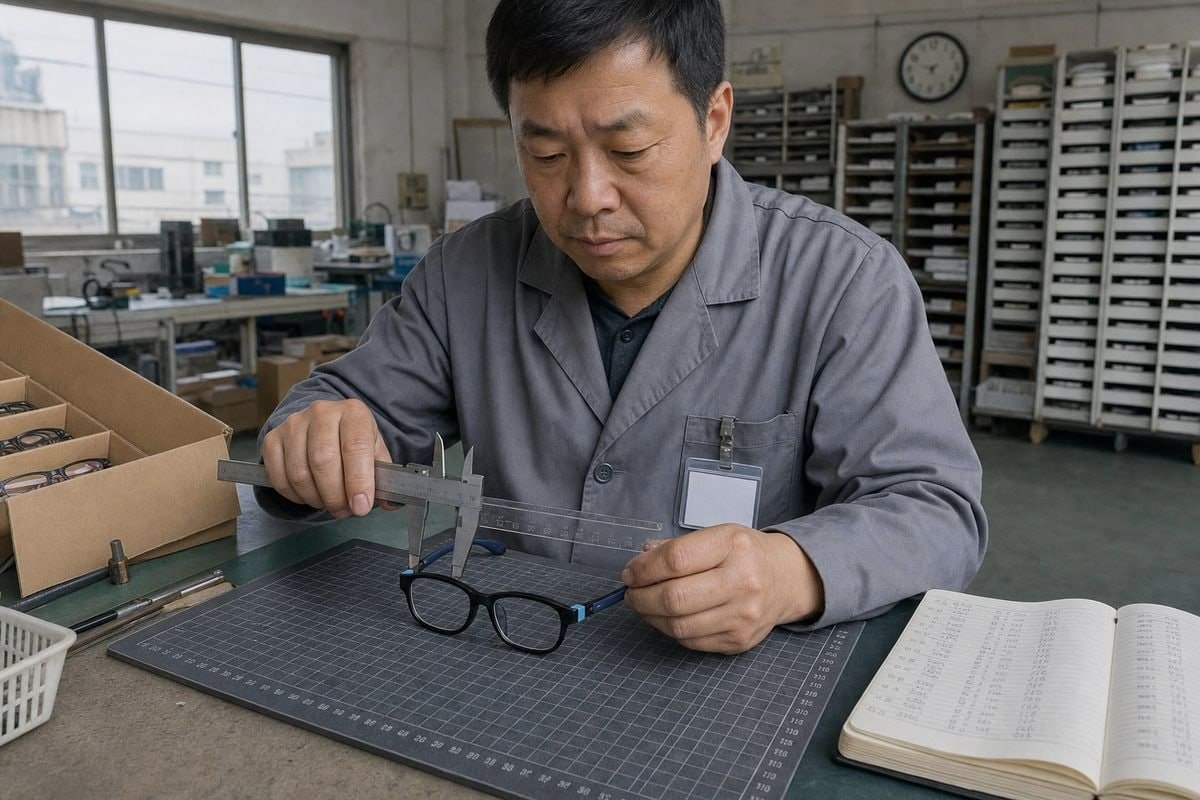
Requesting assembly data for kids’ optical frames 1 sounds simple until a lab rejects your shipment. At our Taizhou factory, we see buyers lose weeks over missing frame dimensions.
To request assembly data for kids’ optical frames, ask your supplier for the A (lens width), B (lens height), ED (effective diameter), and DBL (bridge width) in millimeters, plus frame type, material, and edging notes, and confirm whether values are factory specs or traced measurements.
That short answer covers the essentials. But each measurement has traps, especially in pediatric eyewear where frames are small and tolerances are tight B (lens height) 2. Let me walk you through the full process, from definitions to a ready-to-send request template.
What Do the A, B, ED, and DBL Measurements Actually Mean for My Frame Order?
A buyer from Australia once asked me why her lab needed "ED" when the frame already said 46□16. That question comes up so often in our export work that it deserves a full answer.
A is the horizontal lens width, B is the vertical lens height, DBL is the distance between lenses (bridge width), and ED is the effective diameter — the smallest circle that fully encloses the lens shape. All four come from the boxing system and are stated in millimeters.
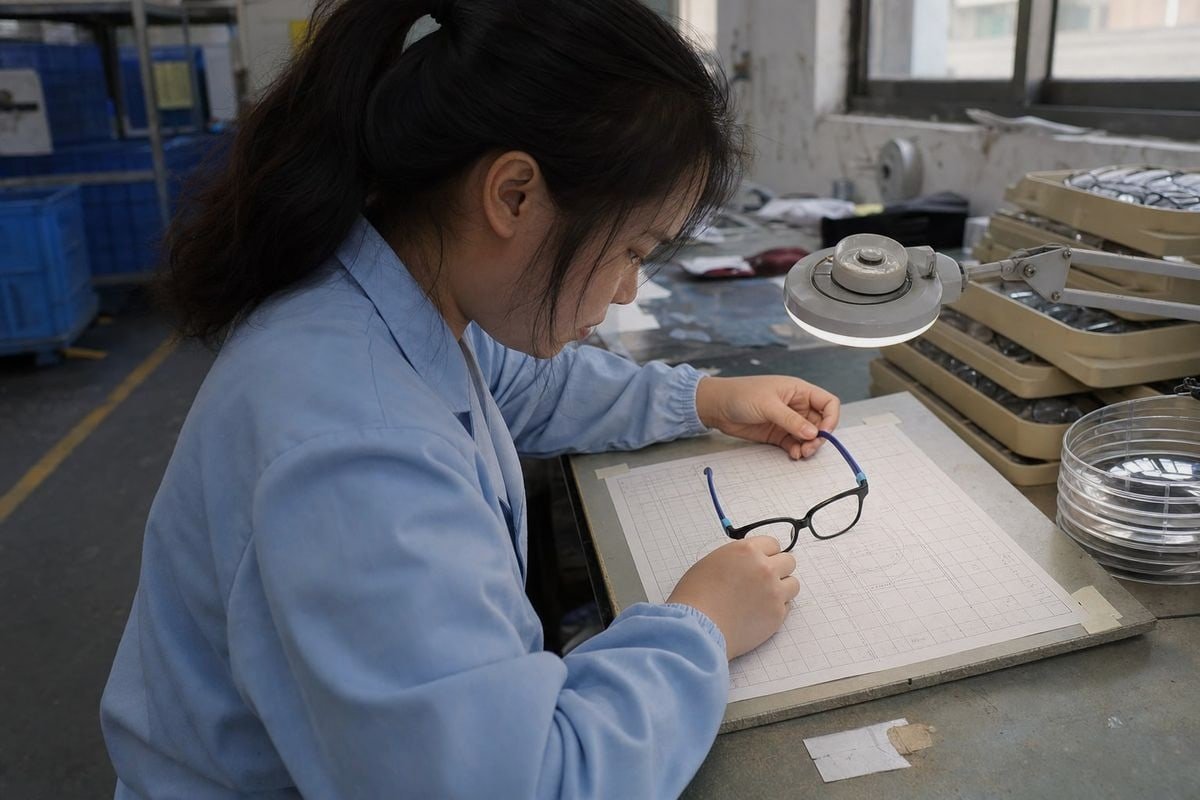
These four numbers are the language that frame factories, optical labs, and buyers all share. They come from the boxing system, which imagines a tight box drawn around each lens opening. Once you understand the box, every measurement makes sense.
The Four Core Frame Dimensions Explained
| Measurement | What It Means | How It Is Determined |
|---|---|---|
| A | Horizontal lens width (eye size) | Widest horizontal point of the lens opening |
| B | Vertical lens height | Tallest vertical point of the lens opening |
| DBL | Distance between lenses (bridge width) | Narrowest gap between the two lens openings |
| ED | Effective diameter | Twice the longest radius from the geometric center to the farthest edge |
The number printed on most temples — for example, 46□16-125 — gives you A, DBL, and temple length. Notice what is missing: B and ED. Those two usually need to be measured or traced, and they are exactly the values labs need to select the right lens blank.
Why ED Causes the Most Confusion
Some suppliers describe ED loosely as "the diagonal of the lens plus a bit." That shorthand works as a rough estimate, but it is not the trade definition. ED is the smallest circle that fully encloses the lens shape. For rounded rectangular kids' frames, like our glossy black TR90 style with flexible TPEE temples, the difference between an estimated ED and a traced ED can decide whether a lens blank cuts out cleanly or leaves an unglazed edge. When we prepare an eyewear technical data sheet for a new style, we always mark whether the ED value is calculated or traced, so the buyer's lab knows what it is working with.
How Can I Make Sure My Supplier Provides Accurate and Complete Assembly Data?
Early in my export career, we shipped a batch where the drawing said A=47 but the production sample measured 46.4. The buyer's lab caught it. That lesson shaped how our QC team documents frame dimensions today.
Ask the supplier to state the source of every value — factory drawing, physical sample, or lab trace — and request a technical drawing or trace file. Then verify by measuring an actual sample yourself using the boxing system before placing a bulk order.

Accuracy is not about trust; it is about knowing where numbers come from. A catalog spec, a CAD drawing, and a traced production sample can all differ slightly. For adult frames, a half-millimeter drift is often forgivable. For pediatric eyewear, it can matter.
Three Sources of Measurement Data, Ranked
There are three common ways suppliers generate frame dimensions, and they are not equal in reliability:
- Catalog or marketing specs. Rounded numbers, fine for quoting, not fine for lab work.
- Measured physical samples. Better, but hand measurement with a PD ruler introduces small errors, especially on curved fronts.
- Lab-traced measurements. The gold standard. A frame tracer captures the true lens opening shape, which gives the most accurate ED and supports edging directly.
When a buyer tells me they only need numbers "for the catalog," approximated values are acceptable. When lenses will actually be cut, I recommend trace-based data every time. Some sourcing guides suggest estimating ED from A plus a margin, and that is a fair shortcut for quick quoting — but if you are ordering finished pediatric eyewear or sending frames to a lab, insist on traced values. The cost of a remake is always higher than the cost of one traced sample.
Verification Steps Before Bulk Ordering
| Step | Action | Why It Matters |
|---|---|---|
| 1 | Request the dimension sheet with source labels | Reveals whether data is nominal or measured |
| 2 | Order a physical sample | Confirms production reality, not just drawings |
| 3 | Measure A, B, DBL yourself with a ruler | Cross-checks the supplier's stated values |
| 4 | Have your lab trace the sample | Confirms ED and cutout before volume commitment |
| 5 | Confirm tolerance range in writing | Sets the standard for incoming QC on bulk goods |
At our 5S-managed workshop, we keep a production master for each of our roughly 800 existing styles, so buyers testing the market with wholesale optical frames can get consistent, repeatable dimensions on reorders — not numbers that drift batch to batch.
Why Does Getting the Right Frame Measurements Matter for Children's Comfort and Fit?
One trade-off we weigh constantly in OEM/ODM manufacturing: buyers want kids' frames as small and light as possible, yet every millimeter removed shrinks the margin for measurement error. Small frames punish imprecision.
Kids' frames are smaller than adult frames, so the same millimeter of error is proportionally larger. Wrong A, B, ED, or DBL values cause lens decentration, poor optical centration, unstable bridge fit, and discomfort that leads children to stop wearing their glasses.
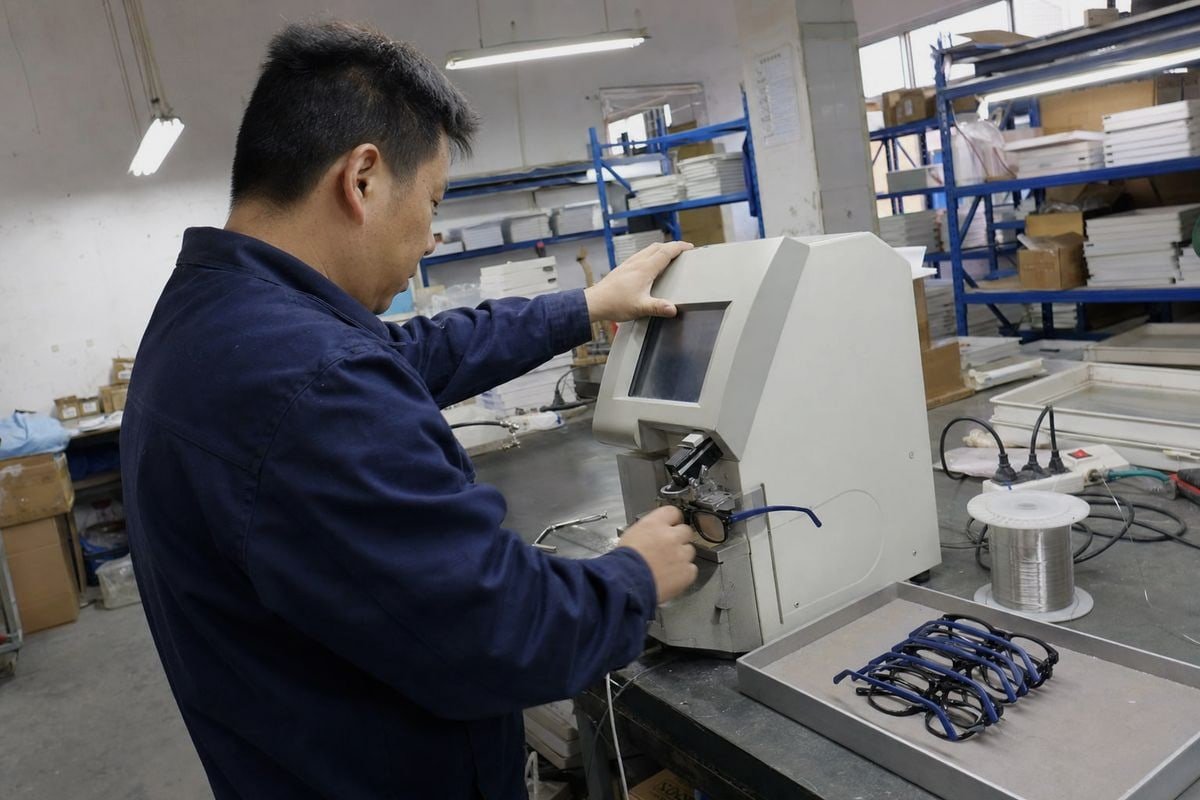
Think about the math. On an adult frame with a 54 mm lens width, a 1 mm error is under 2% of the opening. On a child's 44 mm frame, the same error is proportionally much larger — and it lands on a face with far less room to compensate.
The Bridge Is Where Fit Lives or Dies
Children's noses have lower, softer bridges than adults'. The DBL — the bridge width — decides whether the frame sits on the nose or slides down it. If the stated DBL is wrong by even a millimeter, a frame designed to rest gently can pinch or slip. This is why our engineers pay obsessive attention to the bridge area when we develop TR90 kids optical frames. Durable frame materials only help if the geometry is right first. Our translucent blush-pink acetate-look style, for example, went through several bridge revisions before we approved the production master, because the softly angular oval shape changed how the DBL measuring point sat between the nested lens openings.
How Dimensional Errors Turn Into Real Problems
| Wrong Value | Downstream Problem | Impact on the Child |
|---|---|---|
| A too small/large | Lens decentration relative to pupils | Prismatic effect, eye strain, poor vision correction |
| B inaccurate | Wrong blank selection, cutout failure | Delays, remakes, thick or unglazed edges |
| ED underestimated | Lens blank too small to cover the shape | Rejected job at the lab, wasted inventory |
| DBL wrong | Frame slides or pinches on the nose | Child pushes glasses up constantly or refuses to wear them |
There is also a behavioral dimension. Adults tolerate mediocre fit. Children do not. A frame that slips gets pulled off, bent, or "lost." Accurate children's glasses sizing is not a technical nicety; it directly determines whether a prescription actually gets worn. That is why we pair precise frame dimensions with flexible TPEE temples and looped ear grips on our sporty styles — geometry gets the frame in the right place, and flexible materials keep it comfortable there.
What Information Should I Include When Requesting Assembly Data From a New Supplier?
A procurement manager from Japan recently sent us the most complete data request I have seen in fifteen years. Her email became my internal example of how buyers should communicate. Here is what she got right.
Request A, B, ED, and DBL in millimeters, plus temple length, frame type (full-rim, semi-rimless, rimless), front and temple materials, bevel or groove notes, the measurement source, and a technical drawing or trace file. For kids' frames, add safety compliance documents.

A vague request gets a vague answer. A structured request signals that you are a professional buyer, and it usually earns a more careful response. Beyond the four boxing system values, a complete package for pediatric eyewear should cover materials, mounting details, and safety documentation.
The Complete Request Checklist
- The full dimension set: A, B, ED, DBL, and temple length, all in millimeters
- Frame type: full-rim, semi-rimless, or rimless (this determines the edging groove or bevel treatment)
- Exact materials of the front and temples (for example, TR90 front with TPEE temples)
- Whether the values are for the finished frame opening or a nominal frame size
- Whether values come from a factory drawing, a physical sample, or a traced measurement
- Bevel depth and groove notes, since bevel geometry affects sizing and mounting
- A technical drawing, dimension sheet, or trace file if available
- For children's products: material declarations and test reports for impact resistance and chemical safety (lead, phthalates, BPA), plus regional compliance such as REACH, CPSIA, or EN71
- UV protection claims and lens category classification for any tinted or sun styles
- Frame weight and intended age group
A Template You Can Copy
Here is the message format I recommend to new buyers who contact us:
"Please send the full dimension set for this kids' optical frame: A, B, ED, and DBL in millimeters, plus temple length. Include the frame type and material, any groove or bevel notes, and confirm whether these values are from a factory drawing, a sample, or a traced measurement. If possible, attach a technical drawing or dimension sheet, along with your safety test reports for children's eyewear."
Two more items are worth asking about, depending on your business model. First, customization parameters: if you plan private-label development, ask what ranges are possible for temple length adjustment or alternative bridge fits, since pediatric faces vary widely. Second, data format: some buyers now request dimension data in formats compatible with their practice management or ordering software, and forward-looking suppliers can also provide 3D CAD files to support virtual try-on tools. In our OEM/ODM manufacturing projects, we prepare all of this as one package — dimension sheet, compliance documents, and drawings — because a complete first response saves both sides weeks of back-and-forth.
Conclusion
Accurate assembly data protects your lens orders, your inventory, and the children wearing your frames. Request A, B, ED, and DBL properly, verify the source, and choose suppliers who document everything.
Footnotes
1. Replaced with an authoritative source from the American Association for Pediatric Ophthalmology and Strabismus on fitting children’s glasses. ↩︎
2. Explains the B measurement as the vertical height of the lens. ↩︎
More Articles You Might Like

August 5, 2026
Bio-Based vs Regular Cellulose Acetate: What's the Difference for Kids' Frames?

August 5, 2026
How Recyclable Are Kids' Optical Frame Materials, and What Eco-Friendly Alternatives Exist?
August 5, 2026
Do Kids Optical Frames Whiten or Age in Storage, and How to Control Warehouse Conditions?
Looking for a Reliable Kids Eyewear Partner?
Explore 800+ ready styles and full OEM/ODM support tailored to your brand.
Get in Touch English
  Español de México
  Deutsch
  Français
  日本語
日本語  العربية
  Português do Brasil