How to Read Kids’ Sunglasses Size Specs (Lens, Bridge, Temple)?

Kids’ sunglasses size specs confuse many of the buyers who email our factory in Taizhou. They order frames labeled “junior,” and then discover the fit is wrong. Returns pile up. Reviews mention slipping frames and pinched noses. The fix is simpler than most people think: learn to read the three numbers printed on almost every frame, and you can compare any pair of kids’ sunglasses with confidence.
Kids’ sunglasses size specs use three numbers in millimeters, such as 46-16-125. The first is lens width, the second is bridge width (the gap between lenses), and the third is temple length. Together they define how the frame fits a child’s face, nose, and ears.
Once you know what each number does, sizing stops being guesswork. Let me walk you through each measurement, what it affects, and how to use it when you source or shop.
What Do the Numbers on Kids' Sunglasses Frames Actually Mean?
During a QC inspection last spring, one of our team members caught a batch where the temple printing read 48-16-120 instead of 46-16-120. Two millimeters matters. That is why we check these markings on every production run before shipment.
The numbers printed inside the temple arm, like 46-16-125, mean lens width 46mm, bridge width 16mm, and temple length 125mm. Lens width is one lens at its widest point, bridge width is the distance between lenses, and temple length runs from hinge to tip.
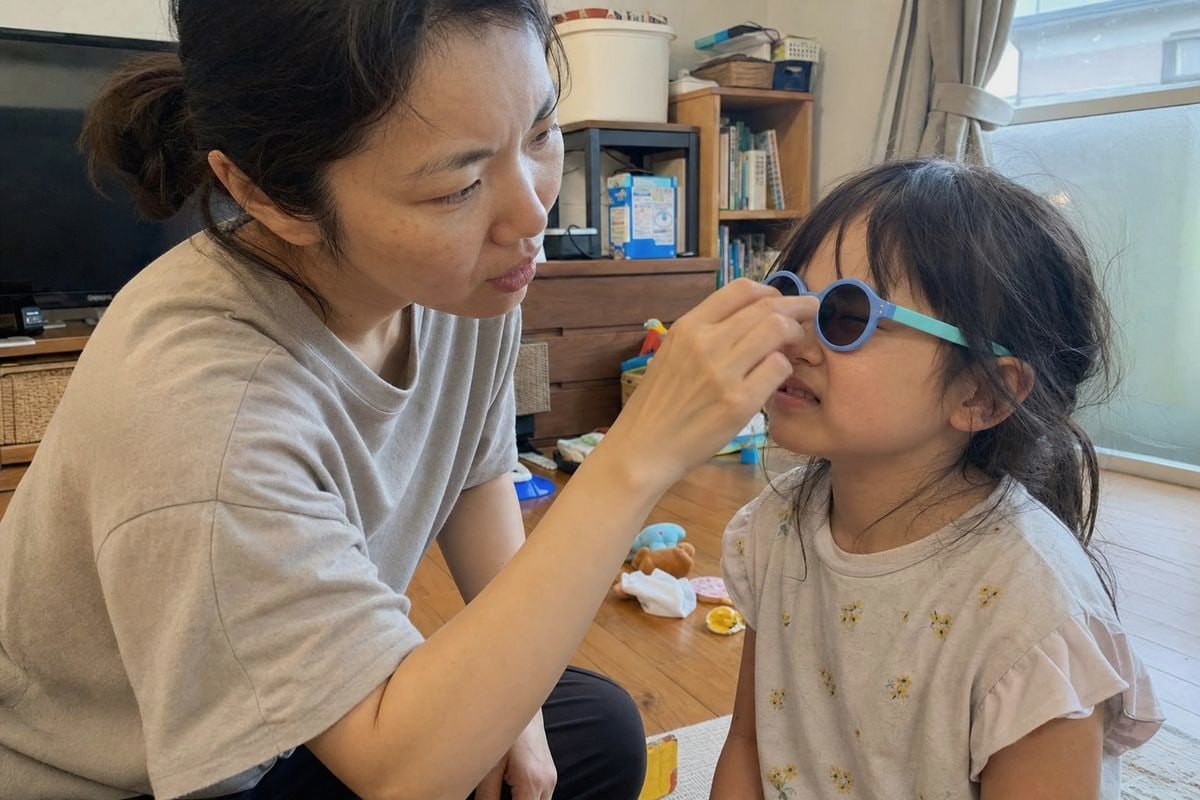
The format is nearly universal. Look on the inside of the left or right temple arm. You will usually see three numbers separated by dashes or small squares. All three are in millimeters. Here is what each one covers:
Lens Width
This is the horizontal width of a single lens, measured across its widest point. It is the first number. For children, it typically falls between 38mm and 52mm. Younger kids sit at the low end. Preteens move toward adult small sizes.
Bridge Width
Also called DBL, or distance between lenses. This is the second number. It describes the gap where the frame rests on the nose. Kids' bridges usually run from about 12mm to 20mm.
Temple Length
The third number measures the arm from the hinge to the tip that curls behind the ear. Children's temples generally range from roughly 100mm to 145mm.
| Measurement | What It Is | Typical Kids' Range |
|---|---|---|
| Lens width | Widest horizontal point of one lens | 38–52 mm |
| Bridge width (DBL) | Gap between the two lenses | 12–20 mm |
| Temple length | Hinge to tip behind the ear | 100–145 mm |
One extra term worth knowing is frame width 1. Some brands list it as an overall left-to-right measurement. It is useful, but the three-part breakdown tells you more about actual fit. In our catalog of roughly 800 existing styles, we always publish all three numbers, because international buyers compare specs across brands, and labels like "small" or "junior" mean different things everywhere.
A quick shape note: our sport wraparound shield styles, like the glossy black frame with the orange-to-gold mirrored lens, use a single lens. For those, the effective lens measurement reflects the shield's coverage per eye, and the wrap curvature makes the same numbers fit closer to the face than a flat round frame would.
How Do I Know Which Bridge Size Fits My Child's Face Shape?
A distributor in Japan once asked us why the same frame fit local children differently than it fit her European samples. The answer sat in the bridge. Nose bridge 2 shape varies widely between children, and it varies by region and by age.
Match bridge size by watching where the frame rests. A correct bridge sits flat on the nose without pinching or leaving gaps. Younger children with low, soft nose bridges usually need 12–15mm; older kids need 16–20mm. If frames slide down, the bridge is too wide.
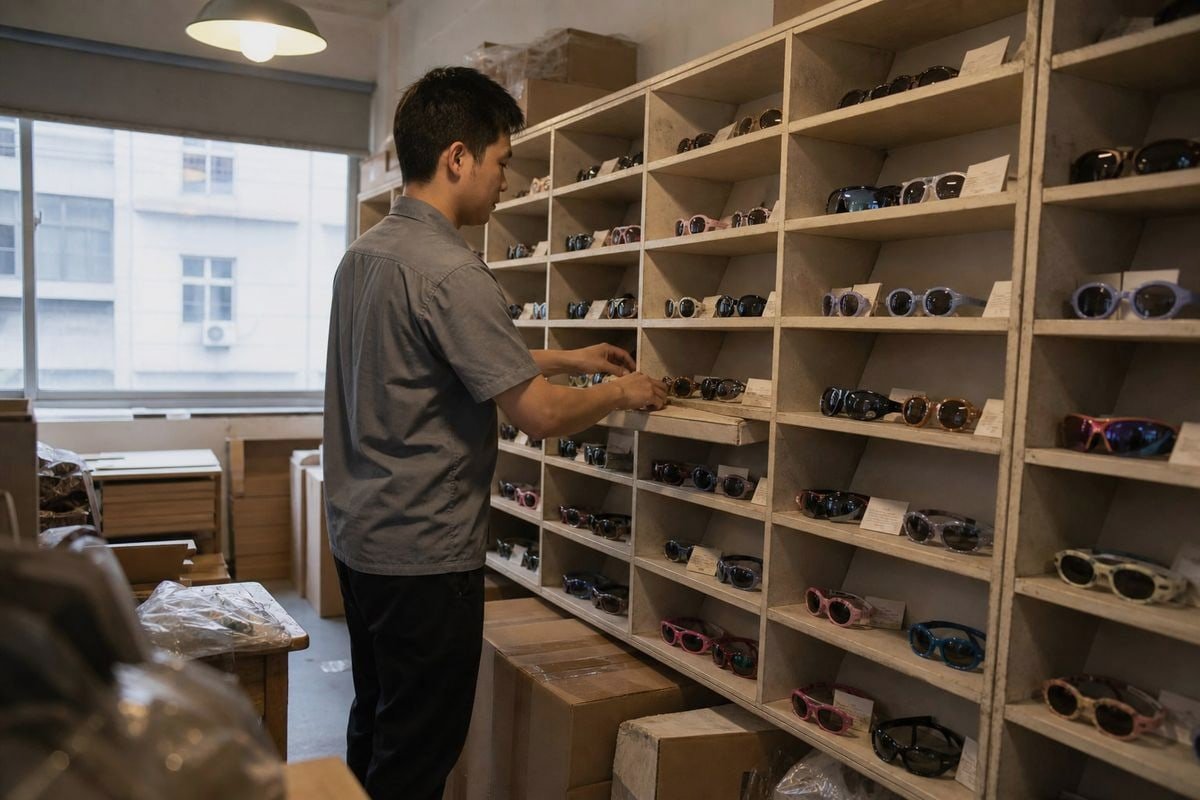
The bridge is the smallest number on the spec, but it causes the most fit complaints. Here is why. A child's nose bridge is still developing. Toddlers often have almost no defined bridge at all. So the frame cannot rely on a tall, firm nose to hold it in place the way adult sunglasses do.
Signs the Bridge Is Wrong
Watch for these cues on the child's face:
- Too narrow: the frame presses red marks into the nose, or the sunglasses sit unusually high, pushing the lenses up toward the eyebrows.
- Too wide: the frame slides down within minutes, and the child keeps pushing it back up or takes it off entirely.
- Just right: the frame rests evenly, the eyes sit roughly centered in the lenses, and there are no pressure marks after wear.
Eye centering 3 is a detail opticians care about. Each eye should sit close to the center of its lens, ideally no more than a few millimeters off. If the bridge is far too wide for the face, both eyes shift inward relative to the lenses, which looks odd and reduces optical comfort.
Material Makes the Bridge Forgiving
This is where frame material earns its keep. Our engineers design most children's bridges in flexible TPEE 4 or TR90 5 precisely because these materials flex slightly to distribute pressure. A rigid frame with a slightly wrong bridge hurts. A flexible frame with the same spec often still fits comfortably. Some designs also add soft silicone nose pads 6, which can effectively adjust the functional bridge fit by a few millimeters, letting one frame serve a wider range of nose shapes. Our compact round style with the periwinkle-blue front and mint-teal temples uses exactly this soft-touch approach, so it stays gentle on low toddler bridges.
Why Does Temple Length Matter So Much for Growing Children?
Fifteen years of building children's frames has taught our team one blunt lesson: a child will not tolerate an uncomfortable temple. Adults adjust and endure. Kids simply pull the sunglasses off, and then the UV protection 7 you paid for sits in a bag.
Temple length decides whether sunglasses stay on during movement. Temples that are too short press behind the ears and cause pain; temples that are too long let the frame bounce loose and fall off during play. Kids typically need 100–145mm, growing longer with age.
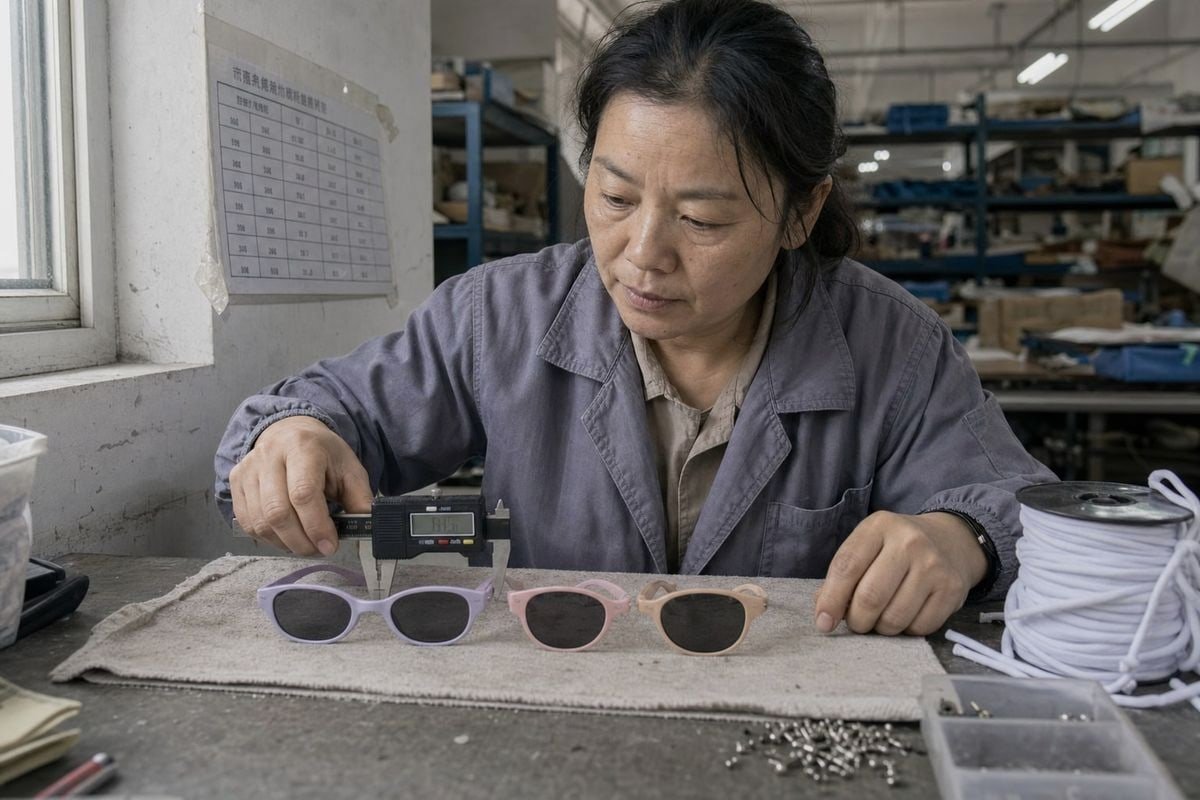
Children do not sit still in sunglasses. They run, jump, hang upside down, and ride bikes. The temple is the anchor that keeps the frame in place through all of it. That makes the third number arguably the most important spec for real-world wear.
How Temple Length Works Mechanically
The temple should extend from the hinge, pass just above the ear, and curve gently down behind it. Consider the failure modes:
- Too short: the tip cannot reach the natural bend point behind the ear. The arm digs into the skull or the top of the ear. The child feels pressure within minutes.
- Too long: the bend sits far behind the ear where it grips nothing. The frame shifts with every head movement and drops off when the child looks down.
- Correct length: the curved tip wraps the back of the ear lightly, so the frame stays put without squeezing.
Growth Changes Everything
Head size grows fast in early childhood, then slows. A frame that fits at age three will likely be tight by age five. We tell our brand customers to plan product lines around this, and we advise parents to re-check fit every six to twelve months rather than assuming one pair lasts for years.
| Age Group | Typical Temple Length | What to Watch |
|---|---|---|
| Baby (0–2) | 100–120 mm | Very soft tips; straps often help |
| Child (3–7) | 115–130 mm | Fast growth; recheck fit twice a year |
| Older child (8–11) | 125–140 mm | Active sports demand secure wrap |
| Preteen (12–14) | 135–145 mm | Approaching adult small sizes |
Flexibility matters here too. We pair TR90 fronts with TPEE temples on many styles because TPEE arms bend outward without snapping when a child yanks the frame off with one hand. That flex also forgives small sizing errors during growth spurts, extending how long one pair fits comfortably. On our sport shield styles, the thick sculpted temples taper into slim, flexible tips for exactly this reason.
How Can I Choose the Right Size Range When Sourcing for Different Age Groups?
Buyers launching their first children's line often ask us to recommend a single "universal" kids' size. We always push back gently. Covering ages one to fourteen with one spec is like selling one shoe size for all children. It cannot work.
Source by age band, not by one universal size. Plan roughly 38–42mm lenses for babies, 42–48mm for young children, and 48–52mm for preteens, with bridges and temples scaling up in step. Always compare millimeter specs, because size labels vary between brands.
For B2B buyers, sizing is a range-planning decision. Here is the framework we share with brands sourcing from our catalog. Age bands are a starting point, and specs are the deciding factor.
| Age Band | Lens Width | Bridge Width | Temple Length |
|---|---|---|---|
| Baby (0–2) | 38–42 mm | 12–14 mm | 110–120 mm |
| Toddler (2–4) | 40–44 mm | 13–15 mm | 115–125 mm |
| Child (5–8) | 44–48 mm | 15–17 mm | 120–130 mm |
| Preteen (9–12) | 48–52 mm | 16–19 mm | 130–140 mm |
| Early teen (12–14) | 50–54 mm | 18–20 mm | 140–150 mm |
Published charts disagree slightly at the edges, and that is normal. Some place preteens at 48–52mm, others stretch to 54mm. Treat the overlaps as flexibility, not error, and let the actual frame design settle the choice.
Practical Sourcing Advice
A few points we repeat to nearly every new customer:
- Cover two or three bands, not one. A baby style, a core child style, and a preteen style cover most of the retail market. Testing from an existing range of styles keeps this affordable, because no new molds are needed.
- Frame style shifts effective fit. Wraparound sport shields, like our mirrored single-lens designs, hug the face and fit slightly snugger than flat round frames with the same printed numbers. Account for curvature when comparing.
- Fit affects protection. A loose, mismatched frame leaves gaps at the lens edges, letting UV light 8 leak in from the sides even when the lenses themselves block 100% of UV. Correct sizing is a safety issue, not just comfort.
- Ask your supplier for full specs. We provide lens, bridge, temple, and overall frame width on every style, plus samples, because photos alone cannot confirm fit on a real child's face.
If a brand plans custom colors, logos, or packaging, sizing decisions should come first. Locking the size range early prevents costly changes after retail-ready artwork is done.
Conclusion
Wrong sizes cause returns, complaints, and unworn sunglasses. Reading lens, bridge, and temple specs solves this. Match millimeters to the child's face, recheck as they grow, and source by age band. That is how well-fitting kids' eyewear gets built.
Footnotes
1. Background reference for standard eyewear measurement terminology including frame width. ↩︎
2. Background on nasal anatomy relevant to discussion of bridge fit on children’s faces. ↩︎
3. National Eye Institute is an authoritative source on vision comfort factors like lens centering. ↩︎
4. Explains elastomer properties that make TPEE temples bend without snapping. ↩︎
5. Background on the flexible thermoplastic materials used in children’s frame construction. ↩︎
6. Ophthalmology guidance on sunglasses fit features like nose pads for children. ↩︎
7. EPA resource on UV exposure risks supporting the importance of proper protective eyewear. ↩︎
8. WHO explains UV radiation health risks relevant to gaps in poorly fitted eyewear. ↩︎
More Articles You Might Like



Looking for a Reliable Kids Eyewear Partner?
Explore 800+ ready styles and full OEM/ODM support tailored to your brand.
Get in Touch English
  Español de México
  Deutsch
  Français
  日本語
日本語  العربية
  Português do Brasil