How Long Is Production Lead Time for Custom Kids Sunglasses Mold Development?
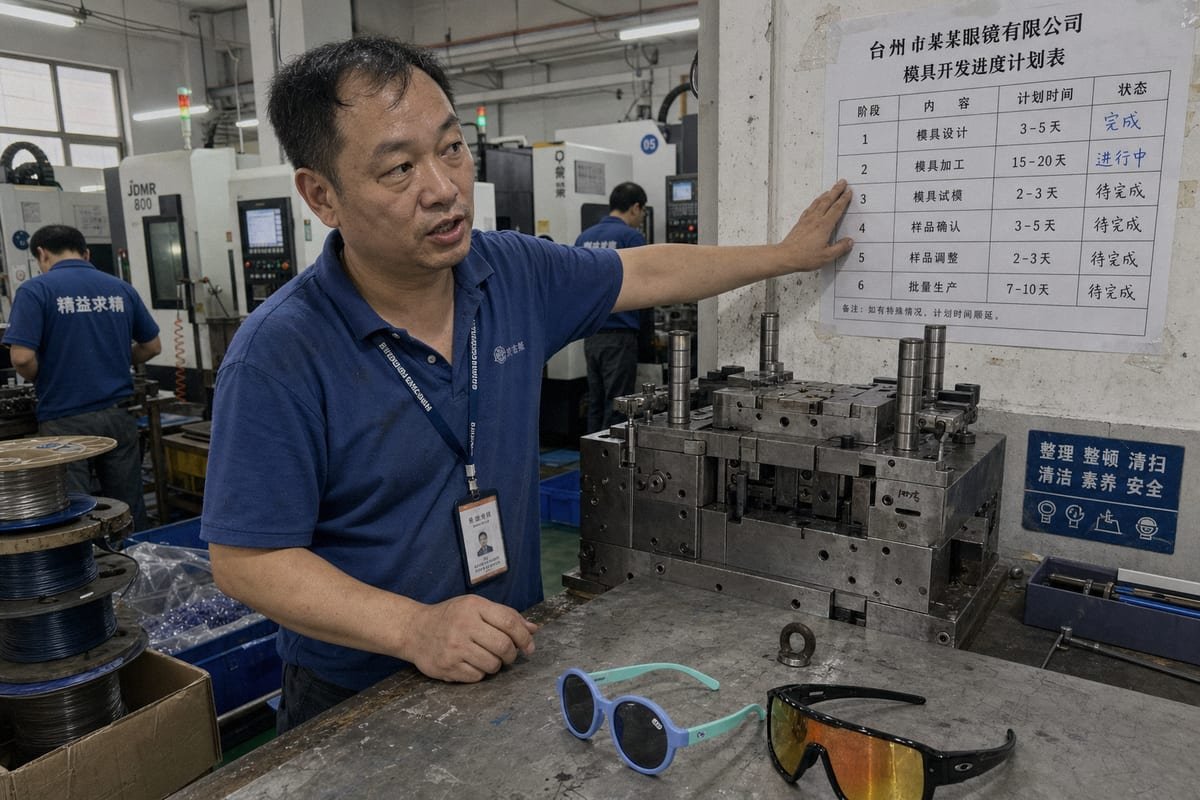
Buyers often ask me about production lead time for custom kids sunglasses mold development. Miss the estimate, and your launch season slips away. Our factory has seen this pain repeatedly — so let me give you real numbers.
Custom kids sunglasses mold development typically takes 45–90 days from design finalization to bulk goods. The mold and tooling phase alone usually requires 20–45 days, plus 7–15 days for sampling, and 30–50 days for mass production. Complex designs can extend to 3–6 months.
That range is wide, so let me break it down. In this article, I will show you each stage, what slows things down, and how to plan around it.
How Can I Reduce Mold Development Time When Launching a New Kids Sunglasses Style?
Last spring, a European baby brand came to us with a hard deadline before summer retail. We compressed their timeline by weeks — not by rushing the mold, but by removing every avoidable delay.
You can reduce mold development time by delivering a complete tech pack upfront, approving CAD designs quickly, choosing proven materials like TR90 or TPEE, using 3D-printed prototypes for early feedback, limiting revision rounds, and working with a vertically integrated factory that controls tooling in-house.
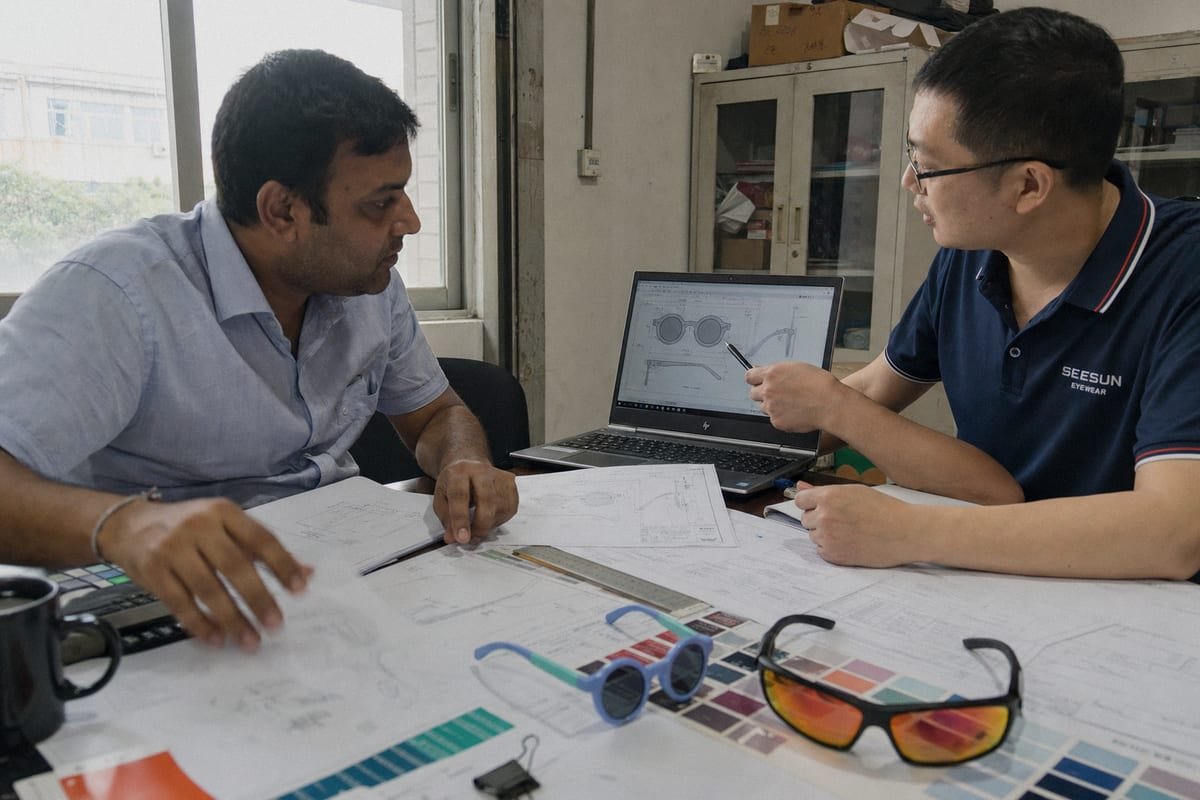
The slowest step controls your whole schedule. So the goal is not to speed up one stage. The goal is to remove dead time between stages. In our experience running OEM eyewear manufacturing projects for brands in 20+ countries, most delays come from waiting — waiting for design approval, waiting for sample feedback, waiting for a revised drawing.
Start With a Complete Tech Pack
A complete tech pack saves more time than any other single action. It should include your 3D CAD files 1 or reference frame, exact dimensions for the target age group, lens specifications, hinge type, color codes, and logo placement. When our engineers receive a full package, technical drawings 2 take 3–5 days. When information trickles in piece by piece, that same step can take three weeks.
Use Rapid Prototyping Before Steel Cutting
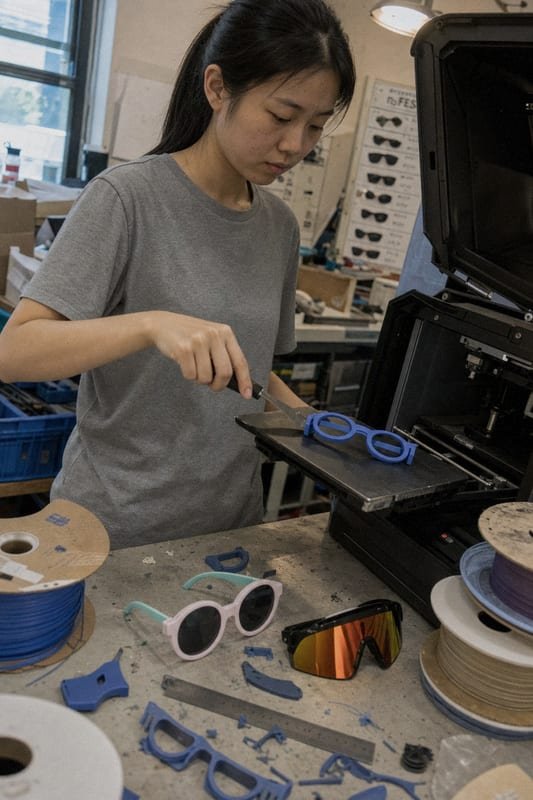
We often produce 3D-printed or CNC-machined samples before any steel is cut. This prototyping and sampling step adds 7–15 days upfront, but it prevents expensive mold modification cycles later. Changing a printed prototype takes a day. Changing hardened tooling takes two weeks or more.
Respond Fast and Limit Revisions
Here is a simple comparison of what fast buyers do differently:
| Action | Fast Buyer | Slow Buyer |
|---|---|---|
| CAD design approval | 1–2 days | 1–2 weeks |
| Sample feedback | Consolidated in one email | Multiple scattered comments |
| Revision rounds | 1 round | 3+ rounds |
| Material decision | Locked before tooling | Changed mid-project |
| Time saved overall | Up to 3–4 weeks | Baseline |
Finally, timing matters. Booking your project in the off-season, before the pre-summer rush, means your mold does not sit in a queue behind twenty other tools.
What Factors Affect Lead Time When I Order Custom Molds for Children's Eyewear?
One project on our line taught me this lesson clearly: two frames that look similar on paper can have completely different tooling timelines once you examine the details.
Lead time depends on frame complexity, material choice, mold type, factory workload, sampling rounds, and safety testing. Simple single-color TR90 frames tool fastest; dual-color injection, integrated flexible hinges, seasonal factory congestion, and CPSIA or EN71 compliance verification can each add two to four weeks.
Let me unpack each factor, because supplier quotes often hide these variables.
Design Complexity
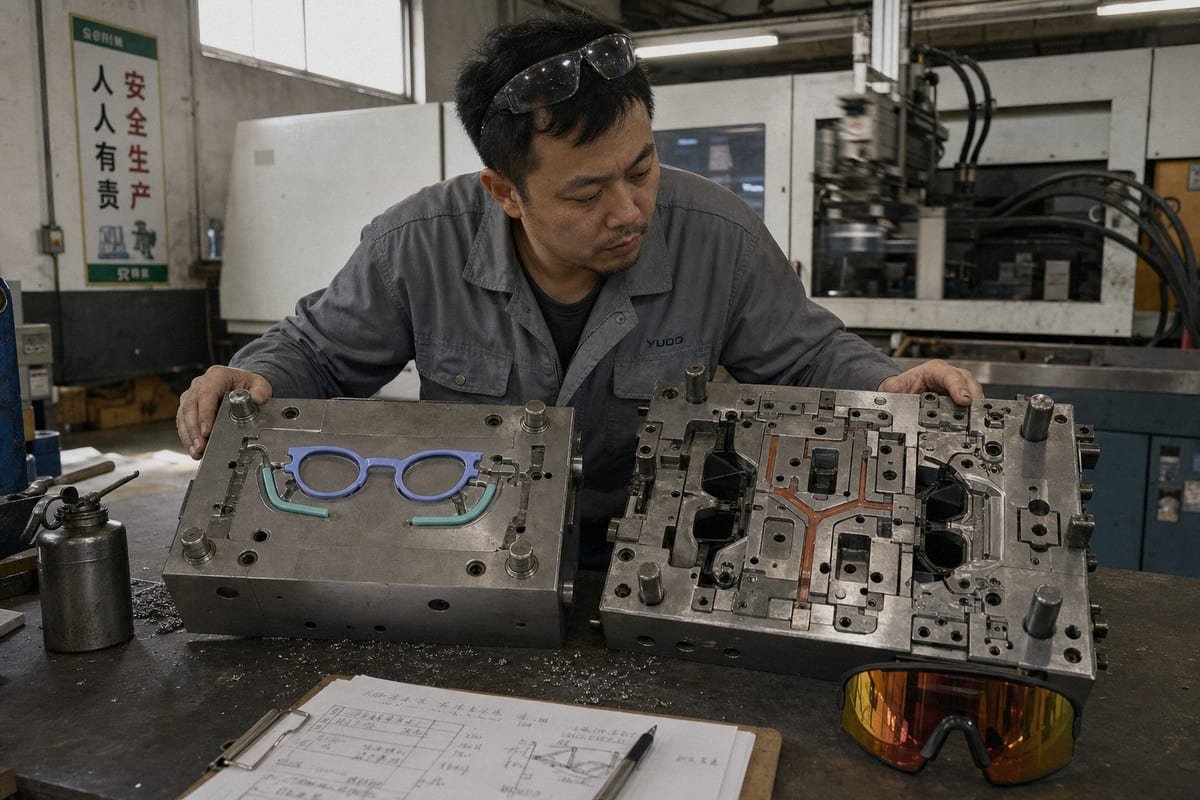
A rounded, one-piece frame — like the pastel two-tone kids' round style we produce — uses relatively straightforward tooling. A wraparound sport shield with an angular brow bar, segmented hinges, and rubberized temple tips needs more cavity detail and more trial shots. Dual-color injection (overmolding) is the biggest multiplier. A two-color mold can take up to two months on its own, because it is effectively two synchronized tools.
Material Choice
The injection molding process behaves differently by polymer. TR90 material flows and shrinks differently than standard polycarbonate 3, so molds need specific cooling channel configurations. TPEE, which we use for flexible children's temples 4, demands careful gate design to keep the finished part soft yet dimensionally stable. Kids' frames are small, so shrinkage errors that would be invisible on adult frames become fit problems on a toddler's face. Some factories now run AI-driven mold flow analysis during design to predict shrinkage before steel is cut, which reduces the mold modification cycle afterward.
Compliance and Testing for Children's Products
Children's eyewear is regulated more strictly than adult fashion frames. A golden sample from the final mold 5 typically goes to a lab for CPSIA safety standards 6 or EN71 verification. Plan a 10–14 day buffer for this before mass production begins.
Factory Schedule and Season
| Factor | Typical Impact on Lead Time |
|---|---|
| Simple single-color frame | Baseline: 20–30 days tooling |
| Dual-color overmolding | +20–30 days |
| Integrated flexible hinge | +1–2 weeks |
| Peak season / holiday congestion | +2–3 weeks |
| Compliance lab testing | +10–14 days |
| Imported components (special lenses) | +1–3 weeks |
Chinese New Year and pre-summer peak season in manufacturing hubs regularly add two to three weeks of queue time. If your supplier quotes an aggressive timeline during these windows, ask how they will actually deliver it.
Should I Choose an Existing Mold or Invest in a New Custom Mold for My Brand?
A procurement manager from Australia once asked me this exact question during a video call. My honest answer surprised her: for a first launch, I usually recommend against a new mold.
Choose an existing mold if you are launching a new brand, testing a market, or need speed — customization of colors, lenses, logos, and packaging still creates a branded product. Invest in a new custom mold only when you have proven demand and need a truly unique, protected design.
This is not a sales pitch for one option. It is a risk calculation, and I have watched buyers get it both right and wrong.
The Case for Existing Molds
Our factory maintains roughly 800 existing styles. A buyer can pick a proven frame shape, then customize colors, UV400 or polarized lenses 7, temple logos, and retail-ready packaging. The result looks fully branded on the shelf. Lead time drops dramatically because tooling fabrication is already done. You skip mold cost entirely, and the fit has already been validated on real children's faces across many production runs.
The Case for a New Custom Mold
A new mold makes sense when your design is genuinely distinctive — a signature silhouette, a patented hinge, or a shape tied to your brand identity. It also protects you: a mold you paid for is typically exclusive to you. But it demands upfront investment, a 45–90 day development window, and enough order volume to amortize the tooling cost.
Side-by-Side Comparison
| Consideration | Existing Mold + Customization | New Custom Mold |
|---|---|---|
| Lead time to bulk goods | 30–45 days | 45–90+ days |
| Tooling investment | None | Significant upfront cost |
| Design exclusivity | Shared shape, unique branding | Fully exclusive |
| Market-testing risk | Low | High |
| Fit validation | Already proven | Needs pilot run testing |
| Best for | New brands, importers, promo buyers | Established brands scaling up |
A Practical Middle Path
Many of our long-term partners do both, in sequence. They launch with existing molds, learn which shapes and colors sell, and then invest in custom tooling for their best performer. Some factories also use modular mold bases, where only the cavity inserts are customized. This approach can reduce development time by up to 30% when a brand launches multiple sizes for different age groups.
How Do I Plan My Production Schedule Around Mold Development Timelines?
Every year, a few buyers contact us in March hoping to have custom-molded sunglasses in stores by June. The math rarely works, and I would rather explain why now than apologize later.
Work backward from your launch date. Reserve 45–90 days for mold development and production, 10–14 days for compliance testing, and 5–40 days for shipping depending on air or sea freight. In practice, start a fully custom project five to seven months before your retail launch.
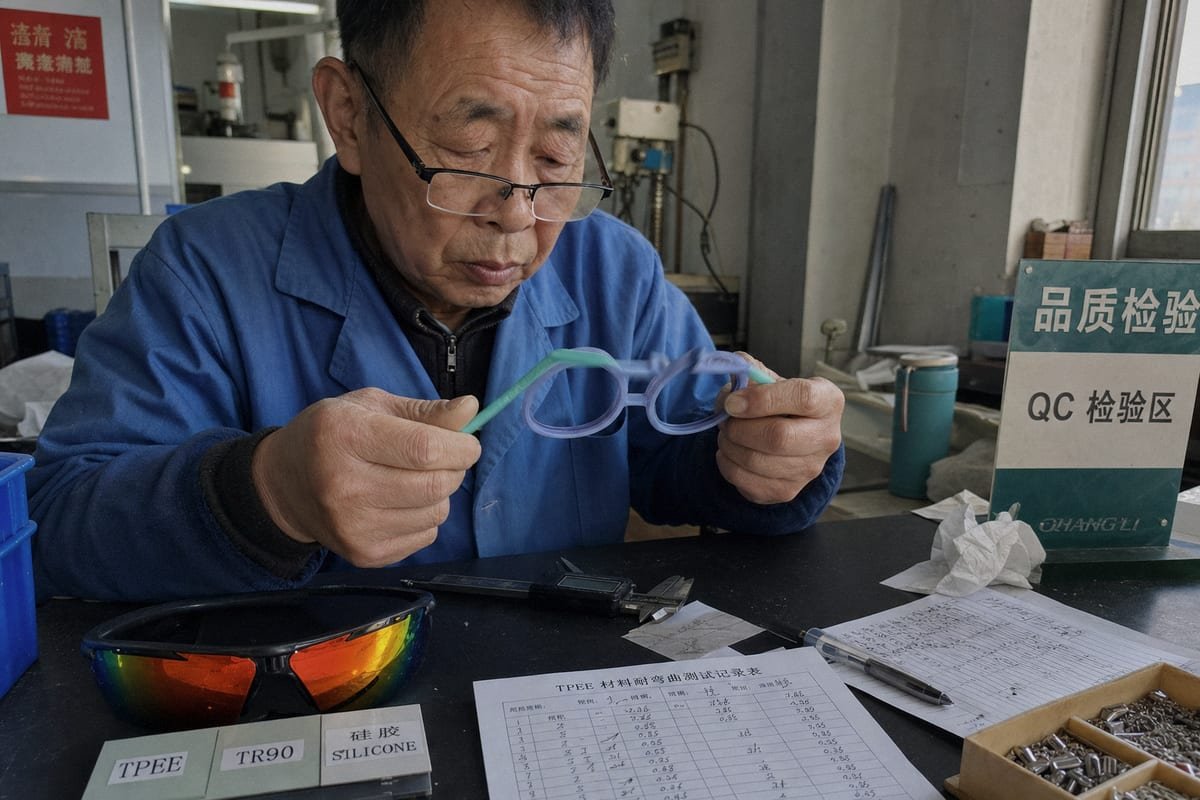
Planning backward is the only reliable method. So let me walk through the stages the way we schedule them on our own production line.
The Stage-by-Stage Timeline
- Design and CAD approval — 3–7 days. Technical drawings are prepared and confirmed. Your speed of CAD design approval directly sets the pace here.
- Prototyping and sampling — 7–15 days. 3D-printed or machined samples verify shape and fit before tooling begins.
- Tooling fabrication — 20–45 days. The steel mold is machined, polished, and assembled. Complex two-color tools sit at the long end.
- First off-tool samples and pilot run testing — 7–14 days. We shoot trial parts, check dimensions, test hinge strength, and confirm the fit on the target age group. Any mold modification cycle adds 7–20 days here.
- Golden sample and lab verification — 10–14 days. CPSIA or EN71 testing runs on parts from the final mold.
- Mass production timeline — 30–50 days. Injection, lens cutting, assembly, quality control, and packing.
- Shipping — 5–7 days by air, 25–40 days by sea. Freight is always separate from the manufacturing quote.
Build In Buffers, Not Hope
Add a two-week buffer for revisions and a further two to three weeks if your schedule crosses Chinese New Year or peak season. One real-world rush case I know of squeezed fully custom-molded sunglasses into a 35-day delivery window — and even the supplier admitted it sat at the edge of what was physically possible. Do not build your business plan on the edge case.
Also, read supplier quotes carefully. When a factory says 30 days, ask exactly what that covers. Some quotes include only tooling. Others include tooling plus sampling. Very few include compliance testing, packaging, and freight. Aligning definitions upfront prevents the most common scheduling disaster: two parties agreeing on a number while meaning different things.
Conclusion
Custom mold development is slow because every stage depends on the last. Plan 45–90 days minimum, add buffers, or launch faster with existing molds — then invest in tooling once demand is proven.
Footnotes
1. Technical definition of the digital design files required for mold development. ↩︎
2. International standards for technical drawings in engineering and manufacturing. ↩︎
3. Technical properties of the common thermoplastic used in eyewear manufacturing. ↩︎
4. Official site for Hytrel TPEE, a material commonly used for flexible eyewear components. ↩︎
5. General engineering overview of the molding process and mold types. ↩︎
6. Authoritative Wikipedia entry providing a reliable, accessible overview of the federal safety statute. ↩︎
<span id="footnote
More Articles You Might Like



Looking for a Reliable Kids Eyewear Partner?
Explore 800+ ready styles and full OEM/ODM support tailored to your brand.
Get in Touch English
  Español de México
  Deutsch
  Français
  日本語
日本語  العربية
  Português do Brasil