How Does Lens Thickness Affect Protective Performance of Kids’ Sunglasses?
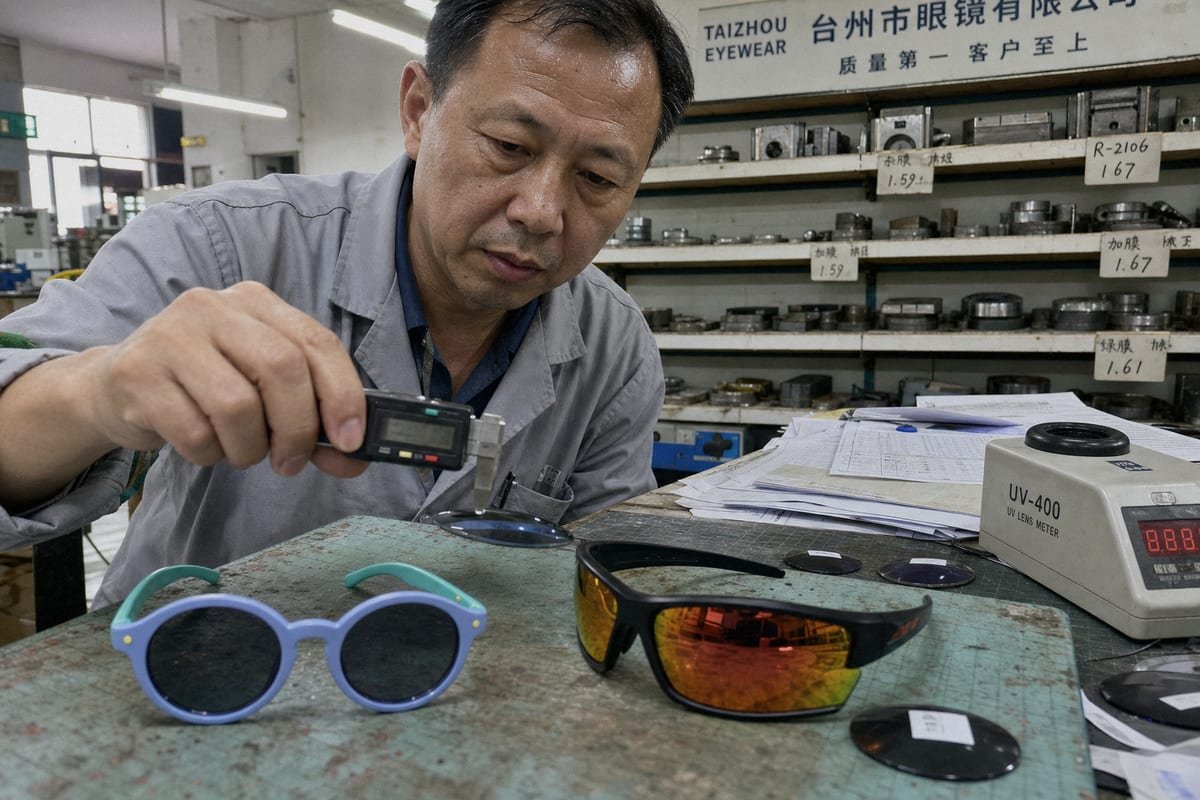
Buyers often ask me whether lens thickness decides the protective performance of kids’ sunglasses. On our production line in Taizhou, that question comes up in almost every sourcing call.
Lens thickness affects the protective performance of kids’ sunglasses far less than lens material and certification. A 1.0–2.0 mm polycarbonate or Trivex lens with verified UV400 protection outperforms a thicker standard plastic lens, because impact resistance and UV filtration come from the material, not the millimeters.
That answer surprises many first-time buyers. So let me break it down step by step. We will look at thickness, standards, materials, and how to verify a supplier actually tests all of this.
How thick should kids' sunglasses lenses be to guarantee real UV and impact protection?
Last spring, a European baby-brand buyer asked us to quote "the thickest lens possible" for safety. Our engineers had to walk her through why that brief missed the real point.
Kids' sunglasses lenses made from polycarbonate typically need only 1.0–2.0 mm of center thickness to pass impact testing, with 2.0 mm being the common safety-lens benchmark. UV protection is independent of thickness entirely — it comes from the lens material or its coatings, not physical depth.
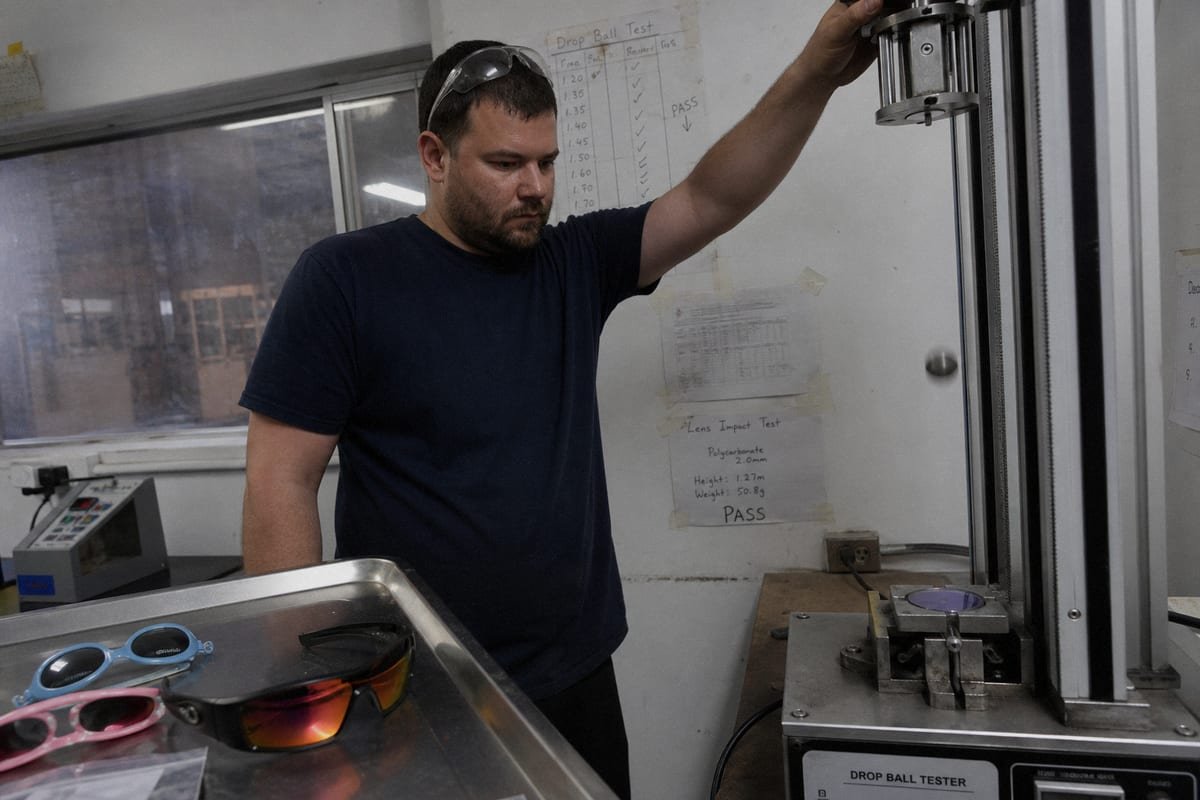
Thickness matters, but only within a sensible range. FDA guidance treats children's sunglasses intended for sun protection as impact-resistant devices, so they must pass drop-ball impact testing 1. Here is the key fact: even 1.0 mm center-thickness polycarbonate 2 exceeds those minimum impact requirements. Standards like ANSI Z80.3 3 focus on optical and UV performance, while high-impact safety ratings under ANSI Z87.1 commonly reference a 2.0 mm minimum for polycarbonate safety lenses.
Why thickness and UV protection are separate questions
UV400 protection 4 is a chemical property. UV absorbers are built into the lens material or applied as a treatment. A thin lens can block 100% of UVA and UVB. A thick lens with no UV additives can block almost nothing while looking dark and "safe." Tint is not protection. This is one of the most important points for pediatric eye health 5, because a dark, non-UV lens dilates a child's pupil and lets more harmful radiation in.
Where thickness genuinely helps
Extra thickness does help a lens absorb and dissipate kinetic energy from a fast-moving ball or rock. So for sports styles, we often specify closer to 2.0 mm. But more is not automatically better. Excessive thickness adds weight, which makes glasses slide down a small nose and expose the eyes to unfiltered light from above.
| Thickness | Typical use | Protection reality |
|---|---|---|
| ~1.0 mm polycarbonate | Lightweight casual kids' styles | Already exceeds FDA minimum impact requirements |
| 1.5–2.0 mm polycarbonate | Everyday and active kids' wear | Our standard recommendation; balanced weight and strength |
| 2.0 mm+ polycarbonate | Sports and shield styles | Extra energy absorption for high-velocity impacts |
| Any thickness, no UV additive | Not acceptable | Zero UV protection regardless of thickness |
Can thinner lenses still meet UV400 safety standards without compromising my brand's quality promise?
In our QC room, we spectrometer-test lens batches before assembly. I have watched featherlight lenses from our round pastel toddler frames block the full UV spectrum without any trouble.
Yes. Thin lenses meet UV400 safety standards without any compromise, because UV filtration is built into the lens material or its coating, not the thickness. A 1.0 mm polycarbonate lens can block 100% of UVA and UVB, protecting both children's eyes and your brand's quality promise.

This is where I encourage brands to shift their marketing language. Instead of promising "thick, sturdy lenses," promise verified UV400 protection, impact resistance, and comfortable fit. Those are the claims that both regulators and informed parents respect.
How UV400 works in a thin lens
UV400 means the lens blocks wavelengths up to 400 nanometers, covering all UVA and UVB. In polycarbonate lenses, UV blocking is essentially inherent to the polymer. Trivex 6 behaves the same way. That means the protection cannot rub off, scratch off, or fade the way a surface-only treatment might. When we develop UV400 or polarized lens options for our clients, we verify transmission with instrument testing on every batch, not just once at development.
The hidden risks of going too thin
I will be honest about the trade-offs, because a good partner should be. Ultra-thin lenses carry a few practical risks:
- Coating-induced embrittlement. Rigid hard-coatings on very thin lenses can create a brittle surface layer that acts as a crack initiator under high-stress impact.
- Thermal warping. Thinner lenses have lower thermal mass, so they can permanently warp if left on a hot car dashboard — a very real scenario in family life.
- Retention in the frame. A very thin lens needs a well-cut bevel and a snug groove, or it may pop out during a fall.
This is why our standard practice is a moderate thickness, never the absolute minimum. The lens stays light and comfortable, yet the optical clarity and structural safety margin remain solid. Your quality promise is protected by process control, not by adding millimeters.
What lens materials let me balance lightweight comfort with strong protective performance for children?
A trade-off we weigh daily: every gram we shave from a lens improves comfort, but the material must still shrug off playground abuse. After 15 years making children's eyewear, our answer rarely changes.
Polycarbonate and Trivex are the best lens materials for children's sunglasses. Both are lightweight, shatterproof, and block 100% of UV inherently. Polycarbonate is the proven default; Trivex adds slightly better optical clarity. Avoid glass and standard CR-39 plastic for active kids.
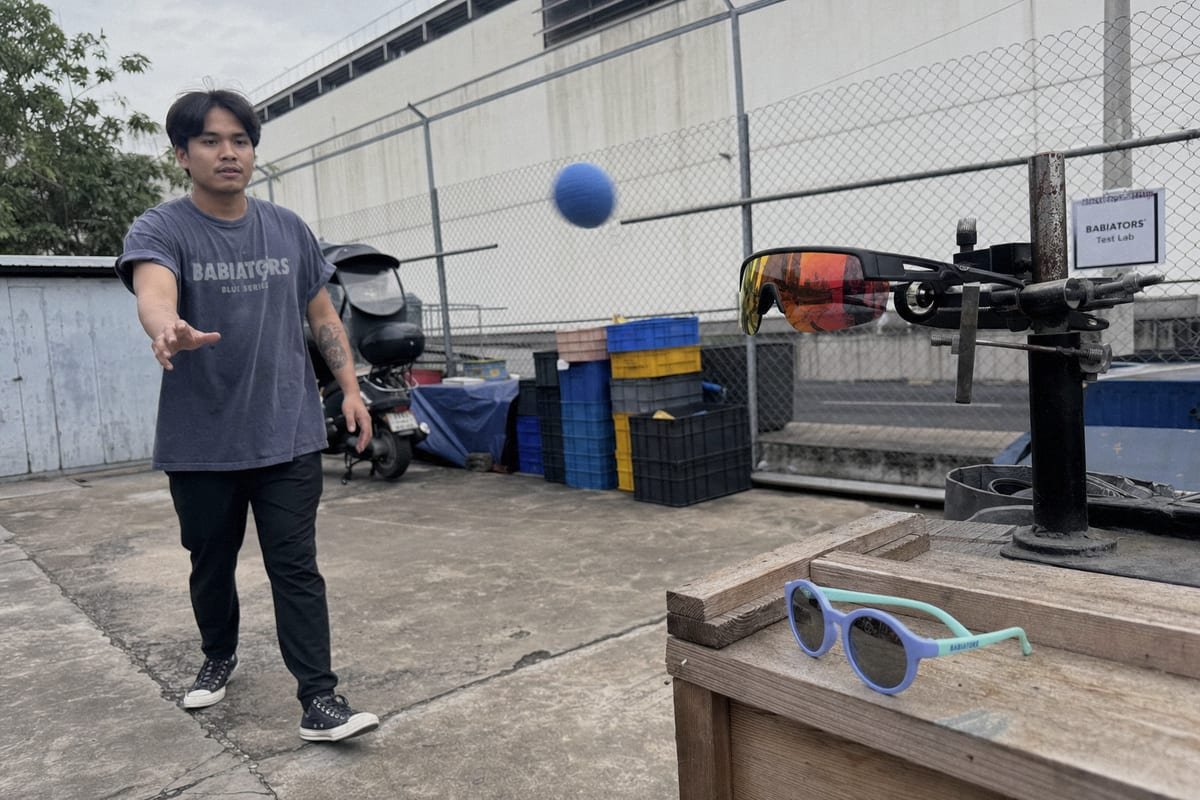
Material choice is where thickness and protection finally connect. A stronger material lets you use a thinner, lighter lens while keeping — or improving — impact resistance. That is the whole game in children's eyewear. Here is how the main options compare:
| Material | Impact resistance | Weight | UV blocking | Verdict for kids |
|---|---|---|---|---|
| Polycarbonate lenses | Excellent | Very light | Inherent, 100% | Best default choice |
| Trivex lenses | Excellent | Very light | Inherent, 100% | Great when optical clarity matters most |
| CR-39 / standard plastic | Poor–moderate | Light | Needs coating | Avoid for protective kids' eyewear |
| Glass | Poor unless very thick | Heavy | Varies | Wrong fit for active children |
| High-index plastics | Moderate | Light, thin | Usually coated | Prescription niche only, not the safety default |
Why material beats millimeters
Glass needs far greater thickness than polycarbonate to pass the same safety tests, and it still shatters into dangerous fragments. Polycarbonate flexes and absorbs energy instead of fracturing. That is why lens material durability, not raw thickness, defines real-world protection. It is also why we pair these lenses with flexible TPEE and TR90 frames in our own catalog — a shatterproof lens in a brittle frame is only half a safety system. Frame and lens must fail gracefully together.
Comfort drives compliance
There is a softer factor here that seasoned buyers understand. Sunglasses only protect a child who actually wears them. Lightweight lenses in flexible frames stay comfortable through a full day outdoors. Heavy lenses cause pressure points, sliding, and constant readjustment, and the glasses end up in a backpack. For our sport wraparound styles with mirrored shield lenses, we also check for visual distortion at the lens periphery, because a distorted view in a high-wrap design can affect a child's spatial awareness during play.
How do I choose a reliable manufacturing partner who tests lens thickness and safety consistently?
A procurement manager from Australia once told me she had received three shipments from a previous supplier, each with visibly different lens quality. That conversation shaped how we present our QC process today.
Choose a factory that measures lens center thickness with calibrated tools, verifies UV400 transmission by instrument on every batch, performs impact testing to FDA and ANSI-referenced protocols, and documents results in inspection reports. Ask for their QC checkpoints, sample retention policy, and third-party test history.

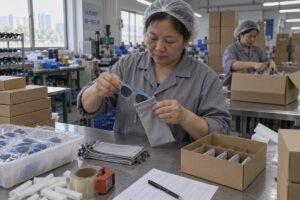
Consistency is the real product a manufacturing partner sells you. Almost any factory can produce one good sample. The question is whether piece number 40,000 matches piece number 40. In our 5S-managed workshop 7, with around 120 workers, we built the answer into the process rather than relying on final inspection alone.
A practical audit checklist for buyers
When you evaluate a supplier — including us — walk through these steps:
- Ask how they measure lens thickness. They should use calibrated thickness gauges at incoming inspection, with recorded tolerances, not eyeball checks.
- Ask how UV400 is verified. Batch-level spectrometer testing is the standard. A certificate from two years ago is not verification.
- Ask about impact testing. They should describe drop-ball testing and reference relevant standards such as FDA impact requirements and ANSI Z80.3 for sunglass performance.
- Ask about frame-lens retention. A safe lens must stay seated in its groove during impact, especially in high-wrap sports frames.
- Ask about traceability. Can they trace a finished order back to its lens batch? If not, a failure cannot be contained.
What consistency looks like in practice
| QC checkpoint | What should happen | Red flag |
|---|---|---|
| Incoming lenses | Thickness, optical clarity, and UV transmission checked per batch | "Our lens supplier already tests them" |
| In-process assembly | Lens seating and hinge torque spot checks | No in-process records at all |
| Final inspection | AQL sampling plus function checks on flexible frames | Only cosmetic inspection |
| Documentation | Inspection reports shared with the buyer | Reports available "on request" but never sent |
One more signal worth watching: whether the factory pushes back on bad specifications. When a client asks us for something that would hurt safety — like ultra-thin lenses in a rough-play sports style, or a heavy glass lens for toddlers — we say no and explain why. With around 800 existing styles, we can usually redirect a buyer to a proven construction instead of experimenting on children's faces. A partner who never disagrees with you is not protecting your brand.
Conclusion
Parents assume thicker lenses mean safer kids' sunglasses. They do not. Material, UV400 verification, fit, and disciplined factory testing decide protection. Choose polycarbonate or Trivex, moderate thickness, and a partner who proves consistency.
Footnotes
1. CPSC oversees consumer product impact-testing standards relevant to children’s protective eyewear safety. ↩︎
2. Background on polycarbonate’s material properties clarifies why it resists shattering better than glass. ↩︎
3. Background on ANSI clarifies the standards body behind the referenced sunglass performance requirements. ↩︎
4. NIH resource explains UV radiation risks, supporting the claim that UV400 protection depends on material chemistry. ↩︎
5. CDC vision health resource supports claims about children’s eye protection and UV exposure risks. ↩︎
6. Wikipedia overview explains Trivex composition, supporting claims about its UV-blocking and optical properties. ↩︎
7. Government (EPA) resource explaining the 5S methodology within lean manufacturing frameworks. ↩︎
More Articles You Might Like

Looking for a Reliable Kids Eyewear Partner?
Explore 800+ ready styles and full OEM/ODM support tailored to your brand.
Get in Touch English
  Español de México
  Deutsch
  Français
  日本語
日本語  العربية
  Português do Brasil