How Is Impact Resistance Tested in Kids’ Sunglasses, and What’s a Passing Level?
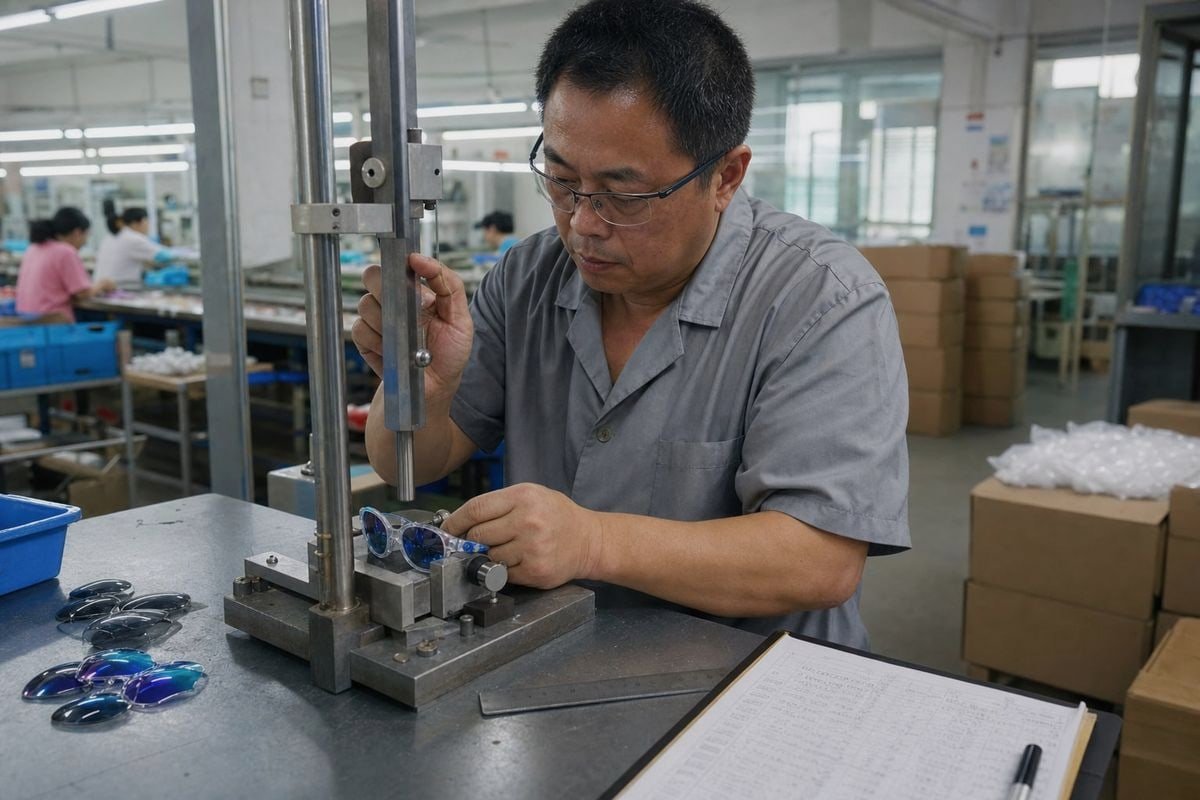
Impact resistance in kids’ sunglasses is something I check daily on our production line — because a lens that shatters near a child’s eye is every buyer’s worst nightmare.
Impact resistance in kids’ sunglasses is tested with the FDA drop ball test: a 5/8-inch steel ball weighing 0.56 ounces is dropped from 50 inches onto the lens center. A passing lens must not fracture, crack through, or shed fragments toward the eye.
That is the short answer. But the details matter — [which standard applies](https://okayeyewear.com/what-impact-resistance-standards-kids-sunglasses-meet-should/), how the test is actually run, and what “pass” really means personal protective equipment 1. Let me walk you through it.
How do I know which impact resistance standard my kids' sunglasses need to meet?
A buyer from Australia once asked me why her US distributor and her EU distributor requested two different test reports for the same sunglasses. The answer lies in regional standards.
The standard depends on the destination market: the US requires the FDA drop ball test under 21 CFR 801.410 plus ANSI Z80.3, Europe uses ISO 12312-1, and Australia follows AS/NZS 1067.1. Sports-marketed eyewear may additionally need ASTM F803 sports safety testing.

Over 15 years of exporting children's eyewear to more than 20 countries, we have learned that no single test report covers the world. Each market has its own rulebook, and the differences are real, not just paperwork.
The main standards at a glance
| Market | Standard | Impact test method | What "pass" means |
|---|---|---|---|
| USA | FDA 21 CFR 801.410 2 + ANSI Z80.3 | 5/8-inch steel ball dropped from 50 inches | No through-crack, no fracture, no fragments detaching from the eye-side surface |
| Europe | ISO 12312-1 3 compliance | Robustness test with a 22 mm steel ball under static load, plus optional impact classes | Lens and frame stay intact under the specified load |
| Australia / NZ | AS/NZS 1067.1 | Aligned with ISO methods, mandatory for sale | Compliance with the harmonized robustness requirements |
| Sports use | ASTM F803 4 | High-velocity projectiles at sport-specific speeds | Eyewear withstands impact and stays on the face |
Two questions that decide your standard
First, where will the sunglasses be sold? The FDA drop ball test is the legal baseline for any sunglasses entering the US, because the FDA classifies sunglasses as medical devices 5. Europe treats sunglasses as PPE under ISO 12312-1, and Australia enforces AS/NZS 1067.1 as a mandatory standard.
Second, how will the product be marketed? If your packaging says "sports-ready" or shows a child playing baseball, regulators and retailers may expect ASTM F803 sports safety compliance, which is a much tougher test involving high-velocity impact protection, lens retention, and peripheral coverage. Everyday beach sunglasses do not need that level — but the claims on your box must match the tests behind them.
When our buyers are unsure, we ask about their retail channels and marketing claims first, then map the right test plan. That conversation up front prevents rejected shipments later.
What testing methods does OKAY EYEWEAR use to verify impact resistance before shipment?
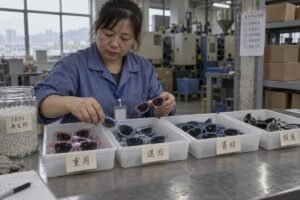
In our 5S-managed workshop in Taizhou, the QC bench sits right beside the assembly line — on purpose. Impact checks happen during production, not just after it.
We verify impact resistance through the FDA-style drop ball test on lens samples from each batch, plus frame flex and torsion checks, temple pull tests, and lens retention checks. Statistical batch sampling ensures consistency without destroying every unit.
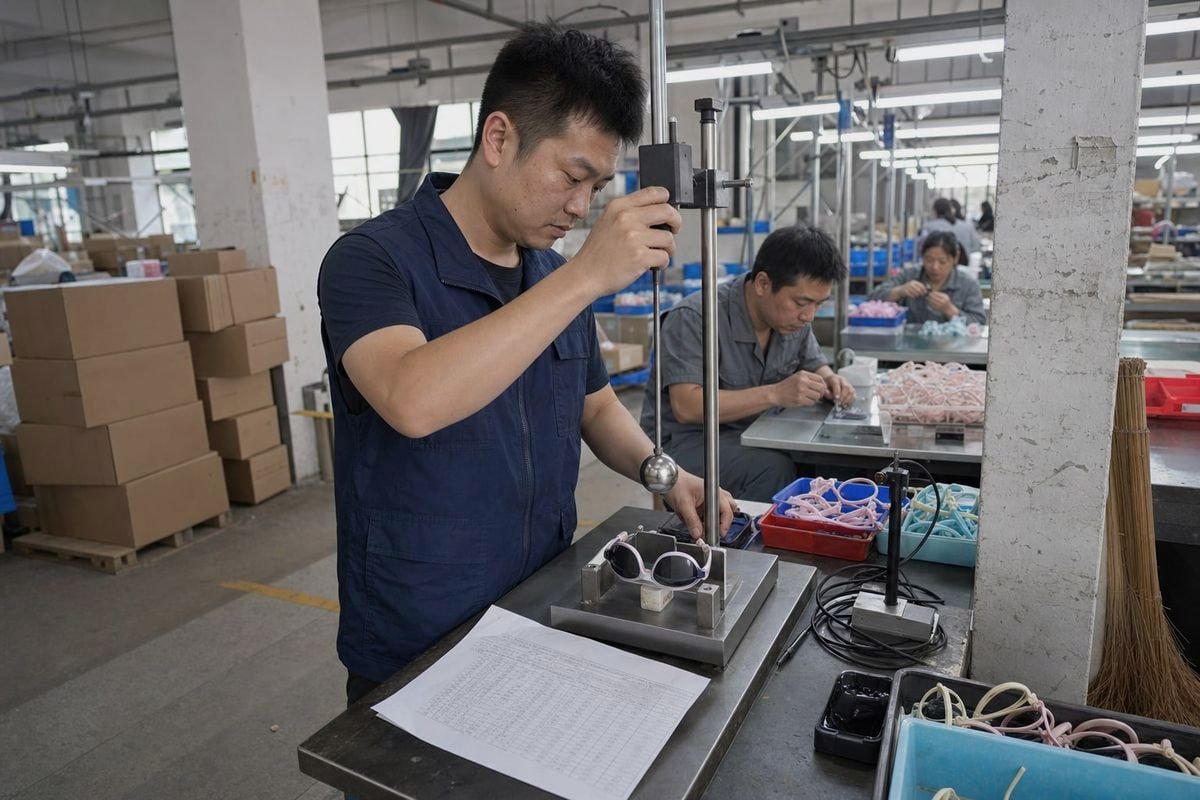
Our approach follows a simple logic: the lens must survive impact, and the frame must keep that lens where it belongs. Testing only one of the two leaves a gap in eye injury prevention.
Our step-by-step verification process
- Incoming lens inspection. We check lens material certificates and thickness before molding begins, because polycarbonate 6 lens durability starts with resin quality.
- Drop ball testing on batch samples. A 5/8-inch steel ball is guided through a tube ending about 4 inches above the lens and dropped from 50 inches onto the horizontal lens surface. The impact must land within a 5/8-inch circle at the lens center, with the lens mounted in a proper support fixture.
- Pass/fail judgment. The lens fails if a crack runs through its full thickness, if it separates into two or more pieces, or if any material detaches from the surface nearest the eye. There is no score — it is strictly binary.
- Frame and retention checks. We flex temples through repeated open-close cycles, twist the frame front, and verify the lens does not pop out under normal stress. A shatter-resistant eyewear lens is useless if it ejects backward into a child's face.
- Final random inspection. Before packing, we pull finished units at random from cartons and repeat key checks.
Why we sample rather than test every lens
The drop ball test is destructive in failure cases, so regulations allow statistical batch sampling for non-prescription lenses. We test a defined percentage of each production run. If any sample fails, we hold the entire batch, investigate the root cause, and retest. In fifteen years, this discipline has kept our rejection disputes with buyers close to zero — and it keeps our name off any recall list.
Why do TR90 and TPEE materials perform better in impact resistance tests than rigid frames?
The trade-off we weigh in every new development project is simple: stiffness gives a frame a premium hand-feel, but flexibility is what saves it when a child sits on it.
TR90 and TPEE absorb and disperse impact energy by flexing instead of snapping. Rigid acetate or hard plastic frames concentrate stress at hinges and lens grooves, so they crack under the same force that flexible frame materials simply bend through and recover from.
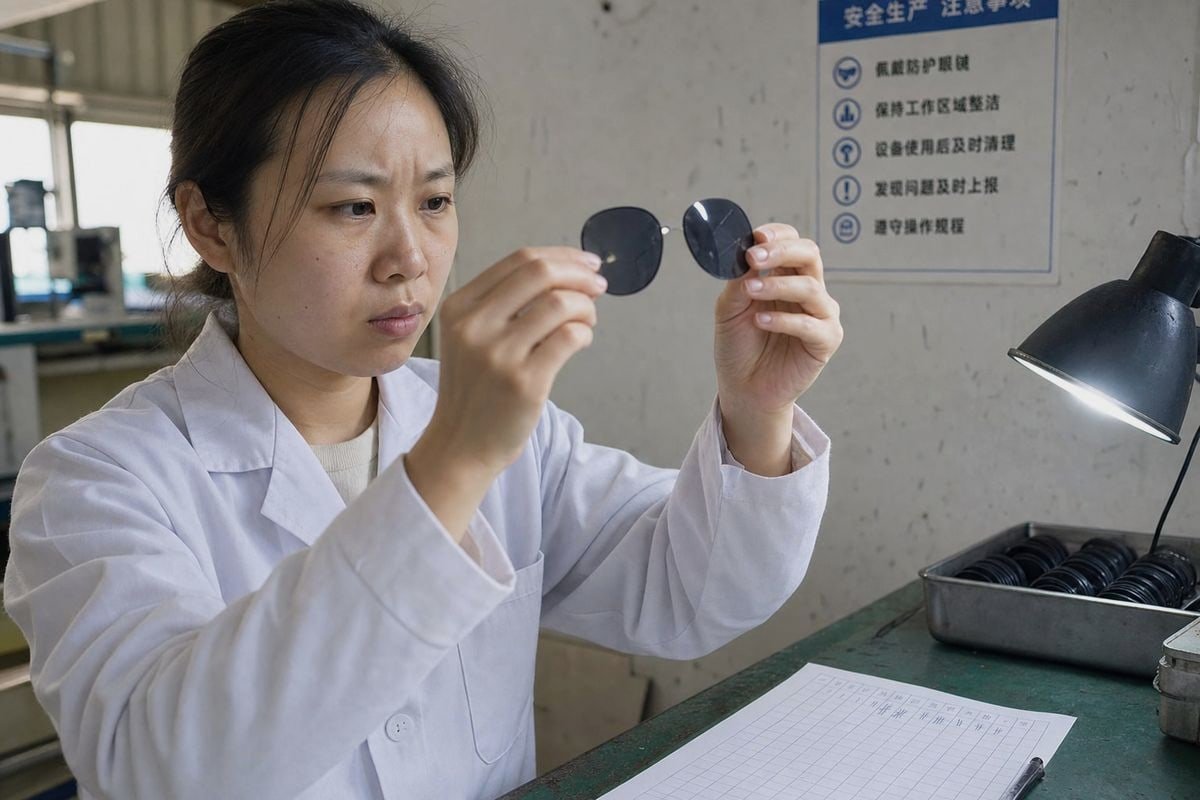
Our engineers have twisted, dropped, and frozen thousands of frames over the years. The pattern is consistent: material choice decides whether an impact ends in a bounce or a break.
How the materials compare
| Property | TR90 | TPEE | Rigid plastic / acetate |
|---|---|---|---|
| Flexibility | High — memory polymer returns to shape | Very high — rubber-like elasticity | Low — brittle under sharp impact |
| Weight | Very light | Very light | Heavier |
| Failure mode | Bends, rarely cracks | Bends, almost never cracks | Snaps at stress points |
| Skin safety on impact | No sharp edges formed | No sharp edges formed | Can create sharp broken edges |
| Best use | Frame fronts, full frames | Temples, baby frames | Adult fashion frames |
The physics in plain English
When the steel ball or a playground collision hits a rigid frame, the energy has nowhere to go. It concentrates at the weakest points — usually the hinge screws and the lens groove. The material reaches its stress limit fast and fractures. Worse, rigid plastics break into sharp-edged pieces near a child's face.
TR90 is a thermoplastic memory polymer 7. It deforms under load, spreads the energy across a wider area, and springs back. TPEE goes further — it behaves almost like rubber, which is why we use it for temples and for our youngest age groups. Our TR90 frames with TPEE temples combine a stable front with temples a toddler can twist without breaking.
Pair those frames with polycarbonate lenses — the same shatter-resistant material family as Trivex material properties in premium optics — and the whole unit works as a system. The lens resists the impact; the frame absorbs the shock and holds the lens in place. That system thinking is why flexible-material eyewear consistently outperforms rigid frames in both formal tests and real playground life.
How can I request test reports or certifications to prove impact resistance to my customers?
A procurement manager from Japan once told me she chose us over a cheaper quote because we sent full test documentation before she even asked. That lesson shaped how we handle paperwork today.
Ask your supplier for third-party lab reports referencing the specific standard — FDA drop ball test, ANSI Z80.3 standard, ISO 12312-1, or ASTM F803 — matched to your market. Reports should name the exact model, batch, test date, and pass criteria, not generic claims.
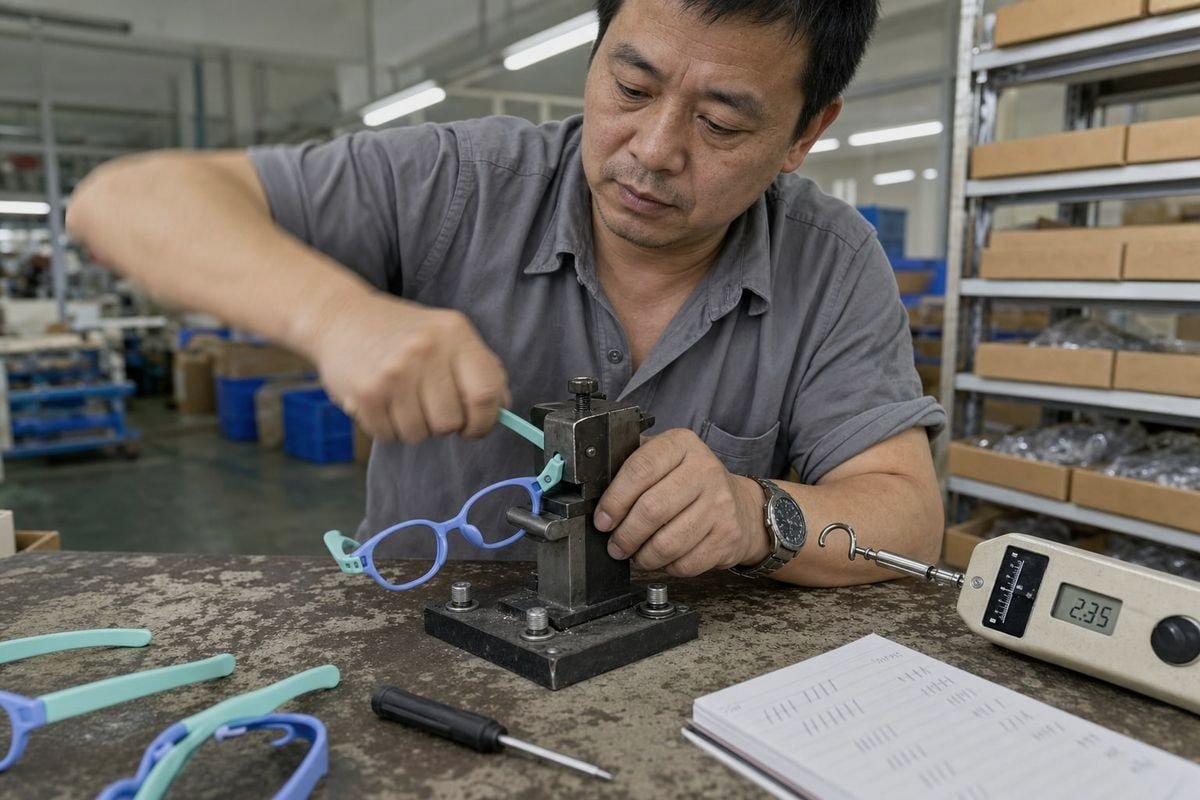
Documentation is where many buyers get caught. A vague "impact resistant" line on a spec sheet is a marketing phrase, not proof. Retailers, customs authorities, and end customers increasingly ask for the real evidence behind the claim.
What a credible test report should contain
| Report element | Why it matters |
|---|---|
| Named standard and clause | Confirms the test method, e.g., 21 CFR 801.410 or ISO 12312-1 |
| Specific model number and lens material | Prevents a report for one SKU being reused for another |
| Batch or production date | Ties results to your actual shipment |
| Accredited lab identity | Third-party labs carry more weight than in-house-only data |
| Pass/fail statement with criteria | Shows the binary result, not vague "good performance" wording |
How we support buyers with documentation
At our factory, documentation support is part of the OEM/ODM service, not an extra. Here is the process we recommend to every new brand partner:
- Tell us your target markets and retail channels at the quotation stage.
- We confirm which standards apply and quote testing into the project timeline.
- Samples from your actual production run go to an accredited third-party lab.
- You receive the full report, which you can share with retailers and distributors.
- For repeat orders, we advise periodic retesting — coatings, colorants, and even long-term UV exposure can change lens behavior over time, so a report from two years ago may not reflect today's batch.
One more practical tip: keep reports linked to your customs paperwork. When a shipment is questioned at import, a report that matches the invoice model numbers resolves the issue in days instead of weeks. Buyers who plan this early rarely face compliance surprises later.
Conclusion
Impact resistance in kids' sunglasses comes down to
More Articles You Might Like


Looking for a Reliable Kids Eyewear Partner?
Explore 800+ ready styles and full OEM/ODM support tailored to your brand.
Get in Touch English
  Español de México
  Deutsch
  Français
  日本語
日本語  العربية
  Português do Brasil