How to Handle Returned Damaged Kids’ Sunglasses & Share Cost With Supplier?
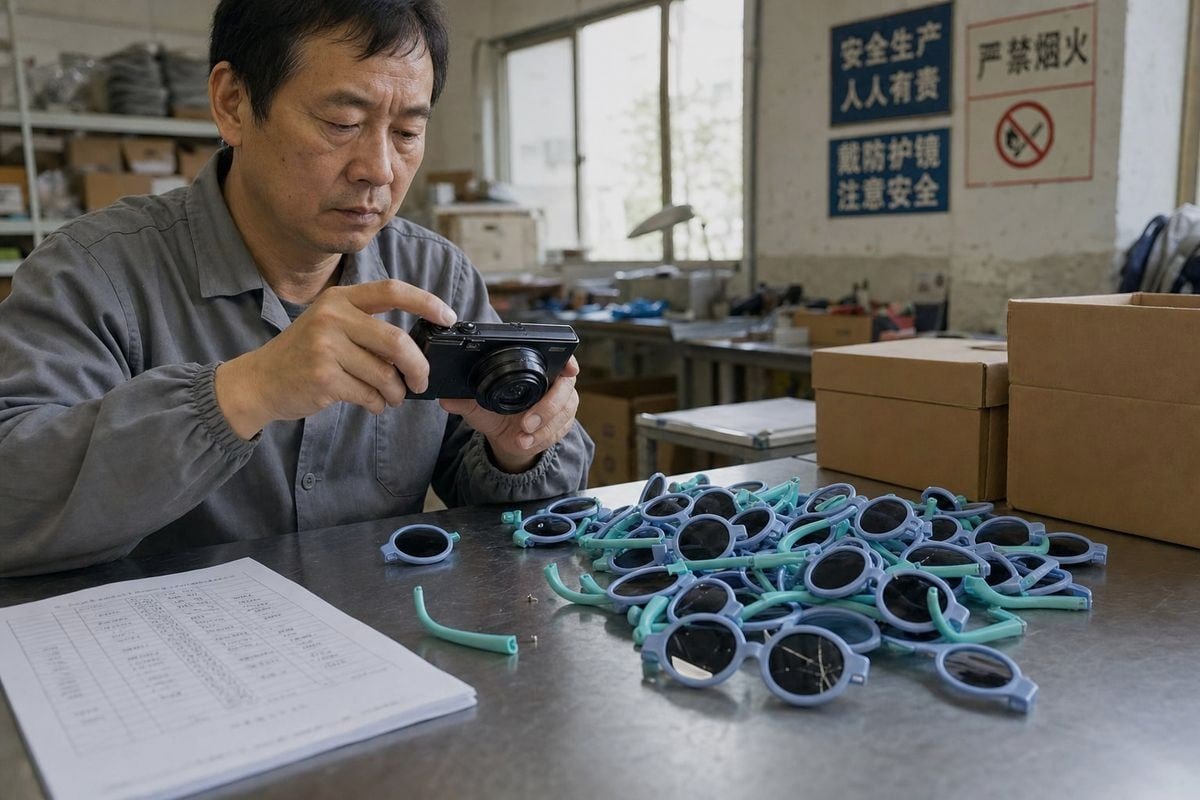
Returned damaged kids’ sunglasses drain margin fast. On our Taizhou production line, we have watched buyers lose money simply because nobody agreed in advance who pays for what.
To handle returned damaged kids’ sunglasses, freeze the refund, photograph the damage within 48 hours, classify the cause as defect, shipping, or misuse, then claim a supplier chargeback for genuine defects, negotiate a split for unclear cases, and absorb customer-caused damage yourself.
That single sentence hides a lot of detail. Below, I will walk through the full process: setting cost-sharing terms, collecting evidence, diagnosing the damage, and preventing repeat returns.
How can I set fair damage cost-sharing terms with my sunglasses supplier?
A buyer from Australia once asked me a blunt question: "Alan, if these break, who pays?" That conversation reshaped how we draft every vendor liability agreement at our factory.
Fair cost-sharing terms are set before the first purchase order: agree on an AQL threshold, a defect allowance of one to three percent off the invoice, digital-evidence claims instead of physical returns, and a rolling credit ledger applied to future production runs.

The worst time to negotiate cost sharing is after a pallet of broken frames arrives. The best time is inside the master service agreement, before production starts. In our fifteen years supplying children's and baby product brands across twenty-plus countries, the smoothest partnerships always had these terms in writing from day one.
The four building blocks of a fair agreement
First, define "defective" using Acceptable Quality Limit (AQL) 1 standards. A bent TPEE temple that springs back is normal flexibility. A hinge screw that falls out is a defect. Write the difference down. Second, agree on a defect allowance. Many of our long-term buyers take a small flat discount on each invoice. That discount self-funds routine customer returns and removes the paperwork of chasing individual claims. Third, agree that photos and videos settle claims. Shipping a $2 pair of kids' sunglasses back to China costs more than the product replacement cost, so digital evidence plus a local destruction agreement is the practical route. Fourth, use a credit memo system rather than cash refunds. Credits applied to the next order keep both sides invested in the relationship.
| Cost-sharing mechanism | How it works | Best for |
|---|---|---|
| Defect allowance (1–3% off invoice) | Buyer self-funds routine returns | High-volume, low-ticket orders |
| Supplier chargeback per claim | Credit memo issued for each proven defect | Occasional, well-documented defects |
| Batch failure clause | Supplier covers the whole shipment if a sample set shows a systemic flaw | Structural or material failures |
| Rolling credit ledger | Return value offsets future production runs | Ongoing partnerships |
One more point. Safety failures deserve zero tolerance. If a lens shatters or a part becomes a choking hazard 2 on a children's product, mandatory compliance standards like CPSIA 3 give you leverage to demand 100% supplier-funded replacement. We accept that standard for our own goods, and you should expect it from any factory.
What evidence do I need before requesting a refund or credit for damaged returns?
Early in our export business, we rejected a claim because the buyer sent one blurry photo taken weeks after delivery. Both sides lost. Since then, we coach every customer on evidence.
Before requesting a refund or credit, collect the order number and lot code, dated photos of the item and packaging, the customer's damage report, your inspection notes from the first 48 hours, and a completed RMA form linking everything to the original shipment.
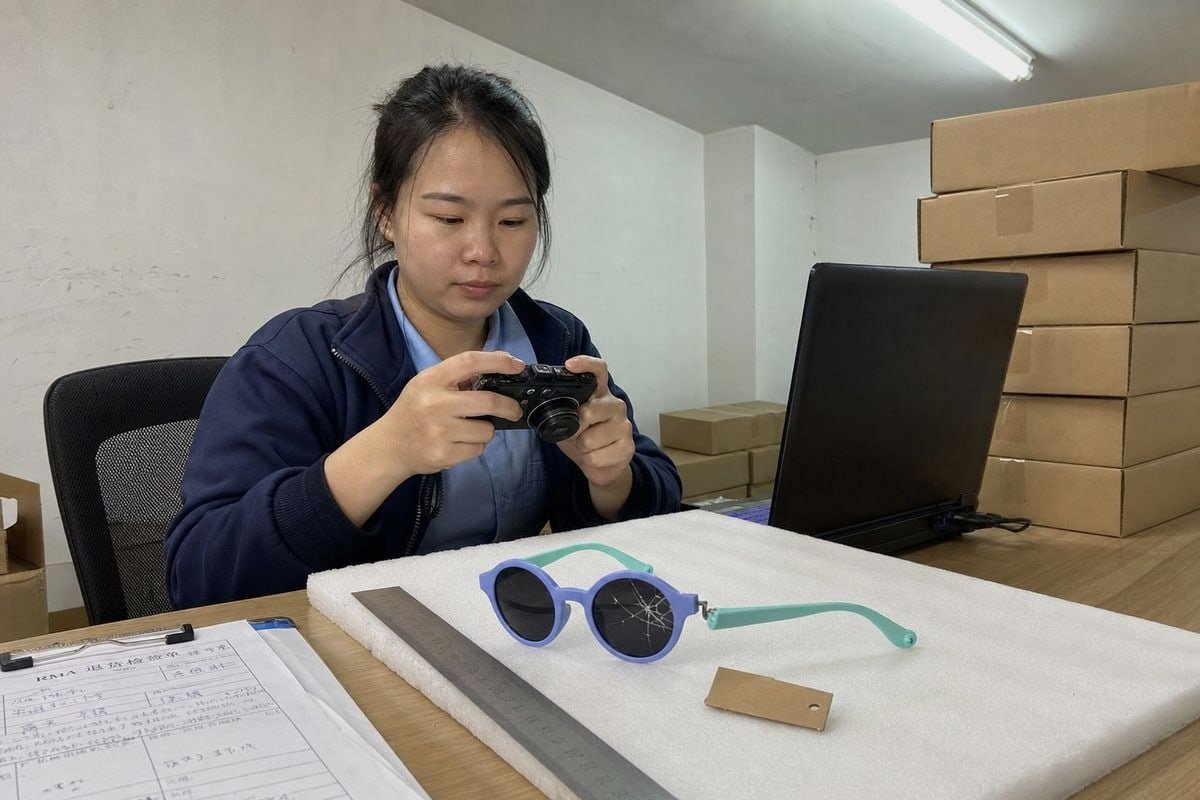
Evidence is the currency of every supplier claim. Without it, a credit request is just an opinion. With it, the conversation becomes short and factual. I have approved credit memos in under a day when the buyer's documentation was complete, because there was nothing left to argue about.
Build a simple RMA process
A formal Return Merchandise Authorization (RMA) 4 process sounds corporate, but for a small brand it can be one spreadsheet and one folder of photos. The steps are simple.
- Log the return the day it arrives. Record the SKU, order number, and lot code 5.
- Photograph everything before touching it: outer box, inner packaging, and the sunglasses from multiple angles.
- Compare against the pre-shipment inspection photos from the original order.
- Record the customer's own statements: when they noticed the damage, whether the packaging was intact, and whether the item was worn.
- Classify the damage and file it under defect, shipping, or misuse.
What strong evidence looks like
| Evidence type | Why it matters | Weight in a claim |
|---|---|---|
| Dated unboxing photos or video | Proves condition at delivery | Very high |
| Lot code and SKU trace | Links the unit to a specific production batch | High |
| Customer damage report | Establishes timing and usage | Medium |
| Original packaging condition | Separates transit damage from factory defects | High |
| Retailer inspection log | Shows the return was validated, not assumed | Medium |
Timing matters as much as content. Many eyewear sellers require damage reports within 7, 14, or 30 days. Suppliers think the same way. A claim filed within a week of receiving the return is credible. A claim filed three months later invites doubt. And warn your customers not to repair frames themselves; a glued hinge can void the entire claim.
How do I tell if returned sunglasses were damaged by shipping, retail handling, or a manufacturing defect?
There is a trade-off I weigh every time a claim photo lands in my inbox: investigate deeply and delay the buyer, or approve quickly and risk paying for damage we did not cause. Good diagnosis solves both.
Manufacturing defects show up as repeated failures at the same point, such as hinges or lens coatings, across multiple units from one batch. Shipping damage matches crushed or torn packaging. Retail or customer damage shows scratches, flex marks, and wear on an otherwise sound product.

Every damage type leaves a signature. Once you learn to read those signatures, most disputes disappear because the physical evidence answers the question for you. Here is the diagnostic logic we use in our own QC room when a return comes back for analysis.
| Damage signature | Likely cause | Who typically bears the cost |
|---|---|---|
| Same hinge or weld failing on several units from one lot | Manufacturing defect | Supplier, via chargeback or batch clause |
| Crushed frame plus crushed or punctured carton | Shipping damage | Carrier claim; depends on incoterms |
| Deep lens scratches, bite marks, stretched temples | Customer or child misuse | Retailer or customer |
| Peeling lens coating within days of normal use | Material or coating defect | Supplier |
| Loose screws with intact packaging | Assembly defect or retail handling | Investigate frequency first |
The pattern test
One damaged unit tells you little. Five units from the same lot with the same broken hinge tell you everything. That is why lot tracking matters. When we produce TR90 frames with TPEE 6 temples, each batch carries a lot code. If a buyer reports a pattern, we pull retained samples from that lot and re-test them. A systemic flaw triggers our batch responsibility, not a one-by-one debate. This is also where the manufacturing defect rate becomes a useful number: if returns from one shipment run far above your normal baseline, treat it as a batch problem and escalate it as one.
The packaging test
Shipping damage almost never leaves the packaging pristine. If the sunglasses are snapped but the box, blister, or pouch is perfect, transit is an unlikely culprit. Conversely, a torn carton with a bent frame points to shipping damage claims against the carrier, and responsibility then follows whoever controlled the freight under your incoterms.
What quality control steps can prevent future returns of damaged kids' sunglasses?
The lesson that changed our workshop came from a Japanese optical buyer who rejected a shipment over hinge torque inconsistency. We tightened our quality control standards 7, and returns from that account nearly vanished.
Prevent returns of damaged kids' sunglasses through incoming material checks, in-line hinge and stress testing, AQL-based final inspection, drop and flex tests on flexible frames, protective retail-ready packaging, and lot coding so any field failure traces back to its batch.
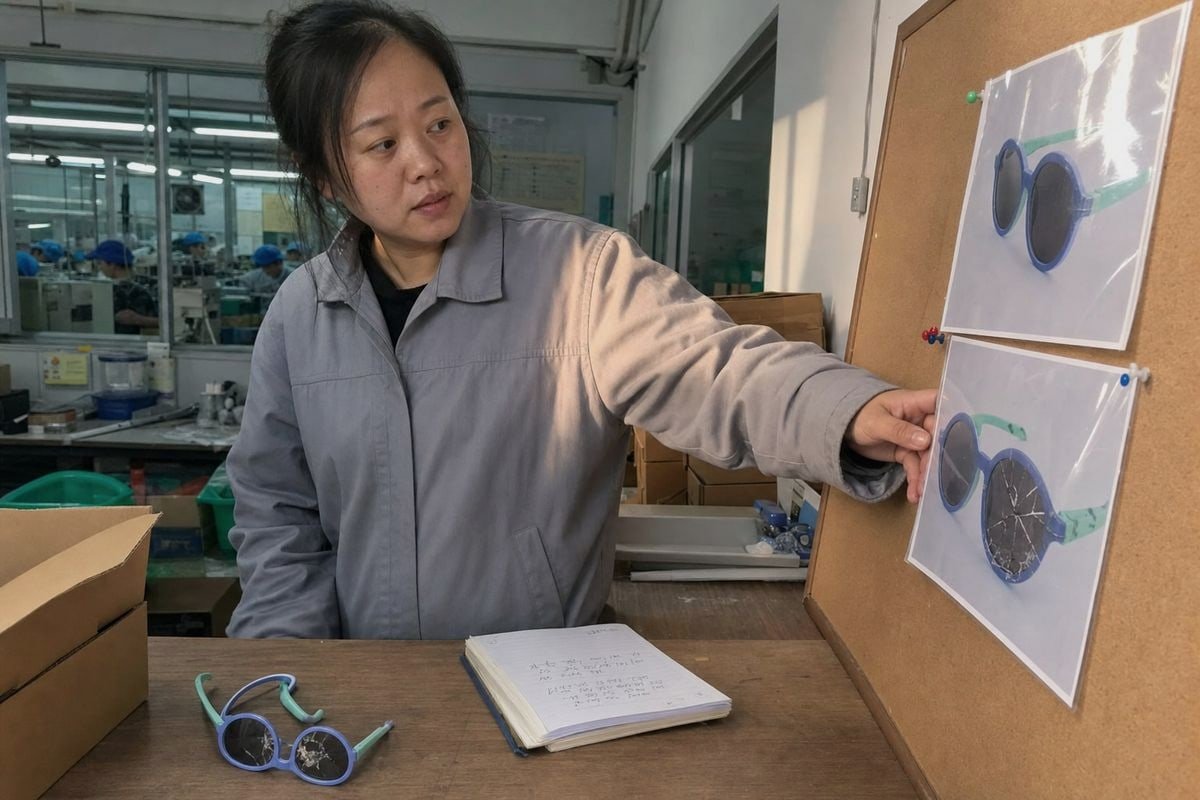
Prevention is cheaper than any cost-sharing formula. Every return you never receive saves the product replacement cost, the return freight, the inspection time, and a small piece of customer trust. In our 5S-managed workshop, we treat QC as a chain with five links, and a return means one link failed.
The five-link QC chain
- Material verification. We start with TPEE and TR90 because flexible materials survive children better than rigid plastics. Brittle, cheap resin is the root cause behind many snapped kids' frames, so material choice is the first QC decision, not the last.
- In-line inspection. Hinges, screws, and lens seating get checked during assembly, not only at the end. Catching a loose hinge on the line costs seconds; catching it in a customer return costs a claim.
- Stress testing. Kids' sunglasses should survive twisting, flexing, and drops. We test temples through repeated open-close cycles and flex frames well past normal wearing angles.
- AQL final inspection. Sampling against agreed quality control standards before packing gives both sides a shared reference point. It also protects your wholesale return policy, because you can prove goods left the factory conforming.
- Packaging and lot coding. A well-designed box prevents transit damage, and a lot code on each polybag turns any future complaint into a traceable data point instead of a mystery.
There is a buyer objection worth addressing here. Some founders worry that strict QC and strict return rules will feel hostile to parents. The opposite is true. Tight factory QC lets you offer a generous customer-facing policy safely, because genuine defects become rare. You can replace a broken pair for a parent without a fight, then recover the cost upstream instead of eating an inventory write-off. Strictness belongs at the factory gate, not at the customer service desk.
Conclusion
Damaged returns will happen; unmanaged losses do not have to. Document fast, diagnose the cause, share costs by written agreement, and choose a factory whose QC prevents most claims. Policies vary by jurisdiction and contract, so confirm the details with your own supplier — we are always glad to talk through them.
Footnotes
1. Explains the sampling standard buyers and suppliers use to define acceptable defect rates. ↩︎
2. CPSC guidance on toy and children’s product choking hazards supports the safety claim made. ↩︎
3. Official source describing the US children’s product safety law referenced for zero-tolerance defects. ↩︎
4. Background definition of the RMA process buyers are told to set up. ↩︎
5. GS1 standards explain batch/lot coding used for product traceability in claims. ↩︎
6. Explains the flexible elastomer material used in children’s eyewear temples. ↩︎
7. ISO’s own quality management resource backs the referenced factory inspection standards. ↩︎
More Articles You Might Like
August 1, 2026
Should Factory Handle Kids Sunglasses Packaging & Labeling, or Use a Designated Supplier?
August 1, 2026
Own Warehouse vs Supplier Direct Fulfillment: Which Cuts Return Costs for Kids Sunglasses Brands?

August 1, 2026
Direct-to-Port Warehouse or Overseas Staging: Which Saves More on Kids Sunglasses Shipping?
Looking for a Reliable Kids Eyewear Partner?
Explore 800+ ready styles and full OEM/ODM support tailored to your brand.
Get in Touch English
  Español de México
  Deutsch
  Français
  日本語
日本語  العربية
  Português do Brasil