How Do Cartoon-Shaped Kids’ Sunglasses Meet Toy Safety Directive and EN 71 Tests?
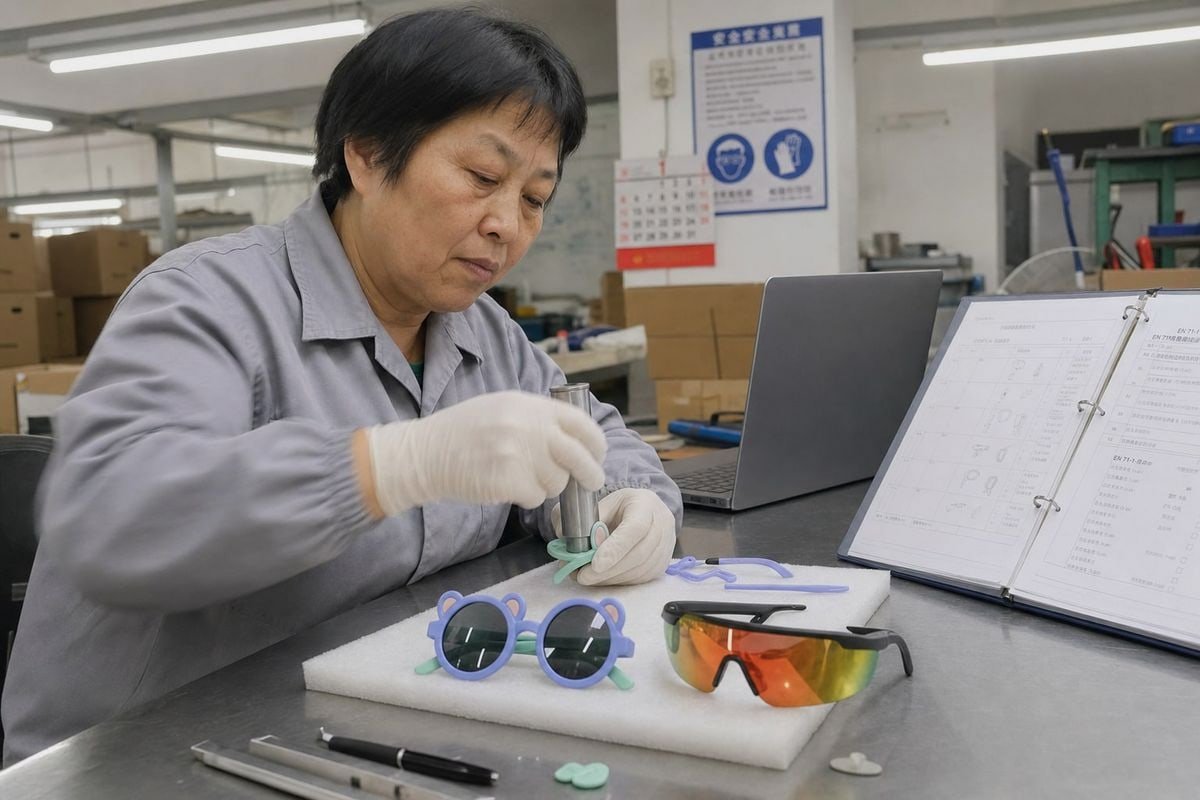
Cartoon-shaped kids’ sunglasses sit in a regulatory gray zone, and on our production line we see buyers discover this too late. A blocked shipment at EU customs can erase a season’s profit. The fix is understanding when EN 71 applies — before you order.
Cartoon-shaped kids’ sunglasses meet the Toy Safety Directive when their play value triggers 2009/48/EC compliance. That means EN 71-1 mechanical testing for sharp edges and small parts, EN 71-2 flammability checks, EN 71-3 chemical migration limits, plus CE marking backed by a technical file.
The rules depend on how your product is designed, marketed, and age-graded. Below, I walk through classification, the specific EN 71 tests, supplier documentation, and the material choices that make passing easier.
How Do I Know If Cartoon-Shaped Sunglasses Count as Toys Under EU Regulations?
A German importer once asked us to add detachable animal ears to a standard kids' frame. That single design change moved the product from eyewear rules 1 into toy territory — and we told him so before tooling started.
Cartoon-shaped sunglasses count as toys under EU regulations when their intended purpose or presentation gives them play value. EN 71-1 states sunglasses meant purely for eye protection are not toys, but novelty character designs marketed for dress-up or amusement fall under Directive 2009/48/EC.
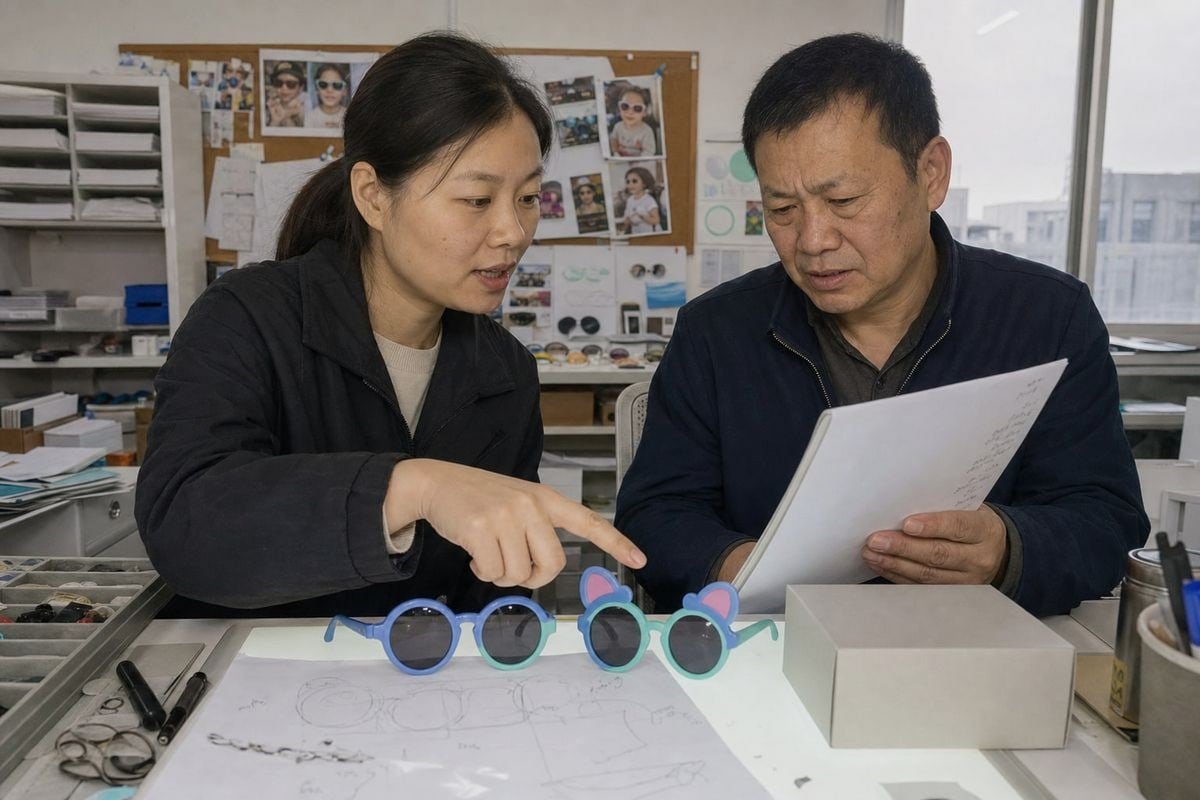
The key question is not "Is it sunglasses?" but "Is it intended or marketed as a toy?" Regulators look at intended purpose 2 and presentation, not just the object's basic form. A pair of standard round kids' sunglasses — like our two-tone periwinkle-and-mint frames — sold mainly to block sunlight is assessed under eyewear rules, typically the ISO 12312-1 standard. But add oversized cartoon character faces, animal shapes, or costume styling, and the primary appeal shifts to play. That shift triggers toy classification.
The Dual-Compliance Reality
Some buyers argue their cartoon sunglasses are "just eyewear" and should only be tested as sunglasses or PPE. I understand the appeal of that position — one test report is cheaper than two. But in our fifteen years exporting children's eyewear to more than twenty countries, we have seen that argument fail at market surveillance. If your listing shows a child playing dress-up, or your gift-box packaging emphasizes the character theme, the product carries play value. Many cartoon styles end up under a dual-compliance mandate 3: ISO 12312-1 for the optical and UV function, plus the EN 71 series for the toy function.
Signals That Push a Product Toward Toy Classification
| Signal | Eyewear Classification | Toy Classification |
|---|---|---|
| Design | Standard frame shapes | Character faces, animal ears, costume features |
| Marketing | "UV protection for kids" | "Fun dress-up shades", party or gift themes |
| Packaging | Optical-style case | Toy-style blister or gift box |
| Lens function | Genuine UV400 protection levels 4 | Decorative or tinted-only lenses |
| Age presentation | General children's sizing | Cartoon age-group branding |
Online marketplaces make this riskier. Listings often emphasize cartoon styling over protective function, and that presentation alone can push classification toward toys.
What EN 71 Tests Should I Require Before Importing Cartoon Kids' Sunglasses?
Before we release any novelty style from our Taizhou workshop, our QC team runs internal abuse checks that mirror laboratory safety testing — because a frame that sheds a decorative nose during a drop test will fail the real thing too.
Require EN 71-1 mechanical tests for sharp edges, sharp points, small parts, tension, torque, drop, and impact; EN 71-2 flammability testing because the product is worn on the head; and EN 71-3 testing for migration of certain elements from paints, coatings, and plastics.

EN 71-1 mechanical properties testing is the core of the framework. It simulates how children actually use — and misuse — products. For a sunglasses-style toy, the vulnerable points are the decorative ears, character noses, lenses, hinges, temple arms, stickers, and foam embellishments. Each of these can detach, fracture, or expose sharp edges under stress.
The Three EN 71 Parts That Matter Most
| EN 71 Part | What It Covers | Why It Matters for Cartoon Sunglasses |
|---|---|---|
| EN 71-1 | Mechanical and physical properties | Decorative parts must not become a small parts choking hazard; broken frames must not expose sharp edges and points |
| EN 71-2 | Flammability | Worn on the head near the face, so frame materials need a limited rate of spread of flame |
| EN 71-3 | Migration of certain elements | Vibrant cartoon paints and plastics must not leach 19 regulated elements, including lead and cadmium |
Age Grading Changes the Test Severity
EN 71-1 applies different loads by age bracket. Strength testing uses 50 kg for toys intended for children 36 months and over, and 25 kg for under-36-months products. Here is the trap: cartoon sunglasses are often sold simply as "kids'" items with no clear age claim. When the age range is ambiguous, the standard requires the more demanding load. For under-3 products, small detachable parts are the biggest concern, because anything that fits the small-parts cylinder 5 is a choking hazard. Parts that break off during abuse testing may also be assessed as small-ball hazards.
Abuse Tests to Specify in Your Order
- Tension test on temple arms, hinges, and glued decorations.
- Torque test on protruding character features.
- Drop and impact resistance testing on the assembled frame.
- Compression test simulating a child stepping on the product.
- Sharp-edge and sharp-point assessment after every abuse cycle.
Newer checks are also worth requesting. Puncture hazard assessments verify that protruding cartoon shapes cannot injure an eye if a child falls while wearing them. And if your design uses over-molding for multi-colored character faces, ask for bond-strength testing so the layers cannot peel off and be ingested.
How Can I Verify My Supplier's Compliance Documentation for Toy Safety Directive?
One lesson we learned early in our export business: buyers who only ask "Do you have CE?" get burned. A procurement manager from Australia once showed me a competitor's "CE certificate" that referenced the wrong directive entirely — it was worthless paper.
Verify compliance by checking that test reports come from accredited laboratories, cite EN 71-1, 71-2, and 71-3 by number and version, match your exact product and materials, and are supported by a Declaration of Conformity, a complete technical file, and correct CE marking.

Harmonised EN standards are your practical route to compliance. Toys conforming with harmonised standards published in the Official Journal are presumed to comply with the corresponding requirements of Directive 2009/48/EC. This presumption of conformity 6 is exactly why serious factories invest in EN 71 testing — it is the recognized way to demonstrate that the essential safety requirements are met. But the paperwork only protects you if it is genuine, current, and specific to your product.
A Practical Verification Checklist
- Confirm the laboratory is accredited and the report is traceable — call or email the lab to verify the report number.
- Match the report to your product. The photos, model number, materials, and colorways in the report must match what you are buying. A report for a plain frame does not cover a cartoon version with glued decorations.
- Check the standard versions. EN 71 parts are updated; an outdated version may no longer grant presumption of conformity.
- Request the Declaration of Conformity naming the manufacturer, product, and applicable directives.
- Review the technical file summary — design drawings, bill of materials, risk assessment, and test evidence. CE marking requirements demand this file exists before the mark goes on the product.
- Ask about chemical documentation beyond EN 71-3, including phthalate content testing under REACH and confirmation of BPA-free materials.
When our own customers audit us, we walk them through our material declarations and batch-level QC records from our 5S-managed workshop. A supplier who hesitates to share documentation is telling you something. One more forward-looking point: the new Toy Safety Regulation (EU) 2025/2509 will phase in a Digital Product Passport 7, requiring a scannable link to the product's safety and chemical composition data. Ask your supplier now how they plan to support DPP data — the answer reveals how seriously they take long-term compliance.
What Material and Design Choices Help My Cartoon Sunglasses Pass Safety Testing?
The trade-off we weigh most often in product development is rigidity versus resilience. A stiff frame holds crisp cartoon shapes beautifully — and snaps into sharp shards the moment a laboratory impact test hits it.
Choose high-flexibility materials like TPEE and TR90 that bend instead of shattering, mold decorative features integrally rather than gluing them on, use migration-safe paints and inks, add UV400 lenses secured against pop-out, and design protrusions with rounded, puncture-safe profiles.

Material selection decides half your test outcome before the lab ever opens the box. In our factory, nearly every children's style uses TPEE or TR90 — often TR90 fronts 8 with TPEE temples — precisely because these materials deform under stress and return to shape. When an EN 71-1 impact or compression test hits a brittle frame, it fractures into fragments with sharp edges and points. When the same test hits a flexible frame, it flexes and survives. That difference is why we standardized on these materials fifteen years ago, and why we keep them BPA-free and environmentally friendly for the brands we serve.
Material Comparison for Cartoon Frame Construction
| Material | Flexibility | Shatter Risk | Suitability for Cartoon Designs |
|---|---|---|---|
| TPEE | Very high | Very low | Excellent for temples and soft decorative features |
| TR90 | High | Low | Excellent for fronts holding detailed character shapes |
| Standard PC/ABS | Low | Higher | Risky; brittle failure can create sharp shards |
| Rigid acrylic | Very low | High | Avoid for children's novelty frames |
Design Rules That Prevent Test Failures
Integral molding beats attachment. Ears, horns, and character features molded as one piece with the frame cannot detach and become a small parts choking hazard. If you must attach a part, specify mechanical anchoring plus adhesive, and demand tension and torque data on that joint. Round every protrusion; a soft, radiused animal ear passes a puncture hazard assessment far more easily than a pointed one.
Surface decoration needs equal care. Choose paints and inks pre-verified against EN 71-3 limits for the migration of certain elements, so bright cartoon colors never leach heavy metals like lead or cadmium. Printed graphics should also pass saliva and sweat resistance testing, because young children mouth their sunglasses and skin contact is prolonged. Finally, do not sacrifice function: genuine UV400 protection levels with securely retained lenses keep the product useful as eyewear, support your dual-compliance story, and protect the child either way.
Conclusion
Cartoon styling turns kids' sunglasses into regulated toys, and untested products risk seizure at EU borders. Classify honestly, test to EN 71 early, verify documentation, and choose flexible, migration-safe materials from the start.
Footnotes
1. Provides a general overview of eyewear categories and classification standards.
More Articles You Might Like
August 1, 2026
Should Factory Handle Kids Sunglasses Packaging & Labeling, or Use a Designated Supplier?
August 1, 2026
Own Warehouse vs Supplier Direct Fulfillment: Which Cuts Return Costs for Kids Sunglasses Brands?
August 1, 2026
Direct-to-Port Warehouse or Overseas Staging: Which Saves More on Kids Sunglasses Shipping?
Looking for a Reliable Kids Eyewear Partner?
Explore 800+ ready styles and full OEM/ODM support tailored to your brand.
Get in Touch English
  Español de México
  Deutsch
  Français
  日本語
日本語  العربية
  Português do Brasil