How to Avoid Poor-Quality OEM Kids’ Sunglasses When Importing?
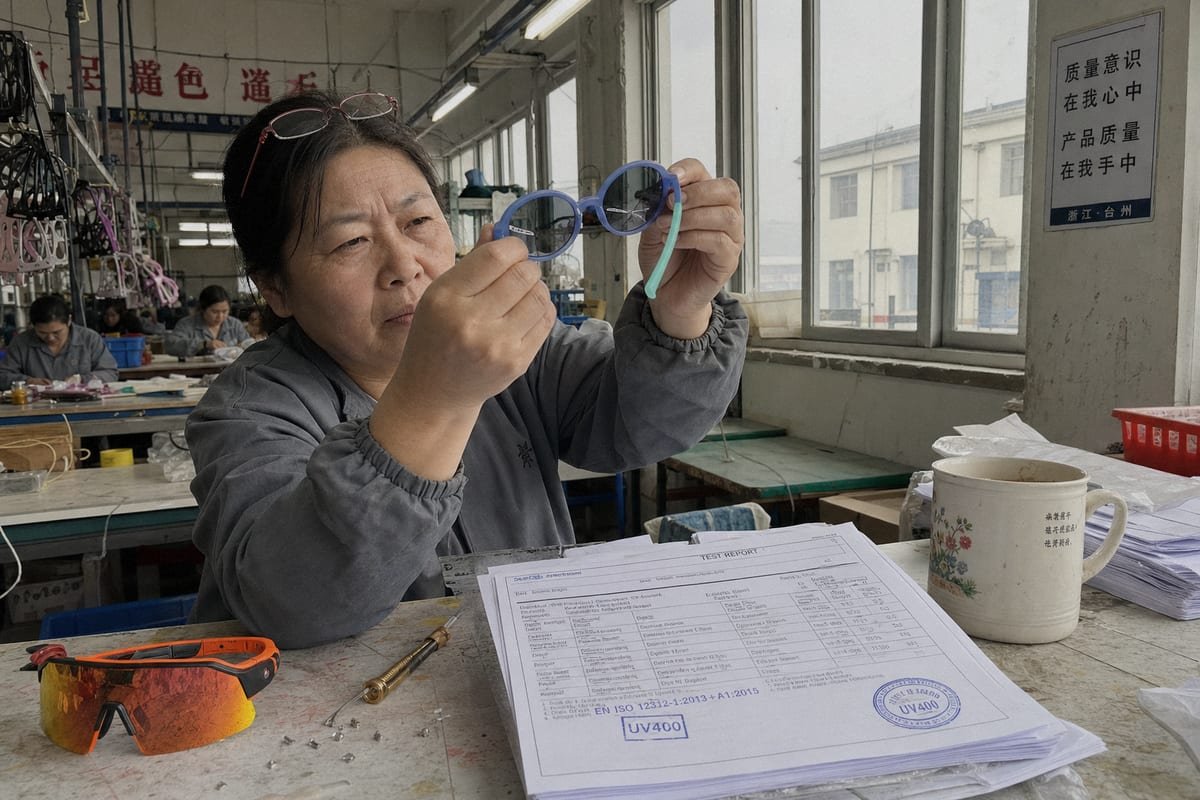
Poor-quality OEM kids’ sunglasses can sink a brand fast FDA registration 1. On our Taizhou production line, I have seen exactly where cheap eyewear fails — and how buyers avoid it.
To avoid poor-quality OEM kids’ sunglasses, verify the factory’s legitimacy, demand batch-specific compliance documents like UV400 and EN ISO 12312-1 test reports, physically test pre-production samples, and enforce third-party pre-shipment inspections before goods leave the factory. Never rely on catalog photos or price alone.
That answer sounds simple. In practice, each step has traps. Below, I walk through the exact checks I recommend to every buyer who contacts us, based on fifteen years of making children’s eyewear.
What Quality Checks Should I Require Before Approving a Kids' Sunglasses Order?
A buyer from Australia once asked me why her previous supplier's frames snapped within weeks. The answer was simple: nobody had defined quality checks before the order was approved.
Before approving a kids' sunglasses order, require verified UV400 protection reports, optical clarity checks for lens distortion, hinge fatigue testing with pass/fail logs, chemical safety testing on frames and coatings, and an agreed AQL sampling standard for the final pre-shipment inspection.
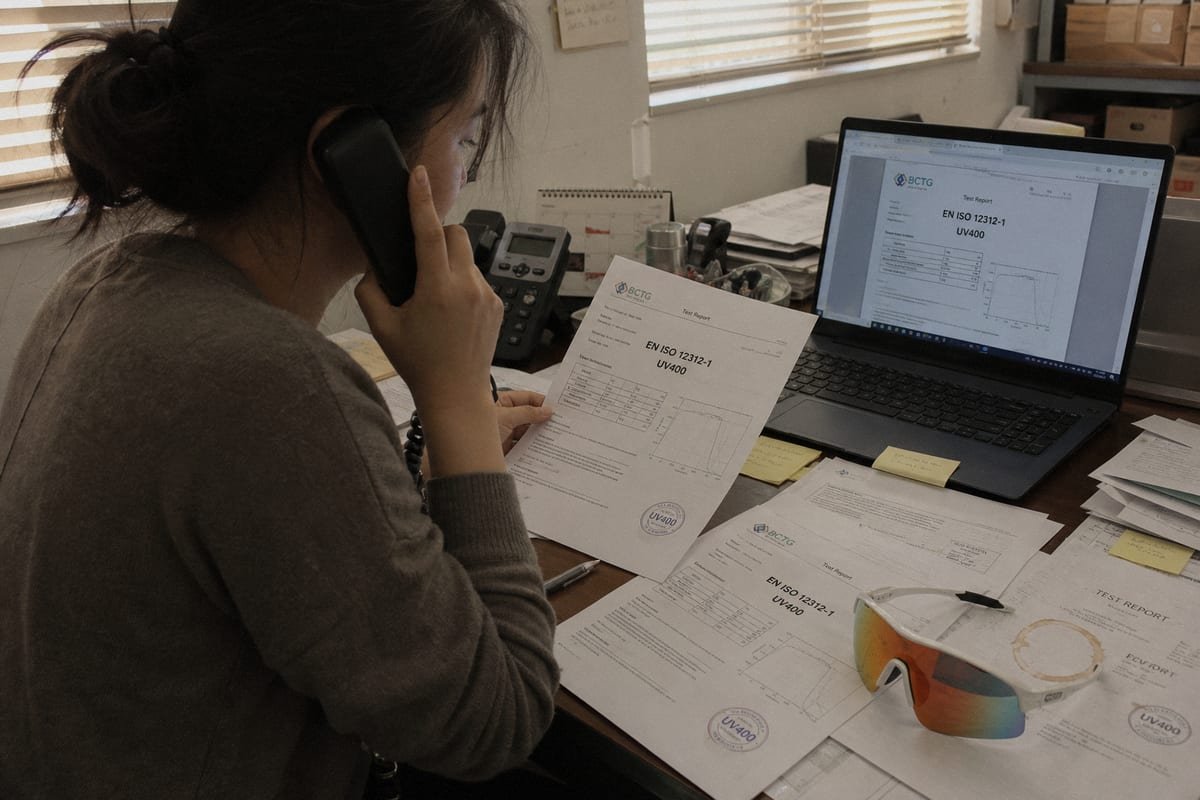
Quality checks for children's eyewear must cover two things at once: optical protection and physical durability. A frame that survives rough play but fails UV filtration is dangerous. A lens that blocks UV but sits on a brittle frame is useless after a week. In our workshop, we treat both as pass/fail gates, not nice-to-haves.
The core checklist I give buyers
Here is the baseline checklist I share with new B2B clients before any purchase order is signed:
| Check | What It Verifies | When to Do It |
|---|---|---|
| UV400 protection 2 test | Lenses block 100% of UVA/UVB | Before sample approval |
| Optical clarity report | No distortion that causes eye strain | Sample stage |
| Hinge cycle testing | Screws and joints survive repeated folding | Pre-production |
| Chemical migration test | Safe if a child chews frames or temple tips | Before mass production |
| Coating adhesion check | Lens coatings and frame colors don't peel | In-line QC |
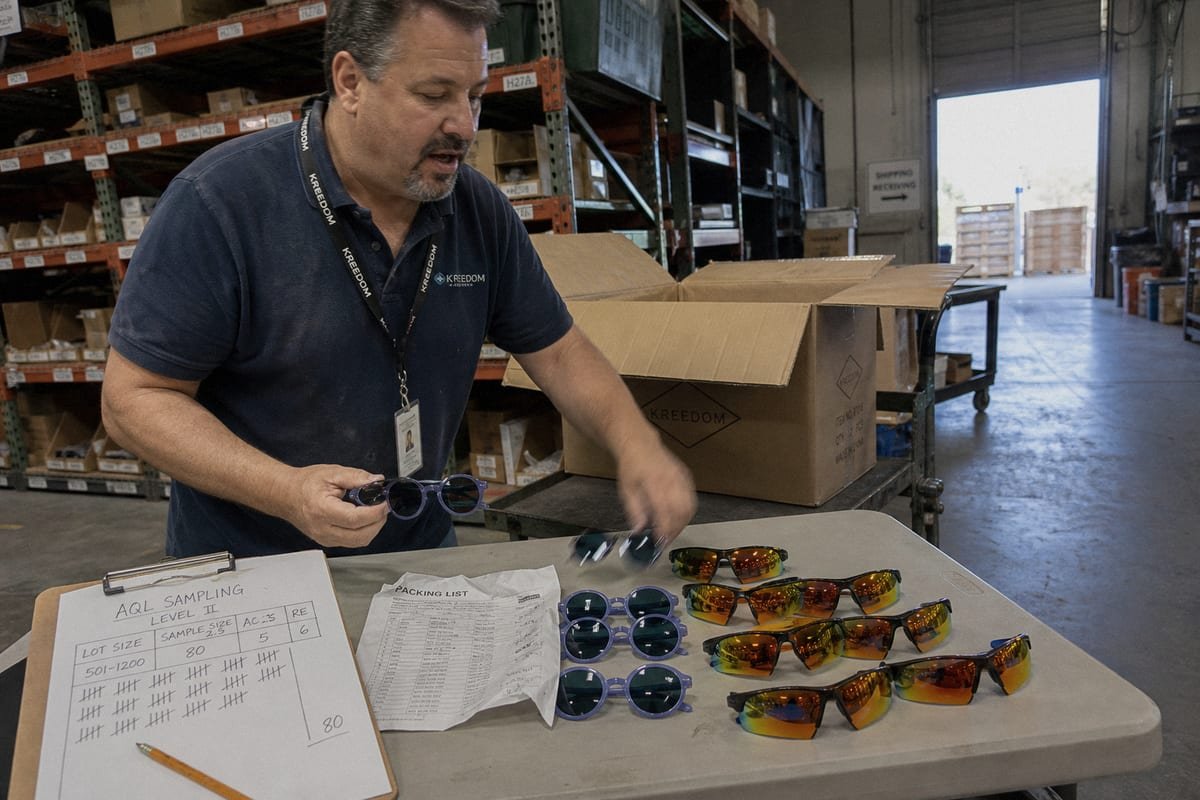
| AQL sampling 3 inspection | Batch consistency, not one golden sample | Pre-shipment |
Why batch-level checks matter most
One compliant sample proves nothing about production run number three. This is the mistake I see most often. Buyers approve a beautiful sample, then skip inspection on bulk goods. Serious factories run in-line checks during production and accept AQL sampling standards at final inspection. If a supplier resists an agreed AQL level in writing, that tells you their real confidence in their own consistency. Ask for pass/fail logs, not verbal assurances. On our line, hinge fatigue tests and coating checks are logged per batch, because children's products get returned — and complained about — faster than any adult category.
How Can I Verify a Manufacturer's Safety and Material Standards Before I Commit?
Documents arrive in my inbox every week from buyers asking one thing: is this certificate real? After fifteen years in eyewear, I can say verification is where most importers stumble.
Verify safety and material standards by requesting batch-specific third-party lab reports for UV400 and EN ISO 12312-1, confirming report numbers directly with the issuing lab, checking BPA-free certification and CPSIA compliance for children's products, and reviewing FDA registration for US-bound shipments.
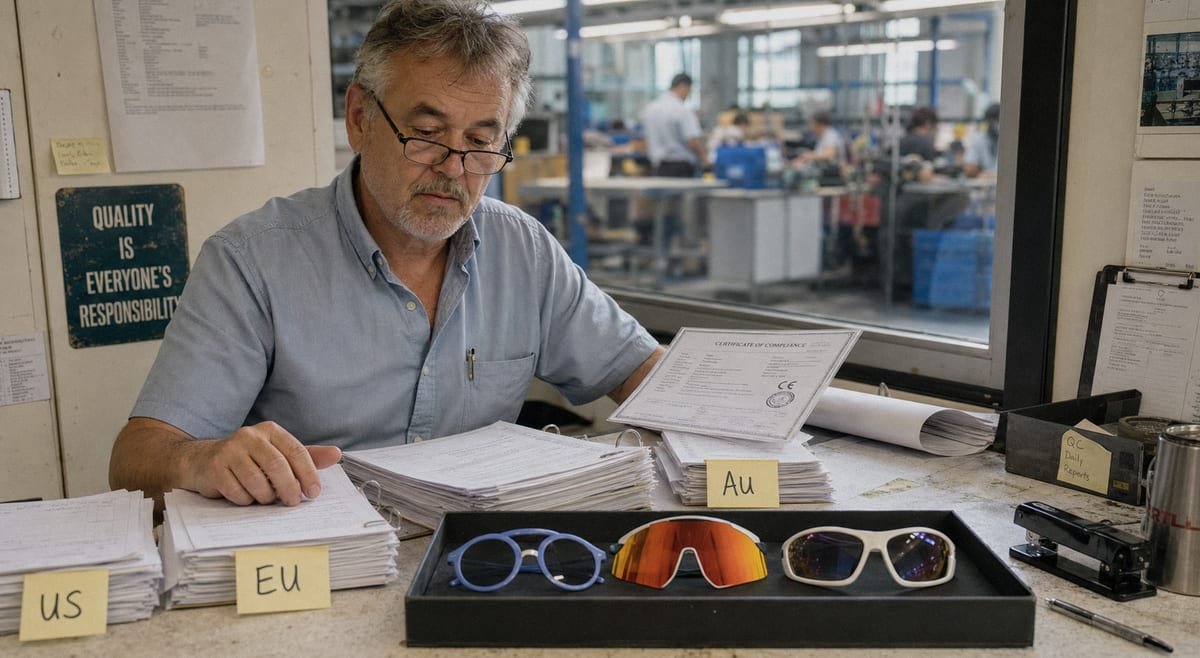
A PDF certificate is easy to fake. A verified report number is not. That is the single most useful habit I teach buyers: take the lab report number and check it directly with the issuing laboratory. Reputable third-party lab testing 4 bodies let you confirm authenticity in minutes. Fraudulent or reused certificates are common enough in eyewear sourcing that skipping this step is genuinely risky.
Match the document to the market
Different destination markets demand different paperwork. Do not accept a generic "quality certificate" that names no standard, no model, and no batch.
| Destination Market | Key Documents to Request |
|---|---|
| United States | CPSIA compliance 5 testing, FDA registration, UV claims substantiation |
| European Union | EN ISO 12312-1 6 test report, Declaration of Conformity, CE marking basis |
| Australia / NZ | Sunglass category compliance per local standards, UV400 reports |
| All markets | BPA-free certification, phthalate and lead testing, batch traceability |
Material verification goes beyond the lens
Children chew on temple tips. They bend frames backward. So chemical migration testing on frames — not just lenses — matters. When we developed our TPEE flexible frames, we chose the material precisely because it bends without snapping and meets chemical safety requirements for children's products. Ask your supplier to name the exact raw material grade. High-grade TR90 and TPEE behave completely differently from cheap recycled plastics TR90 material 7 that turn brittle and create snapping or choking hazards. A factory that sources traceable raw materials will show you supplier records without hesitation. A trader usually cannot.
What Red Flags Signal an Unreliable OEM Eyewear Supplier During Sourcing?
Early in our export history, a client showed me a competitor's quote that undercut ours by forty percent. Six months later, she came back — with a container of unsellable frames.
Red flags include prices far below market average, refusal of factory audits or video tours, stock photos instead of production images, certificates that don't match the model or batch, vague answers about raw materials, and unwillingness to accept third-party pre-shipment inspection.
The most dangerous suppliers are not the obviously bad ones. They are the polished ones: professional websites, fast quotes, beautiful stock images. Many are trading companies presenting generic factories as their own. That is not automatically a problem — until quality issues appear and nobody takes responsibility.
Red flags ranked by severity
- Refusing a factory audit or live video tour. A real factory with real production lines welcomes scrutiny. We regularly walk buyers through our 5S-managed workshop by video call. A supplier who deflects this request is hiding something.
- Certificates that don't match the product. A report for an adult acetate frame tells you nothing about a child's TPEE sunglass. Model numbers and batch references must line up.
- Prices that seem too good. Genuine UV400 lenses, TAC polarized lenses, virgin-grade TR90, and proper QC all cost money. A price forty percent below market means something was cut — usually the parts you cannot see.
- Vague material answers. Ask what specific plastic grade they use. "Good quality plastic" is not an answer. Brittle recycled resin looks identical to TR90 in photos.
- No export history or references. Suppliers serving buyers across many countries have paperwork trails, freight forwarder relationships, and repeat customers you can ask about.
- Slow, evasive communication. In my experience, communication quality during sourcing predicts communication quality during a crisis. If they are slow before your money arrives, imagine after.
None of these red flags alone is proof of fraud. But two or more together should end the conversation. The pattern I trust most: suppliers who welcome inspection are usually the ones who least need it.
How Do I Choose Between Sample Testing and Mass Production Quality Control?
Buyers sometimes ask me which matters more: the sample or the bulk inspection. The honest answer I have learned over fifteen years is that treating this as a choice is the mistake itself.
You should not choose — use both. Sample testing screens design, fit, materials, and impact resistance before tooling. Mass production quality control, including in-line checks and pre-shipment inspection under AQL sampling standards, confirms the bulk batch actually matches the approved sample.

A sample is a screen, not proof. A dishonest supplier can send an upgraded sample and ship lower-grade bulk goods. An honest supplier can still suffer process drift during a long production run. That is why the two stages answer different questions, and both questions matter.
What each stage actually catches
| Stage | What It Catches | What It Misses |
|---|---|---|
| Pre-production sample testing | Fit, comfort, lens distortion, hinge feel, finish quality, material choice | Batch variation, material substitution, production defects |
| In-line QC during production | Process drift, assembly errors, coating adhesion problems | Design flaws already locked into tooling |
| Pre-shipment inspection (PSI) | Defect rates across the batch, packaging protection, labeling accuracy | Fundamental design problems too late to fix cheaply |
How to run the sample stage well
Test samples like a child would use them. Flex the temples outward repeatedly — our TPEE temples on TR90 fronts are designed for exactly this abuse, and any kids' frame should tolerate it. Check lens clarity against a straight line; distortion causes headaches and eye strain in children. Open and close the hinges dozens of times. Inspect edges for roughness. Then send a sample for third-party lab testing on UV filtration and impact resistance before you commit to volume.
How to protect the bulk order
Write QC into the contract, not just the conversation. Specify the AQL level, the inspection company, and replacement terms for failed lots. Add accelerated aging tests where transit heat and humidity could peel coatings or fade frame colors. Use secure payment terms that hold final payment until the pre-shipment inspection passes. On our side, we build these gates into every OEM order because they protect both parties — a rejected shipment costs the factory as much reputation as it costs the buyer money.
Conclusion
Poor-quality OEM kids' sunglasses fail children twice — on protection and durability. Verify the factory, demand real documents, test samples hard, and inspect every batch. Choose suppliers who welcome scrutiny.
Footnotes
1. FDA source clarifying registration requirements for US-bound regulated products. ↩︎
2. Background on UV protection standards relevant to sunglasses lens filtration claims. ↩︎
3. Wikipedia background explaining acceptable quality limit sampling used in inspections. ↩︎
4. ISO reference on conformity assessment and accredited third-party laboratory testing. ↩︎
5. US government source explaining CPSIA requirements for children’s product safety compliance. ↩︎
6. Official ISO standard reference for sunglasses safety testing requirements. ↩︎
7. Background on thermoplastic materials like TR90 used in durable eyewear frames. ↩︎
More Articles You Might Like
Looking for a Reliable Kids Eyewear Partner?
Explore 800+ ready styles and full OEM/ODM support tailored to your brand.
Get in Touch English
  Español de México
  Deutsch
  Français
  日本語
日本語  العربية
  Português do Brasil