What Packaging Details Matter When Shipping Kids’ Sunglasses Internationally?
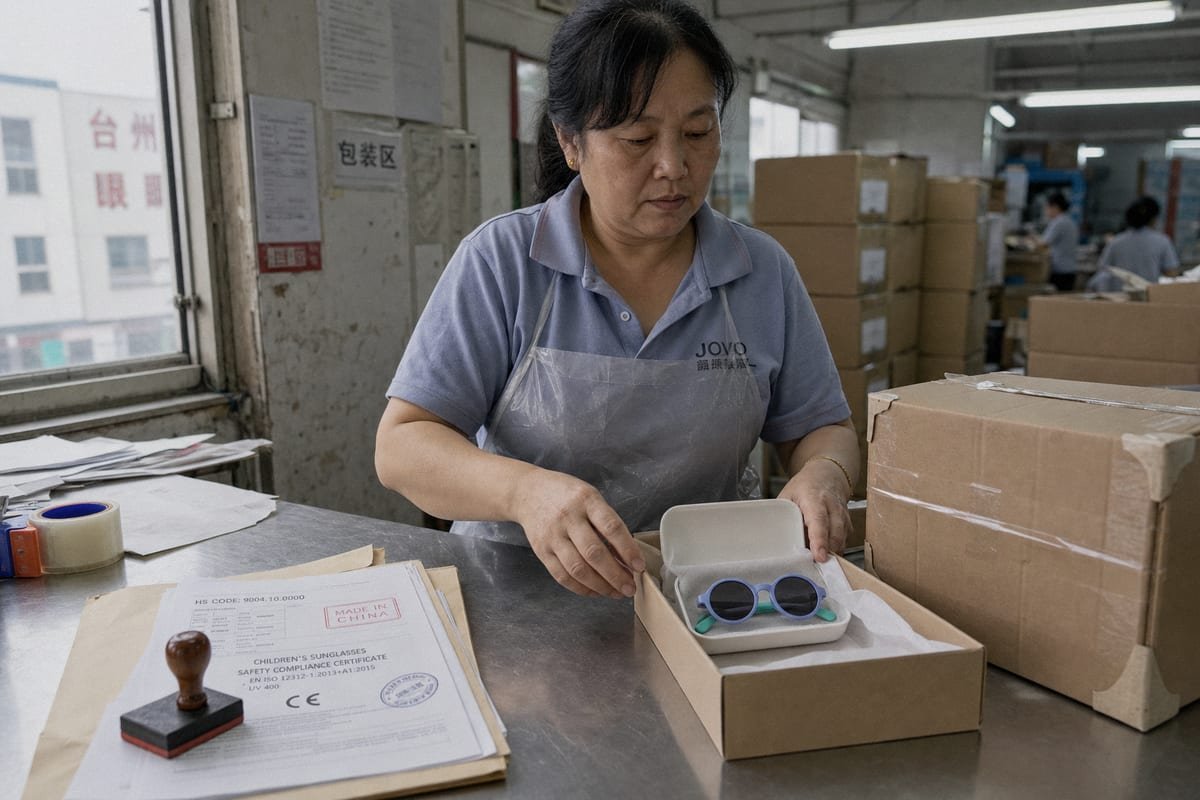
Packaging details for shipping kids’ sunglasses internationally can make or break a launch small parts warning label 1. I learned this early on our production line, when a beautiful shipment arrived overseas damaged.
The packaging details that matter most when shipping kids’ sunglasses internationally are rigid protection, scratch prevention, immobilization, and customs-ready labeling. Use a hard case, a snug inner box, and a cushioned outer box, plus accurate HS codes, country-of-origin marks, and safety compliance documents.
Below, I break each of these details down. I will cover protective packing, retail-ready options, customs rules, and branding, step by step.
How Do I Choose Packaging That Keeps Kids' Sunglasses Safe During Long-Distance Shipping?
Years ago, a buyer in Australia sent us photos of scratched lenses from a trial order. That single claim reshaped how our Taizhou factory packs every export carton today.
Choose a layered system: clean each pair, place it in a hard case or microfiber cleaning pouch, wrap it in tissue or bubble wrap, seat it in a snug inner box, then double-box with roughly three inches of cushioning on all sides to pass a four-foot drop test.
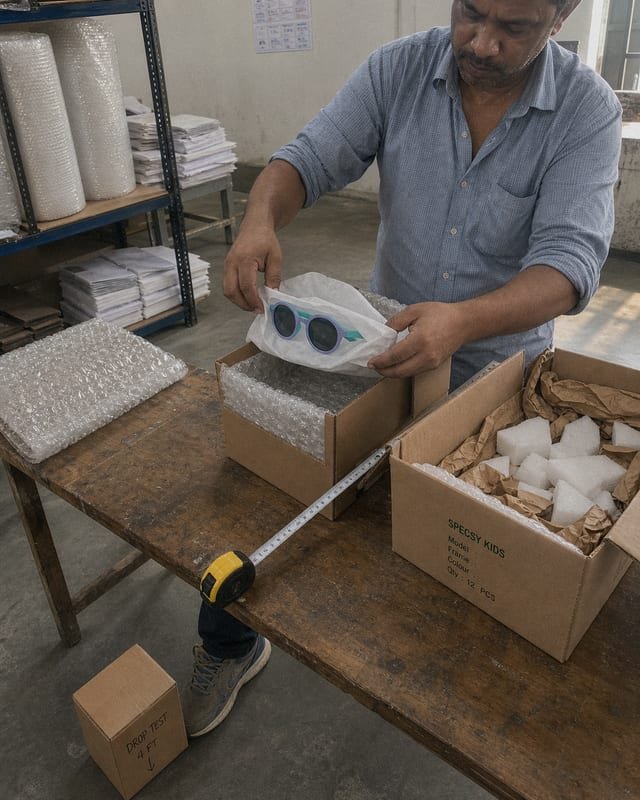
International transit is rougher than domestic shipping. Parcels get stacked, dropped, compressed, and re-sorted at multiple hubs. Kids' sunglasses look small and light, but that does not make them safer. In fact, small frames and lightweight hinges can crush more easily if they shift around inside a box. Even our TPEE flexible frames, which bend and bounce back, still need lens protection. A flexible frame survives pressure; an unprotected lens does not survive grit rubbing against it for two weeks at sea.
The Layer System We Use
Here is the packing sequence we follow for every export order:
- Clean lenses and frames so dust does not scratch coatings in transit.
- Wrap each pair individually in acid-free tissue 2 or slip it into a microfiber cleaning pouch.
- Place the pair in a hard case, or add bubble wrap if no case is used.
- Seat everything in a snug inner box with no room to shift.
- Fill all voids with kraft paper, air pillows, or foam.
- Double-box into a rigid outer carton and tape every seam.
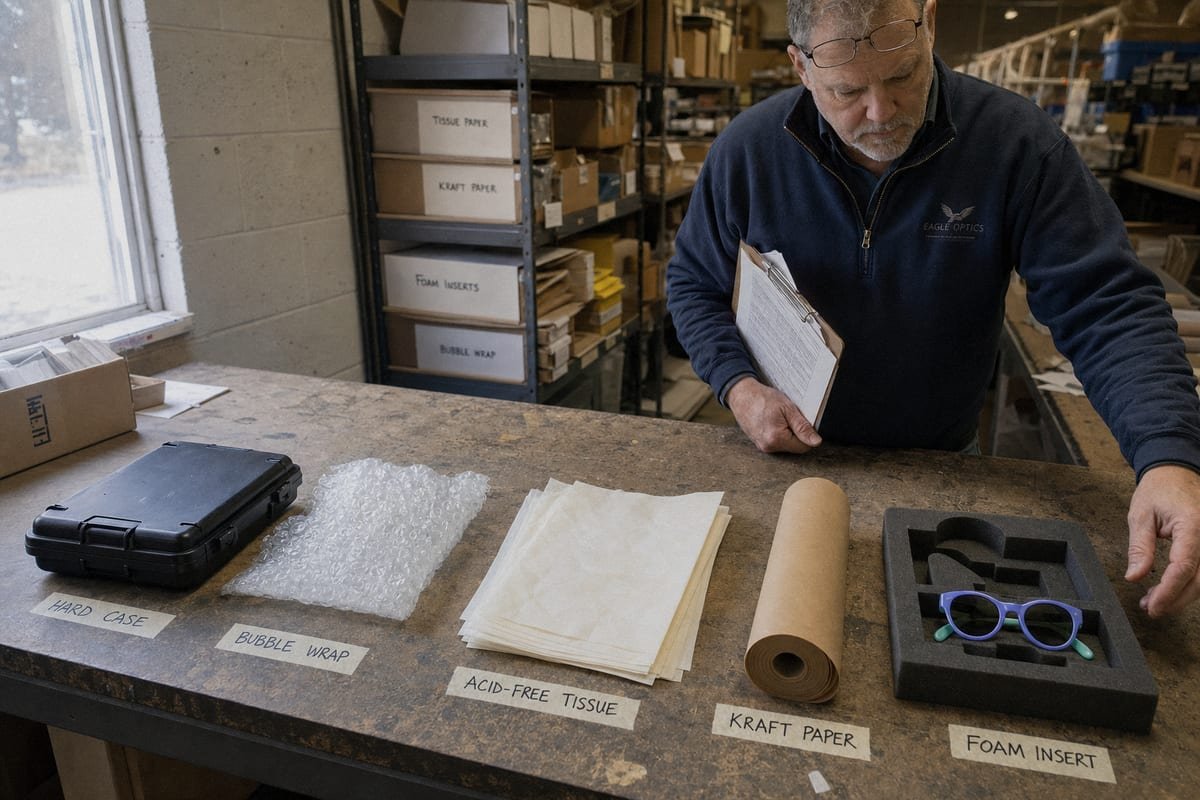
Material Choices Compared
| Matériel | Idéal pour | Weakness |
|---|---|---|
| Hard case | Crush and pressure protection | Adds cost and weight |
| Bubble wrap | Impact absorption | Less sustainable |
| Acid-free tissue | Scratch prevention on lenses | No impact protection |
| Kraft paper | Filling voids, eco-friendly | Can compress over time |
| Foam inserts | Immobilizing frames precisely | Higher tooling cost |
The truth is that no single material wins. We combine tissue for scratch protection with structural cushioning for impact. Also, remember dimensional weight 3. Oversized cartons full of loose filler raise your freight bill. A snug, well-designed pack protects better and ships cheaper.
What Retail-Ready Packaging Options Should I Consider for My Kids' Eyewear Brand?
One of our European buyers once asked us to redesign her unboxing experience three times before launch. Her instinct was right — parents judge a kids' brand by its box before the sunglasses ever come out.
Consider a branded hard case, a printed retail box or hang-tag display, a microfiber cleaning pouch, and eco-friendly mailers for direct-to-consumer orders. Retail packaging must sit inside a transit-safe outer system; the decorative box should never be the only protection layer.
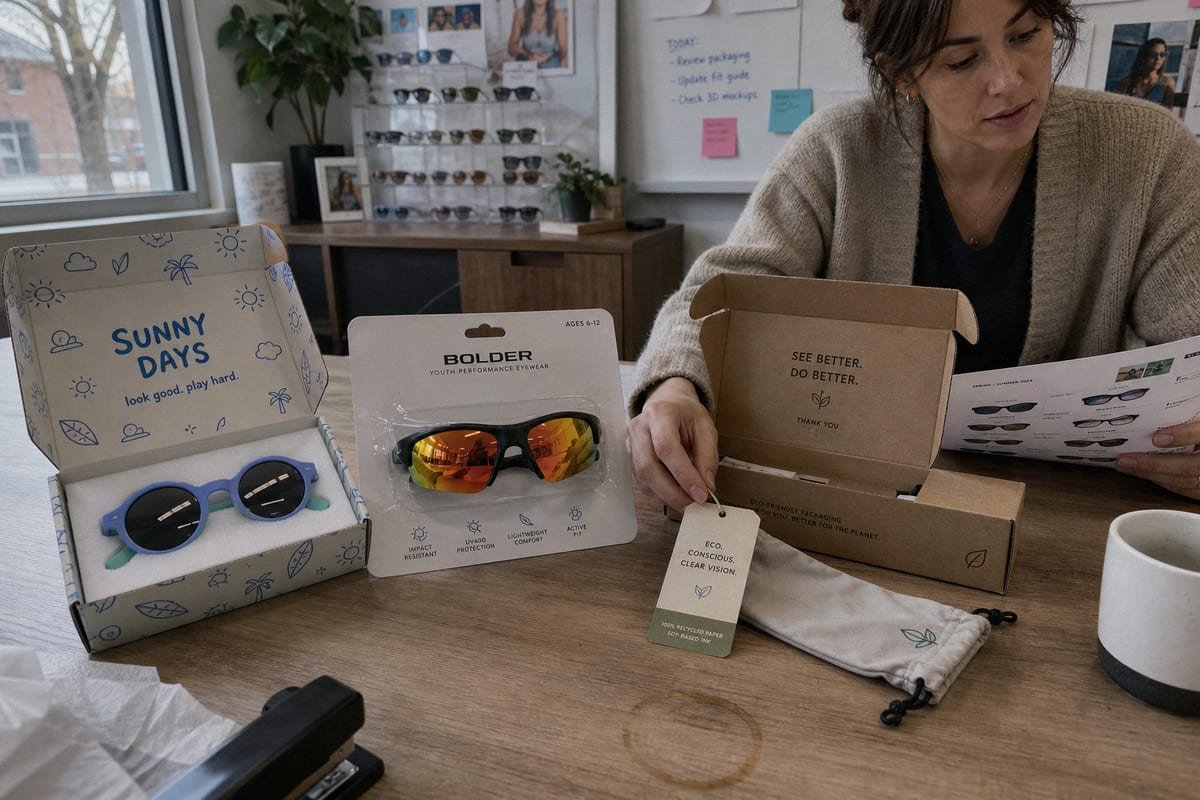
Retail packaging and shipping packaging do two different jobs. The retail layer sells the product and delights the parent. The shipping layer absorbs the abuse of international freight. When we run OEM/ODM projects at our factory, we design both layers together so the pretty box arrives looking pretty. That matters more for kids' sunglasses than for adult styles, because children's eyewear is often bought as a gift. Take our pastel round frames in periwinkle blue and mint teal — buyers usually pair them with soft-touch gift boxes. Sporty wraparound shields with mirrored gradient lenses, by contrast, tend to sell better in bold blister packs or window boxes that show off the lens color.
Matching Packaging to Your Sales Channel
| Channel | Recommended Retail Packaging | Key Priority |
|---|---|---|
| Boutique retail | Printed gift box with hard case inside | Shelf appeal and giftability |
| Mass retail | Hang-tag or blister display pack | Visibility and peg display |
| E-commerce D2C | Branded box plus eco-friendly mailers | Unboxing experience |
| Wholesale bulk | Tray packing with dividers per pair | Separation and efficiency |
Sustainability Without Sacrificing Protection
Many of our buyers serve sustainability-minded parents. So we offer kraft-based boxes, biodegradable fillers, and reusable cases. This fits naturally with our environmentally friendly TPEE and TR90 materials. However, I always advise a balance: paper fillers handle small voids and scratch prevention well, but rigid structure still needs a case or insert. Eco-conscious does not have to mean fragile. A reusable hard case is arguably the greenest option of all, because parents keep using it for years.
One more practical point. With around 800 existing styles available, many of our new-brand customers start with stock frames and invest their budget in custom packaging instead. That is often the smartest way to look premium without paying for new molds.
How Can I Make Sure Packaging Meets Customs and Safety Requirements in My Country?
A shipment stuck at a border teaches you more than any handbook. We once watched a buyer's carton sit in customs for days over a mismatched origin mark — an avoidable, painful lesson.
Match your customs declaration form to your packaging exactly: declare sunglasses under HS code 9004.10, mark a permanent country of origin identical to the invoice, and include compliance documents such as CPSIA test reports, UV400 protection standards evidence, and lens impact-resistance certificates.
Customs officers do not guess. They compare paperwork against packaging, and any mismatch triggers delays or seizures. In our fifteen years of exporting children's eyewear to buyers in more than twenty countries, the smoothest clearances always come from boring, consistent documentation. Describe the goods honestly — "children's sunglasses, non-prescription" — and use the correct HS code 4 for sunglasses, which is 9004.10. Keep the commercial invoice, packing list, and customs declaration form secured in a visible pouch on the outer carton, and place a duplicate packing slip inside the box in case the outer copy is lost.
Safety Compliance Is Part of Packaging
For children's products, safety documentation travels with the goods. Key items to prepare:
- CPSIA compliance documentation for the U.S. market, covering lead and phthalate limits CPSIA compliance 5 for children's products.
- Evidence of impact-resistant lenses, such as a Drop Ball Test certificate, which some markets expect for eyewear entering the U.S.
- Test results showing the lenses meet les normes de protection UV400 6 les normes de protection UV400, since UV claims on the box must be supportable.
- A small parts warning label where required, or better, a package design with no small detachable components at all.
Child-Safe Package Design
The box itself must be safe for a child-led unboxing. That means no sharp staples, no loose small parts, and no hard plastic edges. Some brands go further and add a QR code linking to a digital compliance page, so both customs officers and parents can verify test data instantly. We support buyers with the product-side documentation for our TR90 frames with TPEE temples, but each importer must confirm the rules of their destination market, because some countries restrict certain lens materials or coatings. Checking before packing is always cheaper than re-labeling at the border.
What Branding and Labeling Details Should I Include on My Sunglasses Packaging?
When we develop custom packaging with a new brand, the first mockup is rarely about the logo. It is about which claims and marks legally and commercially belong on the box.
Include your brand logo, UV400 and lens claims, age grading, country of origin, barcode, care instructions, and required safety marks such as a small parts warning label. Add a QR code linking to compliance data, and keep all claims consistent with your test reports.

Branding and labeling serve two readers at once: the parent in a store and the inspector at a border. Both need clear, honest information. So we help buyers map every element onto the box with intention, not decoration. A cluttered box confuses parents; a bare box fails compliance.
The Labeling Checklist We Recommend
| Element | Purpose | Placement Tip |
|---|---|---|
| Brand logo and style name | Recognition and reordering | Front panel, top third |
| UV400 / polarized claim | Purchase driver for parents | Front panel, near lens window |
| Age grading | Fit guidance and safety | Side or back panel |
| Country of origin | Customs requirement | Permanent print, back panel |
| Barcode and SKU | Retail scanning | Back panel, flat surface |
| Safety marks and warnings | Regulatory compliance | Back panel, legible size |
| Care instructions | Reduces returns | Insert card or inner flap |
Branding Details That Build Trust
Beyond the checklist, small touches do heavy lifting. A branded microfiber cleaning pouch doubles as protection and a daily brand reminder. An insert card explaining how the flexible frame bends without breaking turns a material feature into a story parents retell. Some of our clients add a UV-reactive ink patch on the box, so parents can playfully verify UV protection on arrival — a functional, interactive element that suits children's products perfectly. Others embed a QR "safety passport" that opens their compliance summary. Whatever you choose, one rule holds: every claim printed on the packaging must be backed by a document in your files. Marketing that outruns your test reports is a liability, not a differentiator.
Conclusion
Poor packaging quietly destroys margins, reviews, and customs timelines. Layered protection, correct documentation, and honest labeling solve it. Get these details right, and your kids' sunglasses arrive ready to sell.
Notes de bas de page
1. CPSC guidance on small parts choking hazard rules for children’s products. ↩︎
2. Wikipedia explains acid-free paper properties relevant to scratch-safe lens wrapping. ↩︎
3. Wikipedia background on dimensional weight concept affecting freight cost decisions. ↩︎
4. WTO resource explaining harmonized system codes used for customs class
Plus d'articles que vous pourriez aimer

1 août 2026
L'usine doit-elle gérer l'emballage et l'étiquetage des lunettes pour enfants, ou utiliser un fournisseur désigné ?
1 août 2026
Entrepôt propre vs. exécution directe par le fournisseur : lequel réduit les coûts de retour pour les marques de lunettes pour enfants ?
1 août 2026
Entrepôt direct au port ou staging outre-mer : lequel permet d'économiser le plus sur l'expédition des lunettes pour enfants ?
Vous recherchez un partenaire fiable en lunetterie pour enfants ?
Explorez plus de 800 styles prêts et un support OEM/ODM complet adapté à votre marque.
Contactez-nous English
  Español de México
  Deutsch
  Français
  日本語
日本語  العربية
  Português do Brasil