Comment développer des lunettes de soleil exclusives pour enfants pour votre propre marque ?
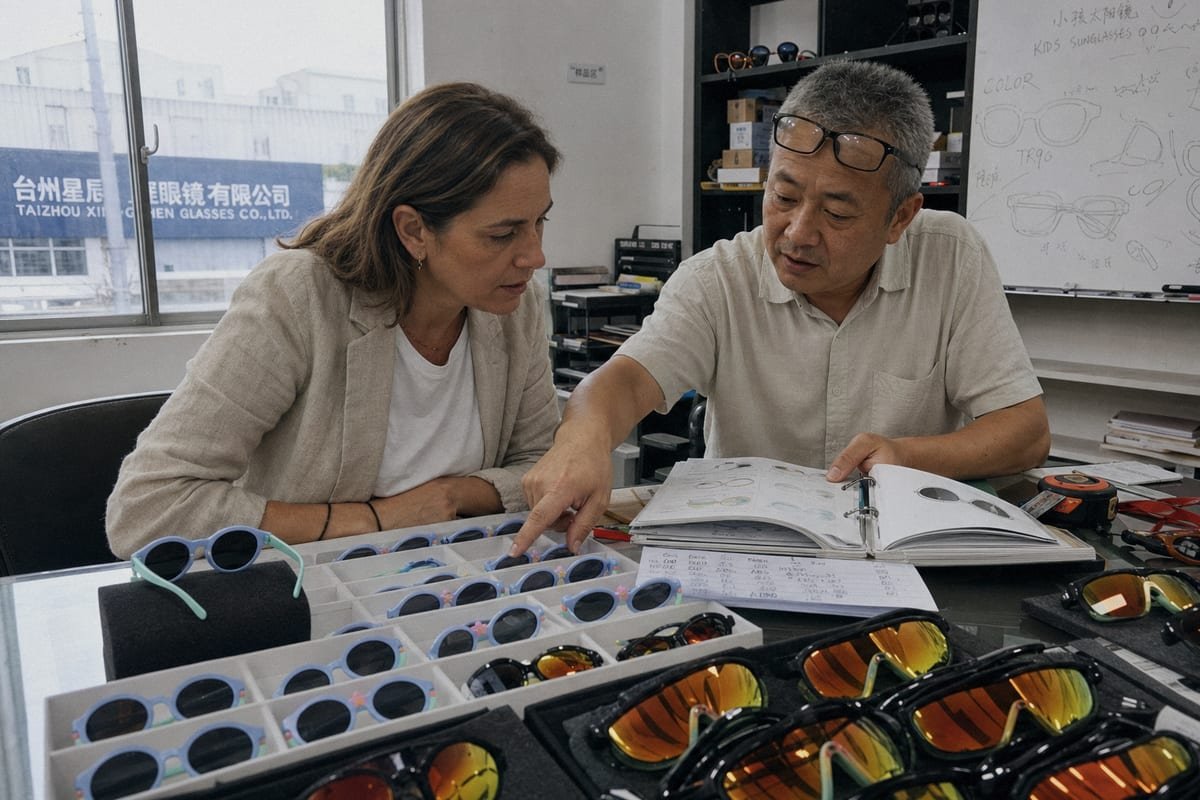
Développer des lunettes de soleil exclusives pour enfants semble simple jusqu'à ce qu'un acheteur visite notre usine de Taizhou et réalise combien de décisions se cachent derrière une petite monture Certificat de produit pour enfants 1. Faites-les mal, et les retours s'accumulent rapidement.
Pour développer des lunettes de soleil exclusives pour enfants pour votre propre marque, définissez une niche spécifique aux enfants, choisissez un partenaire OEM/ODM avec des montures flexibles en TPEE ou TR90, personnalisez les couleurs, les logos, les verres UV400 et l'emballage, vérifiez la conformité de sécurité, puis approuvez les échantillons avant une production en petite série.
C'est la réponse courte. L'image complète implique de choisir la bonne usine, de superposer la personnalisation judicieusement, de protéger la sécurité des enfants et de suivre un flux de développement éprouvé. Examinons chaque étape.
Comment choisir le bon fabricant pour développer des lunettes de soleil exclusives pour enfants pour ma marque ?
Quelques années après l'exportation, j'ai remarqué une tendance : les acheteurs qui auditaient notre atelier avant de commander n'avaient presque jamais de litiges par la suite. Le choix de l'usine décide de la plupart de vos résultats.
Choisissez un fabricant spécialisé dans les lunettes pour enfants, qui propose des matériaux flexibles sans BPA comme le TPEE et le TR90, qui détient une documentation de sécurité vérifiable, qui fournit une vaste bibliothèque de styles existants pour éviter les coûts de moulage et qui prend en charge la personnalisation complète OEM/ODM avec un échantillonnage structuré et un contrôle qualité.
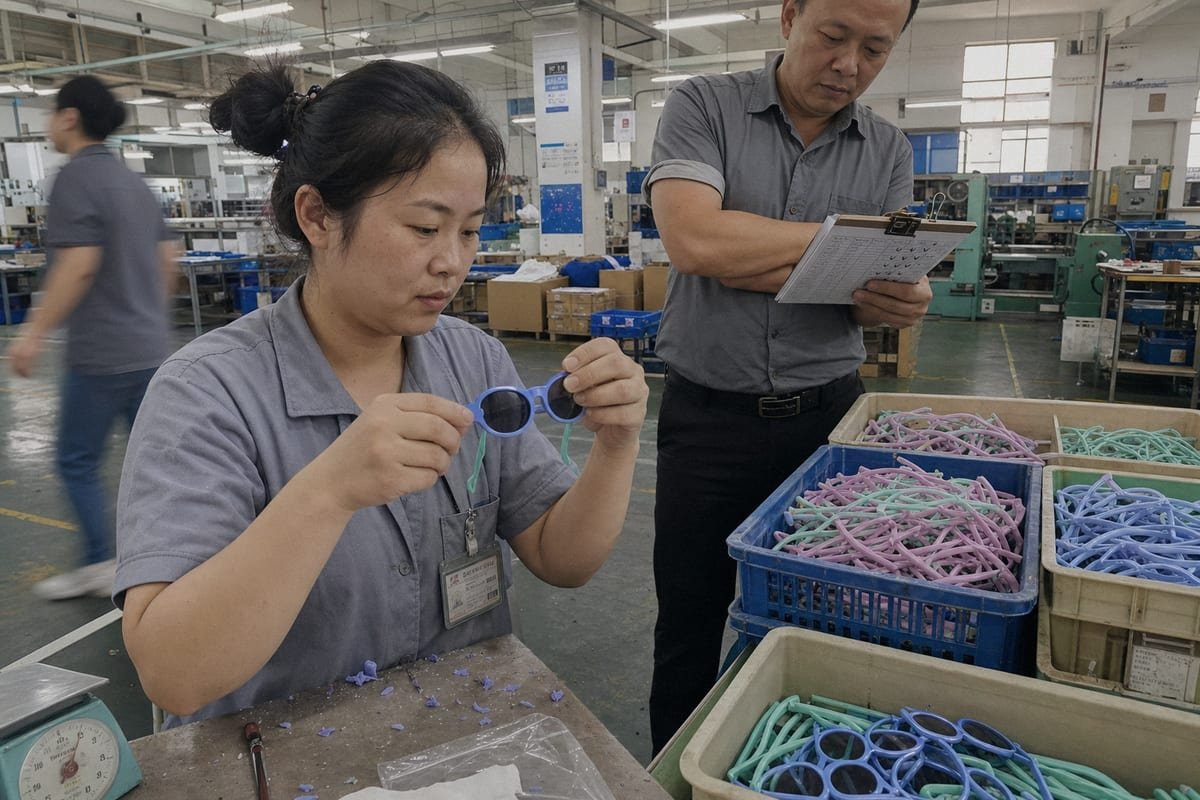
Un fournisseur généraliste de lunettes de soleil pour adultes et une usine spécialisée dans les lunettes pour enfants sont deux choses différentes. Les lunettes de soleil pour enfants nécessitent des montures plus petites, des matériaux plus souples et une réflexion plus stricte sur la sécurité. Dans notre usine, environ 120 travailleurs se concentrent principalement sur les montures pour enfants, et cette spécialisation se reflète dans les petits détails — tension des charnières calibrée pour les petites mains, courbes des branches façonnées pour les ponts de nez bas, et bords polis pour que rien ne raye la peau d'un tout-petit.
Que vérifier avant de s'engager
Posez des questions directes. Les réponses vagues sont un signe d'alerte. Voici une liste de contrôle pratique que je partage avec les nouveaux acheteurs:
| Point de vérification | Pourquoi c'est important | Ce à quoi ressemble un bon résultat |
|---|---|---|
| Usine vs. trader | Les traders ajoutent des coûts et perdent le contrôle | Usine directe avec atelier visible, idéalement géré selon la méthode 5S |
| Expérience spécifique aux enfants | Les spécifications pour adultes échouent sur les enfants | Plus de 10 ans de fabrication de montures pour enfants |
| Capacité matérielle | La sécurité et le confort en dépendent | Véritable Montures flexibles TPEE 2 et TR90 en interne |
| Bibliothèque de styles existante | Réduit votre risque de lancement | Des centaines de styles prêts à être personnalisés |
| Support de conformité | L'accès au marché en dépend | Peut prendre en charge les tests pour CPSIA, REACH, UV400 |
| Processus d'échantillonnage | Prédit la qualité de la production | Rondes d'échantillons structurées avec suivi des révisions |
L'avantage ODM pour les marques débutantes
Voici le conseil honnête que je donne aux fondateurs : ne commencez pas avec un moule entièrement personnalisé. Les nouveaux outils coûtent cher, prennent des mois et vous enferment avant même de savoir ce qui se vend. Notre bibliothèque d'environ 800 styles existants existe précisément pour qu'une nouvelle marque puisse choisir une silhouette éprouvée — comme une monture ronde pastel ou un masque enveloppant sportif — et la rendre exclusive grâce aux couleurs, aux verres, aux logos et aux emballages personnalisés pour lunettes. Cette voie ODM raccourcit le délai de mise sur le marché et vous permet de tester la demande avec une première commande plus petite. Une fois que votre première collection fait ses preuves, investissez alors dans le développement de montures exclusives. Cette séquence a évité à plusieurs de nos clients des stocks invendus coûteux.
Quelles options de personnalisation puis-je utiliser pour rendre les lunettes de soleil de mes enfants vraiment exclusives ?
L'un de nos clients australiens m'a dit un jour que son best-seller était né d'une seule décision : remplacer un verre gris standard par un dégradé miroir sur une monture blanche sportive. De petits choix, de grands résultats.
Vous pouvez créer de l'exclusivité grâce à des couleurs et finitions de montures personnalisées, des combinaisons signature bicolores, des teintes de verres et des revêtements miroir ou polarisés, le placement du logo par gravure laser ou impression sur les branches, des emballages et accessoires de marque, et des coloris saisonniers en édition limitée — superposés progressivement à mesure que votre marque se développe.
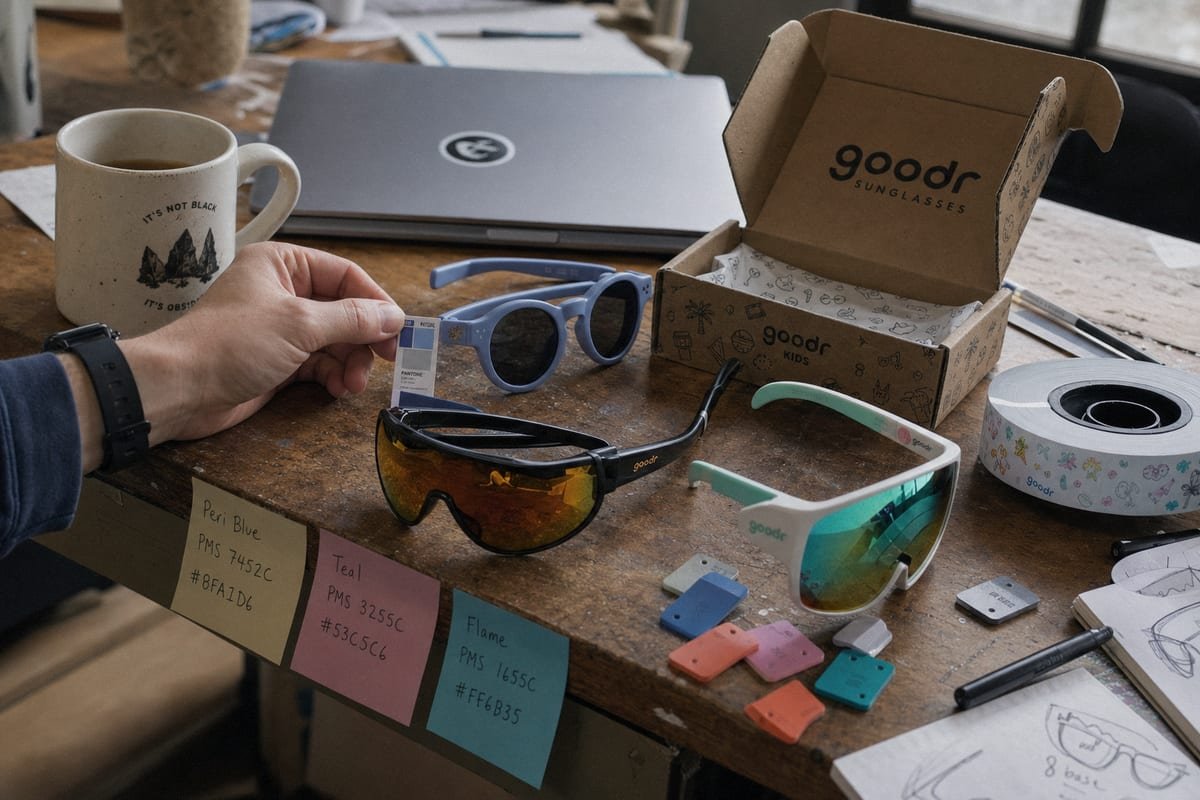
L'exclusivité dans les lunettes pour enfants vient rarement d'une ingénierie radicale. Elle vient de petits détails bien exécutés, empilés les uns sur les autres. Dans nos projets de fabrication en marque blanche, je décompose la personnalisation en couches, du risque le plus faible au plus élevé.
L'échelle de personnalisation
- Emplacement du logo. Commencez ici. Nous recommandons la gravure au laser ou l'impression interne sur les branches plutôt que les autocollants de surface. Les montures pour enfants sont constamment en contact avec la crème solaire, la sueur et l'eau salée, et les impressions à faible adhérence se décollent en quelques semaines. Le marquage à haute adhérence résiste à l'enfance réelle.
- Sélection des verres. Choisir protection UV400 3 comme référence, puis différenciez avec des teintes, des dégradés miroir ou des lentilles TAC polarisées pour l'extérieur lunettes de soleil polarisées 4 et positionnement plage. Un revêtement miroir orange-à-turquoise vibrant sur un écran de sport sépare instantanément votre produit du gris catalogue.
- Couleurs et finitions de monture. Correspondance Pantone personnalisée, textures tactiles douces mates et constructions bicolores — comme un devant pervenche avec des branches menthe — vous donnent une palette signature qu'aucun concurrent ne duplique exactement.
- Emballage et accessoires. Étuis de marque, chiffons en microfibre, cartes d'instructions et boîtes cadeaux. Les parents achètent souvent des lunettes de soleil pour enfants comme cadeaux, de sorte que l'emballage personnalisé des lunettes augmente directement la valeur perçue.
- Éditions limitées et éventuellement moules personnalisés. Les sorties saisonnières maintiennent la marque fraîche. Une silhouette propriétaire vient en dernier, après que la demande soit prouvée.
Faire correspondre la personnalisation au positionnement
| Positionnement de la marque | Direction de la monture | Direction de la lentille | Direction de l'emballage |
|---|---|---|---|
| Mignon pastel mode | Formes rétro arrondies, bicolore mat | Fumée ou teinte subtile, UV400 | Boîte cadeau couleur douce |
| Enfants sportifs actifs | Écrans enveloppants, poignées en caoutchouc | Lentilles TAC miroir ou polarisées | Étui zippé robuste |
| Mini-moi premium | Silhouettes inspirées des adultes en tailles enfants | Teintes dégradées | Ensembles assortis parent-enfant |
| Éco-conscient | Options recyclables ou biosourcées | Norme UV400 | Emballage en papier recyclé |
Choisissez une voie. Les marques qui essaient de servir tous les positionnements dans une première collection finissent généralement par paraître génériques dans tous.
Comment puis-je m'assurer que mes lunettes de soleil personnalisées pour enfants sont sûres et confortables pour les enfants ?
Lors d'une tournée de contrôle qualité l'année dernière, nous avons plié une série de branches en TPEE à 180 degrés, une par une, avant l'emballage. Cela semble excessif. C'est exactement ce que fera un enfant de trois ans le premier jour.
Assurer la sécurité en exigeant des verres 100% UV400, des montures flexibles en TPEE sans BPA ou en TR90 qui se plient sans se casser, des bords arrondis et une construction légère, des tests de conformité pour le CPSIA et le REACH, y compris un certificat de produit pour enfants pour les États-Unis, et une approbation documentée des échantillons avant la production.
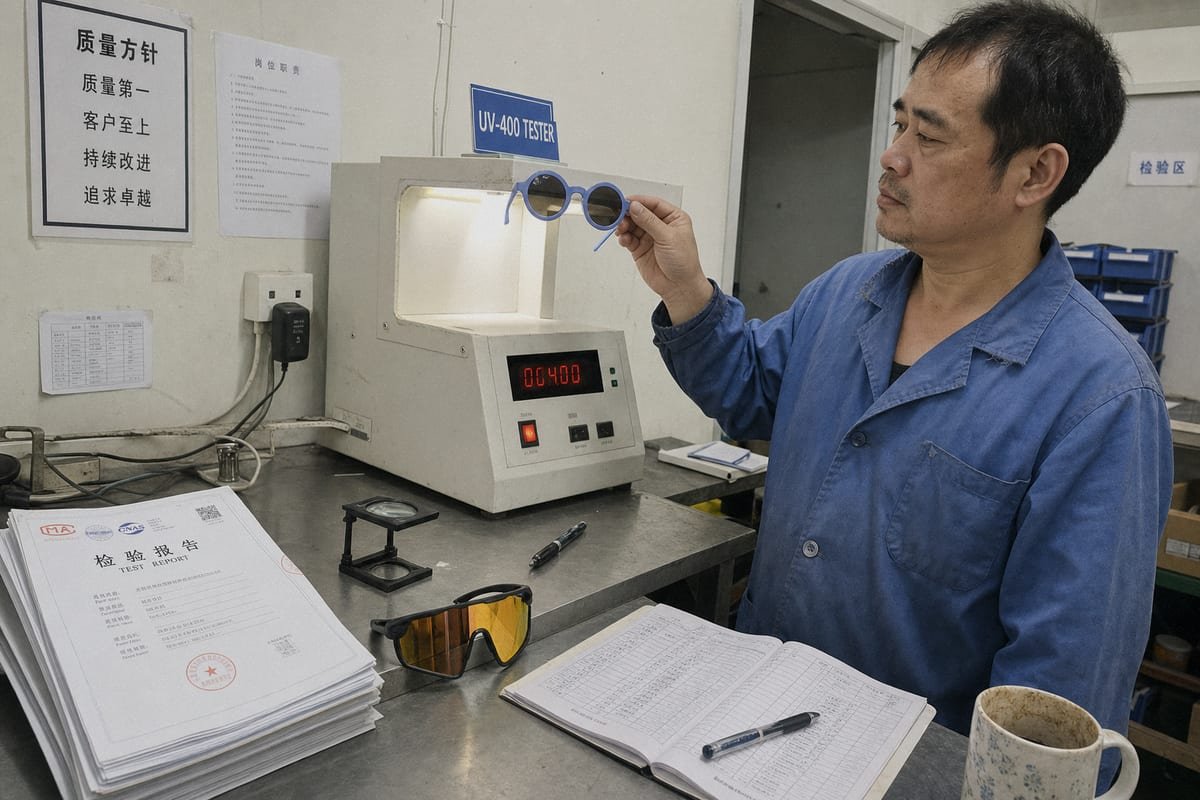
La sécurité est là où la confiance des parents est gagnée ou perdue, et cela commence par la lentille. Les lentilles sombres sans filtres UV appropriés sont pires que pas de lunettes de soleil du tout. Les lentilles teintées provoquent la dilatation des pupilles d'un enfant, et sans une véritable protection UV400, l'œil absorbe plus de rayonnement nocif, pas moins. C'est le piège de la dilatation pupillaire, et c'est pourquoi nous traitons l'UV400 comme non négociable sur chaque lentille pour enfants que nous expédions, qu'elle soit teintée standard ou TAC polarisée.
Matériaux qui survivent à l'enfance
Le matériau de la monture est le deuxième pilier. Nos ingénieurs privilégient les montures flexibles en TPEE et le TR90 car ils plient sous les abus au lieu de se casser en fragments tranchants. Les deux sont légers, Matériaux sans BPA 5, ce qui est important car les jeunes enfants mâchent les extrémités des branches. Une construction populaire que nous construisons est une face en TR90 avec des branches en TPEE — structure là où vous en avez besoin, flexibilité là où l'enfant l'attrape.
| Matériel | Flexibilité | Poids | Ajustement de sécurité pour enfants |
|---|---|---|---|
| TPEE | Extrêmement élevé, presque incassable | Très léger | Excellent pour les bébés et les tout-petits |
| TR90 | Élevé, mémoire de flexibilité | Très léger | Excellent pour les enfants et les préadolescents |
| Acétate standard | Bas, peut se casser | Modéré | Mieux pour les enfants plus âgés |
| Métal | Charnières rigides et flexibles uniquement | Modéré | Généralement non recommandé pour les jeunes enfants |
Une conformité que vous ne pouvez pas ignorer
Différents marchés fixent des règles différentes, et votre usine devrait vous aider à les parcourir. Pour les États-Unis, cela signifie Tests CPSIA 6 pour le plomb et les phtalates et un certificat de produit pour enfants, plus Enregistrement FDA 7 considérations pour les lunettes de soleil en tant que produits réglementés, y compris les normes de résistance aux chocs pour les verres. Pour l'UE, REACH régit la sécurité chimique des peintures, des charnières et des revêtements. Nous documentons les approbations d'échantillons par écrit et soutenons les tests en laboratoire par des tiers, car la paperasse protège les deux parties. Une note de confort supplémentaire : l'ajustement par âge. Les sangles enveloppantes conviennent aux nourrissons ; les branches standard avec poignées caoutchoutées conviennent aux enfants d'âge préscolaire ; les silhouettes mode mini-moi conviennent aux préadolescents. L'ergonomie adaptée à l'âge évite le glissement, les points de pression et le tiroir à lunettes de soleil abandonnées que tous les parents connaissent.
À quoi ressemble le processus de développement lors de la création de ma propre ligne de lunettes de soleil pour enfants ?
Le meilleur brief produit que j'aie jamais reçu provenait d'un acheteur de marque japonaise pour bébés : deux pages, un mood board, des codes Pantone exacts, un prix de détail cible. Nous avons réussi l'échantillon dès le premier tour.
Le processus de développement suit sept étapes : définir votre niche et votre groupe d'âge, rassembler des références visuelles, soumettre un cahier des charges détaillé au fabricant, examiner les rendus ou les échantillons de pré-production, réviser par deux à trois séries d'échantillons, approuver un échantillon de référence, puis lancer une production en petite série pour valider la demande avant de passer à l'échelle.
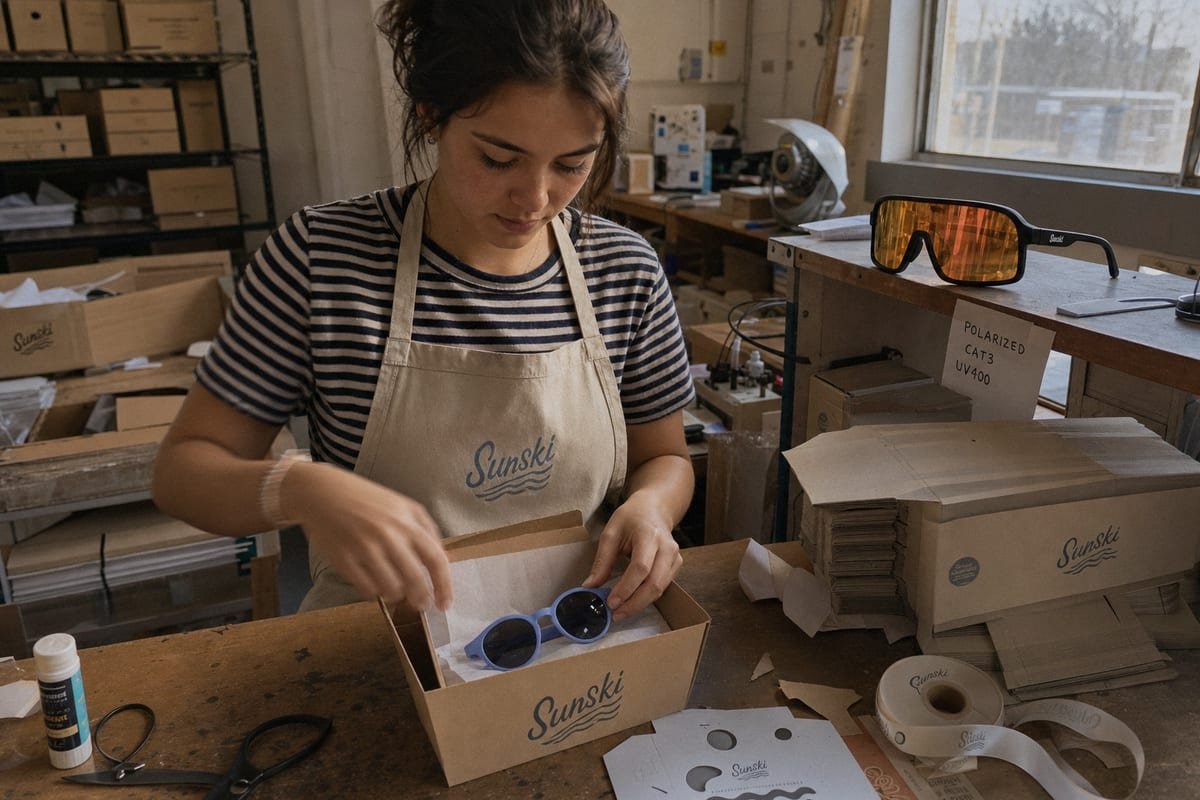
Le brief est le document le plus important de tout ce parcours. Lorsque le brief est mince, l'échantillonnage traîne et les coûts augmentent. Lorsqu'il est complet, une usine expérimentée de lunettes de soleil OEM peut agir rapidement et avec précision. Voici le flux de travail que nous appliquons avec des marques de plus de 20 pays.
Le flux de travail en sept étapes
- Définir le concept. Choisissez votre groupe d'âge, votre cas d'utilisation et votre positionnement. Un masque sportif pour les enfants actifs de six à dix ans est un projet différent d'une monture ronde pastel pour les tout-petits.
- Collecter des références. Rassemblez des images d'inspiration, des exemples de concurrents et un mood board. Analysez les avis des clients sur les produits concurrents pour trouver des plaintes — ajustement glissant, casse, décollement des logos — et concevez en conséquence.
- Rédiger le brief. Inclure la présentation de la marque, le client cible, les références de montures, les préférences de matériaux, la direction des couleurs, les spécifications des verres, le format et l'emplacement du logo, la direction de l'emballage, les marchés cibles pour la conformité et le calendrier de lancement.
- Examiner les rendus. Nous fournissons des dessins ou des visuels 3D lorsque disponibles, afin que vous approuviez la direction avant l'échantillonnage physique.
- Échantillonner et réviser. Prévoyez deux à trois tours. Annotez chaque changement par écrit. Testez les échantillons sur de vrais enfants si possible — les enfants révèlent des problèmes d'ajustement que les adultes manquent.
- Approuver l'échantillon d'or. Cette unité signée devient la référence de qualité pour la production de masse et l'inspection.
- Produire un petit lot. Lancez en petite quantité, recueillez les commentaires des parents et des enfants, envoyez des échantillons à des influenceurs famille-style de vie, puis récommandez en toute confiance.
Délais réalistes
Du brief à l'échantillon approuvé, attendez-vous à quatre à huit semaines selon la profondeur de la personnalisation. La production en vrac ajoute généralement quatre à six semaines supplémentaires. Intégrez le temps de test de conformité dans votre calendrier de lancement, pas après. Les marques qui planifient un trimestre complet du brief à l'entrepôt manquent rarement leur saison ; les marques qui planifient trois semaines le font presque toujours.
Conclusion
Les lunettes de soleil exclusives pour enfants sont basées sur la concentration : une niche claire, une usine spécialisée, une personnalisation multicouche, une sécurité vérifiée et un échantillonnage discipliné. Commencez petit, validez, puis développez votre propre collection signature.
Notes de bas de page
Guide officiel du gouvernement américain sur la certification obligatoire des produits pour enfants. ↩︎
Aperçu technique des élastomères thermoplastiques utilisés pour les montures de lunettes flexibles et durables. ↩︎
Définition faisant autorité de la norme de blocage des rayons ultraviolets. ↩︎
Slug Wikipedia corrigé pour la technologie des lunettes polarisées. ↩︎
Page thématique officielle du NIEHS sur la sécurité du bisphénol A (BPA). ↩︎
Aperçu officiel du gouvernement des exigences de la Consumer Product Safety Improvement Act. ↩︎
Guide de la FDA sur la classification et la réglementation des lunettes de soleil en tant que dispositifs médicaux. ↩︎
Plus d'articles que vous pourriez aimer

Vous recherchez un partenaire fiable en lunetterie pour enfants ?
Explorez plus de 800 styles prêts et un support OEM/ODM complet adapté à votre marque.
Contactez-nous English
  Español de México
  Deutsch
  Français
  日本語
日本語  العربية
  Português do Brasil