What Regional Preferences Matter When Sourcing Kids Sunglasses for Europe and the US?
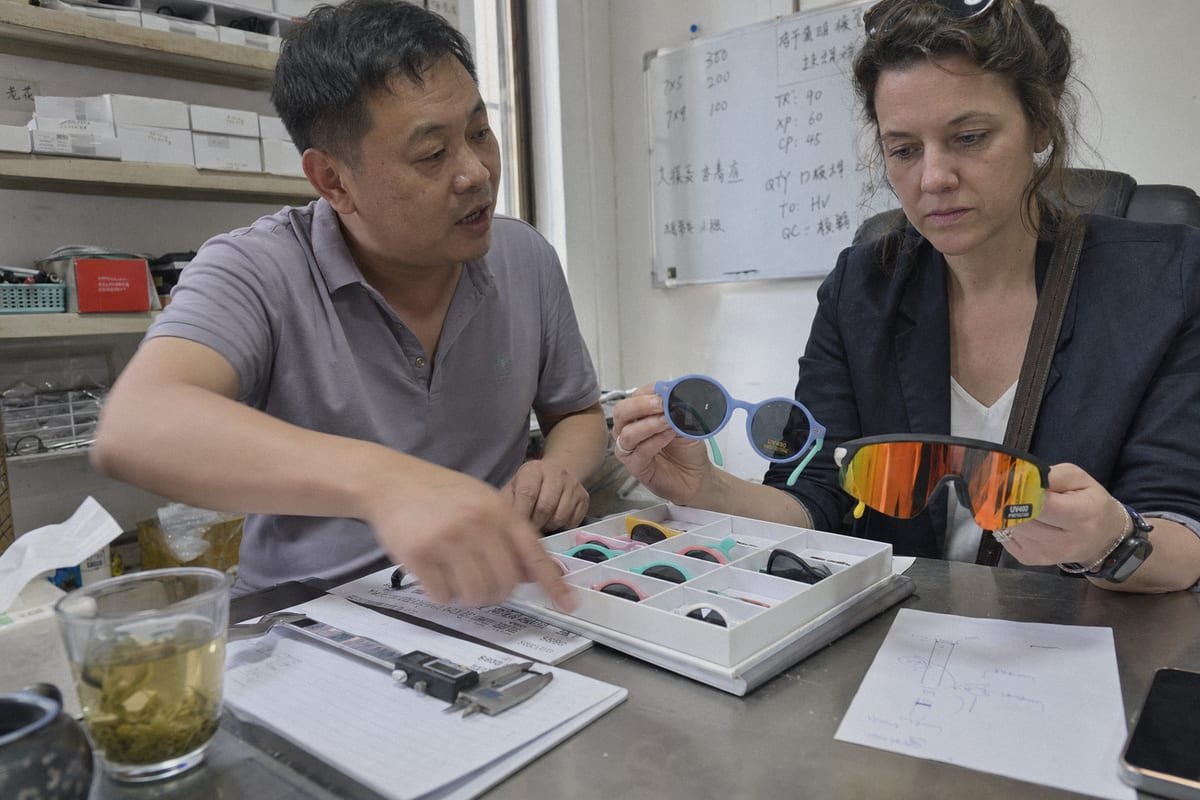
Sourcing kids sunglasses for Europe and the US looks simple until an order gets rejected. On our production line in Taizhou, I have seen buyers lose whole seasons over one wrong assumption.
When sourcing kids sunglasses for Europe and the US, Europe rewards certification, CE marking compliance, premium materials, and optical-retail trust, while the US rewards brand identity, licensed styles, polarized performance lenses, and broad price ladders. UV400 protection is the non-negotiable baseline in both markets.
The same pair of sunglasses can succeed in both regions—but for different reasons. Let me break down exactly what changes, market by market.
How Do European and US Safety Standards Differ for Kids Sunglasses?
A German buyer once asked me for our full technical file before even discussing price. A US buyer the same week asked for drop-ball test results first. That contrast taught me everything about these two markets.
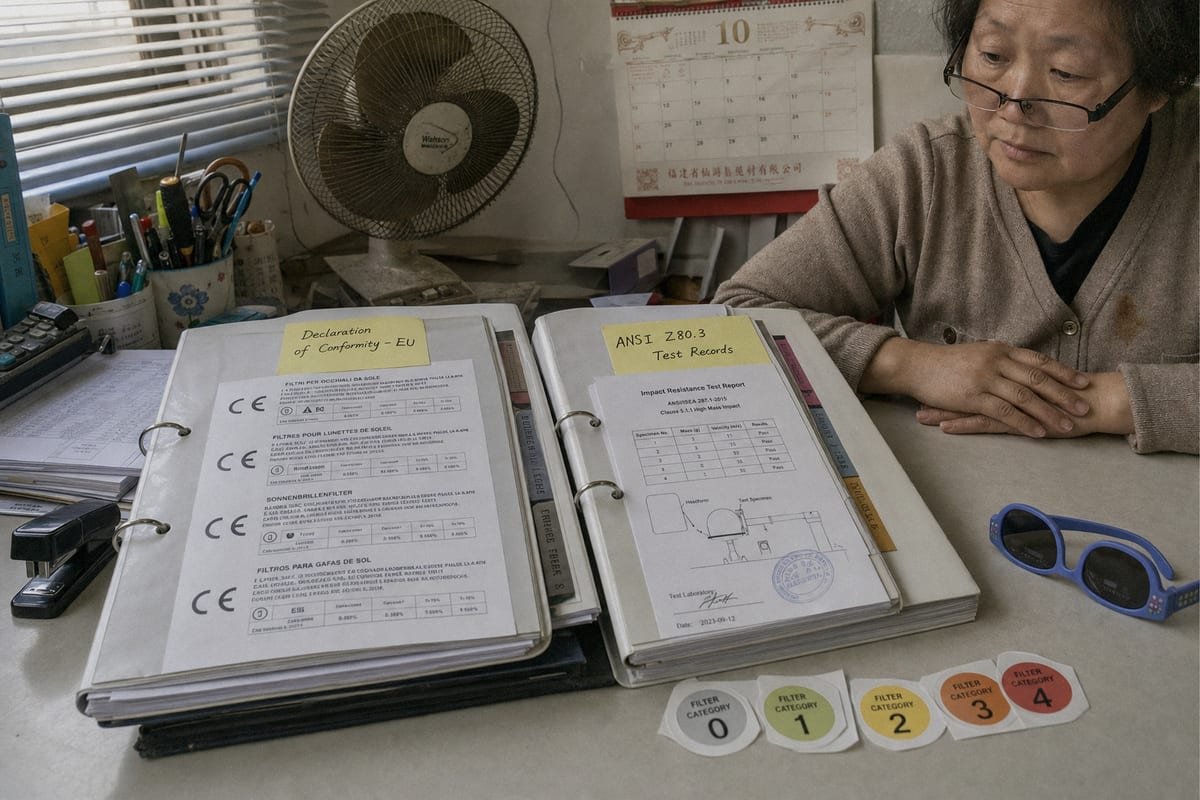
Europe classifies sunglasses as Personal Protective Equipment under Regulation 2016/425, requiring CE marking and EN ISO 12312-1 compliance. The US treats them as Class I Medical Devices under FDA oversight, requiring ANSI Z80.3 conformity and impact resistance testing per 21 CFR 801.410.

The two regulatory systems start from different philosophies. Europe treats a pair of children's sunglasses as protective equipment. That means the product must prove it protects before it enters the market. The US treats sunglasses as a low-risk medical device. The focus there sits heavily on lens impact resistance and truthful labeling.
In our fifteen years of exporting kids eyewear, the documentation burden has always been heavier on the European side. Europe requires a Déclaration de conformité 1, a technical file, and labeling that often must appear in multiple languages for cross-border retail. The US is a single-language market with a simpler paper trail, but the drop-ball impact test is strict and non-negotiable.
Key Compliance Differences at a Glance
| Exigence | Europe | États-Unis |
|---|---|---|
| Legal classification | PPE (Regulation 2016/425) | Class I Medical Device (FDA) |
| Norme de base | EN ISO 12312-1 2 standard | ANSI Z80.3 certification |
| Mandatory mark | Marquage CE | No mark, but 21 CFR 801.410 impact test |
| Lens labeling | Filter category 0–4 | UV claims must be substantiated |
| Documentation | Declaration of Conformity, multilingual | English labeling, test records |
Why This Matters for Sourcing
If your factory cannot show real test reports against both frameworks, you carry the liability. We keep documentation ready for both regions because many of our clients sell across the Atlantic with one product line. One practical tip: confirm that lens filter categories are printed correctly for Europe. Retail buyers there check for it, and missing category labels can stall customs clearance or trigger returns from optical chains.
Materials matter to regulators too. Impact resistant materials like TR90 and flexible Sans BPA 3 TPEE frames reduce breakage risk during active play, which supports compliance narratives in both markets. A rigid, brittle frame that snaps into sharp edges is a problem everywhere.
Which Frame Styles and Colors Appeal Most to Buyers in Europe vs the US?
Two of our best-selling molds tell this story perfectly. A soft pastel round frame—periwinkle blue with mint temples—ships mostly to European boutiques. A black wraparound sport shield with a mirrored orange lens ships mostly to American outdoor brands.
European buyers favor refined, minimalist kids sunglasses in muted pastels, retro rounds, and mini-me adult silhouettes with premium finishes. US buyers favor bolder colors, licensed character themes, sport wraparounds, and mirrored lenses, supported by broader fit ranges and a good-better-best assortment.
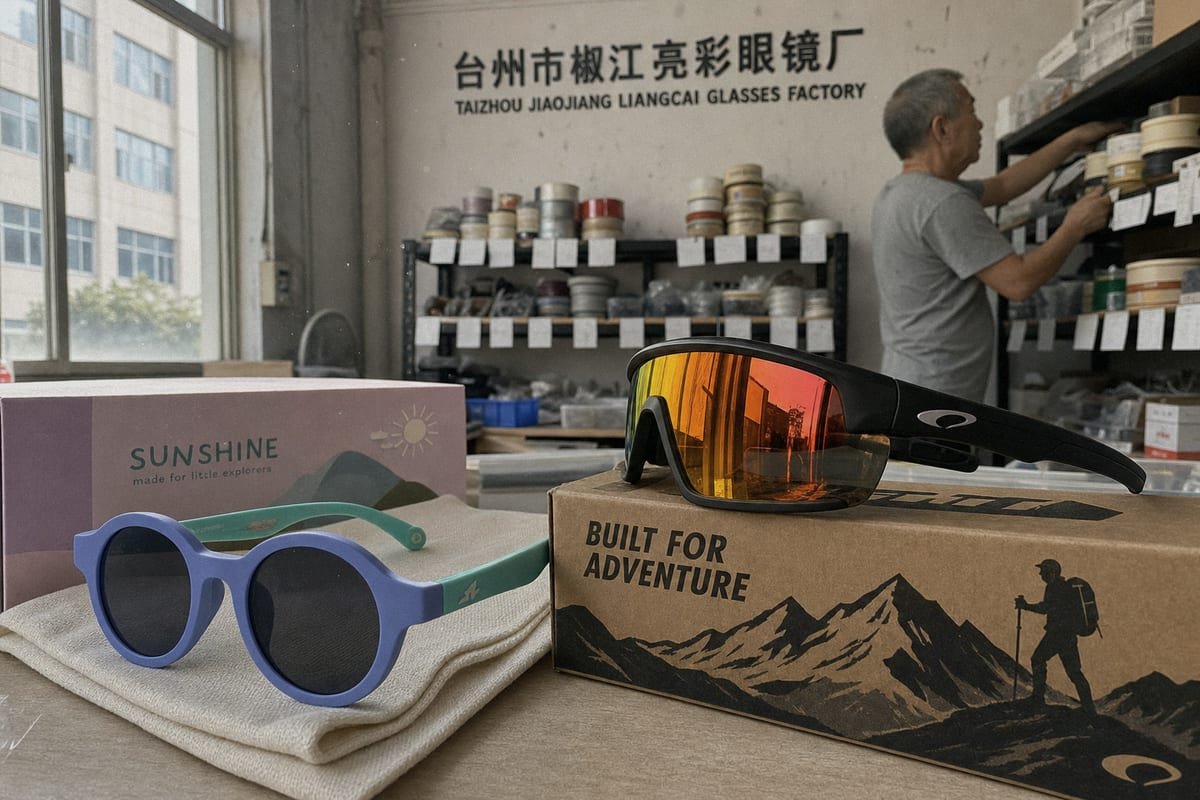
Style preference is not random. It follows retail structure. Europe sells a large share of children's eyewear through optical shops and premium boutiques. Those channels reward polished design, subtle color palettes, and a quality-first story. The US sells heavily through mass retail, e-commerce, and specialty outdoor stores. Those channels reward shelf impact, recognizable characters, and activity-specific designs.
Style Direction by Region
| Design element | Europe | États-Unis |
|---|---|---|
| Color palette | Pastels, earth tones, muted two-tone | Bright, bold, mirrored, high contrast |
| Silhouette | Round, retro, mini-me classics | Wraparound, sport shield, oversized |
| Character licensing | Present, but secondary | Major conversion driver |
| Finish preference | Matte, rubberized, refined | Glossy, iridescent, statement lenses |
| Fit expectations | Narrower, higher-bridge standards | Broader global-fit and alternative-fit needs |
The mini-me trend runs strong in both regions. Parents like children's versions of aviators and wayfarers that echo their own eyewear. But the execution differs. In Europe, a mini-me frame should look like a scaled-down premium adult frame. In the US, the same silhouette can carry a superhero print or a color-shift mirrored lens and sell even better.
Fit is another quiet difference. Our US clients increasingly request wider frames and adjusted bridge fits to serve diverse facial morphologies. European collections still skew toward narrower, high-bridge anatomical standards. When we develop a shared style for both markets, we often run two bridge variants from one design language. With roughly 800 existing styles in our catalog, most buyers can find both directions without investing in new molds—which lowers the risk of testing a new market.
Sustainability also shapes European style briefs. Buyers there ask about sustainable eyewear materials 4, bio-based options, and recyclability far more often than US buyers do. In the US, "Made in USA" storytelling and durability guarantees come up more frequently instead.
Do European and US Parents Prioritize Different Lens Features Like UV400 or Polarization?
Lens specification calls are where I spend the most time with new clients. A UK importer and a Texas outdoor brand can order the same frame, yet their lens briefs read like different documents.
Both regions demand full UV400 protection as the baseline, but European parents focus on certified filter categories, optical credibility, and labeled protection levels. US parents more often expect polarized lenses as standard, plus emerging hybrid features like blue-light filtering for screen-heavy lifestyles.
UV protection is the universal purchase driver. Children's eyes let more Rayonnement UV 5 reach the retina than adult eyes, and parents in both regions know this. A German consumer study found that a large majority of buyers rank UV protection as their main sunglasses purchase criterion. So UV400 protection standards must anchor every product story you build, on both sides of the Atlantic.
The divergence appears above that baseline. European buyers speak the language of certification. They want the lens filter category (0–4) printed clearly, EN ISO 12312-1 test evidence available, and claims that an optician would endorse. The trust framework is regulatory. US buyers speak the language of features and benefits. Polarized lenses for children are frequently treated as a default expectation rather than an upgrade, especially in outdoor, boating, and travel-focused assortments.
How Lens Priorities Stack Up
| Lens attribute | Europe | États-Unis |
|---|---|---|
| protection UV400 | Mandatory baseline, certification-led | Mandatory baseline, benefit-led |
| Polarisation | Valued, roughly a third of youth sales | Often expected as standard |
| Filter category labeling | Critical trust signal | Rarely requested |
| Mirrored / gradient coatings | Selective, fashion-driven | Popular for sport and style |
| Blue-light hybrid lenses | Emerging slowly | Growing fast among tech-parents |
The Hybrid Lens Question
One trend we watch closely: US "tech-parents" are asking for hybrid lenses that combine UV protection with blue-light filtering 6 for kids who move between playgrounds and tablets. This request is currently outpacing similar interest from Europe. When we quote these projects, we advise clients to keep the outdoor UV claim primary and the blue-light claim secondary, so the product stays credible under both ANSI Z80.3 certification expectations and FDA labeling rules.
My practical advice: specify polarized options for any US-focused line, and specify printed filter categories plus documentation for any European line. Doing both from the start costs little and keeps one production run viable for two markets.
How Should I Adjust Packaging and Branding for European and US Retail Markets?
Early in my export career, a Dutch distributor returned a packaging proof because the compliance panel was too small and only in English. That single revision round taught our team more than any seminar could.
For Europe, packaging must lead with compliance: CE mark, filter category, multilingual labeling, and certification cues, ideally with sustainable materials. For the US, packaging should lead with brand story, lifestyle imagery, shelf impact, and benefit callouts like polarization and durability guarantees.
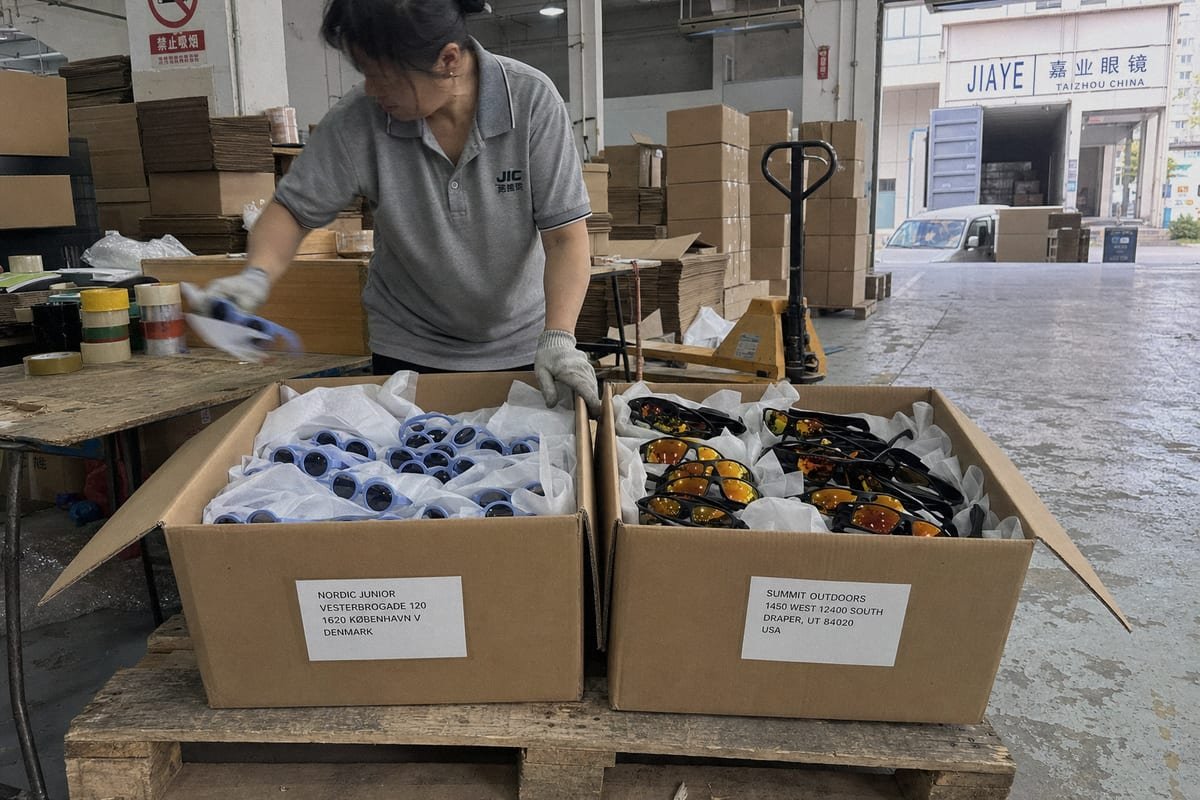
Packaging is not decoration. It is the last trust checkpoint before purchase. And the trust triggers differ sharply by region.
The European Packaging Checklist
European retail—especially optical channels—reads packaging like a document. In our OEM/ODM projects for European brands, we build packaging around these elements:
- CE mark and reference to the EN ISO 12312-1 standard, printed legibly.
- Lens filter category (0–4) stated on the box or hang tag.
- Multilingual copy covering the destination markets, since cross-border sales demand it.
- A Declaration of Conformity available to the retailer on request.
- Material story: eco-friendly, BPA-free TPEE frames and recyclable packaging respond directly to the EU's push on sustainable design.
Understated design works here. Muted colors, clean typography, and a quality narrative outperform loud graphics in most European kids eyewear channels.
The US Packaging Playbook
American shelves and product listings compete on attention. Our US clients typically request:
- Bold brand-forward graphics with lifestyle photography—beach, bike, ballpark.
- Clear benefit callouts: "100% UV400," "Polarized," "Flexible & Unbreakable."
- Peg-ready or counter-display formats for mass retail and e-commerce bundling.
- Support for service-led offers, such as lost-or-broken replacement guarantees, which favor higher-margin durable frames over budget-tier units.
- FDA approved eyewear 7 positioning through documented impact testing, referenced simply rather than technically.
For brands running wholesale private label sunglasses programs in both regions, we usually recommend one shared structural box with two printed variants. The frame inside stays identical. The trust language changes. This approach keeps minimums manageable while giving each market the signals its shoppers expect. One warning from experience: never ship the US-branded version into European distribution to save costs. Missing compliance labeling erodes retailer trust fast, and in Europe trust is the entire sale.
Conclusion
One product, two buying logics. Europe buys certified trust; the US buys brands and benefits. Source kids sunglasses with both playbooks ready, and both mature markets open up.
Notes de bas de page
1. Explains the EU conformity documentation required for PPE-classified sunglasses exports. ↩︎
2. Official ISO source clarifying the sunglasses safety standard referenced for European compliance. ↩︎
3. Current FDA guidance on the safety and regulatory status of Bisphenol A (BPA) in consumer products. ↩︎
4. Background on sustainable design concepts relevant to European eyewear sourcing trends. ↩︎
Plus d'articles que vous pourriez aimer



Vous recherchez un partenaire fiable en lunetterie pour enfants ?
Explorez plus de 800 styles prêts et un support OEM/ODM complet adapté à votre marque.
Contactez-nous English
  Español de México
  Deutsch
  Français
  日本語
日本語  العربية
  Português do Brasil