Qu'est-ce qui cause les différences de prix dans les lunettes de soleil pour enfants ?
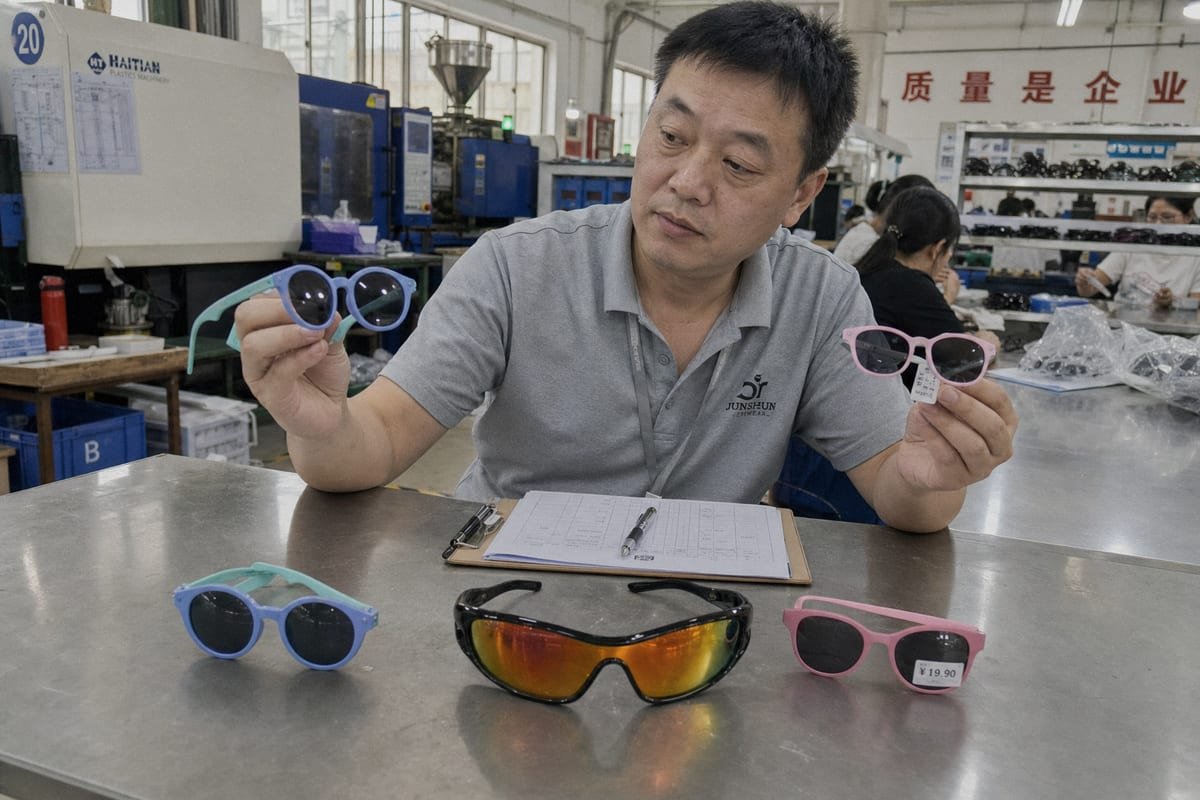
Les différences de prix dans les lunettes de soleil pour enfants confondent de nombreux acheteurs qui visitent notre ligne de production de Taizhou le moulage par injection 1. Un échantillon coûte 0,80 $, un autre 3,50 $, et les deux se ressemblent sur les photos. Cet écart inquiète les nouvelles marques. La vérité est que l'écart n'est pas aléatoire — il correspond directement aux matériaux, aux verres, aux outils et aux choix de personnalisation.
Les différences de prix dans les lunettes de soleil pour enfants proviennent de quatre facteurs principaux : la qualité du matériau du cadre (le TPEE et le TR90 coûtent plus cher que le plastique de base), la technologie des verres (les verres UV400 et polarisés ajoutent des coûts), l'investissement dans les moules et le développement, et le niveau de travail personnalisé OEM/ODM tel que la marque et l'emballage.
Chacun de ces quatre facteurs fonctionne différemment. Certains augmentent votre prix unitaire. Certains augmentent votre investissement initial. Dans cet article, je vais passer en revue les quatre, un par un, afin que vous puissiez décider où votre argent crée réellement de la valeur.
Quel est l'impact du matériau de la monture comme le TPEE ou le TR90 sur le prix final ?
L'année dernière, une acheteuse d'Australie m'a envoyé deux montures à comparer. L'une était notre échantillon flexible en TPEE. L'autre était une monture rigide économique qu'elle avait trouvée ailleurs. Elle les a pliées toutes les deux. Une seule a survécu.
La matière du cadre représente généralement 30 à 45 % du coût unitaire des lunettes de soleil pour enfants. Le matériau flexible TPEE et le TR90 peuvent ajouter 0,50 à 1,50 $ par unité par rapport au plastique PC de base, car ils coûtent plus cher en tant que matières premières et nécessitent un moulage par injection plus précis.
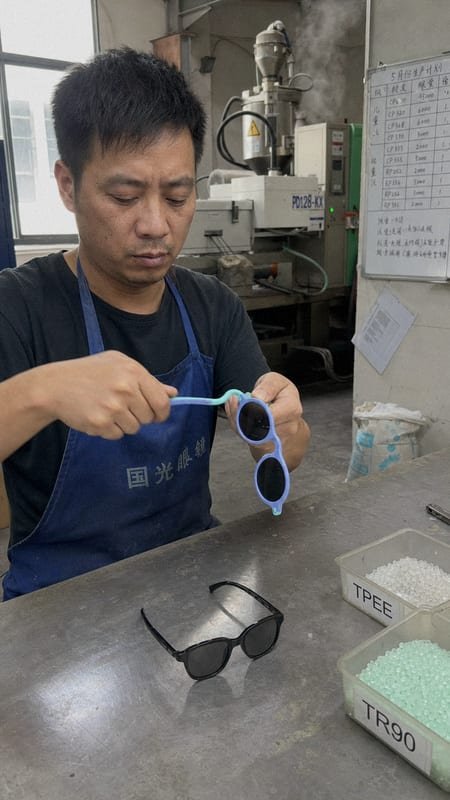
Le choix du matériau est le premier endroit où les écarts de prix apparaissent, et c'est aussi le plus facile à justifier auprès des clients finaux. Les montures bon marché utilisent des plastiques durs et cassants. Ils se fissurent lorsqu'un tout-petit s'assoit dessus. Ils se cassent à la charnière lorsqu'un enfant les retire d'une main. Nos ingénieurs ont testé ce schéma pendant quinze ans, et le mode de défaillance est toujours le même : matériau rigide plus manipulation brutale égale retours et plaintes.
Pourquoi les matériaux flexibles coûtent plus cher
Le TPEE et le TR90 sont des polymères de qualité ingénierie. Leur prix de matière première par kilogramme est significativement plus élevé que celui du plastique de commodité. Mais l'histoire du coût va au-delà du prix du granulé :
- Les matériaux flexibles nécessitent un contrôle plus strict de la température d'injection, de sorte que les temps de cycle sont plus lents.
- Les taux de rejet doivent être gérés avec soin, car les matériaux souples montrent plus facilement des marques de flux.
- Les montures en TR90 avec des branches en TPEE nécessitent deux matériaux et deux étapes de moulage, pas une.
- Les formulations sûres et respectueuses de l'environnement — y compris les montures sans BPA 2 — coûtent plus cher que la résine non certifiée.
Ce dernier point est important pour la santé oculaire pédiatrique 3 et la sécurité globale de l'enfant. Les parents de tout-petits savent que leurs enfants mâchent les embouts de branches. Les acheteurs en Europe, au Japon et en Australie nous demandent de plus en plus de documentation sur la sécurité des matériaux avant même de poser des questions sur le prix.
Comparaison des coûts des matériaux
| Matériau de la monture | Coût relatif | Flexibilité | Idéal pour |
|---|---|---|---|
| Plastique PC/ABS de base | Bas | Rigide, peut casser | Cadeaux promotionnels |
| TR90 | Moyen-élevé | Se plie et reprend sa forme | Lunettes de soleil pour enfants de tous les jours |
| TPEE flexible | Élevé | Extrêmement doux et flexible | Tout-petits et bébés |
| Branches TR90 + TPEE | Élevé | Avant rigide, branches souples | Enfants actifs, lignes premium |
D'après notre expérience d'exportation dans plus de 20 pays, les marques qui choisissent des matériaux flexibles constatent moins de réclamations de garantie. Le prix unitaire plus élevé se rentabilise souvent grâce à la confiance des clients.
Pourquoi les verres UV400 et polarisés coûtent-ils plus cher que les verres standard ?
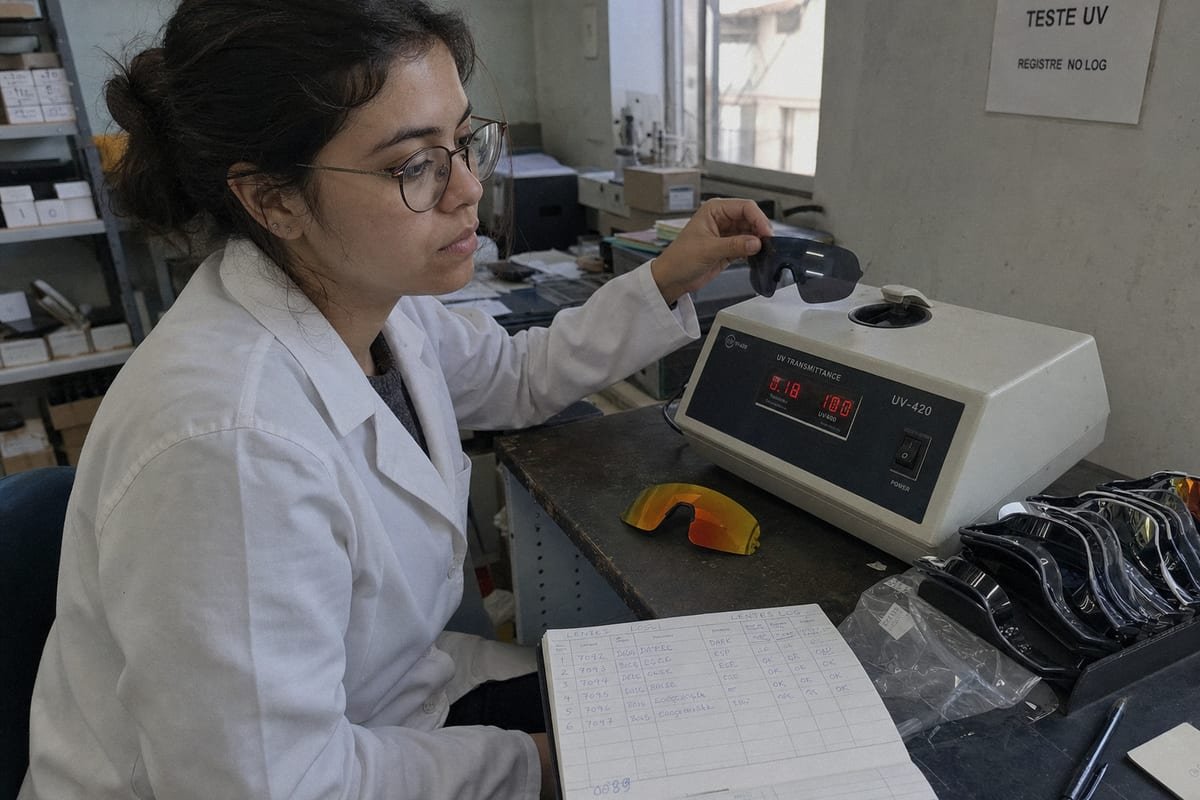
Lors d'un audit de contrôle qualité dans notre atelier au printemps dernier, nous avons prélevé un lot de verres teintés bon marché d'un échantillon retourné d'un concurrent. La teinte était foncée. Le test de transmission UV a quand même échoué.
Les verres UV400 et polarisés coûtent plus cher car ils utilisent des ébauches de verres certifiées, une construction multicouche et des tests par lot. Une teinte foncée seule bloque la lumière mais pas les rayons UV. La véritable protection UV400 ajoute environ 0,20 € à 0,60 €, et la polarisation ajoute 0,50 € à 1,20 € par paire.
C'est le facteur de coût le plus important que les parents doivent comprendre, et c'est aussi celui qui est le plus souvent mal représenté sur le marché. Les verres foncés sans filtration UV sont en réalité dangereux. La teinte foncée fait dilater les pupilles d'un enfant, ce qui laisse entrer plus de lumière UV non filtrée dans l'œil en développement. Ainsi, une paire de "lunettes de soleil" teintées à 0,50 $ peut être pire que pas de lunettes de soleil du tout.
Ce que vous payez dans un vrai verre UV400
protection UV400 4 signifie que le verre bloque les longueurs d'onde jusqu'à 400 nanomètres. Pour fournir cela de manière fiable, nous nous approvisionnons en matériau de verre où le filtre UV est intégré dans le polymère lui-même, et non pulvérisé comme un revêtement qui se dégrade. Ensuite, nous le vérifions. Chaque lot de production sur notre ligne passe par des contrôles de transmission UV avant l'assemblage. Ce temps de test, plus le matériau de verre certifié, est là où se situe le coût supplémentaire.
La plupart de nos verres pour enfants utilisent un matériau résistant aux chocs polycarbonate 5. Il offre une construction incassable, ce qui est important lorsqu'un enfant tombe face la première dans un terrain de jeu. Le polycarbonate offre également une meilleure clarté optique que l'acrylique utilisé dans les lunettes de soleil de qualité jouet, qui peut déformer la vision et causer une fatigue oculaire 6.
Ce que la polarisation ajoute — et ce qu'elle n'ajoute pas
Les verres polarisés contiennent un film filtrant supplémentaire laminé entre les couches de verre. Ce film réduit l'éblouissement de l'eau, de la neige et du trottoir. Pour les vacances à la plage et les sports de plein air, les enfants voient plus confortablement et plissent moins les yeux. Mais la polarisation est une caractéristique de confort, pas un substitut de sécurité. Un verre polarisé sans protection UV400 reste un verre dangereux. Lorsque les acheteurs nous demandent de prioriser, je dis toujours : UV400 d'abord, polarisation ensuite, et un revêtement résistant aux rayures en troisième si le budget le permet.
Choisir parmi les styles existants réduit-il vraiment mes coûts de développement ?
Une fondatrice de startup du Japon avait une fois un budget de 15 000 $ pour des moules personnalisés avant de nous contacter. Après avoir parcouru notre catalogue d'environ 800 styles existants, elle a lancé sa première collection pour une fraction de ce montant.
Oui. Choisir parmi les styles existants élimine l'investissement de moule de $3 000–$8 000 par style et réduit le temps de développement de 60–90 jours à aussi peu que 15–30 jours. Vous ne payez que pour les unités, les couleurs personnalisées et la marque, ce qui réduit considérablement votre risque lors de la test d'un nouveau marché.
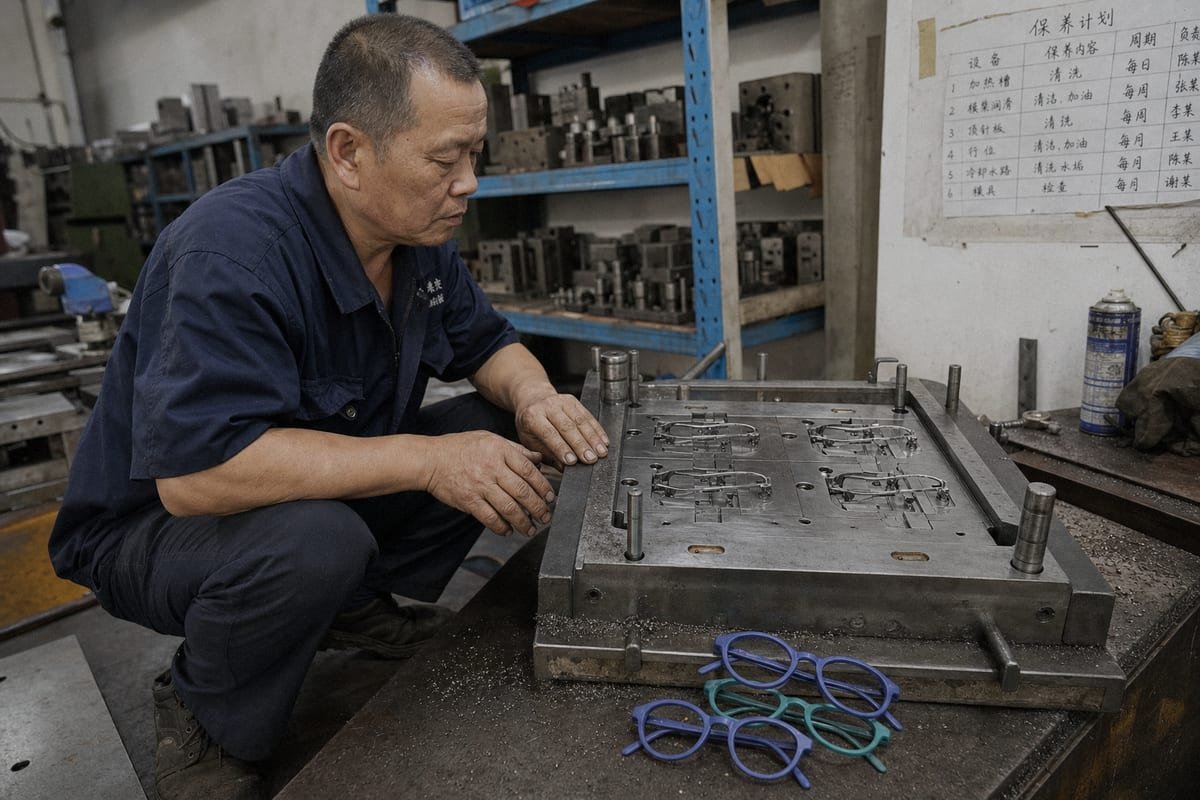
Les coûts de moulage sont le mur caché qui arrête de nombreuses nouvelles marques pour enfants. Un moule d'injection en acier pour une seule monture de lunettes de soleil représente une dépense d'investissement importante. Si votre premier modèle ne se vend pas, cet argent est perdu. C'est pourquoi nous avons construit un bibliothèque d'environ 800 styles éprouvés plus de quinze ans — des montures rondes pastel douces pour tout-petits, comme nos modèles bicolores bleu pervenche et menthe-tendre, aux lunettes de sport enveloppantes avec verres dégradés miroir pour les enfants plus âgés.
La vraie mathématique du moule ouvert vs. moule personnalisé
Voici comment les chiffres se comparent généralement pour une nouvelle marque lançant trois styles :
| Article de coût | Styles existants (Moule ouvert) | Entièrement personnalisé (Nouveau moule) |
|---|---|---|
| Investissement dans le moule | $0 | $9 000–$24 000 pour 3 styles |
| Temps d'échantillonnage | 7–15 jours | 45–60 jours |
| Quantité minimale de commande | Inférieur, flexible | Plus élevé, pour justifier l'outillage |
| Délai de mise sur le marché | 15–30 jours | 60–90 jours |
| Exclusivité de la conception | Forme partagée, couleurs personnalisées | Entièrement exclusif |
Ce que vous contrôlez toujours avec les styles existants
Choisir une monture existante ne signifie pas que votre produit aura l'air générique. Sur le même moule, vous pouvez spécifier :
- Couleurs de monture personnalisées et combinaisons bicolores
- Finitions mates, brillantes ou caoutchoutées soft-touch
- Options de verres — teintes UV400, revêtements miroir, verres polarisés
- Votre logo imprimé ou gravé sur la branche
- Accessoires tels que des étuis, des pochettes et sangles de tête réglables pour bébés
D'après mon expérience, le chemin le plus intelligent pour une nouvelle marque est de lancer avec des styles existants, d'apprendre quelles formes se vendent sur votre marché et d'investir dans un moule personnalisé uniquement pour votre meilleur vendeur éprouvé. Cette séquence protège votre trésorerie et raccourcit votre courbe d'apprentissage.
Comment les fonctionnalités personnalisées OEM/ODM telles que l'emballage et la marque modifient-elles mon prix unitaire ?
Des compromis apparaissent dans presque tous les devis que je prépare. Un acheteur veut un emballage haut de gamme, un logo imprimé, une pochette en microfibre et une étiquette volante — puis demande pourquoi le prix unitaire a augmenté de quarante cents.
Les fonctionnalités personnalisées OEM/ODM ajoutent généralement 0,30–1,50 $ par unité. L'impression de logo ajoute 0,05–0,15 $, les boîtes de vente au détail personnalisées ajoutent 0,15–0,50 $, les pochettes et les étuis ajoutent 0,10–0,60 $, et le développement de lentilles ou de couleurs personnalisées peut entraîner des frais de mise en place. Chaque fonctionnalité est facultative et tarifée séparément.
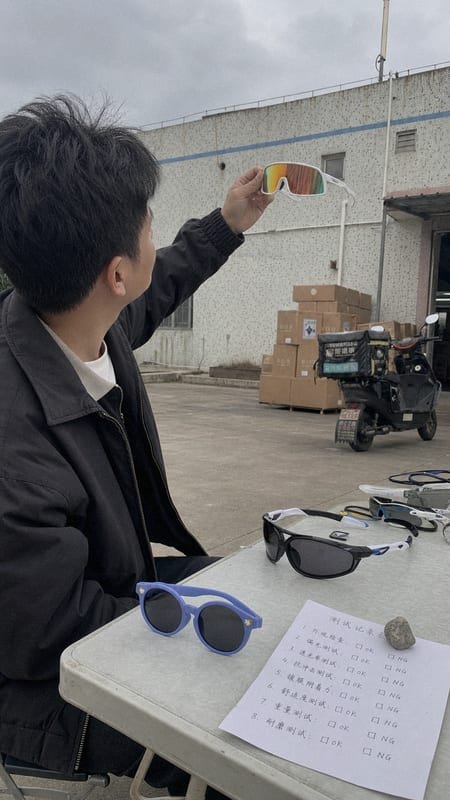
La personnalisation est ce qui fait que deux montures identiques peuvent avoir des coûts d'atterrissage très différents — et des valeurs de détail très différentes. Une paire simple dans un polybag peut être vendue en gros à un prix. La même paire avec un emballage de marque peut être vendue au détail deux ou trois fois plus cher. La question n'est donc pas de savoir si les caractéristiques personnalisées augmentent le prix unitaire. C'est le cas. La question est de savoir si chaque caractéristique augmente la valeur perçue plus qu'elle ne coûte.
Répartition des ajouts courants OEM/ODM
| Caractéristique personnalisée | Coût supplémentaire typique par unité | Valeur qu'elle crée |
|---|---|---|
| Logo sur la branche (impression par tampon) | 0,05 €–0,15 € | Reconnaissance de la marque |
| Gravure de logo ou plaque métallique | 0,10 €–0,30 € | Sensation haut de gamme |
| Couleur de monture Pantone personnalisée | Frais de configuration, faible par unité | Cohérence de la marque |
| Boîte de vente au détail personnalisée | 0,15 €–0,50 € | Présentation prête pour l'étalage |
| Pochette en microfibre ou étui rigide | 0,10 €–0,60 € | Qualité perçue, protection |
| Étiquettes volantes et inserts | 0,03 €–0,10 € | Informations de sécurité, détails de conformité |
| Teinte de lentille personnalisée ou revêtement miroir | $0.10–$0.40 | Look distinctif |
Où le contrôle qualité s'intègre dans le prix
Il y a un coût supplémentaire caché dans le travail OEM professionnel : l'inspection. Sur notre ligne gérée selon la méthode 5S, les commandes de marque passent par des points de contrôle supplémentaires — alignement de l'impression, correspondance des couleurs par rapport aux échantillons approuvés, vérifications de l'assemblage de l'emballage et finale Inspection AQL 7 avant l'expédition. Ce travail est intégré dans le devis. Un fournisseur qui propose un prix nettement inférieur pour la même spécification est généralement en train de supprimer exactement ces étapes. Pour un produit destiné aux enfants, où les affirmations de sécurité et la réputation de la marque sont en jeu, c'est le mauvais endroit pour économiser. Un contrôle qualité fiable n'est pas une caractéristique que l'on voit sur une photo, mais c'est la caractéristique qui maintient vos avis clients propres et vos récommandes régulières.
Conclusion
Les différences de prix dans les lunettes de soleil pour enfants ne sont pas mystérieuses. Elles proviennent de choix réels : matériau TPEE flexible par rapport à plastique cassant, protection UV400 vérifiée et verres polarisés par rapport à une simple teinte foncée, styles existants par rapport à des moules personnalisés coûteux, et image de marque OEM/ODM modulaire. Un devis au prix le plus bas cache généralement un compromis dans l'un de ces domaines — et dans les lunettes pour enfants, ce compromis se retrouve sur le visage d'un enfant. Mon conseil après quinze ans dans cette usine est simple : payez d'abord pour la sécurité, la durabilité et la cohérence, puis ajoutez le style et la marque par-dessus. C'est ainsi que vous construisez une ligne de lunettes pour enfants en laquelle les parents ont confiance et qu'ils recommandent.
Notes de bas de page
Wikipedia explique le processus de moulage par injection utilisé pour la précision de la fabrication des montures. ↩︎
Source de la FDA sur la sécurité du BPA pertinente pour les affirmations concernant les matériaux de montures sans danger pour les enfants. ↩︎
La ressource d'information sur la santé du NIH soutient les affirmations concernant le développement des yeux des enfants et l'exposition aux UV. ↩︎
L'OMS explique les effets des rayons UV sur la santé, soutenant les affirmations concernant la protection des verres UV400. ↩︎
Contexte Wikipedia sur le matériau polycarbonate utilisé dans les verres résistants aux chocs pour enfants. ↩︎
La ressource des CDC sur la fatigue oculaire et la sécurité de la vision est pertinente pour les affirmations concernant la distorsion des verres. ↩︎
Référence de la norme ISO pour l'inspection de la qualité acceptable utilisée dans les processus de contrôle qualité. ↩︎
Plus d'articles que vous pourriez aimer

28 septembre 2026
Les lunettes de soleil pour enfants en TR90 et TPEE peuvent-elles utiliser des matériaux recyclés ou biosourcés ?

28 septembre 2026
Les lunettes de soleil pour enfants en TR90 et TPEE sont-elles recyclables ? Conseils de mise au rebut expliqués ?

28 septembre 2026
Comment éviter la déformation et les rayures lors de l'expédition de lunettes de soleil pour enfants en TR90 et TPEE ?
Vous recherchez un partenaire fiable en lunetterie pour enfants ?
Explorez plus de 800 styles prêts et un support OEM/ODM complet adapté à votre marque.
Contactez-nous English
  Español de México
  Deutsch
  Français
  日本語
日本語  العربية
  Português do Brasil