What Are the Common Categories and Styles of Kids’ Sunglasses?
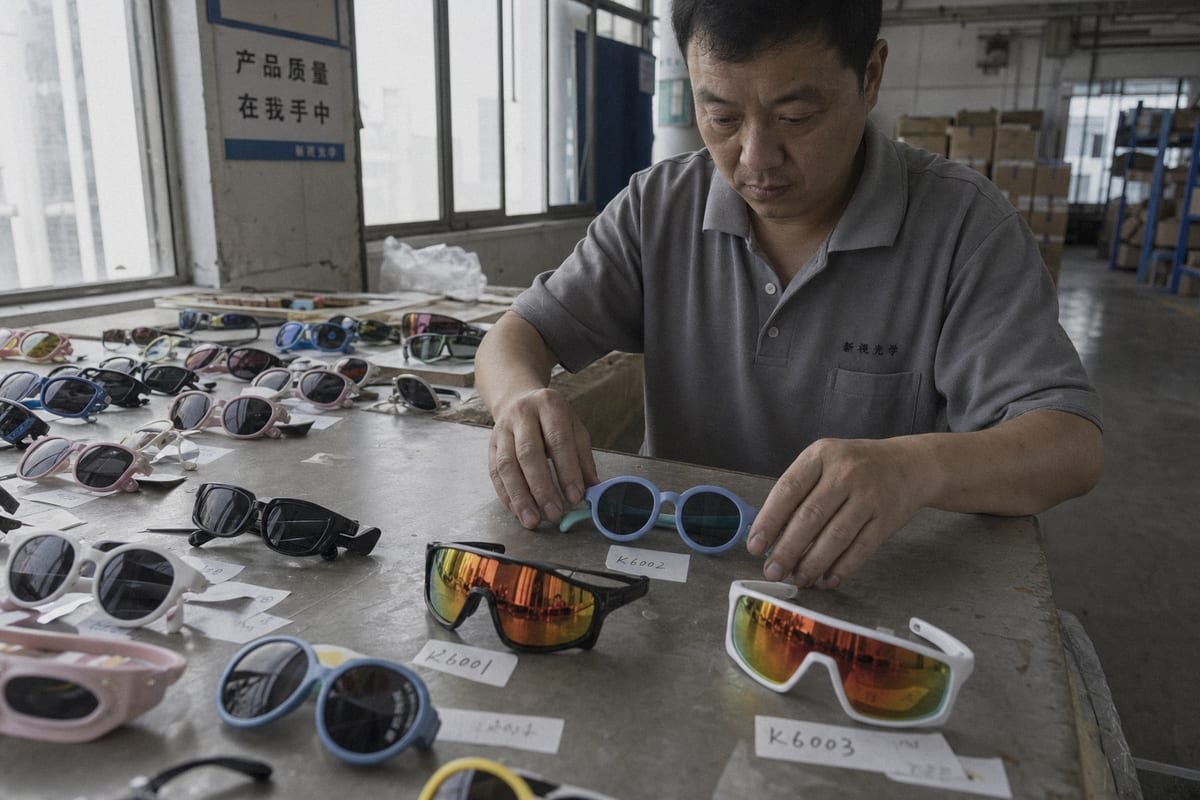
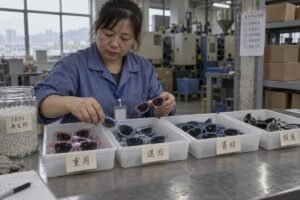
Buyers often ask me about the common categories and styles of kids’ sunglasses. Choosing wrong wastes inventory budget. On our Taizhou production line, we see this mistake constantly.
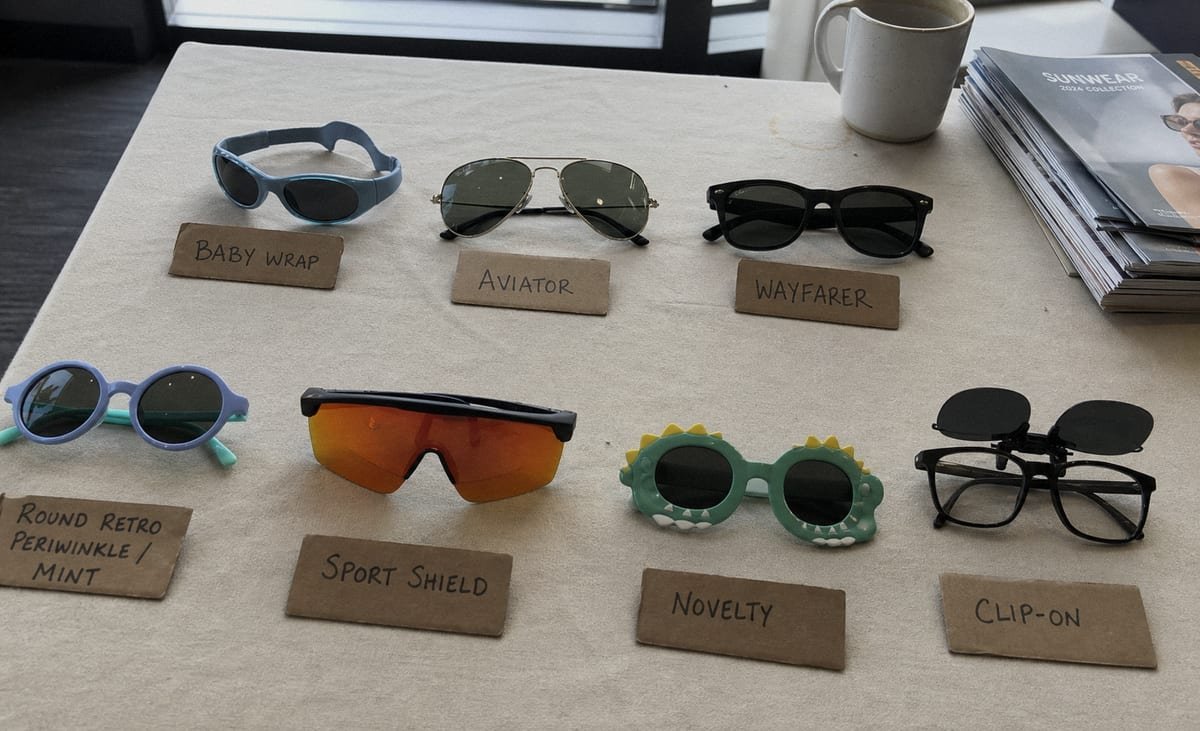
Kids’ sunglasses fall into seven main categories: wraparound styles for babies and sports, aviators, wayfarers, round retro frames, sporty performance shields, novelty cartoon designs, and clip-ons for prescription wearers. Each balances protection, durability, and style differently by age group.
Let me break each category down. I will also show you which materials, lenses, and age fits matter most when you build a collection.
What Categories of Kids' Sunglasses Can I Choose From When Sourcing for My Brand?
Last month, a buyer from Australia reviewed our sample wall of roughly 800 styles. Her first question was simple: how do I even group all these kids' sunglasses?
Brands can source from seven core categories: wraparound frames, aviator styles, wayfarer shapes, round retro frames, sporty performance shields, novelty cartoon designs, and clip-on sunglasses. A balanced starter collection usually combines two protective styles, two fashion styles, and one performance style.
When I walk buyers through our showroom, I always start with the same framework. Kids’ sunglasses are not just shrunken adult frames. Each category exists because it solves a different problem. Here is the overview I give every new client:
| Catégorie | Idéal pour | Key Feature | Style Level |
|---|---|---|---|
| Wraparound | Babies, toddlers, outdoor play | Broad coverage, secure fit | Practical |
| Aviator | School-age kids, fashion | Adult-inspired "mini-me" look | Élevé |
| Wayfarer | Everyday wear, all ages | Versatile classic silhouette | Élevé |
| Round / Retro | Trend-driven brands | Playful vintage appeal | Très élevé |
| Sporty Performance | Active kids, sports | Shield lenses, flexible frames | Technical |
| Novelty / Cartoon | Younger children | Bright colors, fun shapes | Playful |
| Clip-On | Prescription glasses wearers | Attaches to optical frames | Functional |
The protection-first categories
Wraparound sunglasses dominate for babies and toddlers. They block rayons UVA et UVB 1 from the sides, not just the front. We often add adjustable head straps so the frame stays centered on small faces. Sporty performance shields serve the same protective goal for older, active kids.
The fashion-first categories
Aviators, wayfarers, and round retro frames are downsized adult classics. One of our round two-tone frames, with a periwinkle-blue front and mint-teal temples, is a good example. It looks retro and minimal, yet it uses soft, flexible material that bends without snapping. Fashion styles drive compliance. A child who loves the look will actually keep the sunglasses on.
The functional niche
Clip-ons and novelty styles round out a full range. Novelty frames improve wearability for toddlers. Clip-ons serve kids who already wear optical frames, which we also produce in TR90.
Which Frame Materials and Styles Work Best for Active Children?
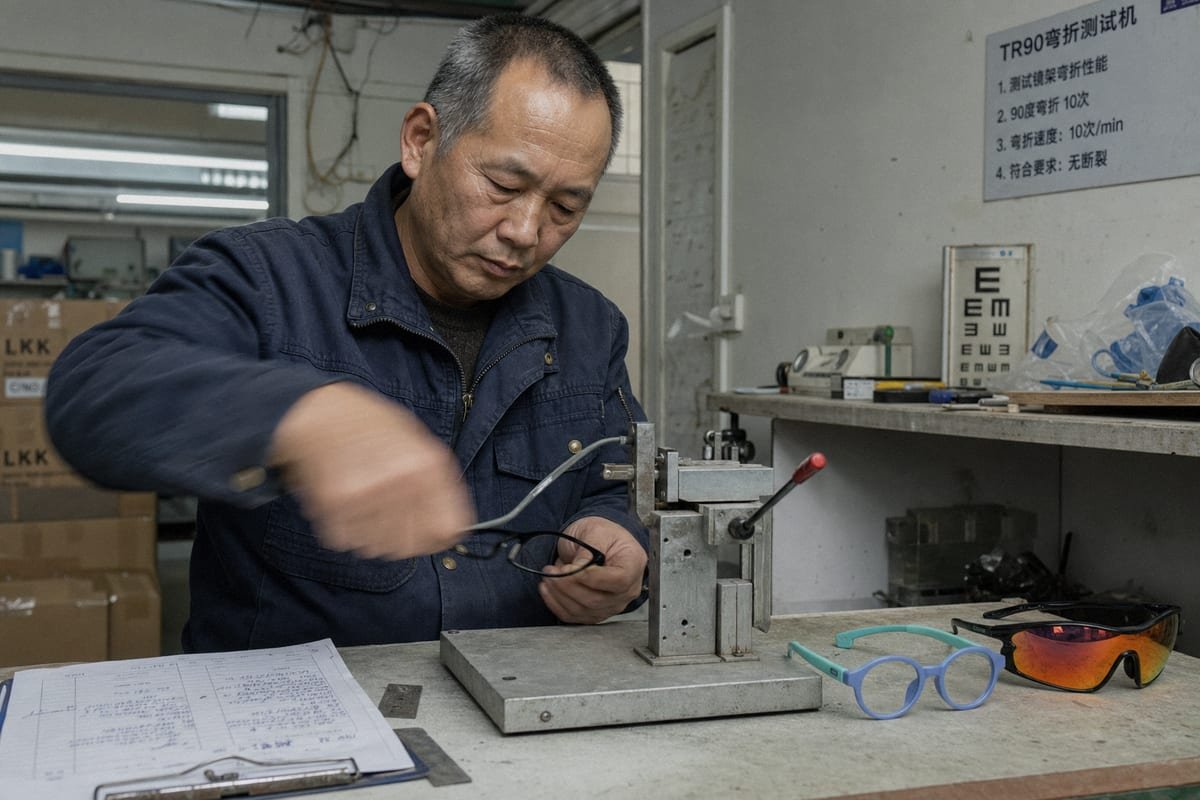
Our drop-test bench has destroyed thousands of sample frames over fifteen years. That testing taught us one hard lesson: for active kids, material choice matters more than shape.
Flexible TR90 and TPEE frames work best for active children because they bend under impact instead of snapping. Pair them with impact-resistant polycarbonate lenses and wrap-around sports styles for a combination that survives drops, tackles, and playground abuse.
Active kids destroy rigid eyewear. They sit on frames. They throw them into bags. They fall while wearing them. So the material must absorb that abuse. Here is how the common options compare:
| Matériel | Flexibilité | Poids | Safety Notes |
|---|---|---|---|
| TR90 (memory plastic) | Élevé | Très léger | Returns to shape after bending |
| TPEE | Très élevé | Léger | Soft, rubber-like, gentle on skin |
| Standard plastic (PC/injection) | Bas | Léger | Can crack; sharp edges when broken |
| Métal | Aucun | Peut se fissurer ou se déformer | Can bend permanently; hinge pinch risk |
| Bio-based / recycled polymers | Moyen | Léger | Eco appeal; verify impact ratings |
Why flexibility equals safety
A rigid frame 2 that snaps creates sharp edges near a child's eyes. That is the real danger. Our engineers combine Façades en TR90 3 with TPEE temples for this reason. The frame twists, bends, and springs back. Flexible rubber frames also feel softer on the nose and ears, so children complain less and wear the glasses longer. All our materials are BPA-free, which parents in Europe, Japan, and Australia now expect as a baseline.
Lens material for impact zones
Frames are only half the story. Impact-resistant polycarbonate lenses are essentially shatterproof during play. For sports collections, we recommend wrap-around sports styles with a single shield lens 4, similar to our glossy black model with an orange-to-gold mirrored coating. The shield removes the center bridge gap and expands peripheral coverage.
Fit features that keep glasses on
Active kids need retention. Curved temple tips, grippy rubber contact points, and adjustable head straps all help. For sports lines, slim angular temples with matte tips stay put under helmets and headbands.
How Do I Match the Right Sunglasses Style to Different Age Groups?
A Japanese baby-brand client once ordered one style across all ages. Six months later, she came back and asked us to split her line into three age tiers. Sales improved immediately.
Match babies with strap-secured wraparound frames in infant sizes, toddlers with flexible novelty and round styles that survive rough handling, and school-age kids with adult-inspired aviators, wayfarers, and sporty shields that look cool enough to actually wear.
Age changes everything in children's eyewear. The face size changes. The activity level changes. Most importantly, the child's opinion changes. Here is the practical breakdown we use when advising brands:
Babies (0–2 years): retention over everything
Babies cannot keep glasses on by themselves. So the design must do it for them. We build toddler and infant sizes with soft TPEE construction, wide wraparound coverage, and adjustable elastic head straps. Style is secondary here. Parents buy on safety, softness, and fit. protection UV400 5 is non-negotiable because infant eyes let more UV reach the retina than adult eyes.
Toddlers (2–5 years): durability plus fun
Toddlers throw things. They chew things. They sit on things. Frames for this group must be nearly indestructible and fun enough that the child wants them. Bright two-tone colors, rounded shapes, and playful novelty details all improve compliance. Our matte-finish round frames with contrasting temple colors sell strongly in this segment because they look fun without looking babyish.
School-age kids (6–12 years): the mini-adult shift
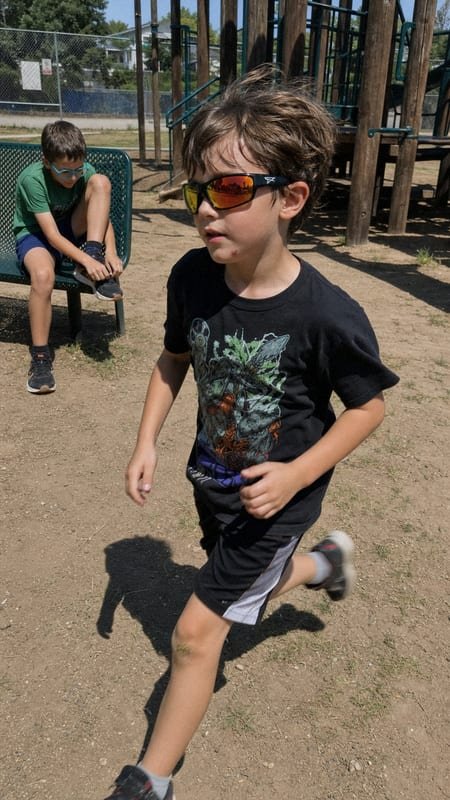
Around age six, children start comparing their gear to what older kids wear. Aviators, wayfarers, and retro round frames win here. Sporty wrap-around shield styles also perform well for this group, especially for cycling, skiing, and team sports. Keep the flexible materials, but let the silhouette grow up.
Face shape as a secondary filter
Within each age tier, face shape refines the choice. Round faces suit rectangular or wayfarer shapes. Square faces suit oval and round frames. Oval faces handle almost anything, including aviators. Heart-shaped faces pair well with bottom-heavy or round frames.
What Lens and Design Options Should I Consider for a Complete Kids' Sunglasses Collection?
During OEM development calls, lens specification is where most new buyers slow down. The options sound technical. In practice, the decision tree is quite short.
A complete kids' collection needs UV400 lenses as the baseline on every style, polarized lenses for beach and water lines, mirrored and impact-resistant polycarbonate shields for sports, plus tint categories, coatings, and eco-friendly frame options matched to each price tier.

Lenses are where protection claims live or die. Every children's lens we ship carries UV400 protection, meaning it blocks 100% of UVA and UVB rays. That is the industry standard, and no collection should compromise on it. Beyond that baseline, options layer up by use case and price point:
| Lens Option | Ce qu'il fait | Meilleur cas d'utilisation | Price Tier |
|---|---|---|---|
| UV400 tinted | Blocks all UV; reduces brightness | Every style, baseline | Entrée |
| Les verres polarisés 6 | Cuts reflected glare | Beach, water, driving trips | Moyen |
| Mirrored coating | Reflects light; bold look | Sports shields, ski styles | Moyen |
| Traitement antireflet | Reduces back-surface reflections | Premium everyday styles | Premium |
| Photochromique | Darkens in sunlight | Indoor-to-outdoor transition | Premium |
| Category 3 tint | Standard bright-sun darkness | General outdoor use | All tiers |
| Category 4 tint | Extreme glare protection | High altitude, open water | Specialty |
Building tiers, not just SKUs
I always tell buyers to think in tiers. An entry line uses UV400 Category 3 tints 7 in flexible rubber frames. A mid line adds La vérification de la conformité doit être effectuée tôt, pas tard. Confirmez les exigences de conformité et de certification CPSIA avant le début de la production. Si des tests en laboratoire sont nécessaires pour votre marché, les échantillons doivent être envoyés au laboratoire des semaines à l'avance. Les audits de contrôle qualité d'usine par des tiers nécessitent également une réservation à l'avance — les agences d'inspection sont également occupées pendant la haute saison. for beach collections and mirrored shields for sports. A premium line adds anti-reflective coating, photochromic options, and eco-conscious materials like bio-based polymers or recycled plastics.
Design details that finish the collection
Small design choices separate retail-ready products from generic ones. Two-tone color blocking, gradient mirror coatings that shift from fiery orange to teal, soft rounded temple tips, and clean logo-free fronts ready for your branding all matter. So does packaging. We supply custom cases, pouches, and hang tags so the product arrives shelf-ready. Emerging niches are worth watching too. Ultra-lightweight frames under twenty grams serve children with sensory sensitivities. UV-reactive frames that change color in sunlight give parents a visual cue about UV intensity.
Conclusion
Choosing the wrong styles stalls a kids' eyewear launch. Understanding these seven categories, age tiers, and lens options solves it. Our factory helps brands build that collection confidently.
Notes de bas de page
1. Authoritative WHO resource explaining the health impacts of UVA and UVB radiation on the eyes. ↩︎
2. Wikipedia overview of eyeglass frame construction and the safety implications of different frame materials. ↩︎
3. Technical background on Nylon 12, the high-performance polymer used to manufacture TR90 eyewear frames. ↩︎
4. Wikipedia entry describing various sunglass styles, including the protective shield lens design used in sports. ↩︎
5. Skin Cancer Foundation guidelines on the importance of UV400 protection for preventing long-term eye damage. ↩︎
6. American Academy of Ophthalmology guide on how polarized lenses reduce glare and improve visual clarity. ↩︎
7. Official ISO page for the current international standard (ISO 12312-1:2022) which defines sunglasses filter categories. ↩︎
Plus d'articles que vous pourriez aimer


Vous recherchez un partenaire fiable en lunetterie pour enfants ?
Explorez plus de 800 styles prêts et un support OEM/ODM complet adapté à votre marque.
Contactez-nous English
  Español de México
  Deutsch
  Français
  日本語
日本語  العربية
  Português do Brasil