Do Kids Sunglasses Need REACH or RoHS Compliance Testing?
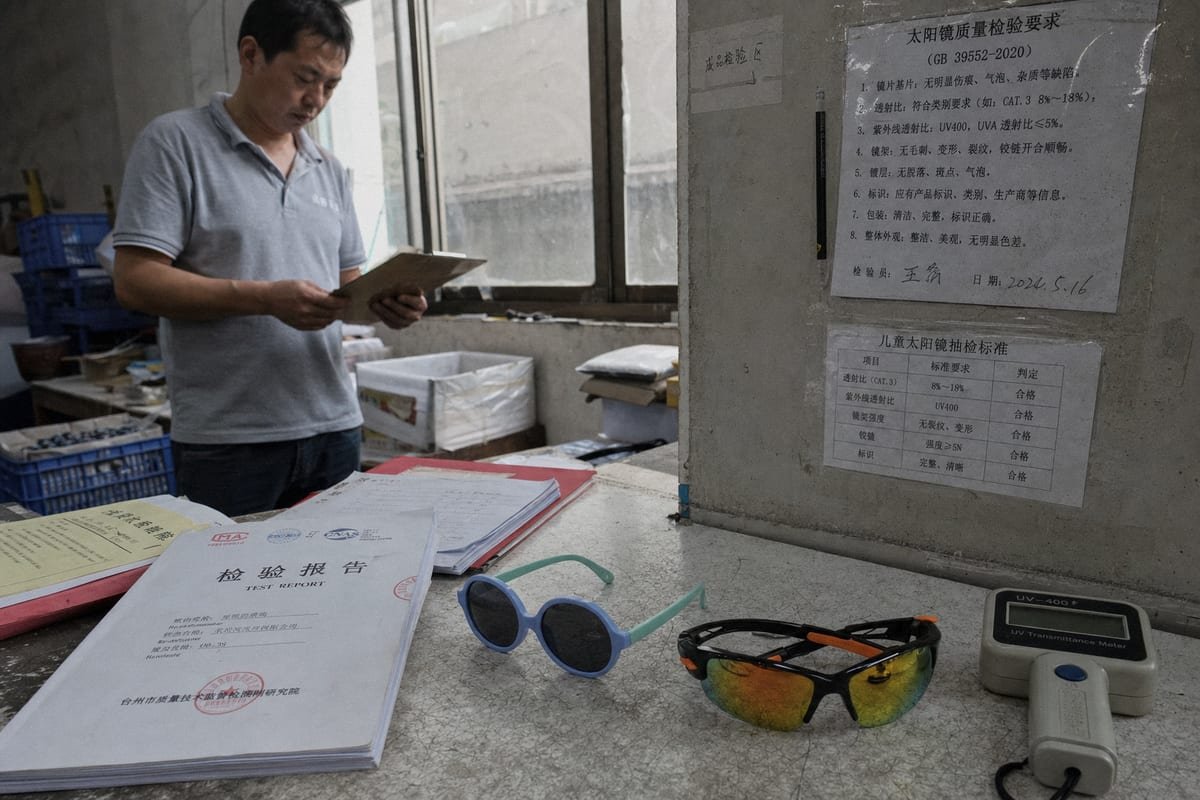
Kids sunglasses compliance questions land in my inbox weekly. Buyers worry about REACH 1, RoHS, and customs seizures. On our production line in Taizhou, I have seen why that fear is justified.
Kids sunglasses sold in the EU and UK almost always need REACH compliance testing, because REACH restricts chemicals in all consumer articles. RoHS does not apply unless the sunglasses contain electronics like LEDs or Bluetooth. Chemical testing and eyewear safety testing are separate obligations.
That short answer hides a lot of detail. The rules change depending on your market, your materials, and even your lens coatings. Let me walk you through what actually matters, step by step.
Which regulations apply to kids sunglasses sold in the EU and UK markets?
A German importer once asked me for a RoHS 2 certificate for a plain TR90 frame. Our team had to explain, politely, that he was asking for the wrong document entirely.
In the EU and UK, kids sunglasses must comply with REACH (or UK REACH) chemical restrictions, the PPE Regulation as Category I personal protective equipment with CE or UKCA marking, and EN ISO 12312-1 performance standards. RoHS only applies if electronic components are present.
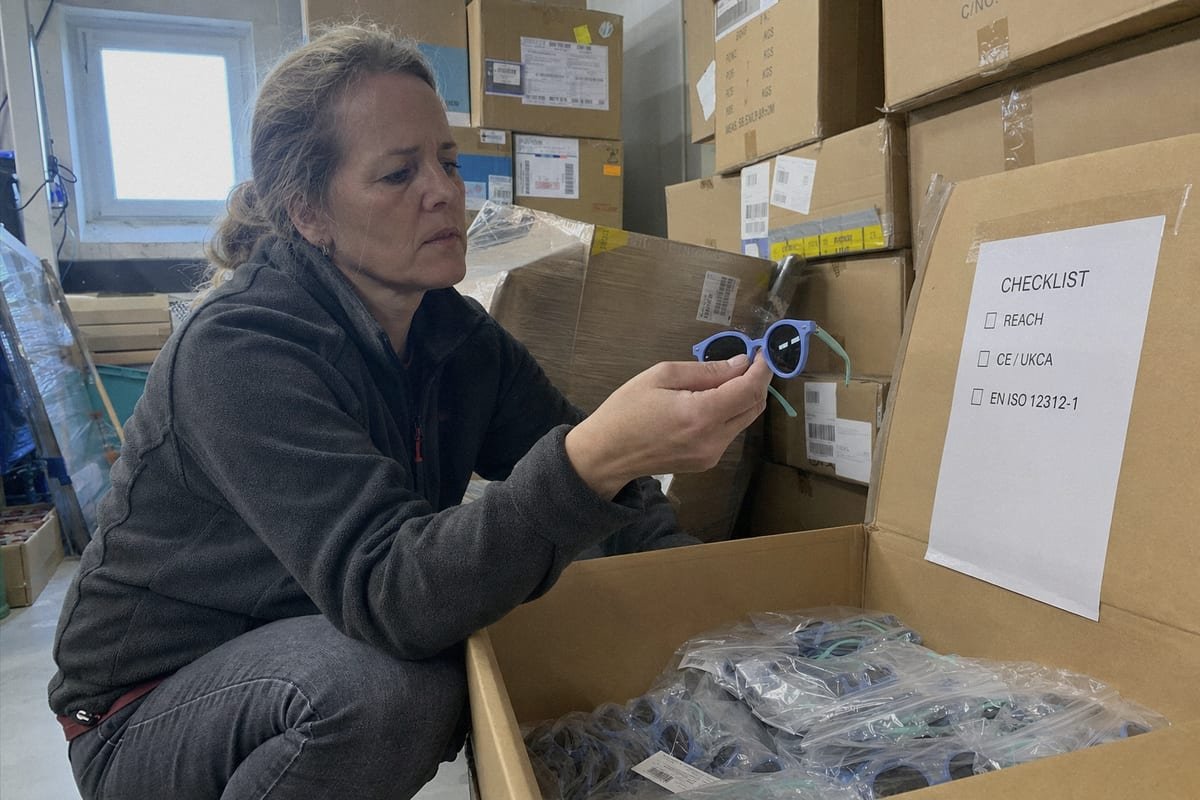
The first thing to understand is that "compliance" for kids sunglasses splits into two separate buckets. One bucket is performance and safety. The other bucket is chemical compliance. You need both. Passing one does not mean you passed the other.
Bucket one: performance and safety rules
In the EU, sunglasses are classified as Category I des équipements de protection individuelle 3. That means you need a Marquage CE, a Declaration of Conformity, and technical documentation. You do not need a notified body for Category I. The key performance standard is EN ISO 12312-1 4. It covers UV protection, light transmission categories, optical power limits, and robustness. In the UK, the structure mirrors this under UKCA marking and UK REACH after Brexit.
There is one important fork in the road. If your product is a toy sunglass — a novelty item with no real protective function — it may fall under the Toy Safety Directive instead. Then EN 71 safety requirements apply, including heavy metal migration limits under EN 71-3. Toy sunglasses that offer no UV protection need clear warnings. We always ask buyers to decide this classification before we quote, because it changes the whole testing plan.
Bucket two: chemical compliance
REACH applies to every consumer article sold in the EU, sunglasses included. The critical part for eyewear is Annex XVII restrictions. These limit substances such as lead, cadmium, nickel release, phthalates, and PAHs in plastics, coatings, and metal parts. You must also be ready to answer questions about Substances of Very High Concern above 0.1% by weight.
| Regulation | Ce qu'elle couvre | Applies to kids sunglasses? |
|---|---|---|
| REACH (EU) / UK REACH | Restricted chemicals in articles | Yes, always |
| RoHS | Hazardous substances in electronics | Only if electronic parts exist |
| PPE Regulation (Category I) | UV and optical safety, CE marking | Yes, for protective sunglasses |
| EN ISO 12312-1 | Sunglasses performance standard | Yes, as the reference method |
| Toy Safety Directive / EN 71 | Toys, including migration testing | Only for toy sunglasses |
Watch the emerging topics too. PFAS restrictions may soon affect hydrophobic lens coatings. Digital Product Passports are also coming, and they will likely require chemical composition records for children's products.
How do I verify a manufacturer's REACH and RoHS test reports before placing an order?
Over fifteen years of exporting children's eyewear, I have reviewed hundreds of test reports — and I have also seen buyers accept documents that would never survive a customs inspection.
Verify the report by checking the lab's accreditation, matching the tested sample to your exact product and color, confirming the test items cover Annex XVII substances like nickel release and phthalates, checking the report date, and contacting the laboratory directly to confirm authenticity.
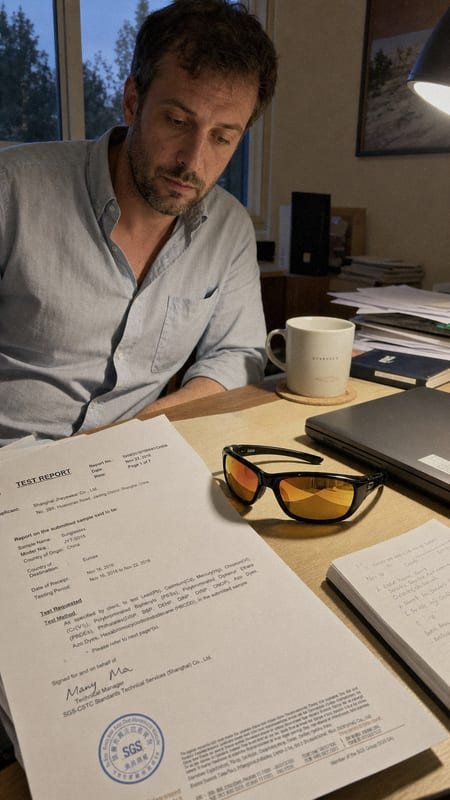
A test report is only as good as its connection to your actual shipment. So the first question is not "does a report exist?" It is "does this report describe my product?" Here is the checking process we recommend to every new buyer.
Un processus de vérification en cinq étapes
- Vérifiez le laboratoire. The report should come from an accredited third-party laboratory testing provider, such as SGS, Intertek, TÜV, or Bureau Veritas. Look for the accreditation logo and report number.
- Match the sample description. The report must describe your frame material, lens type, and ideally the color. A report for a black TR90 frame does not automatically cover a pastel TPEE frame with different pigments.
- Review the test scope. For kids sunglasses, expect phthalates and lead content, cadmium, PAHs, and nickel release on metal parts under EN 16128. The nickel limit is 0.5 µg/cm²/week under Annex XVII Entry 27. If a buyer wants extra assurance for toddler products, ask about Bisphenol A 5 (BPA) screening and EN 71-3 migration testing as well.
- Check the date and version. REACH restrictions update regularly. A report from four years ago may miss newly restricted substances. We treat reports older than two years as expired for practical purposes.
- Verify authenticity. Every major lab lets you confirm a report number by email or an online portal. Fake reports exist. Checking takes ten minutes and can save your whole order.
What honest suppliers should also provide
Beyond lab reports, ask for supplier declarations on raw materials, batch-level change logs, and confirmation that pigments or coatings have not changed since testing. On our line, we keep material declarations for every TPEE and TR90 batch precisely because color masterbatches are a common hidden risk. If a supplier cannot explain what changed between the tested sample and your production run, that is a red flag.
One more note on RoHS: if a supplier hands you a RoHS certificate for plain sunglasses, do not be impressed. It usually signals they grabbed a generic document rather than testing your actual product.
What happens if my kids sunglasses fail compliance testing after import?
The most difficult call I ever received came from a European distributor whose novelty kids frames — sourced elsewhere — got flagged for excessive phthalates at a random port check. The financial damage went far beyond the goods.
If kids sunglasses fail compliance testing after import, authorities can block the shipment at customs, order a market withdrawal or public recall, issue fines, and list the product on the EU Safety Gate. The importer, not the overseas factory, bears the legal responsibility.
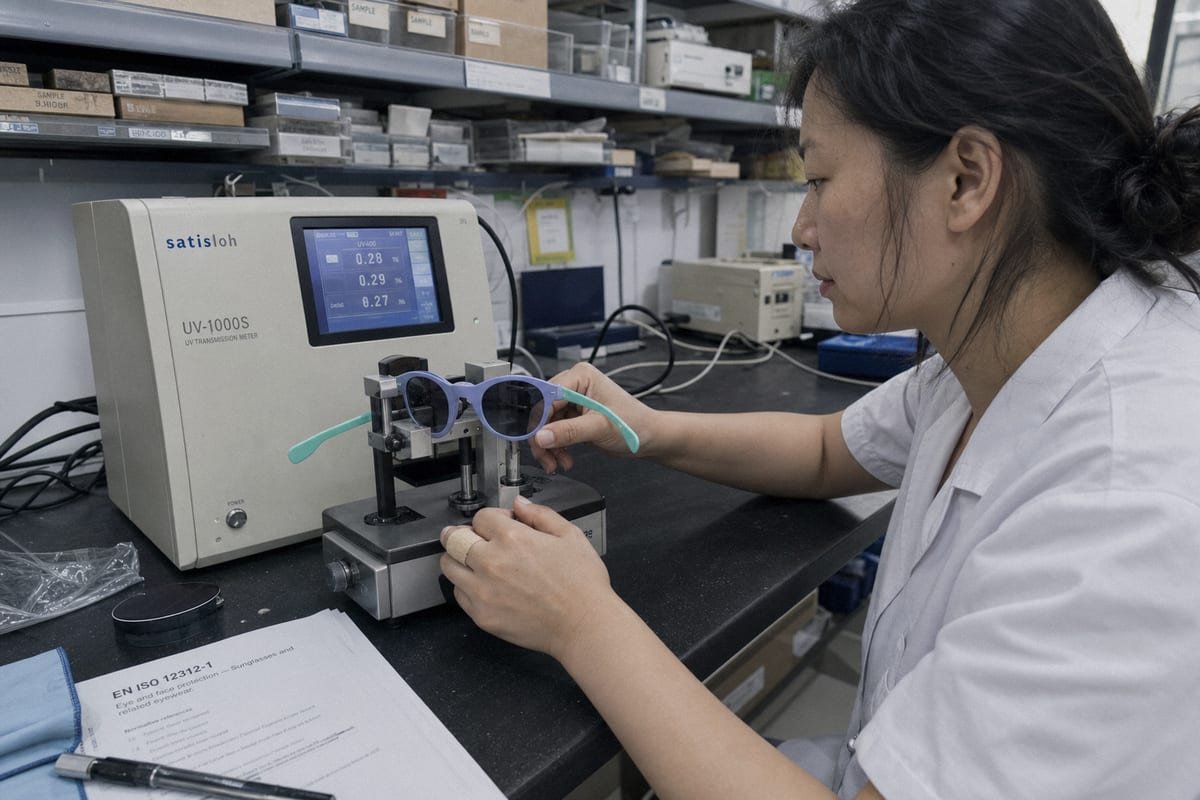
The consequences unfold in stages, and each stage costs more than the last. Understanding the sequence helps you see why testing before shipment is always the cheaper option.
The escalation ladder
| Étape | Ce qui se passe | Typical cost impact |
|---|---|---|
| Customs detention | Goods held pending documents or retesting | Storage fees, delays, lost selling season |
| Rejection or destruction | Non-compliant goods refused entry or destroyed | Full loss of goods plus disposal fees |
| Market withdrawal | Product pulled from shelves and warehouses | Logistics costs, retailer penalties |
| Public recall | Consumers asked to return the product | Brand damage, refund costs, PR expenses |
| Fines and listings | Penalties plus Safety Gate 6 (RAPEX) publication | Legal costs, lasting reputation harm |
For a children's product, the reputational stage hurts the most. Parents do not forgive chemical safety failures. A single recall listing follows your brand name in search results for years. In the US, the situation is parallel but under different law: conformité CPSIA 7 failures for a children's product can trigger CPSC penalties, and selling without a valid Children's Product Certificate is itself a violation, even if the product would have passed testing.
Who is legally on the hook?
This surprises many first-time importers. The EU importer of record carries the legal responsibility, not the Chinese factory. Your supplier's failure becomes your liability. That is exactly why we encourage buyers to build testing into the order timeline rather than treat it as optional. Pre-shipment testing on the actual production batch typically costs a few hundred dollars. A recall costs tens of thousands, plus your relationship with retailers.
The practical defense is simple. Test the golden sample. Test the production batch for high-risk items. Keep all documentation for ten years, as required for PPE technical files. And choose a factory that treats chemical control as routine, not as a special request.
Can I request REACH and RoHS certificates for custom colors and materials I choose?
Custom colors are where compliance quietly breaks. Last year, a buyer wanted our periwinkle-and-mint round frame shifted to a neon palette, and our engineers immediately flagged the new masterbatch for fresh chemical screening before confirming the order.
Yes, you can and should request REACH test reports for every custom color and material you specify, because new pigments, coatings, and additives introduce new chemical risks. A reputable OEM factory will arrange third-party testing on your exact custom formulation before mass production.

When you customize a frame, you are not just changing the look. You are changing the chemistry. Pigments, soft-touch coatings, metallic finishes, mirror lens coatings, and even recycled resin content all alter what is inside the product. Each change can introduce restricted substances that the original stock-color report never covered.
What changes when you customize
| Personnalisation | Hidden chemical risk | Recommended check |
|---|---|---|
| New frame color | Heavy metals or restricted amines in pigments | Full Annex XVII screening on new masterbatch |
| Mirror or gradient lens coating | PFAS in hydrophobic layers, coating solvents | Coating-specific REACH review |
| Soft rubberized finish | Phthalates or PAHs in plasticized layers | Phthalate and PAH testing |
| Metal decorative parts or hinges | Nickel release above 0.5 µg/cm²/week | EN 16128 nickel release test |
| Recycled or "eco" plastics | Legacy contaminants like banned flame retardants | More frequent batch testing |
| Printed logos and artwork | Restricted substances in inks | Ink supplier declaration plus screening |
How a proper OEM testing workflow runs
On our side, the workflow for a custom project looks like this. First, we confirm your target markets, because EU, UK, and US requirements differ. For the US, a children's product needs CPSIA compliance, third-party testing at a CPSC-accepted lab, and a Children's Product Certificate; toy-classified items may also need ASTM F963 8 standards. Second, we lock the exact material recipe — base resin, masterbatch, coatings, inks. TPEE and TR90 are inherently good starting points because they avoid the plasticizer problems of cheaper PVC-based frames, and our standard formulations avoid Bisphenol A. Third, we send production-representative samples to an accredited lab under your specified scope. Fourth, we freeze the recipe. Any later change to pigment or coating triggers a change log entry and, where needed, retesting.
With around 800 existing styles already available, many buyers start with a pre-tested stock combination and only customize logos and packaging. That path keeps compliance simple and launch costs low. But if you want a fully custom color story, budget two to three weeks for testing in your timeline. It is a small delay compared to a detained container.
Conclusion
Kids sunglasses need REACH testing in Europe, not RoHS — unless electronics are added. Verify reports, test custom colors, and partner with a factory that documents everything. We are ready when you are.
Notes de bas de page
1. Official ECHA source explaining the REACH chemical regulation referenced throughout the article. ↩︎
2. Background reference explaining the RoHS directive and its scope for electronic components. ↩︎
3. Background context on PPE classification relevant to Category I sunglasses regulation. ↩︎
4. Official ISO page for the sunglasses performance standard cited in the article. ↩︎
5. FDA resource on Bisphenol A relevant to the chemical safety discussion for children’s products.
Plus d'articles que vous pourriez aimer

Vous recherchez un partenaire fiable en lunetterie pour enfants ?
Explorez plus de 800 styles prêts et un support OEM/ODM complet adapté à votre marque.
Contactez-nous English
  Español de México
  Deutsch
  Français
  日本語
日本語  العربية
  Português do Brasil